Ecommerce industry is in a boom period with lots of new startups coming into the online market. Already-established brands are looking to expand, and big enterprises are integrating AI and ML automations using the best tech stack for ecommerce. This ecosystem is building because businesses across the globe are seeing the customer behaviour and the way they look at their lifestyles. The customers nowadays prioritise comfort, convenience, and a seamless experience in buying products and services. Businesses are eyeing a gap and looking at this situation as an opportunity to grow and scale their ecommerce business. They can achieve scalability by giving a seamless customer experience, and for that, they need to have a robust ecommerce platform. And a robust platform does not only mean attractive design or listing products online. In fact, it is about choosing the best stack for ecommerce that ensures performance, security, long-term growth, and scalability.
With the growth of cloud computing, the use of AI to make personal recommendations, an increase in headless commerce growth, and the growing trend of API-first architecture across multiple platforms. This eCommerce technology stack guide provides you with a helpful overview of all aspects related to eCommerce Technology Stacks, including what a Tech Stack is, how to create a tech stack, what technologies currently drive the modern eCommerce site, what types of eCommerce tech stacks are available, and ultimately, how to build a solid, business-aligned eCommerce tech stack. So let’s start.
What Is an Ecommerce Tech Stack?
Before proceeding, let’s answer a simple question: what is an ecommerce tech stack? An ecommerce technology stack refers to a combination of technologies, programming languages, frameworks, platforms, and tools that collaborate to create, execute, and operate an online shopping environment. Everything from what customers see when visiting your online store to how information is stored on servers to where people buy it will be part of the ecommerce stack.
A modern ecommerce technology stack typically includes:-
-
Frontend Technology – Tools for User Interface and User Experience Design
-
Backend Technology – Tools for Business Logic and Business Operations
-
Database Technology – Tools for Managing Products, Users, Orders
-
Cloud Technology – Tools that Support the Hosting and Scalability of Applications
-
APIs and Integrations – Tools for Managing Payments, Shipments, and Marketing Analytics.
The best ecommerce tech stack allows your store to be fast, secure, easy to manage, and capable of evolving as your business grows.
Key Factors to Consider When Selecting an Ecommerce Tech Stack
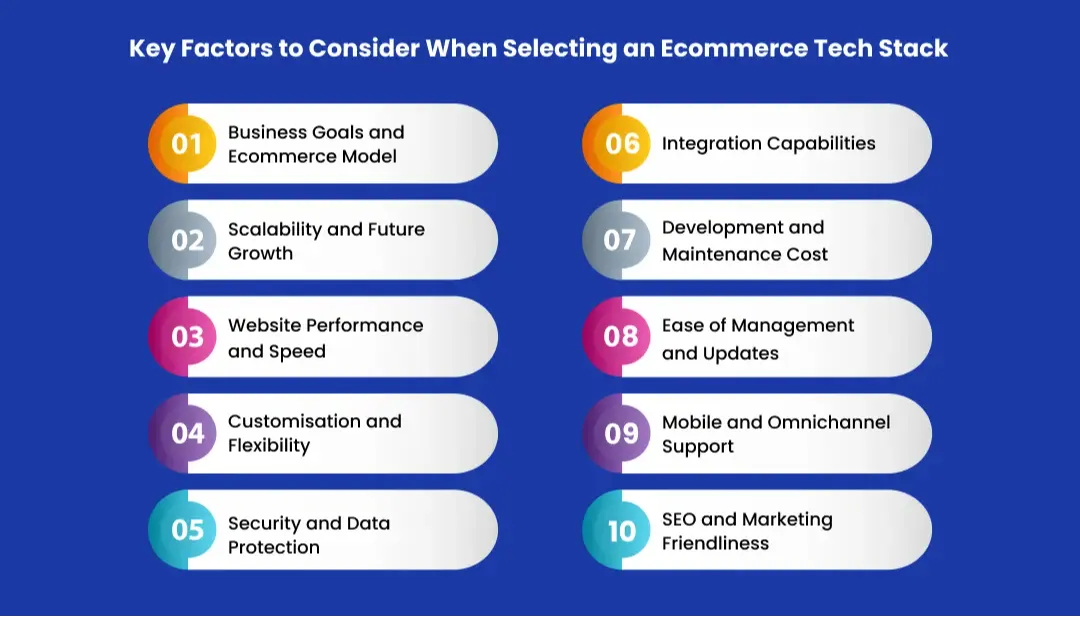
Every business has its own unique needs and requirements when it comes to ecommerce platforms. Some businesses might want a different tech stack compared to their competitors. Before finalising your development partner, consider these factors.
Business Goals and Ecommerce Model
First of all, understand your business needs and goals.Determine the type of eCommerce business model you intend to pursue: whether it will be a B2C, B2B, Marketplace or D2C model. Each model has technical requirements that must be addressed by your technology platform, and the technologies you choose must provide a scope for growth, not simply fulfil your immediate needs.
Scalability and Future Growth
Your eCommerce site should have unlimited potential for growth as your business continues to strengthen. By utilising a robust technology platform, you can expand your site to accommodate increasing volumes of products, users and web traffic, especially during busy periods such as seasonal promotions or product launches, etc.
Website Performance and Speed
When choosing the technological tools for your website, keep in mind that a fast-loading page will dramatically improve the user's experience and also enhance your site's conversion rates. Look for technologies that will allow for quick rendering of pages, minimising latency through caching, etc., thereby reducing the risk of losing customers due to slow page load times.
Customisation and Flexibility
Every organisation has its own characteristics; therefore, its Tech Stack must provide the ability to create Custom Features, Design Changes & Workflow Adjustments that are not bound by significant limitations on flexibility. Flexibility is essential for companies with plans for Innovation or Growth.
Security and Data Protection
Ecommerce sites generally deal with Sensitive Payment information and Customer information; therefore, they require a Tech Stack that provides adequate support for Secure Payment Gateways, Secure Socket Layer (SSL) Encryption, Data Protection Standards, and Routine security Update services that enable Customers to trust their security.
Integration Capabilities
Your Ecommerce Site must be easily integrated with Third Party Software Services such as Payment Gateways, Shipping Services, CRMs, ERPs, and ecommerce marketing tech stack. Having strong Application Programming Interface (API) support will allow for Smooth Integration and easier System Upgrades in the future.
Development and Maintenance Cost
Before partnering with the development company, understand Ecommerce website development cost, which is more than the initial cost. There will be a cost that businesses have to bear for hosting, licensing, updates, and long-term maintenance. Strike a balance between a suitable tech stack and cost-effectiveness that ensures performance and scalability.
Ease of Management and Updates
Sometimes, there is a minor update needed for the ecommerce platform. To reduce time and dependency on ecommerce web developers, your team should be able to know user-friendly backend services. Without technical complexity, they should be able to manage products, order, and content.
Mobile and Omnichannel Support
Shoppers use multiple devices such as mobile apps, websites, and social media. When choosing a technology platform to sell through multiple channels (including mobile), consider how you can provide a similar look and feel regardless of where they're located.
SEO and Marketing Friendliness
For shoppers to have a seamless experience across all your channels, make sure your technology platform utilises Clean URL structures, Fast-loading web page, Schema markup, Optimised website content. Optimising your tech stack will not only help with search engine rankings but also with driving sales through effective marketing campaigns.
Technologies for Ecommerce Website Development
Building an ecommerce website requires multiple layers of technology that work together to ensure smooth experiences, secure transactions and scalable operations. Here are some of the key technologies used in modern ecommerce websites.
Frontend Technologies
Frontend technologies are a user interface layer that controls how your ecommerce platform looks and feels. A well-structured and aesthetically pleasing website engages the customer more, retains them for a longer period, and eventually leads to more revenue. It is a part customer interacts with, like product pages, search filters, cart, and checkout. Some of the key frontend technologies are given below.
HTML5 and CSS3
Every ecommerce site is built upon HTML and CSS. HTML is used to structure the content of your website; CSS is used to define what it looks like and how it handles colour, font size/type, and responsiveness to different devices.
JavaScript
JavaScript makes websites interactive. JavaScript adds interactivity to your website by allowing users to interact with content. Examples of interactive features include dynamic product filtering based on customer selection, image sliders that promote featured items, updated cart contents in real-time, and completely streamlined checkout.
React.js
React is commonly used when creating very fast and highly engaging e-commerce user interfaces. In addition, React supports the development of components. By enabling component-based development, React enables a faster page load and greater user engagement.
Vue.js
Vue.js is a very lightweight JavaScript framework that is extremely flexible. Vue is a great choice for eCommerce projects that require a quick, high-performance solution without requiring significant development complexity.
Next.js / Nuxt.js
These frameworks improve SEO and performance by supporting server-side rendering. They are popular choices for modern, scalable ecommerce websites.
Framework solutions like React.js and Vue.js help develop fast, interactive, and very responsive front-end websites. Instead of loading all of the page elements at once, these frameworks only load the specific section of the page being viewed. Also, using tools such as Next.js or Nuxt.js can further increase a front-end website's performance through better search engine optimization (SEO), increased page load speed, and improved server side rendering. Having a strong frontend tech ensures a good user experience, reduces bounce rates, and increases conversions, especially on mobile devices.
Backend Technologies
Backend technologies are a business logic layer that handles all behind-the-scenes operations. It helps in user authentication, order processing, inventory management, and payment handling. Here are some of the key backend technologies:-
Node.js
As a high-performance platform for handling heavy traffic, Node.js is a great choice for building out the backend of your e-commerce application with real-time functionality such as order status, inventory updates, and other notifications.
Python (Django / Flask)
Python Frameworks are very safe, straightforward, and reliable. They are also used widely by Pipelines to create Data Driven eCommerce Applications as well as AI products/features. Quite a few B2c ecommerce website development companies use Python to develop a robust platform.
PHP (Laravel)
Laravel is considered to be an excellent choice for building eCommerce applications because of how easy it is to work with and develop on the Laravel platform. Many of the same developers creating eCommerce applications are doing so using PHP.
Java (Spring Boot)
Java provides a great deal of stability, security and long-term performance for Business & Enterprise eCommerce Applications specifically. The stability and long-term maintenance help businesses stand out in the highly competitive market.
Technologies like Node.js are popular because they can process multiple requests at once. As a result, Node.js is an ideal technology for running high-traffic, high-volume e-commerce sites. PHP with Laravel is also very commonly used due to the relative ease of use associated with Laravel and the strong ecosystem surrounding ecommerce using PHP, while Java backend development is usually reserved for large enterprise ecommerce solutions because of its ability to provide the highest levels of long-term stability and performance. The back end of your eCommerce site allows for your eCommerce business to operate smoothly, process orders, and grow with no slowdown in overall performance.
Database Technologies
Database Technologies is a data storage layer that stores all ecommerce data like products, customers, orders, transactions and inventory. Here are some of the key database technologies:-
MySQL or PostgreSQL
Structured data like orders, user accounts, and payment history can be stored using reliable relational databases.
MongoDB
A NoSQL database would be most beneficial if you had a very large number of products or dynamic data sets because it offers flexibility and high performance in those situations.
Redis
Caching frequently accessed data can also result in less stress on your web server, allowing you to provide a faster website experience for your customers.
If you operate a large or fast-growing online retail store, NoSQL databases such as MongoDB can be useful in terms of their flexibility. NoSQLs are designed to efficiently manage large amounts of product data with many attributes and dynamically changing content. In addition, Redis provides a way to cache and store frequently accessed data, like product listings or user session information, thus improving the speed of your website when using a relational database as the primary storage medium. A good database ensures data accuracy, fast retrieval, and smooth performance even during high traffic periods.
Best Tech Stack for Different Ecommerce Business Models
Different ecommerce platforms requires different technical requirements. A particular tech stack might not be useful for building another ecommerce platform. Let us now see how the tech stack varies by business type.
B2C Ecommerce Stores
The B2C businesses always look for user experience, personalisation, and speed. This setup supports fast product browsing, personalised recommendations, and seamless checkout. Some of the best ecommerce apps tech stack 2026 for B2C include:-
-
React or Next.js frontend
-
Node.js backend
-
Cloud hosting (AWS, Azure)
-
Headless CMS
B2B Ecommerce Platforms
When it comes to buk orders, role-based pricing, and account management, a b2b ecommerce tech stack comes into play. This stack ensures operational efficiency and long-term scalability. Some of the common stack components are as follows:-
-
Angular or React frontend
-
Java or Node.js backend
-
ERP and CRM integrations
-
Secure authentication systems
Online Marketplaces
The ecommerce tech stack for marketplaces must support vendor onboarding, commission management, and complex workflows. It is helpful for the multi-vendor platforms. This approach ensures flexibility and performance at scale. Some of the recommended tech stacks are as follows:-
-
Microservices architecture
-
React or Vue frontend
-
Node.js or Java backend
-
Cloud-native infrastructure
Startups and New Businesses
An early-stage venture can be smart when building out its ecommerce technology stack by creating a balance between speed, cost, and growth potential. With this approach, you will have the ability to quickly launch your business while leaving the ability to upgrade your tech stack for future use. Some of the typical choices include:-
-
SaaS or Headless commerce
-
JavaScript App-based Stacks
-
Managed Cloud Hosting
Enterprise-Level Ecommerce
The Amazon Ecommerce tech stack is one of the inspired model for other businesses to follow. Their seamless customer experience, well-structured designs, and ability to engage customers make them stand out. They focus on microservices, automation, and AI-driven personalisation. Some of the enterprise-level ecommerce tech stacks are as follows:-
-
Distributed systems
-
Advanced analytics
-
Machine learning integrations
How to Choose the Best Tech Stack for Your Ecommerce Business?
Choosing the right tech stack requires proper planning, strategy, and execution. Do not just go with the trend. Select the tech that aligns with your business strategy. Here are some of the considerations given below.
Clearly Define Your Business Goals
Clearly define your project requirements. If you are unsure of your business aims, the future will be difficult. You must know that when you are launching, how you can scale globally, and how to build a highly customised platform. Inform the ecommerce marketplace development partner about the platform requirements so that they can choose the tech stack as per the needs. Your tech stack should directly support these goals, not work against them.
Understand Your Ecommerce Business Model
The technical capabilities required for B2B, B2C, Marketplace, and D2C are different from each other. Therefore, choose a technology stack that naturally fits your business structure and customer journey.
Plan for Future Scalability
When selecting an eCommerce platform, consider future growth. An eCommerce platform should be able to accommodate increased traffic, more products, and higher order volume without needing to make major rebuilds. A scalable eCommerce platform will save you time and money in the long term.
Prioritise Website Speed and Performance
Select technologies that offer optimised performance and cache capabilities, and are proven to provide seamless user experiences across all devices. Fast loading page speed significantly affects conversions as well as SEO rankings.
Choose Flexibility Over Rigidity
Always choose the flexible technology. Sometimes, the platform requires changes, updates and integration that are not possible in some tech stacks. Avoid those techs that limit you in terms of features. Flexibility allows custom integrations, design changes, and new functionalities.
Ensure Easy Third-Party Integrations
The platform should have the ability to integrate third-party apps like payment gateways, shipping and marketing tools, and AI-powered tools. These integrations help the operations to run smoothly without any complications.
Focus on Mobile-First Experience
The primary source of ecommerce website visitors is via mobile. Start with a tech stack that supports both Fast Mobile Performance and Responsive Design through various technologies. The B2b ecommerce website development focuses on a mobile-first experience for long-term growth.
Check SEO and Marketing Compatibility
Ensure your tech stack supports clean URLs, fast-loading page content, structured data, and content optimisation so that your site can be indexed and ranked by search engines effectively. Choose the Ecommerce website development company that keeps an eye on SEO and Marketing Compatibility.
Other Key Considerations Are As Follows:-
-
Consider Total Cost of Ownership
-
Evaluate Security Requirements
-
Assess Development Team Expertise
-
Consider Time-to-Market
-
Opt for Cloud-Friendly Technologies
-
Think About Long-Term Maintenance
-
Test Before Finalizing
-
Align Technology With Customer Experience
-
Get Expert Guidance When Needed
CONCLUSION
The best tech stack for ecommerce website is the one that aligns with your business goals. It should support growth, ensure security, and deliver an excellent customer experience. In 2026, having the best tech stack for ecommerce is not an option, but a huge requirement. The relevant ecommerce technology stack used to store customer and product information should be chosen for your ecommerce business based on what you plan to achieve, your available resources, the type of products you are selling, your business model, projected growth path, and other criteria. Each of these layers of technology plays a critical role in providing customers with seamless digital commerce experiences.
Selection of the right technology stack today will result in lower overall Ecommerce website development costs over time. It also ensures your platform can adapt to emerging Ecommerce development trends. That is why giving your ecommerce business every possible opportunity to remain competitive and continue to grow through 2026 and beyond, when combined with an effective strategy and effective development partners.