The B2B commerce has changed, and has seen a massive online shift in the last 10-15 years. About 15 years ago, if you had asked a business owner where you could get your stocks, they would have talked about wholesalers, distributor partnerships, and bulk suppliers, and more. But now, the traditional setup is rapidly moving online. With this change, B2B ecommerce website development is now playing a crucial role for manufacturers, wholesalers, enterprise-level sellers, and distributors. It helps in streamlining operations and scaling globally.
A lot of digital tools, AI-based personalisation, and automation are helping B2B businesses offer Amazon-like experiences to their customers. It is something that might not have been possible a decade ago. A business can sell anything from industrial supplies, raw materials, electronics, medical equipment, or customized products. An online platform with a well-planned development process can completely transform your business. This blog will delve deep into everything you need to know about B2B ecommerce in 2026, their benefits, features, trends, and the cost of building. We will also see why hiring expert developers matters. So without any further ado, let’s begin.
Benefits of Developing a B2B Ecommerce Website
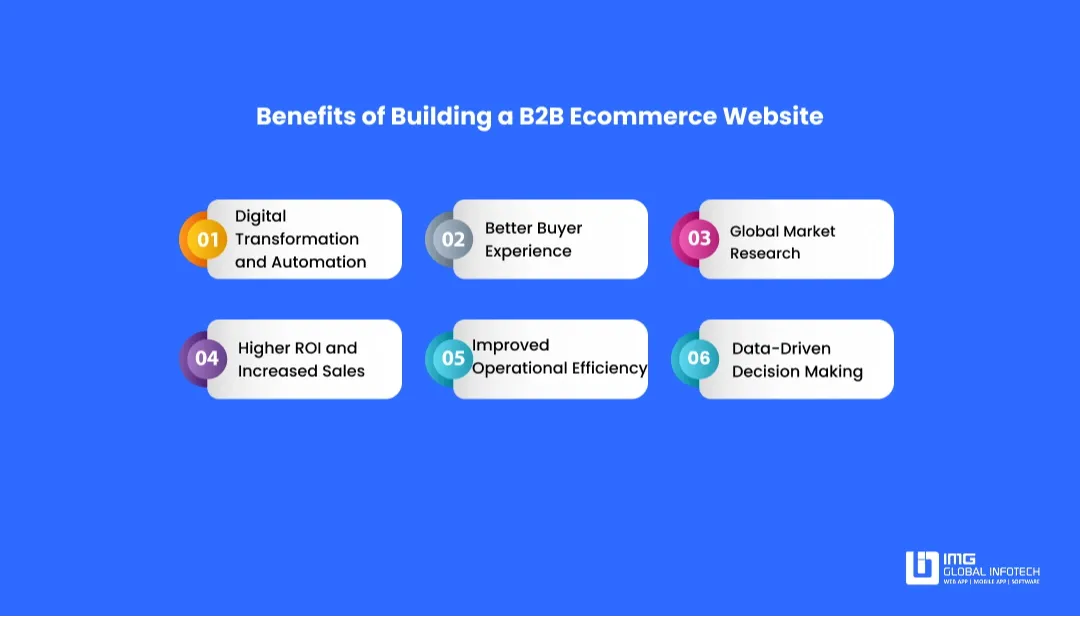
Businesses are investing heavily in B2B ecommerce website development. It brings numerous operational and strategic advantages. Here are some of the advantages listed below.
Digital Transformation and Automation
One of the massive advantages of having a b2b ecommerce platform is that it automates complex tasks like order management, invoicing, reordering cycles, customer segmentation, and pricing. It reduces manual overhead, and with these platforms, the accuracy will increase because not a lot of manpower is needed.
Better Buyer Experience
A B2B ecommerce website provides real-time inventory updates, custom pricing, bulk ordering, one-click reorders, and digital payments. This is something the modern buyers want: smooth, self-service, and intuitive purchase journeys. It leads to higher customer loyalty and regular purchasing, which eventually leads to more revenue and profits.
Global Market Research
Before the digitalization, manufacturers and distributors were only restricted to selling in some parts where they were already familiar. But now, unlike the traditional system, the businesses can sell the products worldwide, with the B2B platforms opening the door to buyers across the globe. Distributors can explore new markets without large operational investments.
Higher ROI and Increased Sales
The B2B ecommerce development agency helps you increase conversions and lifetime value. With features like personalised catalogs, AI-driven recommendations, and automated reordering, customers would be tempted to purchase more, which eventually leads to more profits.
Improved Operational Efficiency
The b2b ecommerce web development helps your business improve operational efficiency. E-commerce businesses can use tools like ERP, CRM, or PIM to achieve peak efficiency. For example, if the sales team wants to reduce delays in communication, they can get real-time data by using these tools. It improves collaboration.
Data-Driven Decision Making
New technologies have allowed businesses to track everything that customers have been doing on the platform. After analysing the data and behavior, businesses can leverage a process intelligence platform within a customized b2b ecommerce development process, helping them to optimize pricing, inventory, logistics, and marketing strategies.
>>>Also Read: Ecommerce Website Development Cost in 2026
B2B Ecommerce Market Trends to Watch in 2026
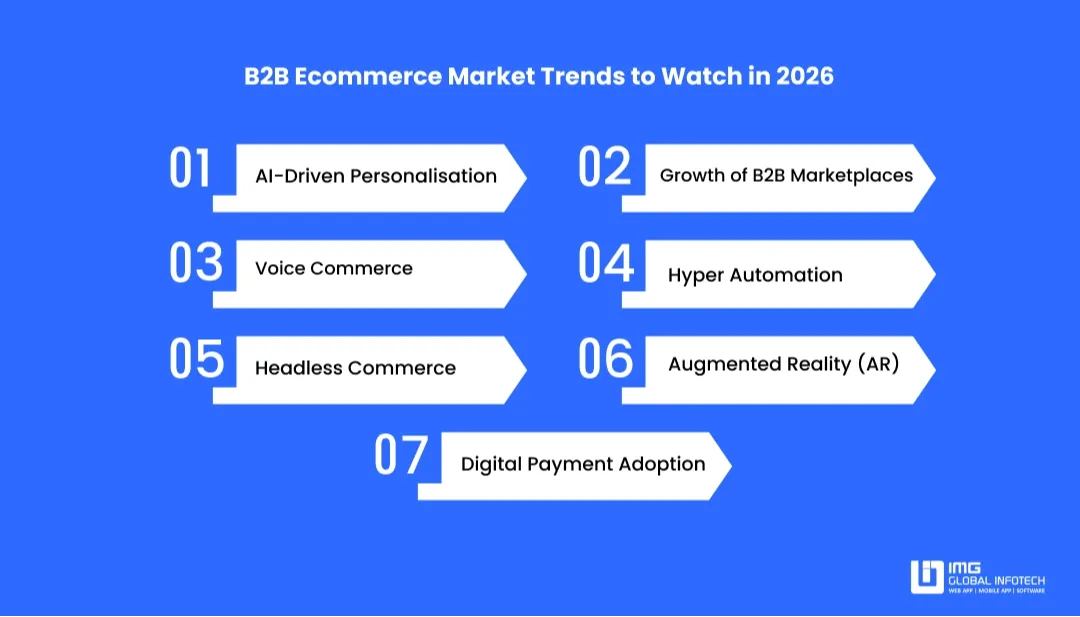
The B2B landscape is evolving at a rapid pace. Here is how the b2b ecommerce website development landscape has changed the trends in 2026.
AI-Driven Personalisation
AI is changing the whole game in this era, with enterprise AI making B2B buying more intuitive through customer-specific pricing, intelligent product recommendations, predictive reordering, and smart search. Taking an example, an AI tool recommends the user a desired product, after analysing their past searches and buying behaviour. It enhances the user experience and boosts conversions.
Growth of B2B Marketplaces
The demand for the b2b ecommerce marketplace website development company partnerships has increased over the years. More companies are eyeing a place in the marketplace-style platforms, expecting a big Return on Investment (ROI). It enables multiple vendors to sell their products in one place or on one site.
Voice Commerce
Nowadays, users do not have to type long texts to find anything. If they are searching for something on the ecommerce platform, they can just enable the voice assistant and tell it what they are looking for. They are adopting hands-free reorder capabilities regularly.
Hyper Automation
In this era of AI, Machine Learning, and RPA, businesses can automate tasks such as invoicing, contract management, complex order approvals, and inventory forecasting.
Headless Commerce
Businesses now prefer decoupled architectures for flexibility, faster development, and custom UI experiences.
Augmented Reality (AR)
The AR technology is allowing users to visualize machinery, parts, and equipment before completing the purchase process. It is a game-changer for B2B businesses.
Digital Payment Adoption
More and more payment gateway options are opening nowadays. The B2B sellers are offering BNPL, multi-currency support, and automated invoicing.
Must-Have Features for a B2B Ecommerce Website
Here are some of the most essential features in robust b2b ecommerce website development.
Advanced User Roles
A robust B2B site must have different account types for different buyers like employees, managers, admins, branch managers, etc. It helps in supporting complex role hierarchies.
Customer-Specific Approach
A B2B website must allow different pricing, depending on contract, tier-based, volume discounts, and negotiated quotes. In the B2B vs B2C ecommerce debate, a B2B platform always wins in this case.
Request for Quote System
There is always a scope of negotiation from the sales team, and authorized buyers can also request custom quotes. It helps in the smooth functioning of buying and selling.
Multi-Level Approval Workflows
The B2B platforms must have an option of approval hierarchies, purchase limits, and automated notifications. Companies prefer internal approvals before making purchases.
Bulk Ordering and Quick Order Forms
Buyers usually purchase hundreds of SKUs, and quick ordering makes it easy for them to upload product lists or search for SKUs.
Reorder Automation
Businesses always look for a stable platform for regular purchases. Your B2B platform must allow one-click reorder as it boosts efficiency and loyal customer retention.
Inventory and Order Management
For smooth operations, your platform must provide options like real-time stock visibility, backordering, order scheduling, or shipment tracking. A manager can see what is going wrong and what to fix after using these tools.
Seamless Integrations
It is a good thing for the managers or higher authority to track everything. Your platform must be integrated with tools like ERP, CRM, PIM, accounting tools, etc.
Multi-Vendor Marketplace
Before building a B2B platform, allow support for seller dashboards, communication management, vendor onboarding, review, and rating systems.
Secure B2B payments
A user should feel secure with the payment ecosystem while using your B2B ecommerce platform. The options must include Bank transfers, BNPL, Purchase Orders, and credit limit management.
Mobile-Optimized Interface
People nowadays use more of mobile phones than websites. They wanted to track orders and communicate via phone. Considering this, your B2B platform development approach should be a mobile-first approach.
Custom Catalog Management
The B2B platform must have features to view custom catalogs, access restricted products to make things easier for buyers.
>>>Read Also: B2C Ecommerce Website Development Guide
B2B Ecommerce Website Development Process
To build a strong B2B platform, one should follow these steps:
Discovery and Requirement Gathering
Before any B2B ecommerce website development, understand your business goals, analyze buyers’ behaviour, identify complex pricing models, and approval workflows. It is the base of the development process.
Platform Selection
If you choose Shopify, you will have to hire a Shopify B2B ecommerce development agency for support. Different platforms require different support. Choose between custom-built solutions, Shopify B2B, Magento Commerce, BigCommerce B2B, WooCommerce B2B, and headless commerce platforms.
UX/UI Design
It is an important aspect in building as it sets the foundation for the user experience. The design phase focuses on product visibility, dashboard layouts, and clean and fast UI.
Custom Development
A customized b2b ecommerce development plays an important role in a business’s scalability and growth. Developers build user roles, pricing modules, RFQ systems, ERP portals, and catalog management features for smooth functioning.
Integration Layer
Hire ecommerce developers who can integrate features like CRM, ERP, Accounting Systems, etc, to simplify complex B2B operations. Integration is an integral part in the development process.
Testing and QA
You just cannot build an app and launch it straight away. Test the app and do quality assurance for seamless operations. Testing includes functional testing, API testing, security testing, device compatibility, and performance testing.
Deployment and Launch
After all the testing and QA, it is time to get the website live for the viewers. The website must go live with a fully optimized setup.
Maintenance and Continuous Support
A company that provides B2b ecommerce development services plays a major role in this step. The B2B platform requires regular maintenance, feature upgrades, UX optimization, and marketplace expansion.
Cost to Develop a B2B Ecommerce Website
The B2B ecommerce website development cost varies, and it depends on several factors like:
Project Complexity
A simple website costs less compared to those with advanced features, custom workflows, and integrations.
Tech Stack
Choosing the right tech stack is important for your platform. Different tech stack usage costs differently. Headless and enterprise solutions typically cost more.
Features Required
The number of features and customization decides ecommerce app development cost. Custom modules like multi-level pricing, RFQ, or complex ERP integrations raise the cost.
Third-Party Integration
Some platforms require third-party app involvement, like API and syncing, navigation, maps, payment gateways, etc. It impacts the cost significantly.
Developer Expertise
Experienced b2b ecommerce developers command higher prices but deliver superior results. Less experienced developers might not be able to deliver as per your expectations.
Estimated Cost Breakdown (2026) (As per Level)
Your business needs, aim, timeline, and goals decide the overall b2b ecommerce web development cost.
Why Hire a B2B Ecommerce Development Company?
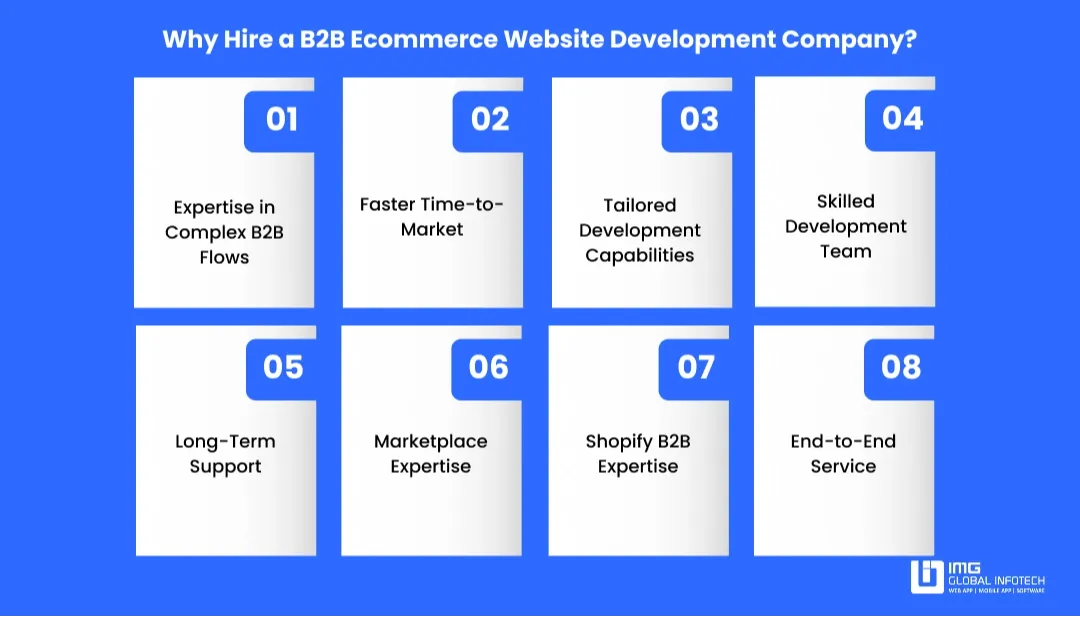
To ensure smooth execution, better performance, and long-term scalability, you have to partner with a professional b2b ecommerce website development company. Here are the reasons.
Expertise in Complex B2B Flows
The development company specializes in complex B2B projects. They have expert developers who provide contract pricing, approval workflows, corporate accounts, and procurement cycles.
Faster Time-to-Market
The Ecommerce website development company has certified developers, using agile workflows. They deliver projects efficiently and ensure seamless operations.
Tailored Development Capabilities
A development company knows how to build custom solutions for your unique business logic. For example, you can hire Shopify developers if you want to build a Shopify-like e-commerce platform.
Skilled Development Team
Work with professional b2b ecommerce website developers to ensure high code quality and long-term sustainability.They have the skills and expertise to build a robust platform, providing a seamless experience to the user—especially when integrated with the best mmm tools for e-commerce brands.
Long-Term Support
A development agency will help you with long-term support and maintenance. From upgrades to new feature development, an agency offers continuous support, ensuring long-term scalability.
Marketplace Expertise
To build a multi-vendor marketplace, hire a b2b ecommerce marketplace website development company. They help you in scalability and high-performing solutions with their experience and expertise in this sector.
Shopify B2B Expertise
Need Shopify? A shopify website development company can help you leverage Shopify Plus for advanced B2B capabilities.
End-to-End Service
The development partner is your end-to-end solution, helping your business from planning and strategy to execution. They bring your idea to life, providing deployment and long-term support, and updates as well.
CONCLUSION
B2B commerce is evolving to be digital, and the current trends of increased buyer expectations and increased automation through technology make investing in B2B commerce website design a must for all manufacturers, distributors, wholesalers and enterprises in 2026.
Due to increasing buyer expectations, B2B buyers today expect many of the features offered by retail buyers, such as personalized pricing, ability to purchase in bulk, request for quotations (RFQs), advanced workflows, and the ability to integrate with other systems. Building an effective platform for your company will require the expertise of a professional B2B commerce development agency or a dedicated B2B ecommerce website development company, or other full-service B2B ecommerce platforms.
Some businesses questioned: How to start an ecommerce business? A well-informed team of B2B ecommerce web developers with knowledge of complex B2B processes will create B2B ecommerce platforms that enable manufacturers, wholesalers, and distributors to grow their businesses and achieve lasting digital transformation.