Price is what you pay. Value is what you get. This quote by Warren Buffett, which hardly gets old, is just perfect for the discussion about digital platforms nowadays.
Say you want to make a truck booking app; the first question that will definitely pop into your head is the simplest one: what will be the cost in Truck aggregator app development? However, the real answer is not only about the figures; it’s about scalability, automation, user experience, and ROI in the long run.
As logistics are continually getting digitized and customer demands are evolving at an extremely fast pace, truck booking apps can no longer be considered mere tools of convenience; rather, they have become indispensable strategic assets.
Development entails various technical complexities ranging from AI-based route optimization and real-time tracking to smooth payment integrations. The price is influenced by the characteristics, technology stack, security layers, and deployment architecture.
Therefore, before forming any opinions, let’s dissect what really determines the investment in a robust and future-proof truck booking app in 2026.
Key Factors Affecting Truck Booking App Development Cost
If you are an entrepreneur who wants to develop a truck booking app, you should first learn about the costs involved in such a project to examine the Truck Booking App Development Cost.
This will enable you to make informed decisions and plan your budget more accurately. The cost of developing a truck booking app depends on several factors, including:
Technology Stack
The selection of technologies and platforms that are used for app development that can impact the cost. The native app development is required to separate the team and higher expenses as compared to cross-platform development.
User Design and Interface
The complexity of the design for the custom animations and the requirement for responsive layouts across different devices can affect the cost of development.
Functionality and Features
The complexity and numbers of features that you need to include that can influence development costs. User registration, booking, tracking, payment integration, and notifications are all basic features.
Advanced features, on the other hand, require more work to develop, such as route optimization, document management, and real-time analytics.
Third-Party Integrations
The integration of third-party services like payment gateways, map APIs, SMS gateways, and analytics tools also especially requires additional development effort and licensing fees in the business.
Data Safety and Privacy
A truck booking app needs to have strong security features like data encryption, secure authentication, and following data privacy rules.
Updates and Maintenance
It’s important to plan for long-term maintenance and support costs when making an app.
Launching and Marketing
To get people to use the app, you need to market it through things like optimizing the app store, running digital ads, running social media campaigns, and making content.
Cost Breakdown by App Features in Truck Booking App
Figuring out the cost structure of a truck booking app can not only help businesses allocate their budgets wisely but also avoid unexpected expenses. Every feature has a direct impact on the development complexity, timeline, and the overall investment that will be required.
User Registration & Profile Management
A robust registration system with features like OTP verification, social login integration, and profile management will definitely increase the development work to Build a truck booking app like BlackBuck. The price will vary depending on the levels of authentication, the architecture of the database, data encryption, and the optimization of a smooth onboarding experience.
Real-Time Truck Tracking
GPS live tracking is only possible with the help of APIs like Google Maps, route optimization algorithms, and backend synchronization. Among the features that bring great value to the user and hence significantly influence the overall development costs and maintenance expenses. Advancing and real-time notifications.
Booking & Scheduling System
The booking component encompasses truck selection, specifying the load, scheduling options, fare calculation, and instant confirmations. The presence of complex logic, dynamic pricing algorithms, and calendar integration makes the technical development more complex, and it also requires a bigger share of the budget.
Payment Gateway Integration
Integration of a secure payment gateway that accepts UPI, cards, wallets, and net banking is a must. Compliance with standards, transaction encryption, multi-currency support, and automatic invoice generation are some of the extras that lead to further development time and higher implementation costs.
Admin Panel & Analytics Dashboard
An all-in-one admin panel allows the management of users, drivers, vehicle operations, commissions, and reports in the Uber for trucks app development. High-end analytics, performance tracking, automated notifications, and data visualization tools have a great influence on the cost of backend development.
Driver App Features
The driver app offers features such as ride alerts, navigation, income tracking, document uploads, and availability switches in the Truck booking app development. To enhance the application with real-time synchronization, performance monitoring, and the rating mechanism, mobile development becomes more complicated, and the testing cycle gets longer.
Cost Based on App Complexity for Truck Booking App Development
The Cost to build a truck booking app would be $5,000 to $15,000 or beyond, but these are average figures. The exact cost depends on app complexity, which we can explain in this concept in table form for you.
Hidden Costs to Consider to Develop a Truck Booking App
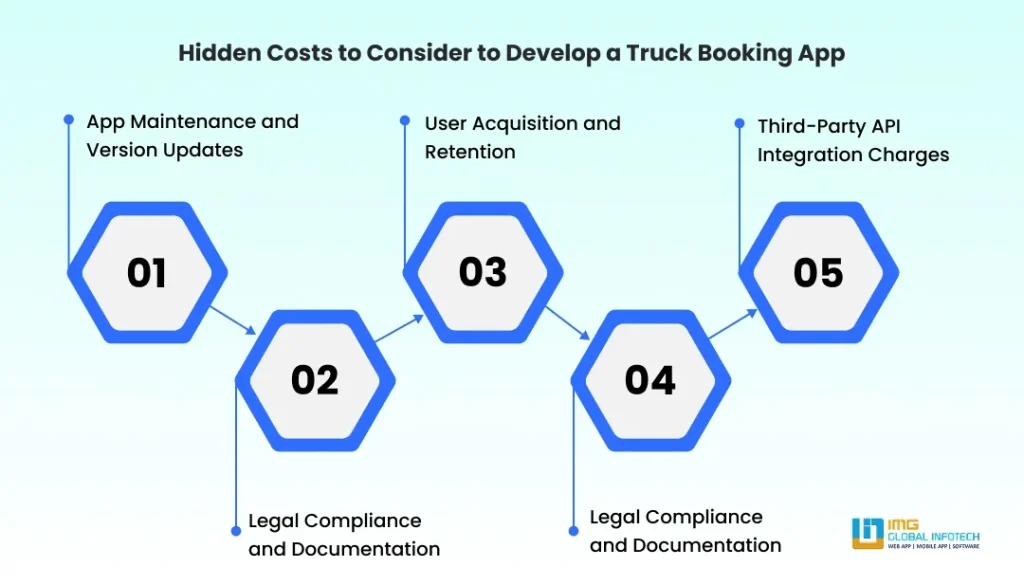
Building a truck booking app majorly includes more than just visible development expenses. Some of the hidden costs will emerge during the scaling to figure out the Logistics app development cost, compliance, maintenance, and long-term operational growth in the app development process.
Here are 5 major hidden costs that businesses often overlook while making a plan to build a truck booking app for the business.
App Maintenance and Version Updates
The post-launch maintenance that includes bug fixes, feature upgrades, security patches, and compatibility requires updates with newer iOS and Android versions. These recurring enhancements require continuous investments and the dedication of technical resources annually as well.
Legal Compliance and Documentation
The truck booking apps must acquiesce to transport regulations, data protection laws, driver verification policies, and GST billing requirements to examine the On-demand truck booking app cost. It mainly includes the legal consultations, documentation processes, and compliance updates that can add unexpected financial hurdles as well.
User Acquisition and Retention
Launching an application is only the first stage. It also includes the paid advertisements, referral programs, discounts, branding strategies in the Truck Booking App Development, ongoing marketing, and SEO campaigns to invest in to attract truck owners, drivers, and customers to the business as well.
Legal Compliance and Documentation
Truck booking apps should be aligned with transport regulations, data protection laws, GST billing requirements, and driver verification policies in the Logistics app development. Legal consultations, paperwork, and compliance updates can bring in unplanned budgets.
Third-Party API Integration Charges
Truck booking apps depend on payment gateways, GPS tracking, SMS alerts, and map services in the Freight booking app development. These third-party APIs frequently bill per transaction or usage; consequently, the monthly operational costs may rise substantially as time goes on.
Also Read: How Much Does Courier Delivery App Development Cost?
How to Reduce Truck Booking App Development Cost?
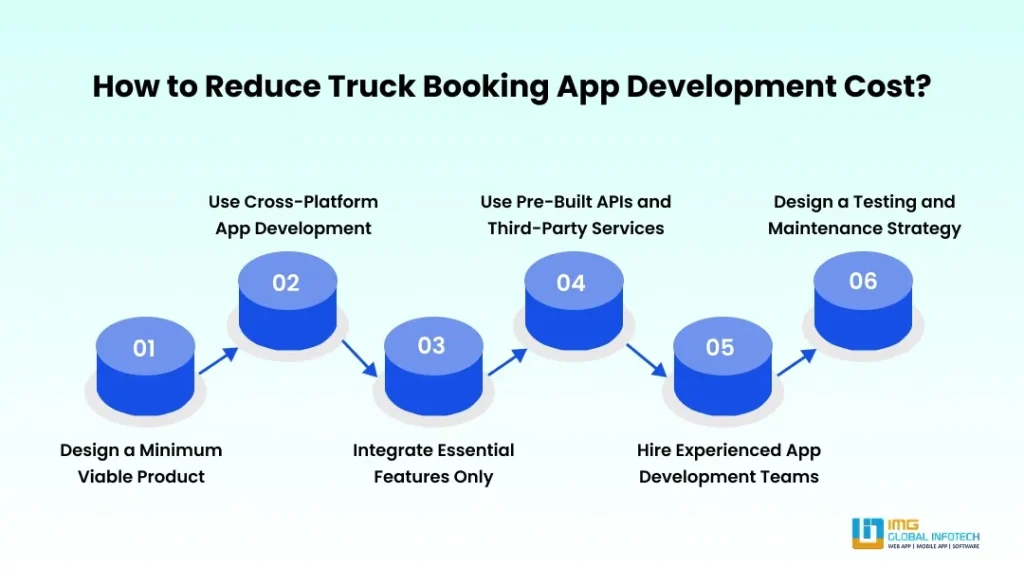
Creating a truck booking app is a costly venture, but proper planning can reduce unwanted expenses to a great extent in an On-demand truck booking app. With proper planning, one can effectively use resources, manage development costs, and create a highly efficient app.
Design a Minimum Viable Product
Instead of creating a feature-rich app, focus on creating a minimum viable product that includes the most important features such as booking, tracking, and payment. This helps reduce development and testing costs, making the app development process more efficient and cost-effective.
Use Cross-Platform App Development
Creating separate apps for Android and iOS is a costly venture. Instead, use cross-platform development techniques such as Flutter and React Native to create a single app that can function on multiple platforms for the Truck transport app development. This helps reduce development and testing costs, making the app development process more efficient and cost-effective.
Integrate Essential Features Only
Avoid using complex and highly efficient features such as AI-based route optimization and analytics in the Load booking app development. Instead, focus on using the most important and essential features of a truck booking app. This helps reduce development costs while ensuring efficient app performance.
Use Pre-Built APIs and Third-Party Services
Instead of creating complex and highly efficient features, use third-party APIs and services to integrate a payment gateway, maps, SMS, and tracking. This helps reduce development costs while ensuring efficient app performance.
Hire Experienced App Development Teams
Hiring an experienced app development team is a cost-effective option. Experienced app developers are highly efficient and can effectively reduce unwanted expenses while creating a highly Build logistics mobile app. This helps reduce development costs while ensuring efficient app performance.
Design a Testing and Maintenance Strategy
Proper planning and execution of a testing and maintenance strategy can help reduce unwanted expenses to a great extent in the Transportation app development. This helps reduce development costs while ensuring efficient app performance.
Closing Statement
In order to make a truck booking app, one needs to have an in-depth knowledge of the logistics sector, the changes in the market, and the crucial features that lead to success.
The entrepreneurs have a perfect product, LoadUp; this white label load board software solution is a ready-to-use, expanding software that has been specially designed to equip the freight brokers with the latest technology under Truck booking app development services so that they can discuss and get the best prices in the market and expand their business.
When the entrepreneurs comprehend these factors, they can confidently start the development process with the aim of offering the truck booking app as a profitable solution for the ever-expanding market.