
Where is my order? This is the question a customer always asks a delivery partner. And what does the delivery partner say? It was dispatched.
Cool… so why is it still somewhere between the warehouse and my patience? If you’ve ever had this conversation—with a customer, a delivery partner, or your own team—you already know the problem.
Today’s logistics world requires more than just delivering products. The companies that are relying on spreadsheets and phone calls as of the year 2026 will find out just how much that will cost them.
Now here’s the real question everyone asks right after deciding to fix the chaos:
‘Okay, but how much does it actually cost to build a logistics app?’
There are many options available for logistics app development, from real-time tracking and route optimization to driver applications, admin dashboards, and AI-powered demand forecasting.
The cost of logistics app development can vary greatly from a smart investment to a financial drain based on the decisions you make during development.
In this guide, we will break down the factors that influence the 2026 costs for logistics app development and assist you in understanding what features are necessary and which ones can be omitted in order to get a future-ready product without breaking your budget. Let’s dig in.
What Is an On-Demand Logistics App?
Digital logistics platforms connect clients, delivery partners, fleet operators, and businesses in real time via an on-demand logistics app. These apps utilize mobile and web technologies to enable efficient cargo shipping with improved tracking for their customers.
Examples include instant courier bookings via the app, truck rentals, cross-city deliveries, and deliveries from a warehouse to home. The emergence of numerous startups that wish to create an app like Porter represents a desire to replicate this success while offering some level of innovative value.
Businesses developing logistics applications would be well advised to allow adequate time to calculate how much they will need to invest in this process and develop features appropriately, to have a viable product once they go live, starting small with only a few essential features and scaling them successfully.
Key Types of Logistics Apps
Different logistics apps serve different operational needs, and each type impacts pricing differently. A professional logistic software development company understands the key types and can help you build a scalable product. Here are some of the key types of Logistics apps given below.
1. Delivery Apps
Delivery applications provide businesses and consumers with an effective means to ship products locally and quickly. The process of shipping includes booking a delivery through an app, tracking the order in real-time, paying digitally, and getting speedy deliveries for retailers and eCommerce companies.
2. Fleet Management Apps
Fleet management applications help the logistics industry by allowing companies to keep track of their drivers, vehicles, routes, fuel consumption, and maintenance schedules. The use of these apps optimizes efficiency and reduces business costs, making it possible for larger logistics companies to utilize data to develop an evidence-based approach to improving business performance.
3. Courier Apps
Courier applications provide instant booking and tracking for packages and documents being delivered. Customers can connect to delivery partners using these apps to receive instant confirmation of their order, along with a receipt showing when it arrives at the final destination. The prices for both personal and business courier deliveries are completely transparent.
4. Freight & Trucking Apps
Freight applications manage shipments of large quantities of goods between cities and regions. These apps allow users to schedule their freight with a truck, match loads, plan routes, manage their compliance, and communicate with shippers, transportation companies, and drivers in a more organized manner.
5. Last-Mile Logistics Apps
Last-mile logistics applications focus on providing service for deliveries made to customers' homes or businesses. These apps use GPS technology to help Routing and Tracking delivery agents in an efficient manner while ensuring the timeliness of a delivery and helping companies achieve higher levels of satisfaction from their customers and a higher success ratio for getting packages delivered on time.
Core Features That Impact Logistics App Development Cost
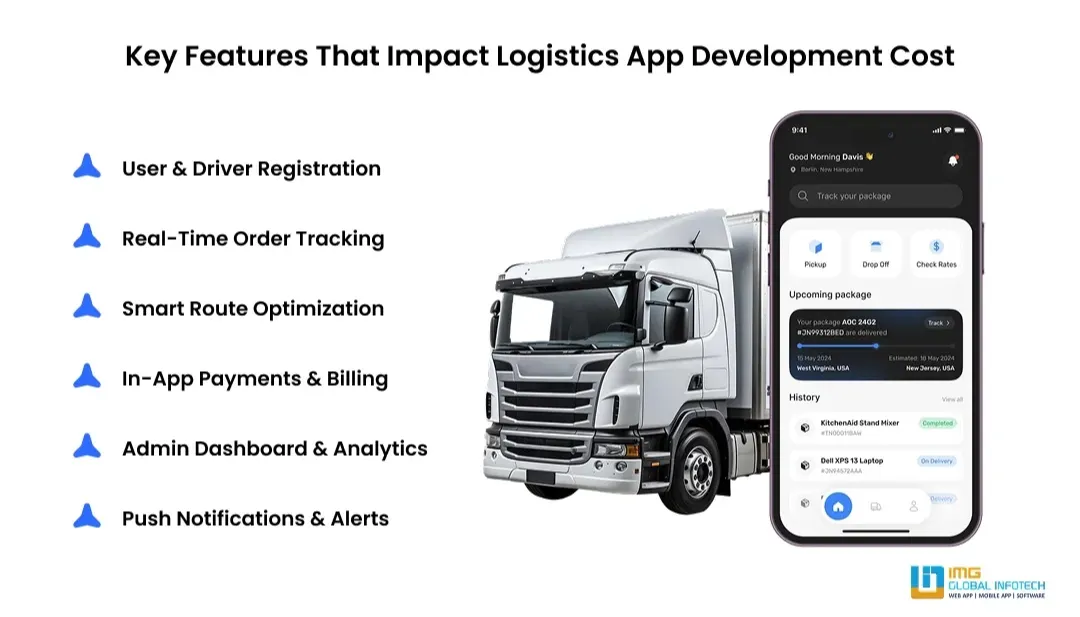
Features are the biggest cost drivers. The more advanced your app, the higher the investment. A trusted Mobile app development company can help you find the balance.
Here are some of the core features that impact app-building cost.
1. User & Driver Registration
The importance of secure onboarding with profile creation, document verification, and role-based access has led to an increase in development effort. It establishes consumer, carrier, and logistics companies' trust and security through smooth operations on their collective platforms.
2. Real-Time Order Tracking
The availability of live GPS tracking of shipments with integration of maps affords the consumer and the admin the ability to monitor shipments in real-time. This will increase the transparency of the delivery process and improve delivery accuracy, but increase backend complexity with each development phase.
3. Smart Route Optimization
AI-Driven route optimization based on traffic, distance, and delivery priority enables the user to see real-time information relative to estimated delivery times and fuel cost. However, the provision of the algorithm for route optimization and the data processing will drive prices and costs upward.
4. In-App Payments & Billing
The use of multiple payment gateways, automated invoice generation, digital wallets, and refund generators can improve the consumer experience. To provide these features, secure integrations, PCI compliance, additional testing, and ongoing maintenance will all add up to increase the app development cost.
5. Admin Dashboard & Analytics
The availability of an admin panel loaded with reports, metric performance, pricing control, and user management will aid the business in scaling rapidly. The Display of this type of data requires backend development effort and maintenance.
6. Push Notifications & Alerts
The presence of real-time notifications for order updating, delays in orders, delivery offers, and delivery status provides high levels of user engagement. The use of reliable cloud services for processing notification events and responding to user notifications will increase app backend complexity.
Other Features That Affect The Cost Are:-
-
Multi-language support
-
Ratings and reviews
-
Proof of delivery (OTP/signature)
-
AI demand forecasting
-
Third-party API integrations
-
Cloud-based data storage
Advanced technologies like AI in logistics—predictive ETAs, demand forecasting, and smart routing—can significantly improve efficiency but also increase development expenses. This is where logistics app development cost rises noticeably.
Logistics App Development Cost Breakdown
Logistics app development cost depends on various factors like the number of features, integration, modern tools usage, methodology, level of the app, complexity, and location of the development team or developers. Let us break down the cost based on the level of an app.
1. Basic or Simple App Cost
A simple or basic-level app cost ranges from $5,000 to $8,000. This is ideal for startups evaluating logistics mobile app development cost for MVPs and for small businesses. Some of the basic features in these apps include Booking, tracking, payments, etc.
2. Mid-level or Intermediate App Cost
A mid-level app cost ranges from $10,000 to $15,000. This range reflects a balanced cost of the logistics app development and is ideal for expansion or growing businesses. Some of the features in the mid-level app include Real-time tracking, an admin dashboard, and notifications.
3. Advanced On-Demand Logistics App Cost
The advanced app costs ranges $15,000 or more, depending on the requirements of your project. This is typical for enterprises calculating the on-demand logistics app development cost or the cost to build on-demand logistics app platforms. It is an ideal choice for large enterprises. Some of the features include AI, analytics, fleet optimization, etc.
Cost (In Table)
Ultimately, the final logistics app development cost depends on your feature roadmap and scalability goals. A few businesses also search for the best porter alternatives. That’s because they think that it will reduce their cost. They need to understand that it is a process that requires proper planning and execution.
Factors Affecting the Cost of the Logistics App Development
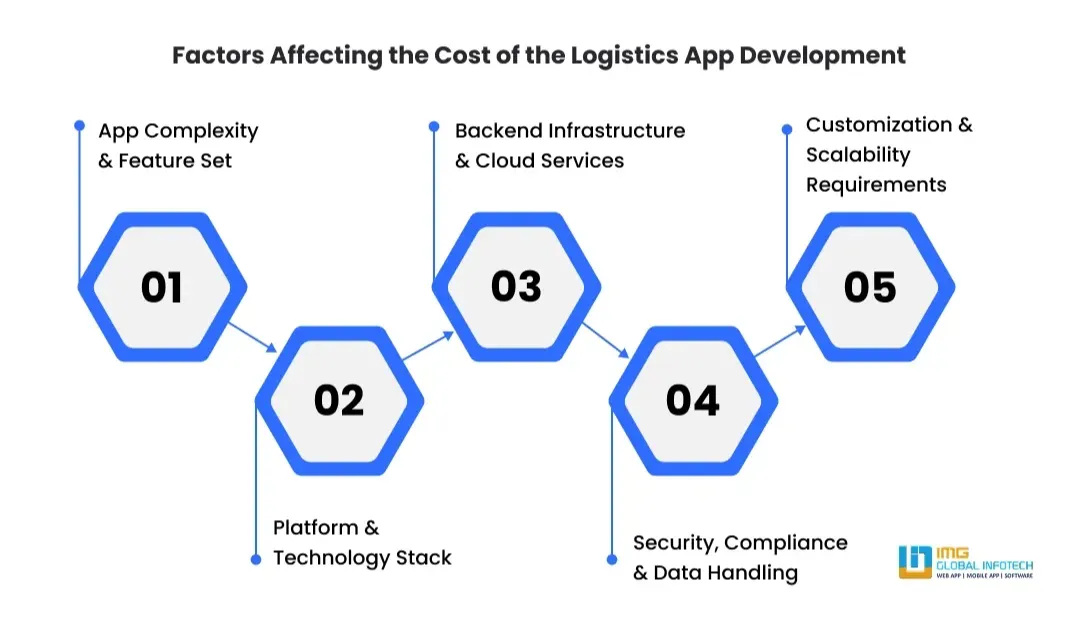
A lot of factors affect the overall Logistics app development cost. An Ondemand app development company analyzes these factors and uses the methods that give best results at affordable prices.
Here are some of the factors given below.
1. App Complexity & Feature Set
Increased backend development, integrations, and testing are required for advanced features like AI-based route optimization, real-time alerts, live GPS tracking, and secure onboarding, which directly increase the total cost of developing a logistics application.
2. Platform & Technology Stack
The choice of developing an Android, iPhone, or cross-platform application will affect their architecture, performance, and maintenance, which will affect the complexity of the backend, the timelines for development, and the long-term costs for developing a logistics application.
3. Backend Infrastructure & Cloud Services
Real-time data processing, notification events, an admin panel, and live tracking all require reliable cloud services, which adds to the backend development and makes scalability and recurring infrastructure costs higher to support.
4. Security, Compliance & Data Handling
The integration of secure integrations, PCI Compliance, document verification, and role-based access requires significantly more time for development, as well as audits and testing, which increase the overall cost of developing a logistics application.
5. Customization & Scalability Requirements
Custom workflows, advanced admin dashboards, performance metrics, and scalable architecture will require ongoing backend development and maintenance, causing the overall costs to increase as the platform continues to develop.
Monetization Models for On-Demand Logistics App
A strong revenue strategy ensures faster ROI (Return on Investment) and scalability. There are various models available. A Courier Delivery App Development Cost might be different, and they might use a different model to recover that money. Here are some of the models given below.
1. Commission-Based Model
The platform generates revenue through commission fees that are either a percentage or fixed per order delivered or booked over time. This approach works at a large scale when there is a high order volume and is used in on-demand logistics marketplaces.
2. Subscription-Based Model
Businesses, delivery partners, and fleets or other types of affiliates will subscribe to the platform every month to utilize premium features - such as advanced analytics, optimum routing, priority listing, and detailed performance reports - that are unavailable for subscribers without premium subscriptions.
3. Dynamic Pricing Model
Pricing is fluctuating as the demand for services increases, as does the distance of service delivery, as do the traffic conditions during service delivery, and as the time-sensitive nature of service delivery is present. By using this pricing model, the platform provides maximum revenue to the service provider through the peak service hours, while still providing the necessary level of flexibility and transparency for customers and service providers.
4. Advertisement & Promotion Model
The logistics applications create revenue by providing access to local businesses to promote their services through advertisements inside their application, through a featured listing within their application, or through sponsored placements within their application to be viewed by a targeted audience of users.
5. Value-Added Services Model
In addition to the traditional delivery costs, the app has an unlimited number of additional cost-associated services that customers can request, such as insurance, express delivery, real-time tracking, warehouse assistance, and specialized handling, creating additional revenue-generating opportunities for the application in addition to just the normal base delivery fee.
Choosing the right monetization model helps offset the cost to develop a logistic app effectively.
Why Choose IMG Global Infotech for Logistics App Development?
IMG Global Infotech has established itself as a leading logistics app development service provider with industry expert knowledge of developing applications available to users in real-time. We can offer user-centric applications to your business at the right price, regardless of the size of your company or how busy you are.
With our dedicated logistics app development team, you can connect your users to their local delivery drivers through our logistics Mobile App Development, which utilizes a unique combination of artificial intelligence (AI), cloud, and intellectual Property (IP) within its development. As a result, it reduces your company's operational costs and increases efficiency.
What will you get at the IMG Global Infotech?
-
End-to-end logistics app development
-
Customized on-demand logistics solutions
-
Scalable and secure app architecture
-
AI-powered features and integrations
-
Intuitive UI/UX design
-
Dedicated project managers
-
Transparent pricing models
-
On-time project delivery
-
Post-launch support and maintenance
-
Experienced logistics app developers
CONCLUSION
Investing in logistics applications in 2026 can drive automation speed and ultimately help improve customer service. The cost of logistics application development will vary depending on specific features, types of applications, and types of technologies. However, a well-designed application will provide long-term benefit. Selecting a suitable development partner, clearly defining requirements, and taking advantage of intelligent monetization strategies will allow you to create a strong logistics solution that is successfully scalable to your business. If you intend to start in this area, now is an excellent opportunity to develop your ideas into a high-performing application offering on-demand logistics service.