The home services industry is changing rapidly. Whether it's plumbing, cleaning, beauty, repairs, or handyman services, users now expect to be able to get all these services on demand via one app. However, developing an app is only part of the equation. The real challenge of home services is monetizing the customer base, like how do you create a steady stream of revenue from the convenience of home service bookings without losing customer trust?
As we approach 2026, competition will be at an all-time high, customer acquisition costs will be at record levels, and users will be more sophisticated than ever. In order to remain competitive, both start-up companies and established corporations must implement innovative monetization strategies that are more intelligent, flexible, and user-friendly. This blog outlines both leading and upcoming methods of monetizing customers that have been proven effective and explains them in a straightforward, casual manner.
What Is a Home Service App?
Service applications for home usage, or home service applications, form a link between consumers and providers of various professional types, such as cleaners, electricians, appliance repair persons, etc. The home service application allows for easy access to the service provider for all types of owner-occupied space cleaning and mechanical repairs, and many other personal services. The home service application acts as an intermediary between the consumer and the provider by allowing for the management of bookings, payments, consumer reviews, and quality control processes.
From a business perspective, the home service app can be categorised as a dual-sided market where each side must also be monetized. Therefore, the customer monetization will present opportunities or challenges on the provider side as to which side to monetize, either from the customer or the service provider, or both. Ultimately, a successful home service app will create a balanced user experience for both sides of its market and allow for the monetization of the providers while also providing adequate incentives to the consumers who use the app to access those providers. Therefore, the selection of an appropriate monetization strategy is critical to achieving this balance. Also, choose the best development partner who have the knowledge of Home service app features.
Top Monetization Models for Home Service Apps in 2026
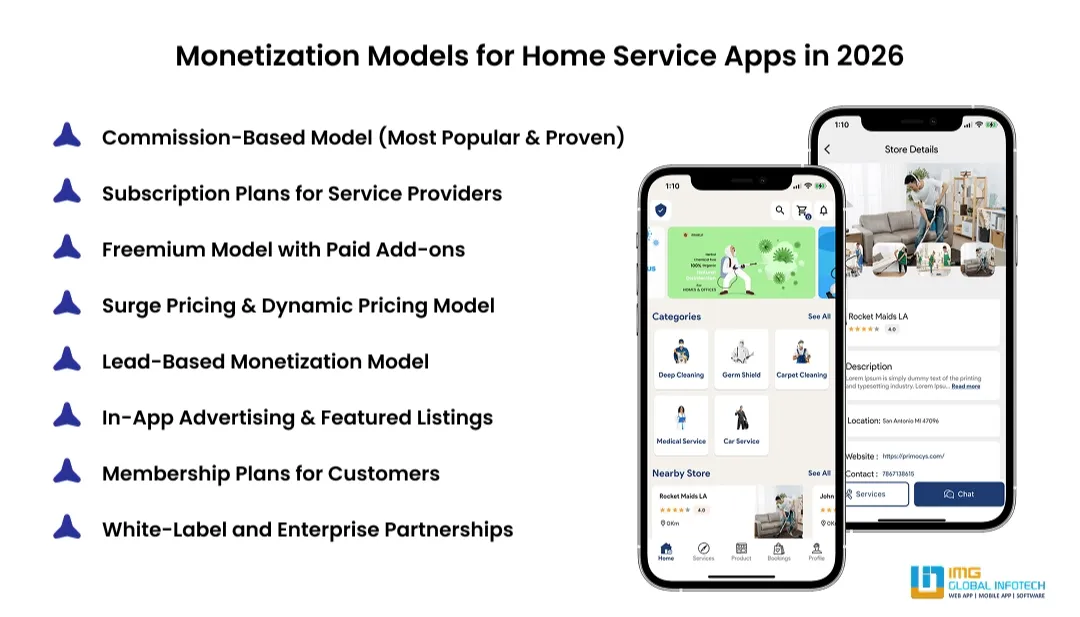
Some businesses search for Urban company like app development cost, because they wanted to replicate the success of the company. They look for different models for home service apps. Below are the most effective and future-ready home service app monetization models that are working globally in 2026.
1. Commission-Based Model (Most Popular & Proven)
The foundation of monetisation for home services customers is still the commission model. The user receives a fixed commission on all successful transactions completed via the app. Most on-demand service apps use revenue models based on commission structures that range from 10% to 30%, depending upon service category. For example, high-frequency services like cleaning will likely have a lower commission structure, while specialised services will typically result in higher commissions.
This monetization model of home service app works well because:
-
Customers pay only for the service
-
Providers pay commissions only when they earn
-
The platform scales revenue with usage
2. Subscription Plans for Service Providers
As of 2026, numerous platforms will be transitioning from a commission model to a subscription-based revenue stream. Many of these platforms will implement their subscription-based platform strategy by having service providers subscribe at the beginning of the subscription period (i.e., paying a monthly or annual fee) and, in return, being given access to the platform and its associated benefits. This represents a great example of how to monetise a service provider application effectively.
This approach improves homes services customer monetization indirectly by:
-
Ensuring higher-quality, committed providers
-
Reducing dependency on per-order commissions
-
Offering stable recurring revenue
3. Freemium Model with Paid Add-ons
Freemium is emerging as one of the top monetization options for apps in the home services industry. Both the end user and service provider will have access to the basic functionality of the application at no charge, but will have the option to pay for advanced features.
This freemium approach will enable home service providers to earn revenue from their customers while not requiring pre-paid fees for their products/services, which makes this model especially beneficial to new or cost-conscious markets. Paid add-ons may include:
-
Instant booking priority
-
Extended service warranties
-
Advanced scheduling tools
-
AI-powered lead matching
4. Surge Pricing & Dynamic Pricing Model
Surge pricing through the use of AI-driven home service platforms will be available in 2026, making it a trend that has moved beyond ride-hailing companies. Home service platforms using dynamic pricing and alerting customers of their future service prices allow the home service customer to establish a trust relationship with home service providers.
This home service app monetization approach increases margins by:
-
Charging premium rates during high-demand hours
-
Encouraging providers to work during peak times
-
Optimizing supply-demand balance
5. Lead-Based Monetization Model
Instead of paying for completed jobs, providers pay for leads. Instead of paying for completed work, providers only pay a fee for inquiries made to them from potential customers. If you have a Home Service Application, it may have complex or offline-based service transactions, creating a unique way to monetize that application based on your business model.
This revenue model for home service apps works best for:
-
High-ticket services (renovation, pest control, AC installation)
-
B2B or semi-professional services
6. In-App Advertising & Featured Listings
Advertising is a secondary but growing part of homes services customer monetization. Providers can pay to:
-
Appear at the top of the search results
-
Get Featured Provider badges
-
Run localized promotional campaigns
As competition increases, particularly in larger metropolitan areas, home service providers need to compete aggressively for business visibility in the marketplace. An effective but less obvious component of monetizing the Home Service Marketplace app keeps the provider continually engaged through continued support via Customer Loyalty Rewards and creates a more stable and predictable future revenue base for the service provider.
7. Membership Plans for Customers
Customer memberships are becoming popular in 2026. Users pay a monthly or annual fee for benefits like:
-
Discounted service rates
-
Free cancellations
-
Faster response times
-
Exclusive offers
This is achieved through a combination of building loyalty, creating predictability in revenue, and retaining the existing customer base.
8. White-Label and Enterprise Partnerships
Platforms have also started monetising their technology by offering it as a service to businesses that wish to license it for use internally, or to build their own brand based on the platform's app features.
The above monetisation strategies for home service apps are typically engineered through working with experienced home service app monetisation consultants. They often assist start-up businesses in growing beyond traditional, single-source consumer revenue streams. If you want to build an app like taskrabbit, choose the best development company who knows all the methodology and provides high-performing and scalable product.
Challenges in Monetizing Home Service Apps
Even with multiple options, homes services customer monetization is not without challenges. Home service app development companies in India are known to cope with these challenges effectively. Here are some of the major challenges given below.
1. Choosing the Right Monetization Structure
The wrong monetization model for a home service app could negatively affect future growth potential. A weak structure will negatively influence the scalability of the home service app business, as well as the satisfaction of providers and the overall performance of the app.
2. Balancing Provider Earnings and Platform Revenue
The presence of high fees in the monetization model of service provider apps may discourage providers from remaining active in the marketplace. When this occurs, it has an immediate effect on the ability for services to be available, which further harms the monetisation of the app.
3. Low User Retention in On-Demand Platforms
Infrequent service needs lead to fewer repeat bookings and therefore create obstacles to the implementation of on-demand service app revenue models. This is particularly true with a reliance on subscription-based revenue or long-term customer plans.
4. Rising Competition and Feature Parity
With so many platforms offering similar features for home service apps, it is increasingly difficult to differentiate oneself from the competition. Such saturation limits premium pricing options and adversely affects the ability of home service apps to create a sustainable monetization strategy.
5. High Operational and Support Costs
The need for customer support, refunds, and dispute management adds considerable costs to the overall expenses incurred by home service apps. These costs, which are often difficult to quantify and predict, further decrease profit margins and ultimately negatively impact the ability of home service apps to utilise their best monetization strategies for success.
How to Choose the Right Monetization Model for Your Business?
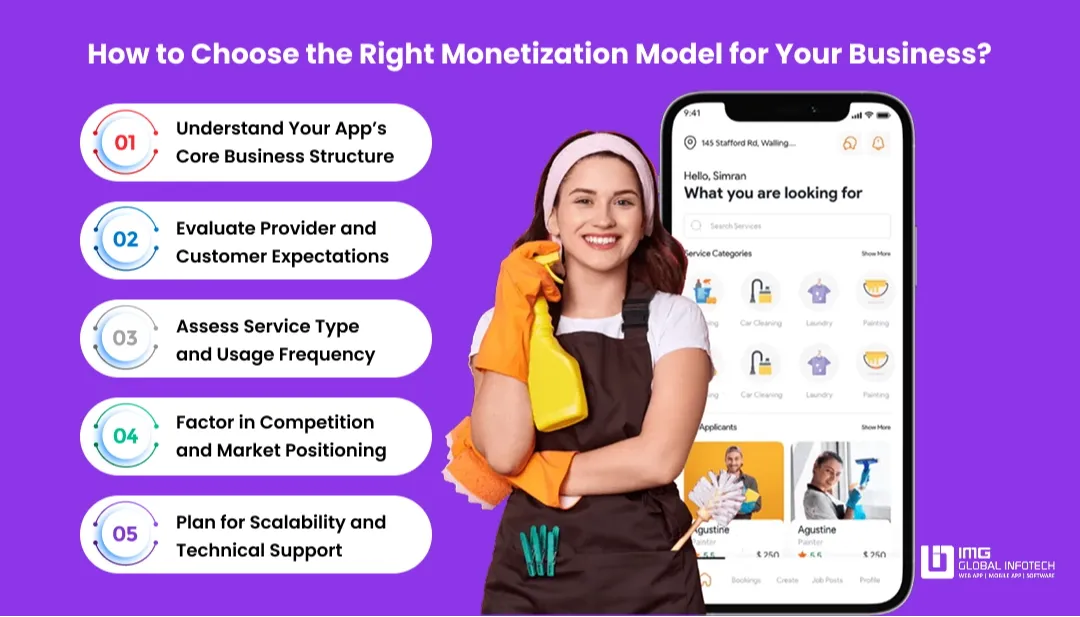
Choosing the right home service app monetization models depends on your niche, target audience, and growth stage. Home service app ideas for startups might be different to the large and established businesses. Here are some of the ways to choose the right monetization model.
1. Understand Your App’s Core Business Structure
Your home service app can use commissions, subscription or lead-based pricing as a monetization strategy. Monetization needs to be aligned with the complexity of services offered and how often users book services.
2. Evaluate Provider and Customer Expectations
A successful monetization model for a service provider app incorporates fair compensation for providers while maintaining transparency. Recognising provider motivations is a key factor in developing an effective monetization strategy that will not increase churn rates or provider dissatisfaction.
3. Assess Service Type and Usage Frequency
Service frequency will play an important role in the chosen monetization model for your home service app. Subscriptions work well for services that are booked frequently, whereas lead-based pricing works well for specialised services. The use of these decision factors strengthens the revenue model of on-demand service apps and support long term sustainability.
4. Factor in Competition and Market Positioning
If you aim to monetize an app like Urban Compa, premium pricing can only be successful if your company is capable of providing strong quality control and pricing justification, thereby supporting advanced home service app monetization strategies.
5. Plan for Scalability and Technical Support
Working with a reputable home service app development company will provide you with the flexibility to change the revenue model of your home service app as user demand and service categories grow through the development of a scalable architecture.
Other ways to choose are:-
-
Validate long-term home service app monetization
-
Ensure fair service provider app monetization
-
Strengthen service marketplace app monetization
-
Experiment with on-demand service app revenue models
-
Optimize the home service app business model
CONCLUSION
By 2026, the likelihood of success for a platform that uses only one revenue source will be greatly diminished. Companies that continue to find new ways to make their services profitable will create the greatest lifetime value for their businesses.
To successfully monetize a strong home services customer base, a thorough knowledge of user psychology, provider expectations, and the dynamics of the market is essential. It is imperative to develop a monetization model that will allow your company to become profitable and grow as your company scales and grows or when launching a brand new venture.
The best monetization models will have built-in sustainability, profitability, and growth potential. An effective plan will create a sustainable, profitable ecosystem within your company's platform that will continue to increase year after year. Some businesses also look to build an app like Urban Company, and try to replicate their revenue model. The Indian companies provides on-demand service app revenue models services and are known for affordable pricing. Choose the best one and kickstart your journey today.