“Wait, I don’t actually need to be on Amazon to survive?”
“In fact, by 2026, if you’re only on Amazon, you’re just renting your customers. If you want to own them, go D2C.
“However, isn’t it expensive to build an entire brand from scratch?”
“It’s an investment. And it’s the most profitable one you’ll ever make, with the right tech.”
The retail world has flipped. In 2026, the “middleman” will be a full-fledged endangered species. D2C ecommerce brands are the new giants of the industry, be it a skincare line, a boutique coffee roaster or a sustainable sneaker brand. Why? Because they do not simply sell products, they sell access, community, and a vibe that a giant marketplace cannot offer.
The Indian D2C market is expected to reach $100 Billion by the end of 2026, and it will grow at an astronomical CAGR of 24%. But be honest—the era of the “gold rush” era of simply setting up a website and letting the money roll in is over. You do not just need a product to launch a profitable D2C ecommerce business today, but a high-performing custom D2C ecommerce platform and a plan that makes all of its customers feel like VIPs.
Why Start a D2C eCommerce Business in 2026?
“Wait, why do I need my own store? If I’m already on a big marketplace, ”
“Because on a marketplace, you are nothing more than a listing. On your own site, you’re a legend.”
Isn’t just a trend—it’s a power move that the shift toward direct-to-consumer ecommerce in 2026. From Jaipur’s local craftsmen to global manufacturing giants, everyone is rushing to launch a D2C e-commerce startup. Why? The reason is that the “traditional” method of selling is beginning to feel like paying a tax on your own creativity.
Total Margin Reclamation
Let’s talk numbers. In the case of traditional retail, a distributor takes a bite, the wholesaler takes a bite, and the retailer takes a massive chunk—usually half of your retail price. In case you start a profitable e-commerce business using the D2C model, you retain the entire pie. That 30-50% incremental does not simply sit in the bank, but it is the war chest that finances your next product innovation, quicker shipping and high-end ecommerce app development.
The First-Party Data Goldmine
In 2026, data has become more valuable than the product itself. By selling through a third-party platform, they will own the relationship with the customer; they know what your buyers like, where they live, and what they purchase next. By having your own custom D2C ecommerce platform, you have that “First-Party Data.” Any way you look at it, the only way to have a sustainable predictive marketing engine that actually functions in a world where third-party cookies are no longer and privacy regulations are becoming stricter, is to own your data.
Unfiltered Brand Voice & Identity
Marketplaces are the ultimate levellers, but not in a favourable sense. They push your high-end product into a small 1:1 square box and put it next to a dozen low-end imitations. By choosing D2C e-commerce development, you recover the narrative. You control the aesthetic, the storytelling videos, the interactive “AR try-ons,” and the high-end “unboxing” experience that makes a one-time buyer a brand evangelist for life.
Hyper-Agility in a Fast Market
2026 moves at the speed of light. In case of a new trend that emerges on social media, a D2C business can pivot its messaging or launch a limited-edition drop in 24 hours. Traditional retail, which is mired in the inventory contract and the retail shelf position, is just not able to keep up.
How to Launch a Profitable D2C Startup?
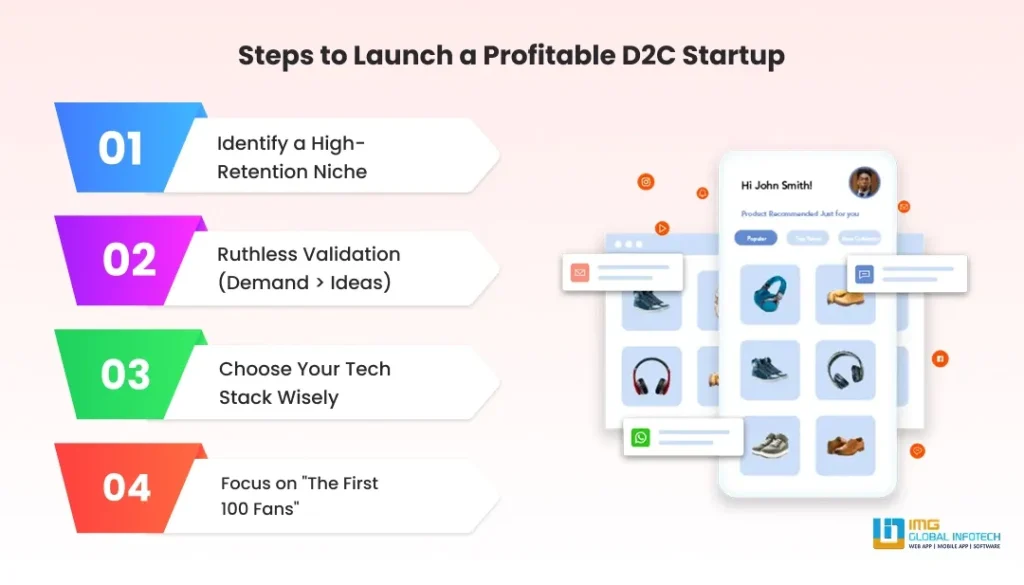
“I have the idea. Now, how do I actually build the machine?”
Identify a High-Retention Niche
Do not attempt to become “The Everything Store.” In 2026, profit is in the niche. Identify an issue that requires resolving—whether it’s “Eco-friendly pet gear for city dwellers” or “High-protein snacks for workers on the night shift.” Successful D2C ecommerce startups are dealing with the “micro-categories” in which they aim to become the uncontested #1.
Ruthless Validation (Demand > Ideas)
Check out the purchase intent before spending a rupee on production. In 2026, founders use “Smoke Tests”—a landing page that contains a “Coming Soon” sign-up—to gauge interest. A pivot may be required of the product when 500 people do not provide their email to get a pre-launch discount.
Choose Your Tech Stack Wisely
This is where the majority of the startups fail. You must have a mobile-first, fast and SEO-optimised platform. Even though SaaS tools are highly effective for starters, many scaling brands now hire e-commerce app developers to build a custom D2C e-commerce platform based on Headless Architecture. This will enable your site to load within less than 2 seconds, which is the requirement of the 2026’s impatient shoppers.
Focus on “The First 100 Fans”
Find 100 people who love your product to the extent that they will refer their friends before you spend 1 Lakh on advertisements. To keep your D2C ecommerce startup profitable, an organic community is the “secret sauce”. In 2026, community-based businesses are 3x more.
Must-Have Features for a High-Growth D2C Platform

Your website is not just a catalogue; it is a high-conversion engine. The “standard” features in 2026 won’t cut it.
AI-Powered Personalisation
Use AI tools for e-commerce business to display various products to various individuals. If a user likes “Blue,” then your entire homepage should subtly lean towards the blue style to them.
Frictionless One-Click Checkout
You’re losing 30% of your sales if your checkout takes more than 10 seconds. There is no bargain on biometric and UPI (Unified Payments Interface).
Social & Quick Commerce Sync
Your site should integrate with TikTok, Instagram and Quick Commerce dark stores (such as Zepto or Blinkit) flawlessly. The “shopping cart” in 2026 is wherever the customer is.
AR Virtual Try-On
Let them see how that rug looks in their room, or that watch looks on their wrist. It reduces returns (RTO) by almost 40%.
How Much Does It Cost to Start a D2C eCommerce Business?
Let’s talk numbers. It depends on how ambitious you want to be and how complicated your technology is, whether it takes a high or a low cost to start a D2C ecommerce business.
Note: Investing in a professional D2C ecommerce app development company early, you avoid the burden of having to rebuild the ecommerce platform once you reach your first 1,000 orders. High-quality code costs less than technical debt.
How to Make Your D2C Startup Profitable?
“Growth” is easy; turning it into “Profit” is the hard part. Here is how you keep your business profitable:
Master the LTV
CAC Ratio: When you spend ₹500 to get a customer (CAC), and they spend once again ₹600, then you are making a loss after shipping and GST. Take subscription models so that their Lifetime Value (LTV) is at least 3x your acquisition cost.
Optimize for RTO (Return to Origin)
Cash on Delivery (COD) returns are profit killers in India. Use AI tools for an e-commerce business to indicate “High-Risk” orders and promote prepaid orders at slight discounts.
Omnichannel Presence
A “Pure D2C” model is a unicorn in 2026. The most lucrative brands use their custom D2C ecommerce platform where they sell on a high-margin basis and gain access to data, and marketplaces where they achieve mass reach.
Sustainability as a Lever
It’s not just for the planet—it’s good for your wallet too. Minimal packaging, eco-friendly, reduces the shipping weight and appeals to 2026’s conscious consumers, which allows reducing the cost of marketing on the better part of “Word of Mouth.”
How IMG Global Infotech Can Help You Launch a Profitable D2C eCommerce Startup?
“I’m ready to build, but I don’t know how to code.”
“That’s why you collaborate with people who can code.”
At IMG Global Infotech, we don’t just build websites; we build engines that drive profits. We also know that 2026 will demand high-speed tech with a human touch, as we are a leading D2C ecommerce app development company.
We assist you in launching a profitable D2C ecommerce business by:
- Custom Platform Development: No “cookie-cutter” templates. We build your brand soul on the MERN or Headless newest stacks.
- Scalable Mobile Apps: We will assist you hire ecommerce app developers that specialise in high conversion UX and smooth payment integrations.
- AI Integration: Well-integrated AI in your dashboard: Smart chatbots, predictive inventory.
- Conversion Optimisation: We not only bring traffic, but we also convert traffic to revenue.
Conclusion
Being honest, is starting an e-commerce business in 2026 difficult?
Yes. It is getting more competitive than ever before in competition, the cost of the ad is getting higher, and the customers are also demanding more than ever before.
But is it worth it?
Absolutely. There has never been a more opportune moment to have your audience, your data, and your destiny. In 2026, the most successful brands will not be those with the biggest ad budgets, but those brands with the best technology, the smartest AI, and the most obvious relationship to their customers.The “Next Big Thing” is not a marketplace, and that is your brand. Are you willing to launch a profitable D2C e-commerce startup and grow it to the moon? The first line of code is ready to be written.