Your competitor’s chatbot just closed a deal at 2 AM. No commission, no coffee runs, and not a single HR complaint.
This isn’t a threat. It’s the new standard.
By 2026, AI chatbots stopped being a “nice touch” and became a must-have. The companies pulling ahead aren’t the ones with the biggest teams—they’re the ones who nailed where to drop in conversational AI for the most impact.
This shift isn’t about kicking people out. It’s about getting them off of the mindless, repetitive stuff so they can focus on work that actually needs a real person.
Ten industries figured this out early. Their ROI? It’s not some guess—it’s hard proof.
Here’s what they built and why you’ll want to pay attention.
What Are AI Chatbots? A Brief Overview
AI chatbots are built to chat like humans, but it’s all just software and artificial intelligence running under the hood. You type or speak; they listen, figure out what you meant with natural language processing, and fire off a reply right away—no human jumping in behind the scenes.
Remember those old-school bots from the 2000s? You’d ask one weird question, and it’d freeze or spit out nonsense by AI Chatbot Development Guide. Not anymore. Modern AI chatbots pick up on context, keep track of your conversation history, and actually handle complicated requests.
You’ll find them everywhere now—websites, apps, call centers, inside the tools companies use every day. They answer questions, qualify sales leads, take care of requests, and know when to pass things over to a person if it gets tricky.
Why ROI Matters When Implementing AI Chatbots
The practice of adopting artificial intelligence solutions becomes expensive because organizations require clear return on investment information.
Every corporate deployment must demonstrate its value through numerical evidence that shows actual results instead of just possible outcomes.
Budget Accountability
The leadership team uses ROI to make decisions about chatbot investment because it provides them with a specific financial justification. The promise of AI remains unfulfilled because it exists only as a pitch deck promise that needs to be proven through quarterly business assessments.
Performance Benchmarking
The ROI measurement establishes an exact standard that can be used to determine whether the chatbot system delivers better results than its previous process or simply introduces another layer of operational inefficiency.
Scaling Decisions
The only valid basis for expanding chatbot operations to other departments requires actual proven return on investment evidence in AI Development Company. The pilot project transforms into an organization-wide initiative that uses verified data to support its implementation.
Risk Justification
Organizations face implementation risks when they adopt new technological systems. The ROI framework for advanced technology helps to minimize implementation hazards while establishing stakeholder confidence in the system before all results become apparent.
Key Factors That Influence Chatbot ROI Across Industries
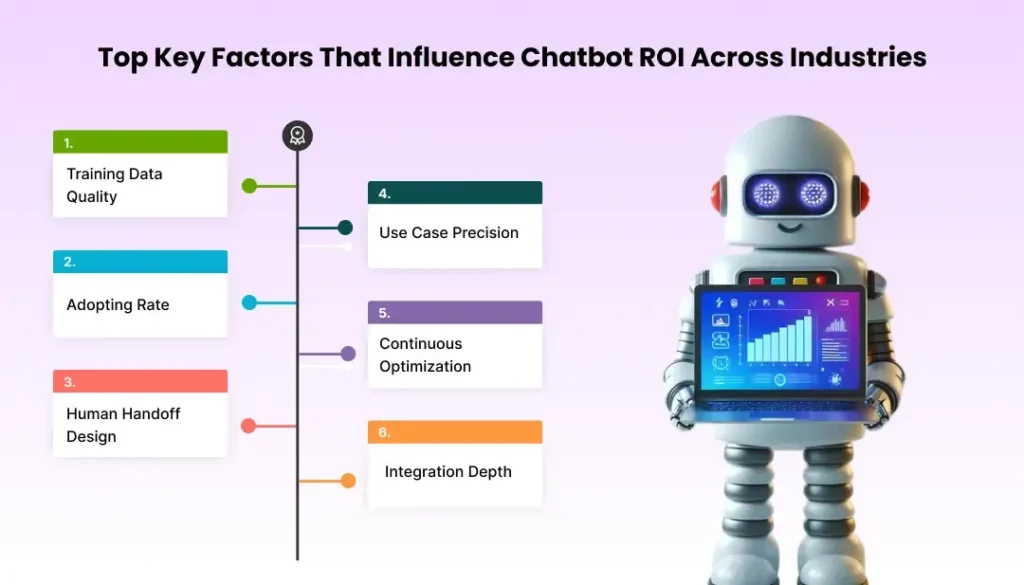
Basically, the chatbot ROI will not happen by accident, and it is engineered. There are 6 core factors that can determine whether to kind of deploy to backup or simply reduce the budget in the development process.
Training Data Quality
I’ll explain this point with the phrase “Garbage in, Garbage out.” Basically, the chatbots are trained on poor or outdated data and produce wrong answers confidently to examine the AI Chatbot Development Cost. The quality training data are the single biggest internal factor that can influence long-term performance on the ROI system in the business.
Adopting Rate
An AI chatbot, nobody, the users can return nothing. The internal resistance that has poor UX or weak onboarding can kill ROI before it starts. The adoption rate is the major metric most companies can underestimate during the main planning.
Human Handoff Design
If a chatbot is unable to identify its own limitations, then it is bound to break a customer’s trust in no time. However, intelligently handing over the conversation to human agents, precisely when the need arises, which is one of the ways of yielding customer satisfaction and safeguarding your business turnover at the same time.
Use Case Precision
It can deploy a chatbot on the right task;agents preciselyportant. A chatbot can handle wrong workflows to create friction; it’s not efficient or precise in use case selection that directly determines how fast returns materialize as well.
Continuous Optimization
The deployment is not the major finish line. The chatbots are not regularly retained but monitored to improve decay quickly by Top Chatbot Development Companies. It can also be ongoing optimization that can separate the one-time cost to integrate the compounding asset.
Integration Depth
A chatbot without any connection to CRM, ERP, or core systems is merely a sophisticated FAQ page in AI chatbot for ecommerce. Carrying out a deep integration with your current infrastructure is what really turns conversations into genuine business results.
Top 10 Industries Using AI Chatbots
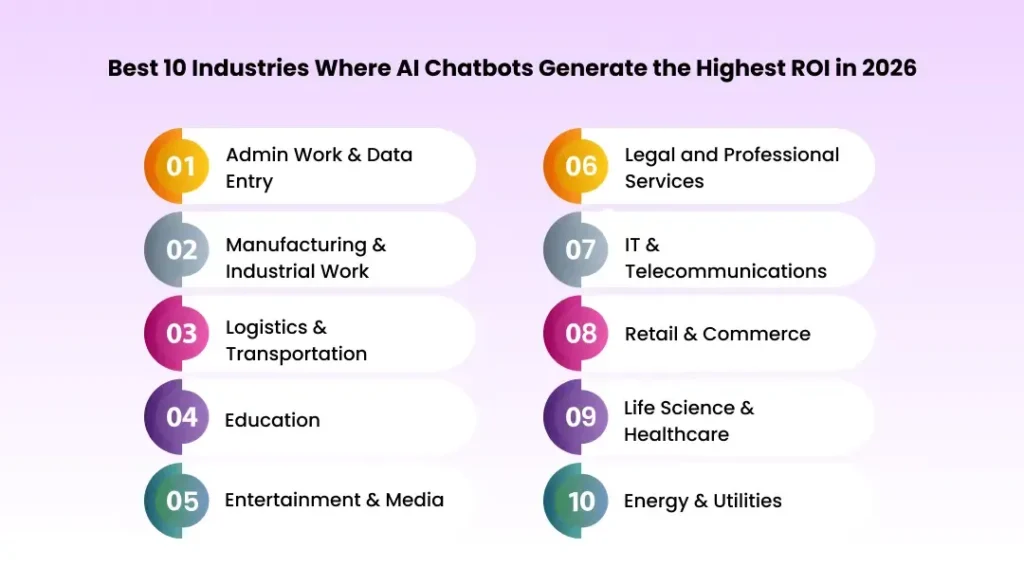
Here is a list of top 10 industries where AI chatbots generate higher ROI in business as well:
- Admin Work & Data Entry
AI can now handle all tasks that people use for data entry and filing work and basic document typing. The system operates with greater speed and higher accuracy. According to MIT and Goldman Sachs, many admin jobs are high risk—like over 2 million manufacturing and office workers might lose jobs by 2025 (The Economic Times). The system has become fully automated since entering 2026.
- Manufacturing & Industrial Work
Factories use artificial intelligence to transform their operations, which include predictive maintenance and automated quality control systems in AI chatbot benefits for industries. Sensors and machine vision systems detect defects in real time, while predictive models forecast equipment failure before it happens, which results in millions of savings from reduced downtime.
- Logistics & Transportation
The complete supply chain ecosystem now operates through artificial intelligence, which manages everything from intelligent transportation systems to self-driving vehicles. The logistics companies UPS and DHL use predictive algorithms to determine their most efficient and economical delivery routes. AI-powered fleet management systems work to decrease both vehicle downtime and greenhouse gas emissions.
- Education
AI systems in educational institutions create personalized learning experiences for students. The educational platforms use student performance data to automatically change their teaching materials and learning speed in AI chatbots ROI. The three tools, ChatGPT, Khanmigo, and Duolingo Max, use an artificial intelligence chatbot system to deliver immediate tutoring assistance.
- Entertainment & Media
Generative AI tools, which create text and music and images and video content, have completely transformed the creative industry. Studios now use AI for script drafting, content localization, VFX automation, and recommendation engines. Netflix uses AI algorithms to determine both viewer content selections and customized thumbnail and trailer displays for each individual user.
- Legal and Professional Services
Law firms together with corporate legal departments employ artificial intelligence technology for their document examination needs and their contract assessment work and their legal case forecasting requirements.
Natural language models can sift through millions of pages in seconds to find relevant clauses and precedents. AI-assisted tools like Casetext and Harvey are already streamlining due diligence work.
- IT & Telecommunications
Telecom operators depend on artificial intelligence to forecast network outages and manage bandwidth and handle automated customer service. The predictive maintenance system for fiber networks and data centers achieves a downtime reduction that reaches 35%. AI assistants handle millions of customer service interactions daily, which enables them to reduce human agent workload by more than half.
- Retail & Commerce
Retail serves as a visible example that demonstrates how artificial intelligence benefits various industries. The consumer experience has been changed through the implementation of personalized recommendations and real-time pricing and chatbot technology. Amazon developed deep learning systems for product recommendations, which now serve as the standard practice for retailers across the globe.
- Life Science & Healthcare
The healthcare industry will benefit more from artificial intelligence than any other sector. Machine learning models now serve as essential tools for hospitals and biotech companies to perform early disease detection and radiology image analysis and patient monitoring and drug discovery operations.
In 2025, AI algorithms will help identify anomalies in X-rays or MRIs with over 90% diagnostics, a rate comparable to or superior to human specialists in some domains.
- Energy & Utilities
AI is developing intelligent systems to control power distribution networks through its advancements. The predictive algorithms of the system enable load balancing while forecasting outages and enhancing the integration of renewable energy sources.
The oil and gas industry uses AI to analyze seismic data for exploration purposes, while the renewable energy sector uses AI to determine the best operational angles for wind turbines and forecast solar energy production.
Benefits of AI Chatbots Across Industries
The function of AI chatbots exists beyond their ability to solve problems because they function as amplifiers for their operational capacity in AI chatbot solutions for enterprises. The five advantages of a sector show consistent statistical evidence that demonstrates its actual benefits to operational performance.
Cost Reduction
Chatbots handle high volumes of routine interactions without headcount increases in AI chatbots in different industries. Companies achieve significant operational cost savings within months after deployment instead of needing to wait for years to obtain their first return on investment.
24/7 Availability
Businesses do not operate according to customer schedules. The AI chatbots provide continuous service throughout the day because they do not require overtime work, they experience no exhaustion and their response capabilities remain constant throughout their operational period.
Faster Query Resolution
The time needed for human agents to complete their tasks takes several minutes, whereas chatbots complete their tasks within second intervals in AI chatbot implementation benefits.
The process of resolving customer issues at a quicker pace leads to higher customer satisfaction ratings and it decreases customer drop-off rates while maintaining uninterrupted service operations.
Scalability without Compromise
The system operates without incurring additional expenses during its expansion process. Human teams reach their maximum operational capacity in AI chatbot benefits for industries.
A chatbot has no such limitations in chatbot business applications. The system maintains constant operational costs, which experience minimal changes when processing between 100 and 100000 requests.
Consistent Customer Enhancements
Businesses need to provide customers with the same experience throughout their entire journey in industries using AI chatbots. Human agents experience fluctuations in performance throughout their workdays.
Customers receive identical service through automated responses, which maintain consistent tone and precise information delivery, which protects the company from developing service delivery gaps that harm its public image.
Future Trends of AI Chatbots in 2026 and Beyond
The 2026 chatbot serves as the initial step that leads to upcoming developments that will deliver enhanced speed and intelligence while eliminating all options for businesses that do not maintain progress.
Emotion-Aware Conversations
The upcoming chatbot technology will identify user frustration and urgent needs and their emotional state through instant analysis of their emotional state. The system will modify its responses, which will create interactions that seem less like automatic replies and more like actual human dialogue that understands the current situation.
Proactive Engagement
The chatbots will begin their conversations without requiring users to initiate contact in chatbot return on investment. Through analysis of user behavior patterns, the system will start dialogue during peak times because it understands customer requirements before they fully express their issues.
Voice-First Interfaces
Voice communication has begun to surpass text-based communication in AI customer service automation. AI chatbots will increasingly operate through natural spoken language, which enables them to function in phone calls and smart devices and all locations where people find it difficult to use text input.
Hyper-Personalization at Scale
Future chatbots will retrieve information from multiple data sources, which include customers’ purchasing history and their personal preferences and their established behavior patterns, in order to create individualized responses. Mass personalization will no longer be a contradiction in corporate terms.
Autonomous Decision Making
Chatbots will develop abilities that enable them to make decisions instead of merely responding to user inquiries. The system performs all four functions, which include booking and approving and escalating and resolving problems without requiring human involvement at each stage. The transition from assistant to autonomous agent has already begun to take place.
Final Notes
Artificial Intelligence has become essential for modern society because it serves as the fundamental system that enables all current work activities across various fields, including hospitals and factories and educational institutions and legal settings.
Health care and finance and manufacturing industries experience the greatest advantages from their structured data operations because they require workers to perform repetitive tasks while providing strong economic benefits.
Organizations will achieve their next round of value creation through three methods that involve AI implementation and workflow redesign and talent development and AI integration into essential business operations by the AI chatbot development company. Successful organizations in the AI era will achieve victory through their ability to unify technological systems with governance structures and human decision-making into an advanced intelligent operational framework.