Artificial intelligence (AI) is an integral part of today's economy. It gives computers access to a variety of data so they can learn from and analyze patterns, make intelligent decisions with little to no human input. With respect to AI-based chatbots, these tools are no longer considered a luxury but rather have become essential tools for businesses. As companies enter the year 2026, businesses are seeking solutions to elevate their chatbots to the next level, and for this, businesses require the best AI chatbot development company. An AI chatbot development company employs advanced technologies, such as artificial intelligence (AI), Natural Language Processing (NLP), and Machine Learning (ML), to create chatbot applications that can accurately interpret and process text or spoken language and offer responses in real time, replicating a conversation.
Selecting an AI development company is a strategic endeavour that requires careful consideration and planning. A poor choice can adversely affect the customer experience, productivity, and scalability. This AI Chatbot Development Guide has been developed to educate businesses, startups, and enterprises about how current chatbots function, the technologies that make up the chatbot offering, and the estimated costs associated with creating a chatbot application. Additionally, we will assist you in selecting the best company to assist you in developing an AI chatbot for long-term success. Now, let's get started.
How AI Chatbots Work?
Using several different methods, such as algorithms, data, and ML (Machine Learning), AI chatbots have been designed to mimic and respond to a person during a conversation. Modern technology also allows the AI to learn, adapt, and respond in an intelligent way to humans. Here's what happens when you use an AI chatbot and how they work.
1. Process User's Input
When you use the voice or text option with your chatbot, the AI receives your message and determines the best way to respond by analyzing how you expressed your intentions and how you feel about your current situation through the use of NLP chatbot development.
2. Understand intention and handle context
When a user asks a question, the chatbot creates an "intent" for the request. By storing user-contextual data to create more realistic, human-like interactions, more sophisticated AI chatbots perform human-like conversational flow—just like a person speaking to another person.
3. Creating Responses
Chatbot responses are created using one of the following three ways: through pre-defined rules, through the chatbot's ML models (if set up as such), or through Generative AI Chatbot development as per the chatbot creation model used.
4. Continually Improving and Becoming More Intelligent
AI Chatbots are continually learning and improving. Taking feedback and training data from chat users into account enables the chatbot to get smarter each time the user speaks with the chatbot.
This flow of smart interaction helps identify both Basic and Enterprise AI Chatbots Created Through a Reputable AI Chatbot Development Company.
Types of AI Chatbots
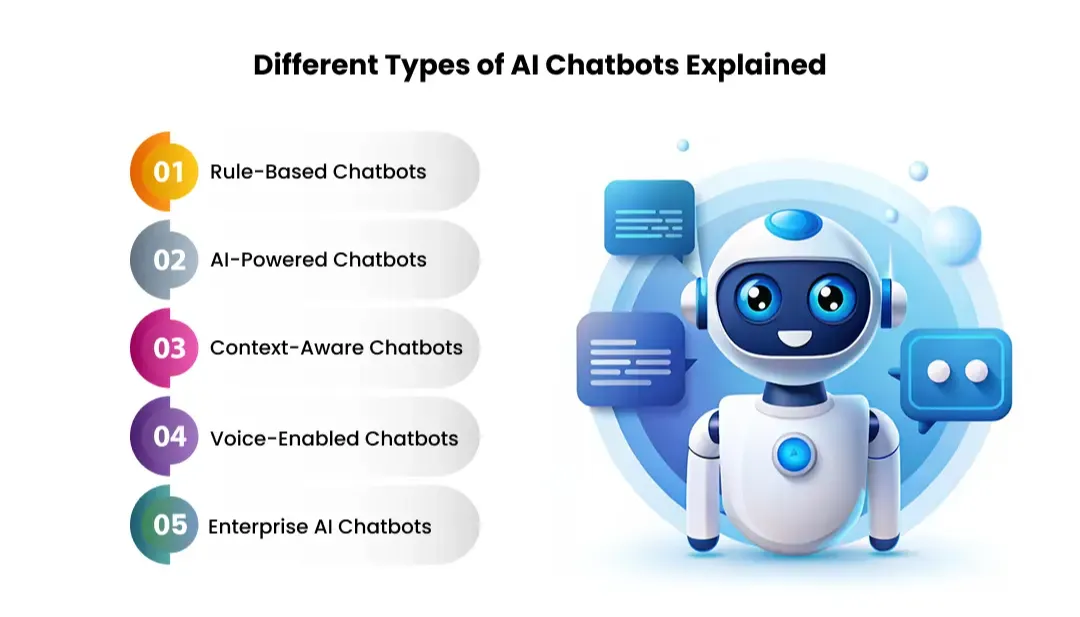
The various types of chatbots will help companies find the right chatbot solution for their needs, based on their objectives and the complexity of the business.
1. Rule-Based Chatbots
Rule-based chatbots have a strict adherence to set rules and follow decision trees to handle user queries. They provide a low-cost solution, but do have limitations in terms of dealing with complicated questions.
2. AI-Powered Chatbots
AI chatbots use machine learning and natural language processing to learn from user queries and use this information to create unique, real-time responses to users. Most AI Chatbots are now using AI to provide better and more accurate customer service.
3. Context-Aware Chatbots
Context-aware Chatbots save past conversations and user preferences for providing a customized experience during each interaction.
4. Voice-Enabled Chatbots
Voice-enabled chatbots are used with voice recognition and speech synthesis technology to create virtual assistant applications and are used in IVR systems.
5. Enterprise AI Chatbots
Enterprise-AI chatbots are specifically designed to be used by larger organizations. They connect to an organization’s CRM, ERP, and other internal systems to automate complex tasks or workflows.
Key Features of a Modern AI Chatbot
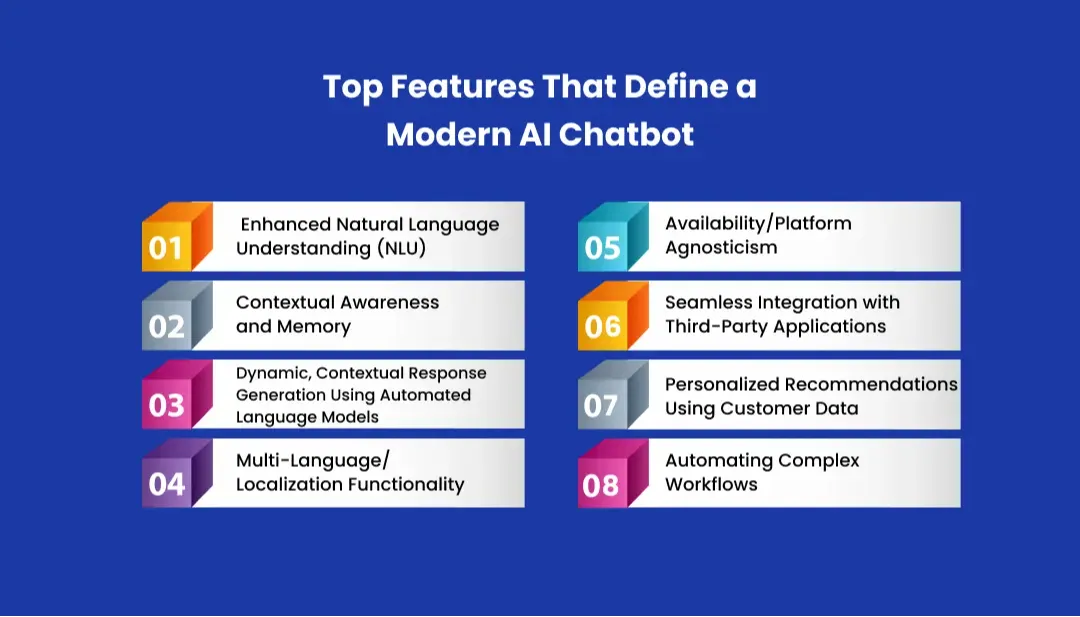
Technological advances in the early 21st century have enabled AI chatbots to evolve far beyond simply providing answers to questions. Today, these chatbots operate similarly to intelligent virtual assistants, interpreting users' requests, learning about them over time, and helping achieve business objectives. Here are some of the key features of a modern AI chatbot.
1. Enhanced Natural Language Understanding (NLU)
Today’s chatbots have powerful natural language understanding (NLU) capabilities that allow them to accurately perceive users' intent and context based on what those users actually say to them, even in cases when queries contain grammatical mistakes, are incomplete, or are informal.
2. Contextual Awareness and Memory
Today's AI chatbots utilize memory retention to allow for continuity of interaction between a user and the chatbot during that user's entire interaction with the chatbot across both short-term (within the same session) and long-term (over multiple sessions) timeframes.
3. Dynamic, Contextual Response Generation Using Automated Language Models
With the advent of large language model technology, AI chatbots will be able to provide more accurate responses in a wider range of contexts and to handle more complex and open-ended inquiries than they previously could by generating responses automatically based on historical data.
4. Multi-Language/Localization Functionality
A modern AI chatbot must be able to communicate in multiple languages. In addition, the chatbot should have the ability to adjust its tone, expression, and cultural nuances depending on the specific language being used. To manage translation strings and localization workflows efficiently during development, many teams rely on dedicated tools like the Tolgee localization platform, which integrates directly into the development process and helps keep multilingual content consistent across chatbot platforms.
5. Availability/Platform Agnosticism
Today, AI chatbots can easily interact with customers through multiple platforms, such as websites, mobile devices, social networks, messaging applications, or voice-activated devices. Users can expect the same experience regardless of which platform they interact with an AI chatbot on, thus providing users with a consistent experience.
6. Seamless Integration with Third-Party Applications
Most of today’s AI Chatbots connect to CRMs, ERPs, Payment processors, Ticketing Tools, Analytics Tools, and Corporate Applications so they can pull real-time data into the AI Chat Bot and update records, and even perform transactions automatically.
7. Personalized Recommendations Using Customer Data
The AI Chat Bot can use customer data collected from behaviours, preferences and historical interactions, to tailor recommendations, responses and offers to customers, leading to improved engagement and conversion rates.
8. Automating Complex Workflows
Most modern AI chatbots go beyond simple conversational support, automating activities like appointment setting, order processing, lead qualification and internal approvals, leading to substantial reductions in manual workload and operating costs.
Other Features You Will Get in a Modern AI Chatbot Are:-
-
Continuous Learning & Self-Improvement
-
Advanced Analytics & Performance Insights
-
Enterprise-Grade Security & Compliance
-
Scalability & High Availability
-
Voice & Multimodal Interaction Support
-
Customizable Conversation Flows
-
Proactive Engagement Capabilities
-
High Accuracy & Low Error Rate
These features show how intelligent, scalable, and business-ready a modern AI chat is. In 2026, businesses are looking for an AI Development Company that helps them to implement the technology correctly to allow a seamless customer experience, streamlininng day to day operations, and gain advantage over competitors in the market.
AI Chatbot Development Process
AI Chatbot Development is a comprehensive project that requires a thorough understanding of how your company works and what you want your AI Chatbot to accomplish. By properly defining the business objectives, business users can develop and implement the requirements for each AI Chatbot.
1. Requirement Analysis
Your first step in the AI Chatbot Development process is to conduct a thorough needs assessment. To create a Sales Bot, for example, the Business must conduct market research, analyze its competition, and determine what type of Sales Strategies will provide the Business with a competitive advantage.
2. Platform & Channel Selection
Another way to determine whether to use an AI Chatbot is to understand the Platform and/or Communication method that will be used to communicate with the end user.
3. Conversation Flow & UX Design
There will also be a number of other considerations that must be taken into consideration when designing your AI Chatbot. The User Experience (UX) will need to be thoughtfully considered from the beginning of the Development process. To ensure that users can easily navigate through the AI Chatbot, you must take the time to define all necessary Conversational Flows, Intents, Entities, Fallback Responses, and Error Handling Paths.
4. Data Collection and Knowledge Base Development
The collection of a large body of rigorous and high-quality training data utilized the following sources: FAQs, Customer Support Logs, Documents, and APIs. A robust knowledge base will allow the bot to return contextually relevant, accurate, and useful responses.
5. AI Model Selection and Training
Selecting the correct models for Natural Language Processing (NLP) and Machine Learning (ML) is essential, along with training them against real-world data. This stage of development focuses on intent recognition, entity extraction, sentiment analysis, and contextual understanding to provide accurate responses.
6. Back-end Development and Integrating Systems
Integrating systems between your bot(s) and CRMs, ERPs, Databases, Payment Gateways, Analytics Tools, and Third-Party APIs will enable real-time data access, automated task execution, and seamless business workflow execution.
7. Testing, Validation, and Quality Assurance
All functional accuracy, flow of the conversation, performance, security, and edge cases of the bot have been subjected to extensive testing. We have also simulated real-life user experience scenarios to identify gaps, eliminate errors, and develop a reliable system.
8. Deployment & Go-Live
Following successful testing, a chatbot will be deployed to selected platforms. As soon as the chatbot has been deployed, monitoring tools will be set up so we can track performance, uptime, response accuracy, and user engagement from day one.
9. Continuous Monitoring, Optimization, and Scaling Process
Once the chatbot has gone live, it will continue to improve through data analysis, user feedback, and conversation logs. The chatbot will be retrained with updated models, new features will be added, and the chatbots will be scaled to accommodate increased traffic and evolving company requirements.
Structured development steps minimize risks, provide greater accuracy, improve chatbot scalability, and produce a high-quality customer experience. By utilizing this process of developing AI chatbots, companies will build more reliable and responsive AI systems that can grow as their customers' and industry's needs evolve.
Technology Stack for AI Chatbot Development
Choosing the right AI chatbot tech stack is important for businesses to achieve a high-performing product and scalability. In 2026, building an AI chatbot is not just about one tool or language. It is the whole ecosystem and requires a detailed breakdown of the tech stack. Here are some of the AI chatbot technologies used in AI chatbot development.
1. Programming Languages
It is the core development layer, forming the backbone of the process. They are used to build logic, handle requests, and connect different components. For example, Python is preferred when it comes to simplicity and a strong AI or ML ecosystem. In the same way, JavaScript is useful for real-time chat apps and web-based bots. It depends on the project size, performance needs, and integration requirements.
2. Natural Language Processing Frameworks
NLP frameworks allow chatbots to decode human language, intent, context, and meaning. For text processing and entity recognition, spaCY and NLTK could be a good choice. To understand advanced language and generative responses, Hugging Face Transformers can be useful.
3. Machine Learning and Deep Learning Libraries
As discussed many times before in this blog, chatbots learn from data and keep improving with time. ML allows chatbots to learn, like TensorFlow and PyTorch are used to train and deploy AI models. They help move chatbots beyond rule-based logic into intelligent, adaptive systems.
4. Generative AI and Large Language Models (LLMs)
Generative AI technologies allow chatbots to provide responses that seem real. They create text based on what they see in the digital world (their environment) as well as the things being discussed in the conversation. By utilizing LLMs, the depth of conversation and interaction tends to be substantially deeper, and there is less reliance on pre-established conversation scripts.
5. Chatbot Frameworks & Development Platforms
Chatbot frameworks improve workflow efficiency by providing out-of-the-box capabilities. The popular frameworks streamline intent handling, conversation management, and integration processes. Chatbot frameworks improve developer speed without compromising stability or scalability.
Other Tech Stack for AI Chatbot Development Are:-
-
Backend & API Layer
-
Databases & Data Storage
-
Cloud Platforms & Hosting Infrastructure
-
Frontend & User Interface Layer
-
Voice & Speech Technologies
-
Analytics & Monitoring Tools
-
Security, Privacy & Compliance Layer
-
DevOps, CI/CD & Deployment Tools
-
Testing & Quality Assurance Tools
-
Integration with Business Intelligence & AI Systems
The right stack of technologies for developing AI-powered chatbots will give you better performance, scalability, security, and user experience than if you had chosen the wrong stack. It will also be cheaper over time and much easier to implement new features or upgrade existing features when needed. When working with an experienced development team, you can rest assured that your AI-powered chatbot technology stack has been created based on both your current business needs and best practices for the industry.
AI Chatbot Use Cases Across Industries
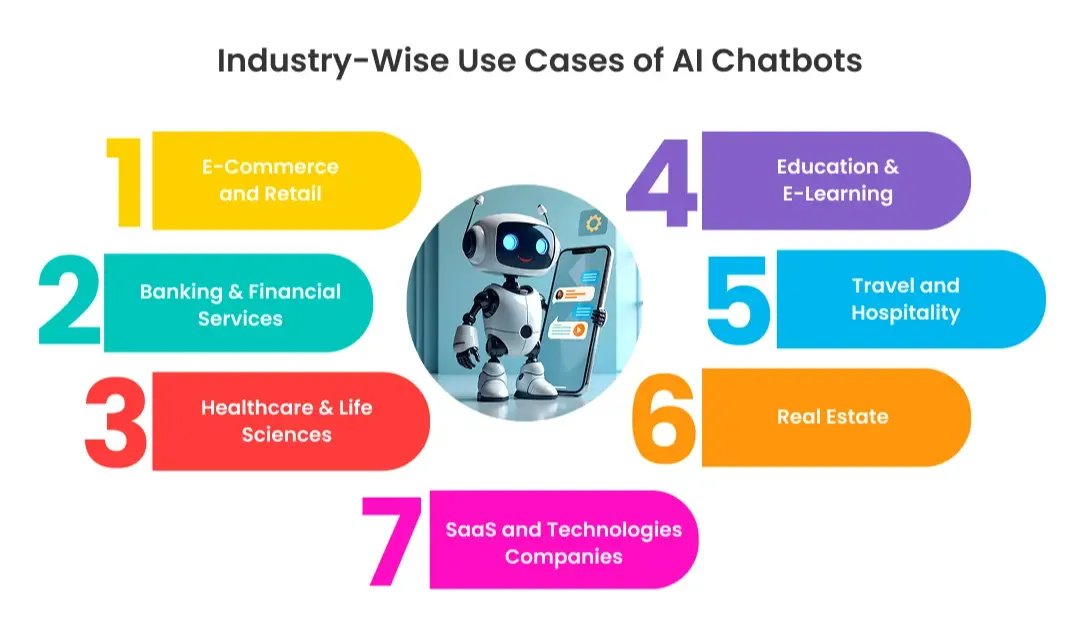
AI chatbots are useful for automating communication, improving customer experience, and ensuring smooth functioning of everyday functioning. Here are some of the use cases of AI chatbots (industry-wise) that help businesses to make informed decisions.
1. E-Commerce and Retail
AI chatbot technology provides customers with seamless product discovery, individually tailored recommendations, order tracking, support for returns and payment assistance. This technology facilitates the reduction of cart abandonment, maximization of conversions, and availability of 24/7 shopping support.
2. Banking & Financial Services
Chatbots provide the ability to check account balances, review the transaction history, block a debit or credit card, determine eligibility for loans, and report fraud alerts. The increased efficiency in customer support provided by chatbot technology creates a secure method for completing financial transactions on demand.
3. Healthcare & Life Sciences
AI chatbots provide appointment scheduling, symptom assessment, medication reminders, and patient follow-up. They help professionals reduce administrative burden and improve patient involvement, but they do not take the place of healthcare professionals.
4. Education & E-Learning
Chatbots can assist students with course enrollment, exam schedules, learning materials, and questions. They offer personalized assistance for learning and help improve student retention and engagement.
5. Travel and Hospitality
Chatbots powered by AI assist in booking questions, itinerary changes, cancellations, and traveller suggestions. Providing instant support before/during/after a travel experience, they enhance the experience of guests through providing answers to questions quickly and providing users with a positive experience when booking hotels.
6. Real Estate
For real estate agents, chatbots qualify leads by assisting agents with scheduling tours of properties, answering questions about listings and providing pricing information for these listings, allowing agents to focus on potential buyers while maintaining a high level of engagement with customers.
7. SaaS and Technologies Companies
AI-powered chatbots are also responsible for providing assistance in onboarding products, explaining product features, helping with troubleshooting issues and managing the subscription process for subscribers. A chatbot reduces the amount of support tickets generated and increases user adoption rates of a product.
Other Industries Where AI Chatbots Are Required Are:-
-
Manufacturing & Supply Chain
-
Human Resources & Recruitment
-
Insurance
-
Media, Entertainment & Gaming
-
Telecommunications
-
Logistics & Transportation
-
Legal & Professional Services
-
Government & Public Services
Benefits of Implementing an AI Chatbot
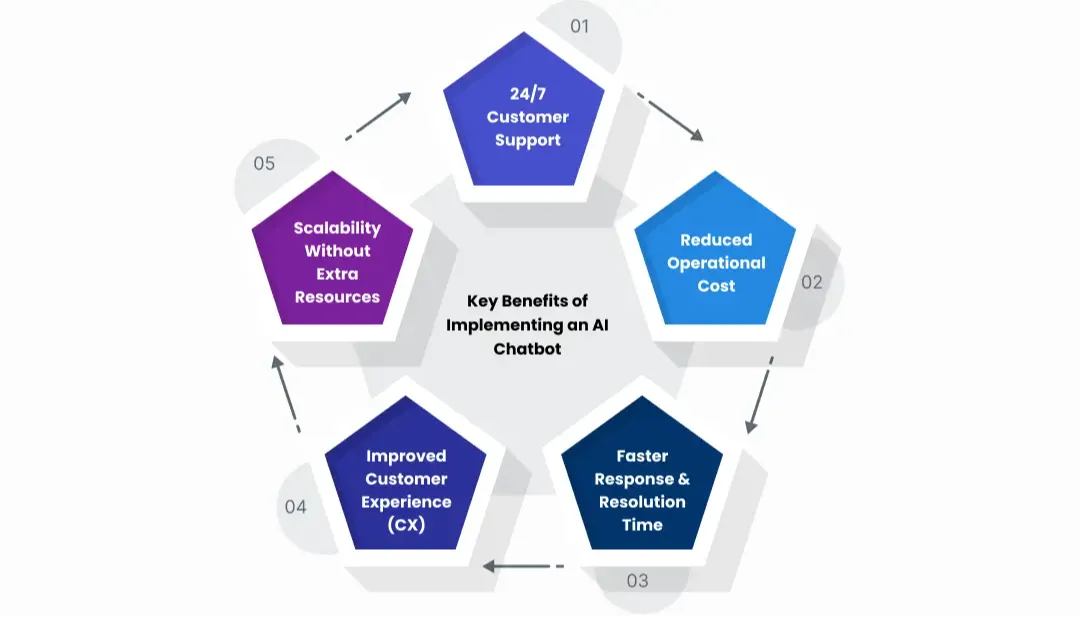
There are quite a few benefits to investing in custom AI chatbot development. Here are some of them given below.
1. 24/7 Customer Support
AI Chatbots are always available to assist your customers. Customers receive answers instantly, no matter what time it is. This results in greater customer satisfaction and eliminates any delays that occur because of time zone differences or the limited hours when a business provides support.
2. Reduced Operational Cost
Because AI chatbots automate repetitive questions, the need for large support teams decreases. This lowers the need for many employees and reduces the cost of doing business while maintaining the same high-quality service.
3. Faster Response & Resolution Time
Chatbots provide immediate answers to simple inquiries, such as confirming a customer’s order or shipment status. Since they respond almost instantly, this increases the first-contact resolution rates for your customers and improves your customers’ satisfaction.
4. Improved Customer Experience (CX)
AI chatbots allow for more engaging and seamless interactions with your customers by providing them with accurate, personalized responses. They therefore contribute to a better overall customer experience.
5. Scalability Without Extra Resources
AI Chatbots can manage thousands of conversations simultaneously. Businesses can easily scale their support operations without needing to hire more people during peak seasons.
Other Benefits of AI Chatbots Are:-
-
Personalized User Interactions
-
Automation of Repetitive Tasks
-
Better Lead Generation & Qualification
-
Increased Sales & Revenue Growth
-
Data Collection & Actionable Insights
-
Consistent Brand Communication
-
Multichannel Customer Engagement
-
Improved Employee Productivity
-
Enhanced Accuracy & Reduced Human Error
-
Faster Business Process Execution
-
Easy Integration with Business Systems
-
Improved Customer Retention & Loyalty
-
Competitive Advantage in the Market
-
Continuous Learning & Performance Improvement
-
Future-Ready Digital Transformation
Explore the top chatbot development companies who ensures high-performing quality products, with a long-term maintenance approach and provide scalability.
Cost of AI Chatbot Development in 2026
The chatbot development cost varies, and it depends on different factors like project requirements, complexity, features, location of the development team, experience of developers, and number of integrations. Here is the cost breakdown as per the level of the chatbots.
1. Basic Chatbots
The cost of basic chatbots ranges from $8,000 to $10,000. It comes with the basic features that are required to start the proceedings. Basic-level chatbots are a good choice for startups and small businesses.
2. Mid-level Chatbots
Mid-level chatbots range from $10,000 to $15,000. It is a suitable choice for businesses looking to expand. A few more integrations will be done by the development partner in mid-level chatbots.
3. Advanced Level Chatbots
An advanced-level chatbot or an enterprise-level chatbot is a complex task that requires heavy spending. It comes with all the modern AI chatbot features and AI integration that automates all the tasks. The cost of an advance chatbot can range beyond $15,000.
Cost Breakdown (In Table)
Challenges in AI Chatbot Development & How to Solve Them
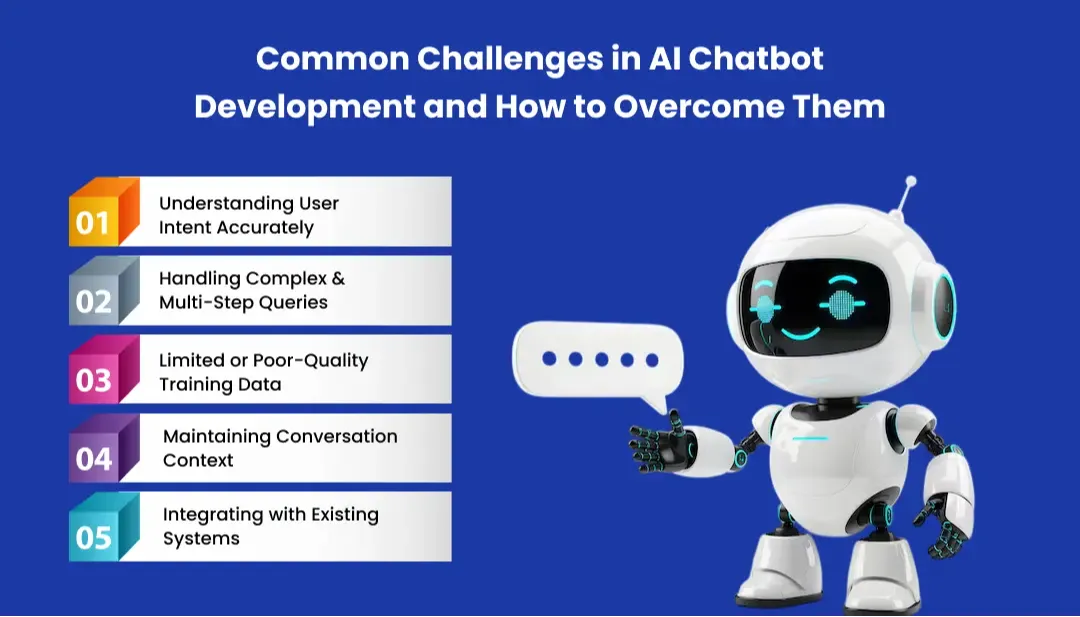
Despite having advantages, there are some challenges that businesses have to face while building an AI chatbot. Here are some of the challenges given below.
1. Understanding User Intent Accurately
The use of varied phrasing to ask the same question can cause ambiguity for chatbots. Improvements to the performance of chatbots are achieved through high-quality training data, advanced NLP models, and continual refining of user intents to better understand context.
2. Handling Complex & Multi-Step Queries
Long, complex, and multi-part queries are difficult for chatbots to process. By building success on enhancements to current technology, chatbots can detect the context of a user's previous question and respond accordingly throughout an extended conversation.
3. Limited or Poor-Quality Training Data
Poor data quality leads to inaccurate responses from chatbots. Developing datasets through real-time conversation monitoring and user feedback is the best way to create accurate response data for chatbots.
4. Maintaining Conversation Context
Chatbots are unable to remember what you previously said during the course of a dialogue, leading to redundant or unrelated responses. Employing session memory and context retention methods can help maintain conversation history.
5. Integrating with Existing Systems
Integrating chatbots with existing CRM, ERP, or legacy systems can be challenging. The use of API-based, Modular Architecture will facilitate successful integration between applications with the greatest flexibility, enabling the creation of scalable and extensible integrations.
Other Challenges of AI chatbot development are:-
-
Ensuring Data Privacy & Security
-
Managing Multilingual & Regional Variations
-
Poor User Experience Design
-
Over-Automation Without Human Support
-
Inconsistent Responses & Brand Voice
-
Scalability & Performance Issues
-
High Development & Maintenance Costs
-
Continuous Model Training & Updates
Future Trends in AI Chatbots (2026 & Beyond)
Here are some of the future trends that need to be followed by businesses during the AI chatbots development.
-
Chatbots can now be emotionally intelligent and detect the user's mood and sentiments in real-time.
-
Generative AI will be used more widely to make human-like, spontaneous conversations possible between chatbots and users.
-
Chatbots will support multi-modal interaction, including the use of voice, images, text, and video.
-
Voice-first and conversational UI will replace graphical user interfaces as the standard user interface.
-
AI agents will work independently from humans to complete tasks.
-
Chatbots will provide hyper-personalized experiences based on the user's behaviours and context.
-
Industry-specific AI chatbots will be trained with domain-focused data sets.
How to Choose the Right AI Chatbot Development Company?
Choosing the right development partner is crucial for a business if it wants to scale. Going with the wrong choice just for cheap rates won't work. They need to have a balance between affordability and quality. Before partnering with someone, consider these points.
-
Proven experience in AI chatbot development services
-
Strong portfolio and case studies
-
Expertise in NLP, ML, and generative AI
-
Ability to build custom chatbot solutions
-
Industry-specific chatbot knowledge
-
End-to-end development services
-
Enterprise-grade scalability support
-
Strong focus on chatbot UX and conversation design
-
Transparent pricing and clear cost structure
-
Flexible engagement and hiring models
-
Robust testing and quality assurance process
-
Post-launch support and maintenance
A reliable AI Development Company can future-proof your chatbot strategy while connecting seamlessly with AI chatbots and Popular AI Apps ecosystems.
CONCLUSION
With the advent of technology in today's marketplace, the use of AI chatbots has become necessary for every digital business. Businesses use AI chatbots to add value throughout all industries, including but not limited to enhancing customer service, automating processes, and increasing efficiency. Achieving meaningful results with AI chatbots requires a thoughtful business strategy along with a solid technology infrastructure and an expert development partner.
An expert AI Chatbot Development Company can assist you with the development of scalable, secure and intelligent AI chatbot solutions that are customized to your specific business needs. As an organization looking to develop the next generation of AI chatbots, refer to this AI Chatbot Development Guide for a complete overview of the planning, building, and deployment processes from 2026 onwards.
Taking the initial step towards AI chatbots with the help of an established expert Development Partner will ensure your success in creating innovative and effective AI chatbots for your organization and for many years to come.