Online shopping has changed due to the rise of instant satisfaction. Consumers increasingly anticipate receiving food, medications, groceries, and other necessities in a matter of minutes rather than days. The hyperlocal ecommerce platform, a business model that links local clients with nearby suppliers for extremely quick deliveries, has grown rapidly as a result of this change. A hyperlocal e-commerce platform, in contrast to standard e-commerce, concentrates on a particular geographic radius, allowing businesses to service clients more quickly, lower transportation costs, and foster strong local trust. Nowadays, a lot of companies, from startups to well-established businesses, are investigating how to create profitable, scalable hyperlocal solutions.
The chatbots vs AI assistants debate is ever-lasting with no proper answer. This blog will outline the real difference between chatbots and AI assistants, discuss the benefits, use cases, future trends related to both technologies, and aid in determining which technology best meets an organization's business objectives. By the conclusion of this blog, you will have an understanding of the chatbots vs AI assistants and how each can assist with automating smarter business practices. So let’s start.
What Are Chatbots?
Chatbot programs serve the purpose of mimicking human conversation by providing either a textual interface or a voice interface for communicating with people who would like to communicate with a computer. Although most chatbot software follows a scripting method in which it responds to the user based on a set of predetermined rules and actions, modern AI chatbots are also capable of being much more flexible than previous generations of chatbot software.
Current versions of AI Chatbot software used by businesses have been greatly improved from older versions.Current AI Chatbots for business can answer frequently asked questions (FAQs), help users complete forms, and provide instantaneous answers across websites, mobile apps, and popular messaging platforms like WhatsApp. To deliver this speed at scale, many companies now leverage the Getgabs WhatsApp Business Platform, which serves as a powerful bridge to automate the most time-sensitive parts of the customer journey. Despite their advancement over previous versions, many AI Chatbots still have limited capabilities when engaged in complex conversations or conversations that are situationally or contextually dependent. Going ahead, this AI Chatbot Development Guide will teach you a few more things.
What Are AI Assistants?
AI assistants differ from chatbots because they are able to learn from past interactions, interpret what users mean, modify their answers as they experience more conversations, and eventually adapt to a user's preferences.
Business-oriented AI assistants can work through intricate workflow processes, connect to a business’s backend systems, and provide managers with a way to make informed choices. While chatbots usually provide answers, AI assistants go beyond that to offer more in-depth support. The Top Chatbot Development Companies ensure that your AI assistants have all the required qualities to make your operations smooth.
Chatbots vs. AI Assistants: Key Differences Explained
Understanding the difference between chatbots and AI assistants is critical before investing. While both support conversational interfaces, their capabilities differ significantly. Here is the difference table given below.
Benefits of Chatbots for Businesses
Here are the key advantages businesses gain from chatbots.
1. 24/7 Customer Support
With access to a large database of information about products and services, business chatbot solutions can answer questions 24 hours a day, regardless of whether or not there are any available human representatives to assist with an inquiry.
2. Cost Efficiency
The number of repetitive inquiries that a company might receive through chatbots allows them to decrease their operational expenses because they will not have to hire as many customer service representatives.
3. Faster Response Time
Chatbots allow users to communicate directly with them and receive an immediate response, providing the ability to connect to multiple users at once and significantly improving a company's overall customer service.
4. Improved Lead Generation
Lead qualification and customer data collection occur in real time by engaging with chat visitors through chatbots, thus aiding businesses in increasing their conversion rates.
5. Scalability and Consistency
During periods of high demand, companies can easily scale up their chatbot program and provide uniform and accurate responses across thousands of customers.
For organizations just starting their automation journey, chatbots offer a low-risk entry point into conversational AI for business.
Benefits of AI Assistants for Businesses
The benefits of AI assistants for enterprises extend far beyond basic customer support. Here are some of them given below.
1. Advanced Personalization
Personalized experiences via user behavioral patterns, customer preferences, historical interactions are all used to better engage the customer at that point during conversation, thus increasing customer satisfaction.
2. Intelligent Decision Support
AI assistants enable organizations to access timely and actionable information and guidance, such as through real-time processing of significant data sets, leading to faster and better business decision-making.
3. Automation of Complex Workflows
It helps in performing multiple steps within complicated processes. It also reduces the number of manual tasks and operational errors.
4. Seamless System Integration
AI assistants integrate into existing systems, providing a seamless experience between departments and improved data sharing.
5. Continuous Learning and Improvement
AI assistants are continually trained through interactions with users based on user input; therefore, they improve in accuracy, context understanding, and performance with each interaction, thus allowing for the long-term scalability of the business.
Use Cases: When to Choose Chatbots vs. AI Assistants
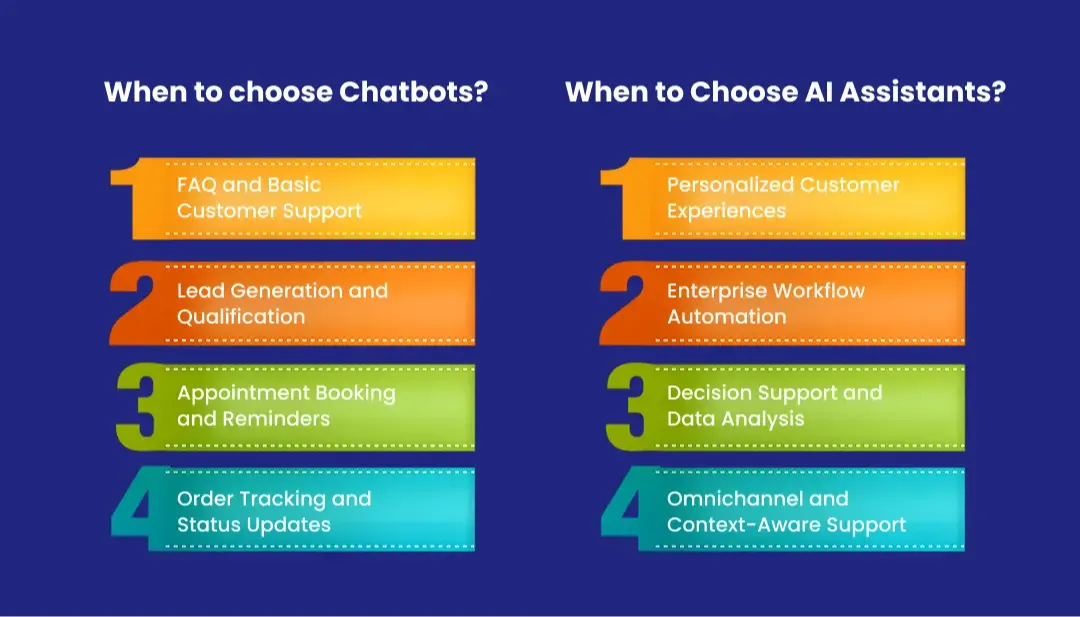
Choosing between chatbots vs AI assistants becomes easier when you look at real-world use cases. The AI assistant vs chatbot use cases are many. Let us now see the use cases of both.
When to choose Chatbots?
1. FAQ and Basic Customer Support
It is best to use chatbots to answer frequently asked questions and solve less-complex problems while providing customers with immediate access to support without needing to speak with a live agent.
2. Lead Generation and Qualification
When used effectively, chatbots can be valuable tools that allow website visitors to interact with your business by generating interest in your services, asking visitors a structured series of predetermined questions, and capturing lead source information.
3. Appointment Booking and Reminders
Chatbots are also an effective means of helping businesses schedule meetings, live demos, and customer service appointments by allowing for automated confirmations and reminders of scheduled events.
4. Order Tracking and Status Updates
Chatbots work well for providing real-time order updates, delivery status, and return information in ecommerce and retail businesses.
When to Choose AI Assistants?
1. Personalized Customer Experiences
The AI assistants analyse consumer data and behaviour to deliver tailored offers, recommendations, and reactions across a variety of touchpoints.
2. Enterprise Workflow Automation
AI assistants are intended to automate intricate business procedures, including IT Helpdesk support, finance approvals, and human resources support.
3. Decision Support and Data Analysis
Large volumes of data can also be processed by AI assistants to produce projections, insights, and suggestions that will aid in continuing strategic business decision-making.
4. Omnichannel and Context-Aware Support
Throughout your whole customer experience, an AI assistant can provide intelligent and seamless customer care by carrying on a conversation and context across all channels.
Key Factors to Consider Before Choosing a Solution
Before deciding between chatbots vs AI assistants, businesses should evaluate several important factors.
1. Business Goals and Use Case Complexity
Determine if your company needs a basic task automation solution with a chatbot or an AI assistant capable of intelligent contextual behaviour.
2. Customer Interaction Volume
The typical model for using the chatbot is for high-volume repetitive interactions. If the volume of inquiries received by the business is increasing and new inquiries are less predictable than the previous version, the AI may offer an advantage.
3. Personalization Requirements
If your company requires a personal touch based on each individual’s behaviour, history, and preferences, then an AI Assistant may be the best choice, rather than a traditional chatbot that can only respond with pre-defined responses based on rules.
4. Integration with Existing Systems
Evaluate the extent to which the AI would be required to integrate with existing tooling like CRM, ERP, Business Intelligence, and other company-wide software, as the Artificial Intelligence Assistant provides greater flexibility and integration into existing systems than does the chatbot.
5. Budget and Long-Term Scalability
Consider the long-term development costs against the potential for future growth. Chatbots generally have the benefit of quicker ROI as they take less time and work to develop, while AI Assistants can be developed into scalable, long-term business automation and intelligence.
Future Trends in Chatbots and AI Assistants
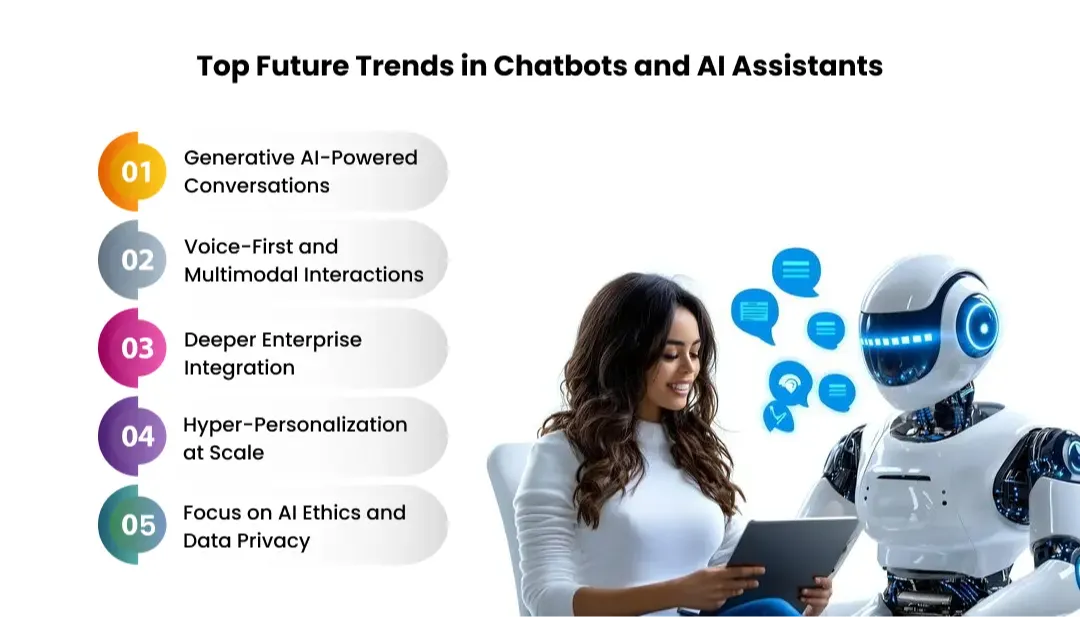
Chatbots are becoming smarter, while AI assistants are evolving into digital coworkers. The AI Development Company makes sure your product is future-ready and scalable.
Here are some of the key trends to look for.
1. Generative AI-Powered Conversations
In the future, users can expect to interact with chatbots or AI-based virtual assistants that communicate in a more realistic, human-like way through the use of context-aware conversational agents. This approach will result in improved engagement and accuracy of responses.
2. Voice-First and Multimodal Interactions
The next generation of virtual assistants will allow users to interact using voice, text, and visual media; therefore, allowing for a seamless exchange of information via smart consumer electronics, smartphones, and business solutions such as ERP and HR systems.
3. Deeper Enterprise Integration
More integrated with the organization's Customer Relationship Management (CRM), Enterprise Resource Planning (ERP), Human Resource (HR), and Analytics systems, AI-based virtual assistants will also help automate end-to-end business processes.
4. Hyper-Personalization at Scale
Machine Learning Advances (ML) will enable AI-based virtual assistants & Chatbots to provide user-customized and personalized content in near-real-time based upon user behaviour patterns, intent, and previous interactions.
5. Focus on AI Ethics and Data Privacy
Organizations that utilize AI solutions for chatbots or virtual assistants will be focused on building secure, transparent, and compliant solutions to mitigate exposure to risk from data privacy violations and reinforce accountability by reducing inherent biases in AI technology.
As conversational AI for business continues to mature, the line between chatbots and AI assistants may blur, but their core differences will remain relevant.
How to Choose the Right Development Partner?
Selecting the right partner is just as important as choosing between chatbots vs AI assistants. An experienced chatbot development company can help you define requirements, choose the right technology stack, and ensure scalable deployment.
1. Proven Experience in AI Solutions
Selecting a partner with a hands-on background in the creation of chatbots and AIs for various businesses will ensure that they have experience with real-world difficulties and how to implement scalable AI solutions.
2. Customization and Scalability Expertise
The ideal partner for your business should be able to deliver custom solutions based on your unique business objectives and will continue to support you with future scaling, integration, and updates for your evolving automation requirements.
3. Strong Technology Stack and Security Practices
Make sure your partner has implemented today’s most current AI frameworks and Natural Language Processing (NLP) models, and follows stringent guidelines regarding data security and compliance in order to produce safe, trustworthy, scalable, and future-proof solutions.
4. Post-Development Support and Maintenance
A dependable partner creates ongoing assistance, performance tuning, version updates, and education so that your chatbot or AI assistant will generate value for you throughout the life of your product.
Other considerations are:-
-
Industry-specific domain knowledge
-
Transparent pricing and development timelines
-
Agile development and testing approach
-
Integration with existing business systems
-
Clear communication and project reporting
-
Proven client reviews and case studies
You may also want to explore industry-specific solutions, such as Build A Smart Healthcare AI Chatbot.
CONCLUSION
Deciding whether to use chatbots vs AI assistants should not be a matter of determining which technology to choose. It is to evaluate both options based on the needs of each company. Chatbots work well for simple questions or tasks. AI assistants will provide a more insightful, flexible, and customized interaction for users.
To evaluate each technology more thoroughly, companies should first identify their own unique needs and how they plan on growing in the future. Once they have done this, making an informed choice between chatbot vs AI assistant for business will benefit them greatly through improved customer satisfaction, efficiency of operations, and ultimately maintaining a competitive advantage as we continue moving into an increasingly automated marketplace. The AI Chatbot Development Cost depends on various factors, and you have to choose your development process along with the requirements and the budget.