Top Generative AI Trends
Not too long ago Sam Altman said generative AI will be “the most influential technology in the history of humankind.” Looking at that prediction now, many people will agree it’s no longer simply a statement of ambition but rather an accurate statement.
Generative artificial intelligence has transitioned away from the experimental towards being essential to how businesses operate in the Generative AI trends. It moves past creating content to enabling cognitive augmentation, machine autonomous decision-making, and hyper-personalized digital experience delivery.
There are also many exciting contradictions that have come along with this new evolution, like efficiency vs. ethics, automation vs. authenticity, and speed vs. strategy.
In 2026, the generative AI environment will be layered, nuanced, and ultimately transformational, moving from multimodal intelligence to enterprise-level AI governance.
This guide details key trends that will affect the future of generative AI in 2026—without the clutter, thus providing you with more insight so that readers not only understand what is happening but also have an idea of how it will impact society.
Understanding Generative AI
What if I ask what the actual meaning of generative AI is? Well, I will explain to you in the simplest form. This is a kind of system that refers to large language models to help users to generate images, audio, text, video, code, and even presentations through foundation models.
The best thing about this system is it doesn’t work like traditional ones; the generative AI can create new content instead of predicting outcomes as well.
Huge datasets are used for training these large language models. That’s why AI can generate creative responses to user prompts in Top Gen AI trends. At this point, prompt engineering is critical; if the prompt is high-quality, then output quality will also be better.
By properly using prompt engineering, organizations can get more value from generative AIs, particularly when using these tools within an enterprise setting.
Market Overview: Generative AI in 2026
As per the report of Grand View Research, the global generative AI market size was estimated at $22.21 billion in 2025 and is projected to reach $324.68 billion by 2033 with a CAGR of 40.8% from 2026 to 2033.
Key Market Trends & Insights:
- In 2025, North America dominated the global generative AI market, accounting for 40.8% of the revenue.
- In 2025, the generative AI market in the United States led North America and had the highest revenue share.
- By component, software led the market, accounting for 64.1% of total revenue in 2025.
- Transformers dominated the market in terms of technology, accounting for 40.9% of total revenue in 2025.
- The BFSI segment is expected to grow at the fastest CAGR of 43.2% between 2026 and 2033.
Top Generative AI Trends in 2026
In the initial time, generative AI is introduced as a tool that is used for generating text, images, or autocomplete codes. Generative AI is now a whole system that can do many operations like reason, plan, and act.
Early adopters are mainly focused on experimentation that can integrate with quick productivity gains in Generative AI Apps. Today, the emphasis is on dependability, integration, and making a genuine difference in the world.
In 2026, generative AI trends will clearly reflect this maturity. And the discussion is no longer about what AI can create, but about how it fits into workflows, aids decision-making, and collaborates with humans.
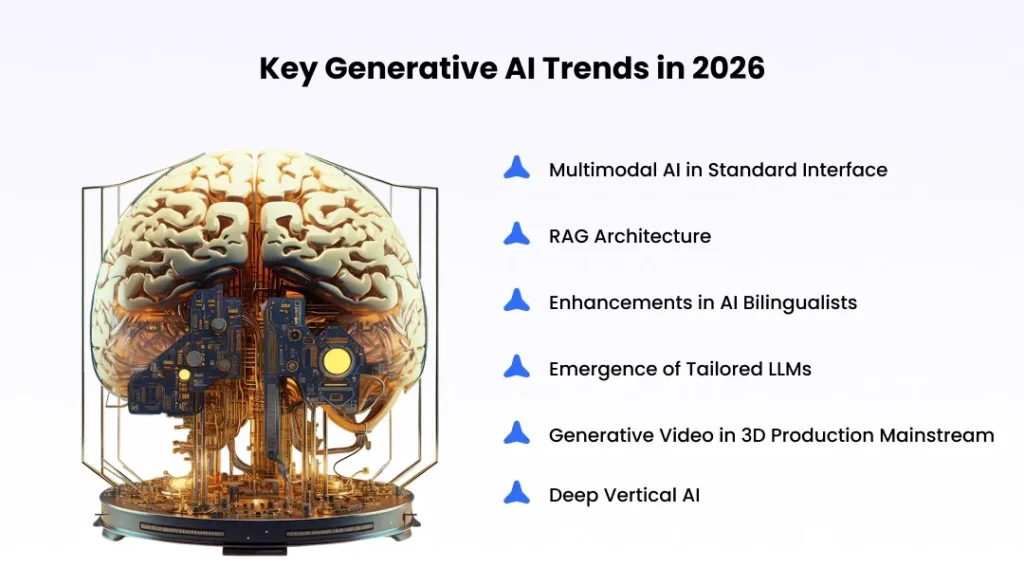
Multimodal AI in Standard Interface
The multimodal AI is quickly becoming the default way that people can interact with intelligent systems. Instead of working with text, AI can now understand and respond to text, audio, video, images, and even gestures simultaneously in Generative AI market trends. This reflects how humans naturally communicate, making AI interactions feel more intuitive and less rigid.
RAG Architecture
Retrieval-Augmented Generation (RAG) is no longer looked at as an option. It is becoming a must-have for any AI system.
At a normal level, RAG aids AI in looking things up before it answers. Instead of depending only on months or years ago during training, AI pulls fresh data for collecting information from real sources, documents, databases, or company systems.
Consider it less like a chatbot guessing an answer and more like a smart assistant who checks the facts first.
Enhancements in AI Bilingualists
In 2026, one of the top generative AI trends will be the emergence of AI bilinguals: individuals who can function effectively in both the language of humans and the logic of AI. These individuals not only know how to utilize AI tools but also understand how to think through them.
An AI bilingualist is able to analyze a business goal and break it down into specific prompt, constraint, and workflow parameters and then re-analyze the output from the AI system back to practical, actionable business decisions in Adaptive AI and Generative AI. Think of these individuals as the link between human objectives and technology being executed by machines.
Emergence of Tailored LLMs
In 2026, one of the major generative AI trends is moving from general-purpose LLMs to domain-specific LLMs. While the general-purpose LLMs can perform many functions, in critical fields such as healthcare, banking/finance, legal services, and engineering, the term “good enough” does not apply.
As an example of domain-specific LLMs: a domain-specific LLM can be trained or fine-tuned using either specialized datasets, including industry terminology in the business transformation, regulations, and workflows associated with the business; or proprietary domain-specific datasets that are available to practitioners and will therefore understand context as a human practitioner would.
Generative Video in 3D Production Mainstream
Generating AI is no longer restricted to crafting text or images; it now produces videos, animations, and 3D content at scale. This is changing industries such as entertainment, advertising, gaming, and education.
Deep Vertical AI
As foundation models become mainstream, the general-purpose bubble is bursting. And in 2025 general-purpose models were valued as if a single model could solve every problem. But in 2026, we see the market moving to prioritize companies with deep vertical-specific applications.
Deep vertical companies take entire industries (e.g., legal discovery, medical development, or supply chain management) and have built purpose-built AI on top of those industries, taking into consideration the unique constraints and vocabulary of those industries.
Industry-Wise Applications of Generative AI
Generative AI is having a significant impact across industries, allowing you to solve problems and achieve goals faster. The following are major industries in which generative AI is making a significant impact.
Healthcare Industry
Generative AI is changing the healthcare world in different ways. Whether you are working in a clinic, hospital, or healthcare facility. Generative AI can help to improve patient care, simplify the tasks, and speed up medical research in generative AI in healthcare. With AI technologies, you can raise the quality of care you offer by making the operations seamless as well.
Retail and E-commerce
Artificial Intelligence (AI) is probably already influencing your retail or eCommerce business. AI can help improve the customer experience, provide customers with individually tailored services, and streamline the inventory process. No matter if you operate a brick-and-mortar or online store, AI can improve your business processes and increase sales.
Logistics & Transportation
The transportation and logistics sectors will be increasingly reliant on artificial intelligence to maximize efficiency (cost savings) and on-time delivery of merchandise. AI will change the way products are transported around the world with technologies in AI innovation trends such as autonomous vehicles, route optimization, and other applications.
Education
AI is changing how students and educators get educated in the education business, and it’s helping to create many new ways for students to learn from AI industry trends. Through AI, you have the ability to give students a customized learning experience, make your administrative tasks easier by using it, and interact with your students through fun, new ways.
Manufacturing
Artificial intelligence is having a large impact on the manufacturing industry. Through activities such as predictive maintenance and employing intelligent manufacturing systems, artificial intelligence allows manufacturers to operate more efficiently, decrease downtime, and enhance their supply chain processes in AI in business transformation. As a manufacturer, you can leverage artificial intelligence to increase efficiencies throughout your operations and create new products or services.
Energy Sector
AI has emerged as a powerful companion in the world of energy. Whether you are working with renewable energy sources such as solar or wind, or managing the flow of electricity on your power grid, artificial intelligence (AI) supports you in every aspect of your operations, from increasing efficiency and productivity to reducing waste and consumption.
In addition to helping you make faster and more effective decisions every day by providing valuable insights into how energy is generated and utilized in Enterprise generative AI solutions, AI can enhance the overall experience of being in this growing industry.
Challenges and Risks of Generative AI Adoption
The development of generative AI technology has progressed from its initial testing phase to full operational use in various sectors, thanks to the best generative AI tools. Organizations that implement their strategic plans through early action will achieve better operational efficiency and innovative development and maintain their market advantage.
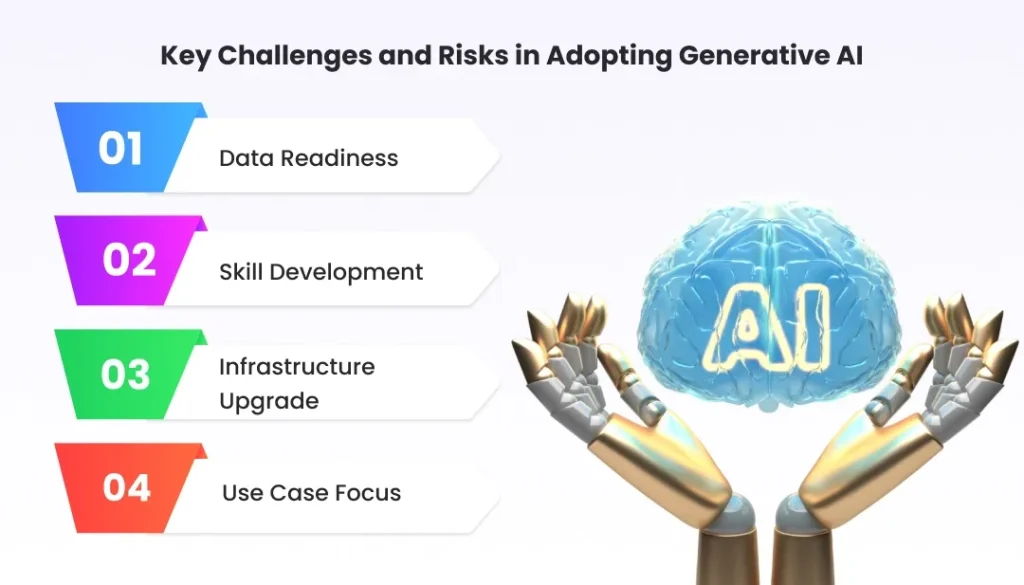
Data Readiness
The team must assess audit data quality and security and accessibility requirements to create governance frameworks that permit ethical AI operations and scalable pipeline development and ongoing system evaluation and dependable model accuracy throughout all organizational operations.
Skill Development
The organization will enhance employee capabilities through organized training programs and AI literacy initiatives and cross-departmental teamwork in Generative AI tools for enterprises, which will enable them to use generative technologies to create automated processes and develop new ideas and achieve business objectives through AI-generated results.
Infrastructure Upgrade
The organization must upgrade its cloud systems and architectural framework to enable model training operations and deployment processes and system integration requirements and scaling activities while maintaining operational flexibility and performance efficiency and cost-effective operations and future resistance to upcoming generative AI demands.
Use Case Focus
The team will determine effective use cases to execute controlled pilot tests and monitor return on investment while they develop solutions through human supervision, which will establish transparent operations and build trust and produce measurable business value and enable organizations to implement AI technology for the long term.
The Future Outlook: What Comes After 2026 in Generative AI?
The period after 2026 will see generative AI transition from providing support to becoming essential digital intelligence systems between Conversational AI Vs Generative AI. Its adoption will create new ways for people and machines and organizations to work together through
From Tools to Autonomous Collaborators
The development of generative AI will progress from its current role as a reactive tool toward becoming an active partner, which will execute task planning and system management while producing context-specific results that can interact with various business sectors and product lines and decision-making platforms throughout worldwide corporate operations.
Advanced Reasoning and Cognitive Depth
The models developed after 2026 will possess advanced capabilities because they can process complex reasoning tasks and track causal relationships while maintaining extensive memory storage, which enables them to tackle multi-step challenges across regulated business operations in various international locations.
Edge-Native and On-Device Intelligence
The future of generative AI will see its operations shift toward on-device and edge execution, which will result in lower latency times and enhanced security for user data and decreased operational expenses to examine the Cost to develop a Generative AI App while delivering intelligent solutions that work in low-connectivity and offline situations for worldwide customers and businesses.
Built-In Governance and Ethical AI
The AI systems of the future will establish governance structures that define ethical norms and compliance standards, which will allow organizations to create explainable systems in the Future of generative AI that can be audited while handling bias reduction through automation. model deployment to meet regulatory requirements and societal demands across multiple markets.
Deep Industry Specialization
The development of generative systems after 2026 will focus on constructing specialized systems that will use company-specific data to create precise healthcare and finance and manufacturing and education in Generative AI growth statistics and other controlled sector outputs that provide measurable return on investment and trust and scalability and assurance, with support from a Generative AI development company.
Final Thoughts
These generative AI trends, which are to shape 2026, are not merely technological changes but shifts in work. The real change in human-machine collaboration is happening through AI copilots and agentic systems, generative video, ethical governance.
The disappearance of jobs is a simple misconception. Designers are AI directors nowadays. Developers are AI orchestrators in the AI Development Company . Marketers become strategic storytellers powered by the latest intelligent tools.
As 2026 heralds a change: generative AI is no longer a novelty concept but an expectation, and the people who learn to collaborate with it in a thoughtful, strategic, and responsible way will not only survive but influence the direction of the industries they work in.