“I need to transport 20 tons of Iron from Bangalore to Delhi by Friday.”
“Okay, let me call my ‘reliable’ guy.”
Three hours of phone tag, two broken promises, and one ‘lost’ truck later… “Still waiting on that quote, boss.”
Sound familiar? This is the chaos that conventional logistics lives in every day. It’s messy, manual, and expensive. Then you look at BlackBuck, and suddenly the chaos seems like a well-oiled machine: one tap, one truck, complete transparency.
Naturally, every entrepreneur in the freight space is now asking:
“Can I build a logistics app like BlackBuck to fix this inefficiency?”
Yes. However, this is where most people hit a roadblock:”
“How Much Does It Cost to Build a Logistics App Like BlackBuck?”
Here’s why building a powerful logistics platform is more than creating a “booking app.” It’s a full-scale business transformation. You’re working with real-time GPS tracking, fleet utilisation algorithms and digital payment mechanisms that can’t afford to fail. There is no such thing as a blanket or universal price tag in this instance, because your cost depends on what it is you’re trying to build — are you creating a basic bridge or digital highway?
In this guide, we’re going to strip away the technical jargon, just plain & simple, down-to-earth logic behind BlackBuck, like logistics app development cost. From the “must-have” features to the tech hidden in plain sight that keeps everything moving, we’ll help you budget transparently and realistically.
The logistics world has gone digital. The question is: Are you ready to lead the fleet?
Let’s dive in.
What Is BlackBuck?
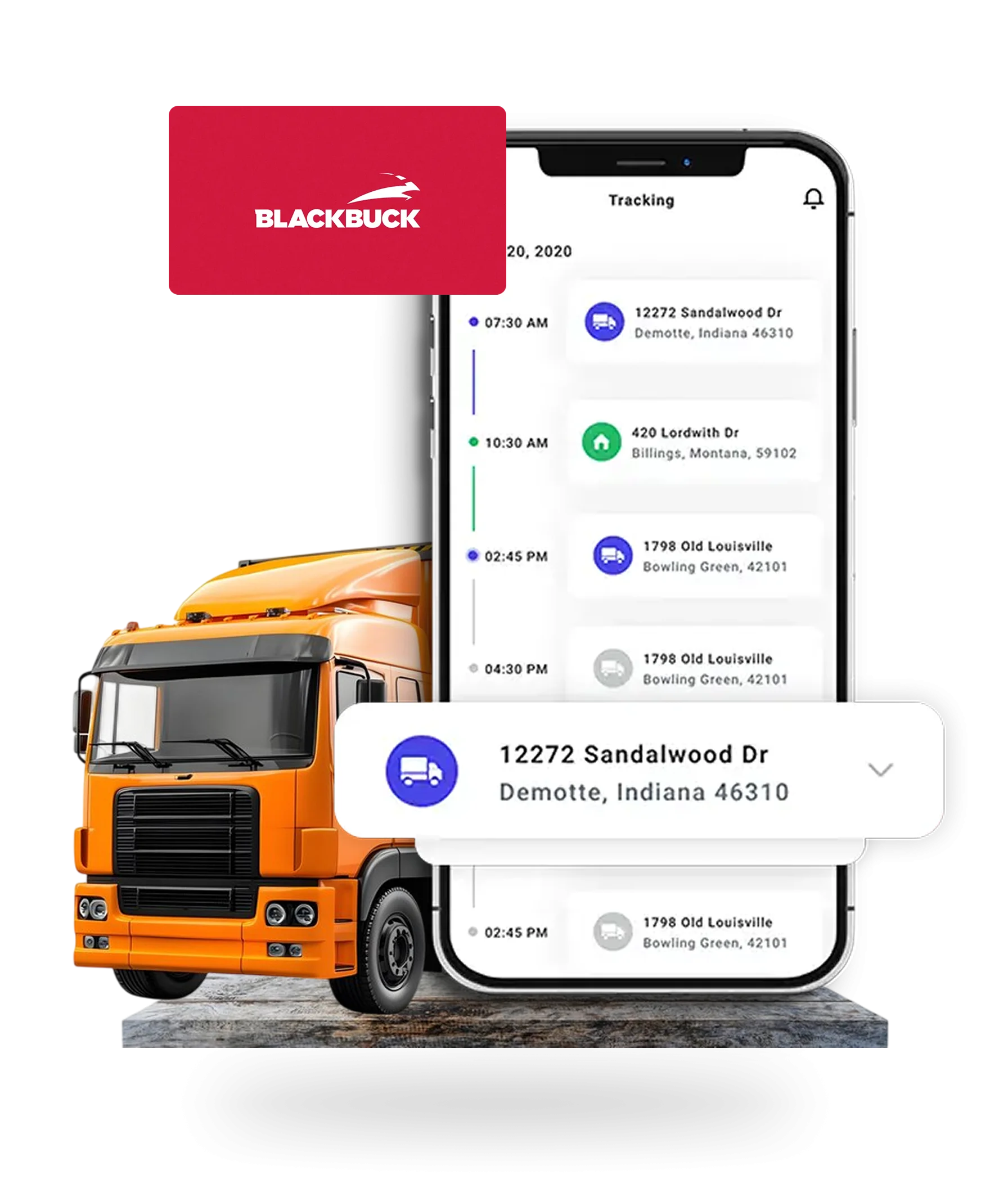
BlackBuck is among the most well-known online freight markets in India. It operates as a truck aggregator app like BlackBuck, which links shippers with truck operators and transporters via a technology-driven platform.
Unlike a basic booking application, BlackBuck is a logistics ecosystem which provides load discovery, fleet management, GPS tracking, digital documentation, and payment settlements. A BlackBuck Similar app commonly has several stakeholders at once — shippers, fleet owners, drivers, and administrators who work within the unified system.
The key takeaway: building such a platform entails developing infrastructure, processes, and algorithms, and not simple screens.
Why Businesses Want to Build Apps Like BlackBuck?
Traditional logistics processes tend to be inefficient in nature — ineffective use of assets, delayed communication, fragmented tracking, and friction in payments. Digital freight platforms address these structural challenges through automation of load matching, enhanced visibility and real-time visibility.
Businesses aiming to build freight marketplace app like BlackBuck tend to be targeting:
- Better fleet productivity
- Faster booking cycles
- Transparent pricing
- Live shipment tracking
- Digitized payments
In other words, logistics digitisation will be a growth driver instead of a convenience option.
Core Features of a Logistics App Like BlackBuck
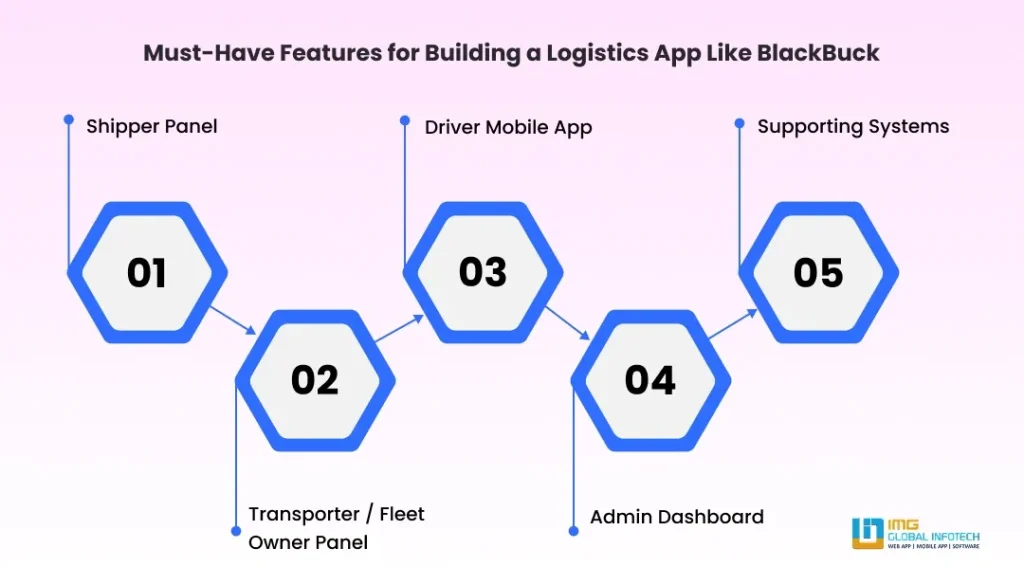
The largest role in determining the cost to develop BlackBuck like app is feature selection. A multi-user ecosystem like a freight marketplace has to be a seamless feature of connecting shippers, transporters, and drivers and has to be operational and financially safe.
- Shipper Panel
The shipper interface gives the capability of posting loads, rate discovery, booking confirmation, tracking shipment and document management. Live tracking of delivery and monitoring is important for transparency and customer confidence.
- Transporter / Fleet Owner Panel
The module offers tools for expense tracking, load matching, trip management, fleet allocation, and earnings monitoring. It assists logistics operators to optimise their vehicles in terms of profitability and utilisation.
- Driver Mobile App
The driver application is the execution layer, which enables trip notifications, navigation, live status updates, and uploading proof of delivery. The most important here is simplicity and optimisation of performance.
- Admin Dashboard
The administrators control users, commissions, pricing policies, disputes, and analytics in a centralised dashboard that guarantees the stability of the marketplace.
- Supporting Systems
GPS tracking, secure online payments, push notifications, and analytics are the main components of core integrations. A combination of these characteristics constitutes an efficient, automated, and real-time logistics intelligence, scalable truck aggregator app like BlackBuck.
Technology Stack Required to Build a Logistics App
Technology decisions have a direct effect on performance, maintenance and BlackBuck clone app development cost.
Most modern logistics platforms are grounded on cross-platform mobile frameworks like Flutter or React Native because they are cost-effective. Node.js, Python or Java are common Backend development languages depending on the scale requirement. The data on structured logistics are stored in databases such as PostgreSQL or MySQL, and dynamic ones may be handled in MongoDB.
Cloud infrastructure offers auto-scaling, security of data, and high availability (AWS, Google Cloud or Azure). The GPS tracking is based on mapping applications like Google Maps or Mapbox.
Razorpay, Stripe, or PayU are combined into payment workflows of payment. There are security layers that guarantee encryption, authentication, and fraud detection.
A logistics marketplace should be designed to be stable within the data flow, especially when tracking vehicles in real time.
The Cost Breakdown: What Are You Paying For?
Now, when you seek the answer to “What is the cost to build a logistics app like BlackBuck?”, what you’re really asking is: “How much value am I building into my system? In logistics, you don’t just buy ‘screens.” You’re purchasing the series of connections between a warehouse in Mumbai and a truck driver in Punjab. To get that done, your investment typically goes into three big buckets:
- The Foundations (Basic): Your “Starter Fleet.” Features a clean shipper UI, driver app with GPS and an admin dashboard to see who’s moving what.
Goal: Travel from point A to point B without crashing.
- The Smooth Operator (Medium): Adds more intelligent route mapping, digital paperwork (e-invoicing), and integrated payment wallets.
Goal: Automate the busy work.
- The Industry Leader (Advanced): The final full-throttle edition — fueled by AI load-matching, IoT for temp tracking and predictive analytics.
Goal: Market dominance.
Total Estimated BlackBuck App Development Cost
So what’s the damage to the bank account? Because you’re not simply building a single app but rather an entire ecosystem that connects shippers, drivers and admins, the cost is affected by how “smart” you want that ecosystem to be.
According to contemporary market standards for building a republic logistics infrastructure, this is the investment breakdown:
The Basic App: $8,000 – $10,000
The “Minimum Viable Product” (MVP). Even load posting, basic tracking and a payment gateway.
- Best for: To quickly validate your concept.
The Medium App: $10,000 – $15,000
A more efficient manager. Added Improved Tracking, Dashboards For Fleet Owners, and better analytics.
- Best for: Regional expansion, local market leadership.
The Advanced Feature App: $15,000+
A high-performance powerhouse. This includes all our AI matching, predictive algorithms, and deep fintech integrations.
- Best for: National-scale operations and total reliability.
The Bottom Line: You don’t have to go big on Day 1. Most successful platforms start with a Basic App and use their initial revenue to fund Advanced upgrades.
Factors That Affect Logistics App Development Cost
Numerous strategic and technical variables affect the cost to build a logistics app like BlackBuck. The most important of them is the feature complexity. The investment needed to create a simple MVP based on load booking and tracking is not as high as a comprehensive freight marketplace with analytics, automation, and fintech features.
Budgeting is also affected by Platform choice. Cross-platform frameworks reduce initial expenses, whereas native systems save more in performance at an extra expense. Real-time GPS tracking adds load issues of back-end, data streaming and optimisation issues which increase the cost of infrastructure.
Third-party integrations — payment gateways, ERP systems, telematics, and compliance tools increase the amount of effort in development. Scalability requirements also have an impact on cost, particularly in the design of high-traffic and shipment-concurrent designs.
Finally, security architecture and skills of the selected Logistics app development company are essential factors in creating the total investment in the project and sustainability.
Cost Optimisation Strategies
Optimising the cost to build a logistics app like BlackBuck needs a strategic balance between the quality of products and budget efficiency. Instead of reducing the expenses in a random manner, emphasis should be placed on investing in areas that bring the greatest impact on the operational level.
The viable strategy is to start with an MVP (Minimum Viable Product). With its initial features, which include load posting, booking workflows, GPS tracking, and payment, logistics software development companies can prove the demand in the market and then expand to advanced modules.
The implementation of cross-platform development frameworks such as Flutter or React Native is much less time-intensive and maintenance-intensive than individual native applications. Similarly, there is the ability to avoid wastage of server cost in the initial growth over time by cloud infrastructure with auto-scaling capabilities.
Prioritisation of features is also very important. A focus on high-value functionalities rather than overbuilding fast-tracks time-to-market and ROI. Also, the collaboration with an experienced Logistics app development company guarantees the planning of the architecture, which will not require any costly rework.
Finally, cost optimisation is regarding the construction of intelligent, scalable, and future-proof logistics.
Monetization Model of Apps Like BlackBuck
The product design is affected by the revenue strategy.
The majority of freight marketplace applications are based on commission-based earnings per completed load. Fleet owners who want high-quality dashboards and analytics are frequently offered subscription plans. Other income streams can be transaction fees, insurance, fuel deals, and the expansion of logistics ecosystem like warehousing or final mile delivery.
A well-designed monetisation model makes it possible to survive not only at the very beginning.
Why Choose IMG Global Infotech for Logistics App Development?
The selection of the appropriate technology partner is to be prioritised as much as the budget.
IMG Global Infotech is a reputable Logistics app development company that focuses on the creation of scalable logistics, freight markets and fleet management solutions. Their experience is in cross-platform application development, GPS tracking systems, payment security systems, and smart automation.
Whether your goal is to build a logistics app like BlackBuck, you want to develop a BlackBuck Similar app, or want to explore other adjacent solutions like a Courier delivery app development or Build porter like app, IMG Global Infotech provides end-to-end product engineering.
They develop in a systematic way, which ensures predictable schedules, clear costs and associated scaling.
Conclusion
So, let’s wrap this up.
As we’ve seen, it comes down to your scope, complexity and scale. You can’t “Buy Now” a digital freight empire, but here’s the quick recap of what you’re going to see:
- A Basic App ($8,000 – $10,000): Great for spinning the wheels on the road with core booking and tracking.
- A Medium App ($10,000 – $15,000): The sweet spot for growing businesses that require improved analytics and smarter fleet management.
- An Advanced Feature App ($15,000+): The “Full-Throttle” model for market-leaders equipped with AI + deep-automation
Ultimately, that investment is not only about a piece of software—it’s about the practical benefits that keep your business moving:
- Better fleet utilisation (No empty runs)
- Minimised inefficiencies (i.e. Less paperwork = More profit)
- Quicker payments (Happy drivers, healthy cash flow)
- Increased visibility (Trust your customers in real-time)
Digital logistics platforms are no longer a “cool option”; they’re the backbone of modern freight operations. In 2026, the only way to be competitive will be to be digital.