The best way to predict the future is to create it. Peter Drucker. And 2026 will be the year of those founders who not only move fast but also think fast.
Do you remember the last time you waited 3 days for a plumber? Annoying, right? That pain is where you have your chance.
The home service sector is becoming more than just a place where you fix a leaking faucet; it is a gigantic $1.2 trillion ecosystem that is ripe for disruption in the home services marketplace. And multivendor marketplaces are at the forefront of that disruption with a faster pace than ever.
However, here is the truth: coming up with one is far from just releasing an application. It requires a profound knowledge of scalable architecture, behavioral economics, and user trust dynamics.
Be it that you’re drawing your first wireframe or you’re already dealing with the intricacies of vendor onboarding and monetization, consider this manual as your guiding light. From MVP to scale, it’s about creating something the market really desires.
How a Multi-Vendor Home Service App Works?
The operations of a multi-vendor eCommerce marketplace come into action when a user browses the products that they want in the Marketplace app development. A multivendor marketplace features the results of the products from various sellers, and the buyer selects the product that they want and places an order.
The order that has been made is sent to the seller of the product for the fulfillment of the order and the provision of the shipping. The vendors and customers can keep track of the order and get notified once the order is delivered.
The roles of a vendor and a user are different. The marketplace offers a platform where vendors are allowed to set up their stores and interact with customers.
Types of Multi-Vendor Home Service Marketplaces
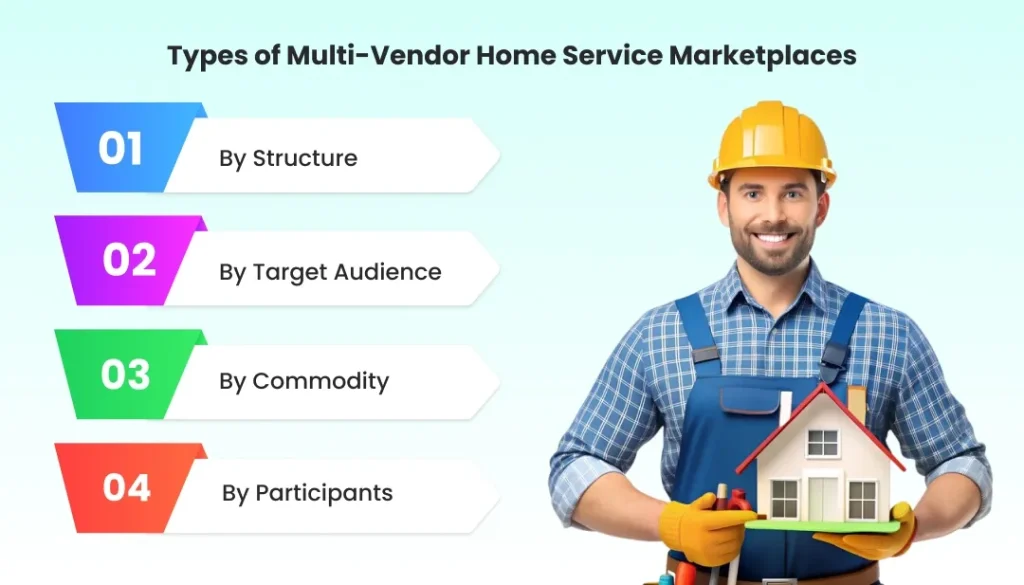
E-commerce marketplaces always follow one pattern that is all about buying and selling products and services from the resellers and merchants. Here we have listed some of the most popular types of online marketplaces that can offer reliable services in the business as well.
By Structure
It can include marketplaces to build market networks. In the product marketplace, the major focus of the customer is perfectly to find a good or service in the online home services marketplace. In this case the market network is especially focused on creating a well-known profile to build a suitable network for the business as well.
By Target Audience
Your audience can be B2B, B2C, or C2C, so it totally depends on the target audience that you are serving. First of all, identify clearly your audience and make a wise choice before you get started on a custom mobile app development project.
By Commodity
It is made up of products, services, and staff. The initial thought that pops into one’s head is the classification of the marketplace apps. These are the products customers can buy via these platforms in the On-demand app development services: Physical products such as clothing, electronics, books, home appliances, etc. Services: house cleaning, tutoring, renting, and more. Staffing: Hiring different positions while filling up.
By Participants
It can be two-sided and multi-sided. In the case of Uber, booking a cab is an example of a two-sided marketplace, whereas ordering food on Swiggy, where you have a choice of a variety of restaurants, is a multi-vendor marketplace.
Must-Have Features of a Multi-Vendor Home Service App
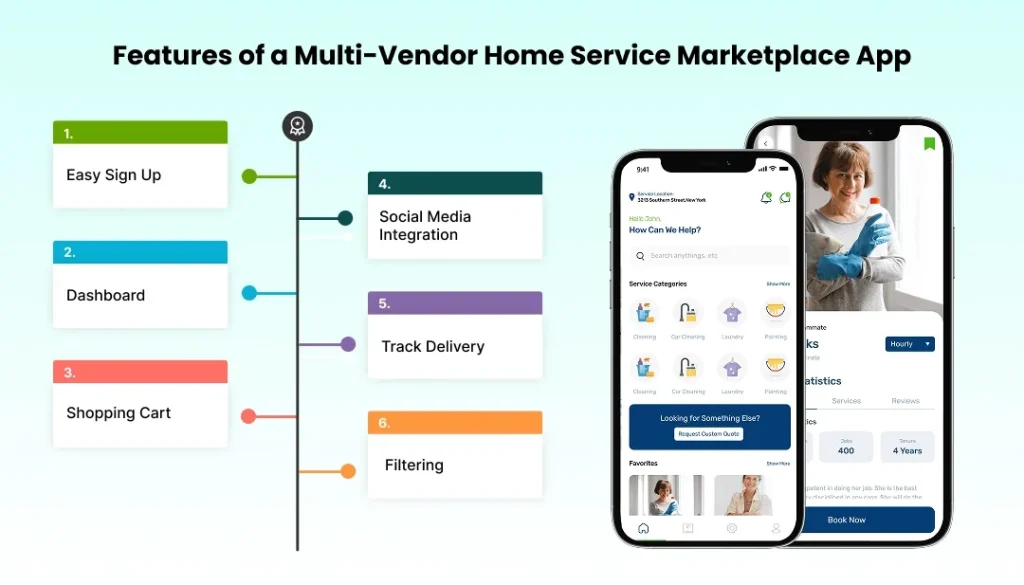
Here is a list of major Home service app features to include in a multi-vendor home service app as well:
Easy Sign Up
The registration process should be simple, as it is the primary cause of an increase in app uninstallations in the Multivendor marketplace home services. The application requires only the name and email address to be entered. Additionally, the user should be able to sign in using social media credentials.
Dashboard
This dashboard works as a home screen for the sellers who want to stay updated with new orders, data, reviews, new orders, and conversations as well.
Shopping Cart
It is an important feature of the marketplace app. This feature can help users to add products to their carts seamlessly, where they can check the total sum upon purchasing products in the online home services marketplace in india. Users can also apply coupons to check the discounted price in the total of the product as well.
Social Media Integration
It is also a most important factor that helps to retain customers in the business in Urban company clone app development. It mainly depends on the promotion of your brand’s product and service on social media platforms that can allow users to share their reviews and feedback as well.
Track Delivery
It is also an important feature for a multi-vendor marketplace app. Users can track their goods, ensuring that they are delivered via a reliable service. Once the buyer has received the item, they should be able to provide valuable feedback.
Filtering
Categories bring life to your application. It makes it easier for users to find and buy specific items based on their needs. Make sure the categories you add are logical and reflect what your marketplace is about.
Steps to Build Home Service Marketplace Platform
Creating a multivendor marketplace is not merely about creating a digital platform; it is about figuring out a sustainable ecosystem that can satisfy the needs of every stakeholder involved. The process requires not only a strategic mind and technical brilliance but also being in line with the market. Here is a detailed list of the essential steps of multivendor marketplace development predominantly from a business perspective:
Market Research and Niche Identification
The starting point of any multivendor marketplace is the understanding of the market it is likely to target. This begins with market research to identify potential niches, understand customer requirements, and analyze the strengths and weaknesses of competitors.
Selecting the Technology Stack
Selecting the right technology stack is critical to ensure that your marketplace is scalable, secure, and flexible in the Home Service Marketplace platform development. At this juncture, the focus should be on finding solutions that can enable smooth interactions between buyers and sellers, fast loading times, and secure transactions.
Designing UI/UX
The user experience is the key to the success of any multivendor marketplace. Whether it is the buyer searching for products or the vendor managing his store, every interaction needs to be intuitive, seamless, and aesthetically pleasing in the Home Service Marketplace App development. This is because user experience has a direct impact on vendor engagement, conversion rates, and transactions.
Agile Development
Once the design is complete, it is time to begin development, which should be done using the agile development process. The marketplace should be developed in short sprints, beginning with the most important elements: the buyer interface (catalogs, filters, and checkout), the vendor interface (product uploads, order management, and performance analysis), and the admin interface (commission management, content management, and analytics).
Testing and Quality Assurance
Before launching the multivendor marketplace, it needs to be tested thoroughly for quality assurance in the Home service multivendor marketplace development. This includes functional testing to ensure that every feature works as expected, performance testing under simulated load conditions, and compatibility testing on various devices and browsers.
Launch & Optimize
The last step is the release; however, one shouldn’t look at it as a finish line; instead, it is the commencement of unremitting progress grounded on upcoming trends and user inputs.
Initially, execute a soft launch or beta version for a small number of users, gather their opinions, and carry out refinements in the multi vendor service app development. At the same time, implement a precisely planned go-to-market strategy that includes digital marketing, influencer outreach, vendor partnerships, and SEO.
Cost to Build a Multi-Vendor Home Service Marketplace App
The cost to build a multi-vendor home service marketplace app would be $5,000 to $15,000 or more. The major cost mainly depends on diverse factors and the level of the customization as well.
Monetization Models for Home Service Apps
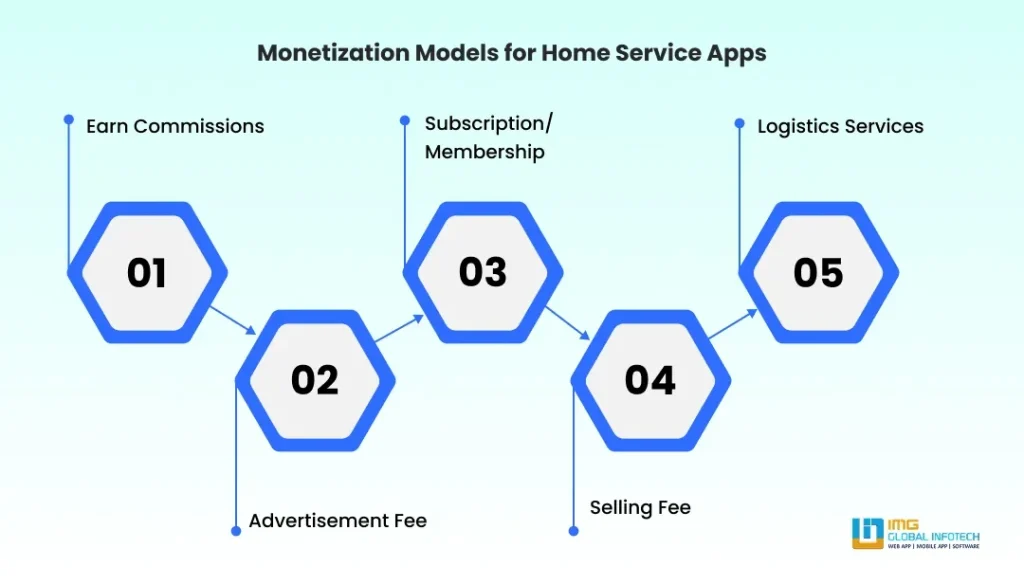
The term “monetization strategy” basically refers to how you intend to generate revenue from your multi-vendor eCommerce marketplace in the Home service app monetization models. You need to create your revenue/income strategy through revenue planning when you want to achieve your desired profit while maintaining your appeal to vendors.
Earn Commissions
The home service marketplace business model gives the marketplace owner a commission, which he receives after every successful transaction that occurs at each store within the multi-vendor marketplace. Your commission charges also have the tax element included in them.
Advertisement Fee
The mult-vendor eCommerce website development company gives manufacturers a platform to launch their advertising campaign functions. The marketplace advertising policy enables them to charge vendors for creating advertisements and product sponsorships and other related services.
Subscription/Membership
To encourage customers to buy a subscription or membership to gain some additional privileges like free shipping, express delivery, etc., the owner could memorize a membership fee.
Selling Fee
A multi-vendor marketplace requires vendors to pay charges based on their chosen selling plan, which includes monthly fees and charges that depend on their total number of products.
Logistics Services
The owner can generate fees for product delivery based on the shipment distance and product weight and product dimensions.
Why Choose IMG Global Infotech for Home Service Marketplace App Development
In today’s technologically advanced world, a strong home service marketplace app is a must for business expansion. At IMG Global Infotech, we provide state-of-the-art solutions as per your specific business requirements.
A home service marketplace app needs strong development to succeed in business growth during the current digital era. At IMG Global Infotech, we provide state-of-the-art solutions as per your specific business requirements.
Expert Development Team
Our team of highly experienced developers has expertise in developing strong, scalable home service marketplace applications that operate at full capacity to support businesses worldwide in meeting their digital solution needs.
Custom App Solutions
We create complete systems for app development that build your brand identity because we develop applications according to your specific brand identity needs and business goals.
User-Friendly Interface
Our designers and developers create interfaces that are visually appealing because of their seamless design and intuitive functionality, which helps users to investigate Home service app development cost while they book home services with ease and speed.
Advanced Technology Integration
Our team of experts uses the latest technologies, which include AI and real-time tracking and secure payment systems and smart notifications, to build a home service marketplace application that delivers high performance and future-ready capabilities.
Timely Delivery & Support
We deliver our projects on their scheduled dates while maintaining our quality standards because our support team provides dedicated maintenance services that continue after project completion to assess the cost to build an app like urban company of app to keep it running smoothly at all times.
Final Thoughts
Building a multivendor marketplace provides great opportunity for business to take advantage of the flourishing e-commerce industry by building a platform that connects multiple vendors into a single online marketplace, allowing for many different types of sellers, products, and services to interact in a mutually beneficial way.
While it is possible to create your own multivendor marketplace from scratch with a leading Home service app development company, you will likely have to decide which option works best for your budget and long-term plans when you are creating your platform.
The right technology partner is key to the success and longevity of your multivendor marketplace in the eCommerce industry, so a partnership with an experienced technology provider will help ensure your platform’s success as eCommerce continues to grow at a rapid pace.