Why are customers browsing but not buying?
Because your store treats everyone the same.
That awkward silence? That’s exactly where modern retail struggles today.
When customers enter your shop or app, they anticipate experiencing the same kind of fast shipping, tailored shopping experience, and 24/7 customer service you would find at Amazon or Netflix. Yet they frequently leave feeling disappointed due to a lack of personalization in their experience. Disappointing for customers means costly for retailers.
This is where AI in retail industry quietly steps in and flips the script.
So… AI just means robots and big budgets? Nope. It means smarter decisions, happier customers, and fewer guesses.
Retailers face a range of common problems, such as predicting customer needs ahead of them actually asking and also ensuring their shelves are stocked at the correct time. AI takes away the hassle of these everyday issues by taking unprocessed data and converting it into actionable, targeted results—automatically.
In this blog, we will break down how AI is currently being utilized in the retail industry, its importance, and what applications are yielding significant results. Let’s talk retail.
Why AI Is Transforming Modern Retail Operations?
Why is everyone suddenly talking about AI? Because customers expect Amazon-level experiences everywhere now.
Let us now see the reasons.
1. From Guesswork to Precision Decisions
Retailers use real-time data insights from AI to assist them with understanding customers’ needs, predicting future demands, and avoiding the classic “Why didn't we think of this?” moment.
2. Customers Want Mind-Reading Brands
Retailers leverage AI to develop personalized experiences for their consumers based upon their behavior, clicks, and preferences that generate goodwill toward the brand—without being creepy.
3. Always-On Stores, Even After Closing Time
AI-powered chatbots and assistants ensure that consumers can receive answers to their questions 24 hours a day, thereby allowing retailers to stop responding to customers’ inquiries at 12:00 am.
4. Faster Operations, Fewer Headaches
Retailers can use AI to automate their supply chain, pricing strategies, and replenishment, which helps reduce delays and errors and the amount of firefighting that retailers engage in every day.
5. Competing With Giants Without Giant Budgets
By providing small retailers with access to smart recommendations, dynamic pricing, and data-based decision-making tools, AI creates an even playing field between large and small retailers.
Retailers adopting Retail automation using AI see fewer stockouts, smarter promotions, faster support, and happier customers. In short, AI doesn’t replace retailers—it upgrades them.
What are the Top 5 Applications in the Retail Industry?
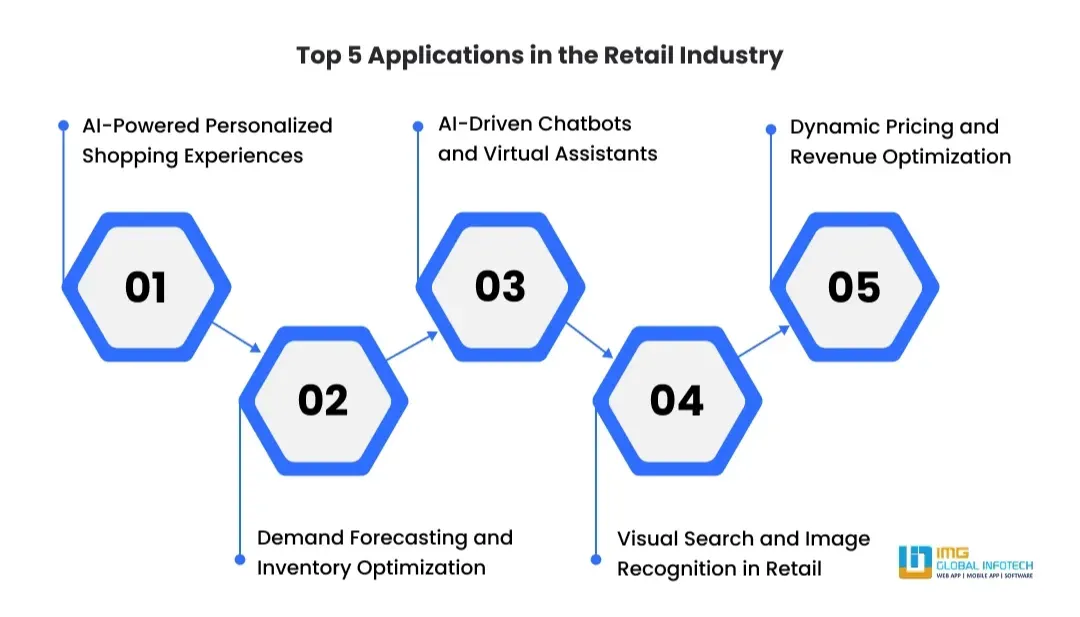
You do not have to compromise on the top AI apps. Let’s explore the top AI applications in the retail industry that are driving real business impact today.
1. AI-Powered Personalized Shopping Experiences
How does this app know exactly what we want? Because AI remembers what you love—even better than you do.
Personalization has become a necessity. Machine learning and artificial intelligence analyze your activity online, how you typically purchase things, where you are, how you've interacted with different brands, and what types of items you like.
Thanks to AI applications in retail being used throughout, retailers can create custom shopping experiences for their customers — from custom product recommendations to personalized discount offers to personalized emails. They provide an AI-driven customer experience that makes shoppers feel valued rather than sold to.
Retailers using AI in retail industry for personalization report higher conversions, longer session times, and stronger brand loyalty.
-
Key benefits: Higher conversions, repeat purchases, stronger loyalty
-
Common use cases: Product recommendations, personalized offers, smart emails
-
Where it shines: Turns casual browsers into “this brand gets me” customers
2. Demand Forecasting and Inventory Optimization
When a store manager asks, “Why do we always overstock winter jackets?” Then AI System be like- “Because last year’s data wasn’t smart enough.”
Inventory management issues cost retailers tens of billions of dollars each year. With AI use cases in retail, demand forecasting is no longer reactive. It becomes predictive. Products will be moved to where they are needed, at precisely the right time.
By leveraging AI technology in retail sector, businesses can minimize excess inventory, decrease the risk of stockouts, and optimize their supply chains. This is especially important in rapidly changing markets like the Retail Industry In The Middle East.
-
Key benefits: Fewer stockouts, reduced overstock, lower operational losses
-
Common use cases: Sales prediction, seasonal planning, smart restocking
-
Where it shines: Keeps shelves full without drowning warehouses
3. AI-Driven Chatbots and Virtual Assistants
When the customer asks - Is this product available in blue? And that’s where chatbots come into existence and help clear the customer’s query. If available, the chatbot will say - Yes, and it’ll be delivered by tomorrow.
AI in retail industry uses chatbots for answering customer questions regardless of time—order tracking, returning items, product recommendations, and FAQs. They learn through experience and improve.
These smart retail solutions reduce support costs while increasing customer satisfaction.
Through their partnership with the best AI Development Company, retailers are able to create multilingual, multi-channel assistants that seamlessly integrate across apps, web pages, and kiosks in stores.
-
Key benefits: 24/7 support, faster responses, reduced support costs
-
Common use cases: Order tracking, FAQs, product suggestions
-
Where it shines: Instant answers without putting customers on hold
4. Visual Search and Image Recognition in Retail
The process that enables customers to upload an image and instantly find a similar product is Visual Search. The use of image recognition as a part of Retail AI applications allows visual searches to identify the colours, patterns, styles, and even brand aesthetics of an object.
Visual Search, or Visual Recognition technology, is the perfect solution to help connect online shopping inspiration with those who wish to purchase, especially younger shoppers. It’s a prime example of how AI is used in retail to remove friction from discovery.
Using AI in retail industry, brands track compliant shelf monitoring, identify theft, and analyse in-store behaviour using computer vision technology.
-
Key benefits: Faster product discovery, improved engagement
-
Common use cases: Image-based search, shelf monitoring, loss prevention
-
Where it shines: Bridges inspiration to instant purchase
5. Dynamic Pricing and Revenue Optimization
Why did prices change overnight? Because demand went up, competition dropped and it’s time to optimize.
Retailers can profitably adjust their prices in real time based on demand, competition, stock levels, and customer behavior, through Dynamic pricing. Dynamic pricing is currently one of the most profitable AI use cases in retail.
Through the use of AI-powered retail solutions, retail businesses can enhance margins while not alienating customers. Retailers offer fair, timely, and contextual pricing to customers.
Establishing ethical pricing strategies that achieve a balance between profitability and confidence can be accomplished through working with an AI Software Development Company.
-
Key benefits: Higher margins, competitive pricing, better demand control
-
Common use cases: Real-time price changes, competitor tracking
-
Where it shines: Maximizes revenue without manual guesswork
What are the Key Benefits of AI Applications for Retail Businesses?
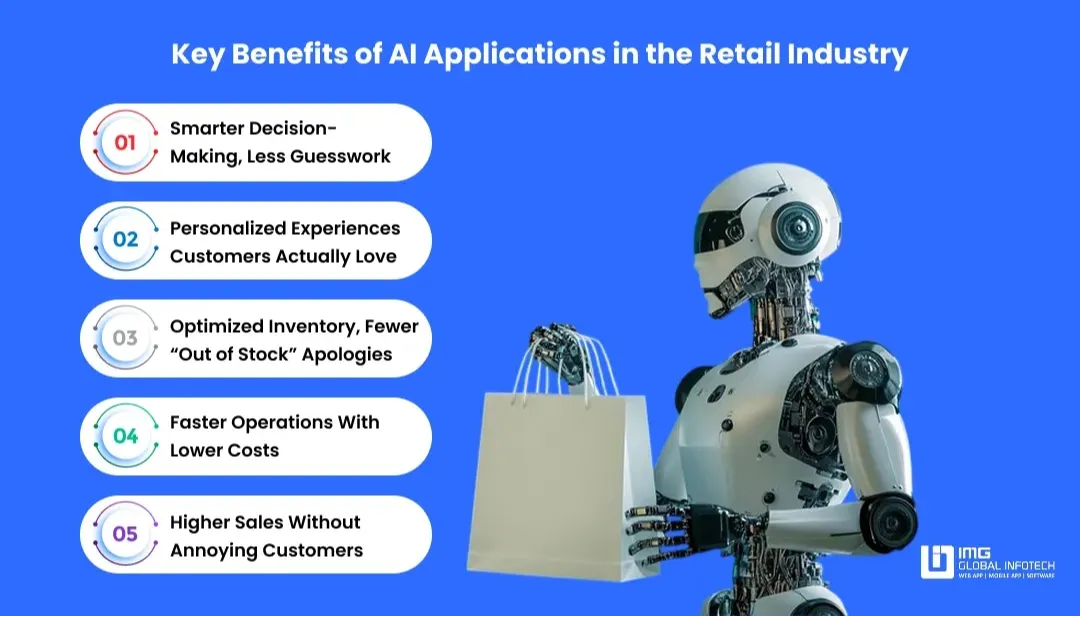
So what’s the real payoff? Let’s talk impact.
The benefits of AI in retail business include smarter decisions, faster operations, and deeply personalized customer journeys. AI eliminates guesswork and replaces it with data-backed confidence.
Retailers using Artificial Intelligence in retail industry gain:
1. Smarter Decision-Making, Less Guesswork
Retailers can analyze real-time data and trends through AI and use that information to make informed decisions based on data rather than relying solely on gut feelings or hoping for the best.
2. Personalized Experiences Customers Actually Love
AI provides personalized recommendations, offers, and content to every shopper by taking into account their preferences and shopping behavior, so they feel appreciated as an individual, rather than being directly marketed to.
3. Optimized Inventory, Fewer “Out of Stock” Apologies
AI predicts demand accurately so that retailers can ensure that they have the appropriate amount of inventory to meet customer demands without stockpiling products in warehouses.
4. Faster Operations With Lower Costs
AI-powered automation enables retailers to automate most processes associated with pricing, effective supply chain management, and customer service.
5. Higher Sales Without Annoying Customers
Retailers can use AI systems to increase their revenue through increased conversion rates by using smart recommendations and using dynamic pricing in a way that feels natural to the customer.
Is Implementing AI in Retail Challenging?
Of course, it’s not all smooth sailing.
Retailers often struggle with data quality, integration complexity, and change management. Implementing AI and Machine Learning in retail industry requires clean data pipelines, skilled talent, and clear goals.
The challenges are as follows:-
1. Messy Data, Messy Results
The successful implementation of AI requires having reliable information in a format that is conducive to the process of creating AI. But with most retailers having vast amounts of non-standardized, unreliable, and/or outdated data,
2. High Initial Investment Pressure
To effectively implement AI projects will require significant capital expenditures for the acquisition of new technology, talent, and infrastructure, which raises the question, ‘When will I see a return on my investment?’
3. Integration With Legacy Systems
Most of the older retail technologies were not designed for use in conjunction with modern AI tools, and therefore, the upgrades that should have been a simple task were, instead, required to be complex, laborious technology projects.
4. Management and Skill Gaps
Adoption of AI by employees may be difficult due to a lack of employee buy-in or a lack of employees who are technically skilled. Significant effort will likely be needed to train employees on the new technologies and to change the organisation's culture.
Choosing the right tech partner is crucial. A seasoned AI Software Development Company helps navigate these hurdles with scalable, future-ready solutions.
What are the Future Trends of AI in the Retail Industry?
What’s next for AI? Retail that predicts needs before customers speak. AI trends in retail have been there to see for everyone.
1. Predictive Shopping Before Customers Ask
With AI's capability to predict consumer habits and behaviors, retailers will be able to present consumers with products that they need at precisely the right time, leading to a unique and intuitive shopping experience.
2. Autonomous and Checkout-Free Stores
With the use of AI-enabled cameras and advanced sensor technology, customers will be able to enter the store, pick items off the shelf, and leave within seconds, without having to wait in line for a cashier.
3. Hyper-Personalized Omnichannel Experiences
AI is capable of consolidating online, mobile, and in-store customer data into one cohesive database, allowing for a seamless customer journey from the point of entry to checkout.
4. Emotion-Aware and Voice-Enabled Retail
Voice commerce will allow for customers to make purchases through conversations by way of advanced AI analysis of tonal inflection and facial expressions.
Expect deeper retail digital transformation, where AI becomes embedded into every touchpoint—from warehouses to checkout counters.
How to Choose the Right AI Solution for Your Retail Business?
Not every solution fits every retailer. Let’s see what to consider while choosing the right AI solution partner.
1. Start With Your Biggest Retail Headache
Evaluate your business for its major pain points; these could be inventory, pricing, or customer experience - so you're using AI to solve real problems versus just making a cool showcase.
2. Choose Scalability Over Short-Term Fixes
Find a scalable AI solution, one that will provide you with continued data, users, and channels for use without constantly having to upgrade your solution to keep up with your growing business.
3. Check Data Compatibility Early
Ensure that you have an integration with your other systems that will allow you to quickly and easily use the data from all of your systems, so you do not have to pay for expensive or time-consuming rework at a later time.
4. Prioritize Transparency and Control
Ensure the AI tool provides an easy way to explain decisions so you and your team can develop trust in the outcome rather than relying on vague science and unclear machine generated recommendations.
5. Work With the Right AI Partner
An experienced AI partner understands retail realities, customizes solutions, and supports long-term success beyond initial deployment and launch.
Working with a reliable Best AI Development Company ensures custom-built solutions rather than one-size-fits-all tools. Focus on scalability, security, and long-term ROI.
CONCLUSION
So, is AI really worth it? Only if you want to stay relevant.
The AI industry in retail is revolutionizing the way businesses operate and how customers purchase goods, ranging from personalization to pricing, automation to analytics. Retailers can operate faster, smarter, and more customer-centric through the use of artificial intelligence.
The brands that succeed today are not simply making assumptions. They are collecting data and using it for real-time analysis to improve their business practices. This ability to learn, anticipate, and adapt using AI technology is what really makes the industry stand out.
If the retail industry revolves around providing a better experience for its customers, then AI is the force propelling this industry when it comes to providing better service during consumer purchases.