Online Education has experienced tremendous growth over the last few years. There is an increasing trend for students to participate in Q&A learning through the use of mobile devices. Apps such as Brainly demonstrate that students prefer to find and receive help from their peers on their phones as opposed to having to wait for a tutor. One of your first concerns as an entrepreneur, startup founder, or owner of an educational company is probably the expense of developing an EdTech app. Before entering this cutthroat industry, you can make an informed choice by being aware of the characteristics involved, the required investment, and the long-term worth.
We'll go over all you need to know in this blog, including Brainly's success model, features, difficulties, ROI, and upcoming trends, so you can find out the EdTech app development cost to construct an EdTech app and what it takes to create a platform that is comparable. So let’s start.
What Is Brainly and Why It’s Popular?
Brainly is a peer-to-peer education site where students can post questions, receive help with their homework, find answers, and collaborate on various types of assignments. They are one of the most popular AI apps in the world. Unlike other educational resources that offer information in one direction, Brainly allows for communication and interaction between users to facilitate collaboration.
The appeal of Brainly lies in its ease of use and the prompt responses from other users. The large number of users from all around the world also makes it an attractive destination for many. It is the point and ranking system that motivates students to be active in assisting fellow students. The gamified approach and the immediacy of getting answers make it an attractive application to use.
The way that Brainly is able to generate revenue creates a viable platform for allowing the continued growth of the company within the EdTech market. The way that each user earns points and levels of achievement is a model based on engagement, and the real-time answers provide immediate gratification. Both of those things create an interesting opportunity for Brainly as they establish themselves within the industry.
Key Features of an EdTech App Like Brainly

The use of AI in Education Industry is massive. Brainly also uses some of the key features. To accurately estimate the Cost to build an app like Brainly, it’s essential to understand the features involved.
1. Question & Answer System
Via text or image submission, students can generate, collaborate, and contribute to one another's studies. They can utilize social collaboration to study. In addition to using prompts to generate answers, students may evaluate all aspects of their study habits. They may use various social networking platforms to generate questions and seek assistance through the platform. There exist various forms of collaboration, including both P2P and P2C.
2. Gamification & Reward Mechanism
Gamification motivates research and supports ongoing learning by encouraging collaboration within a community of researchers. Points, ranks, badges, and leaderboards motivate users to answer more questions, stay active, and build credibility within the learning community.
3. AI-Based Answer Recommendations
Through our recommendation system, it enables users to quickly evaluate the most relevant user-submitted questions based on user expectations and interests. In addition, through AI technology, it will provide users with relevant answers that have been submitted by other users who have previously encountered the same issue.
4. Smart Content Moderation
Both AI and manual moderation play a vital role in separating high-quality, relevant content from low-quality or irrelevant materials, as both forms of content contribute to high-quality, accurate information in educational forums.
5. Advanced Search & Subject Categorization
Users are able to easily locate questions based on subject area, topic, and level of complexity, thereby creating a more organized and easier-to-navigate experience while learning online.
More features include:-
-
User profile and performance tracking
-
Multilingual language support
-
Push notifications and reminders
-
Subscription and premium access
-
In-app messaging and discussions
-
Analytics dashboard for admins
-
Cloud-based scalability support
These are the foundational Features of EdTech apps that ensure smooth interaction between learners. When planning Brainly-like app development, adding advanced AI-driven features significantly impacts the EdTech app development cost, but also improves user retention and engagement.
Factors Affecting the Cost of Building an EdTech App

The EdTech app cost is not fixed. It varies depending on several technical and business factors. Here are some of the factors given below.
1. App Platform Selection
Depending on whether your development will involve Android, iOS, or both will result in additional time frames, resources, and overall expenses associated with differing technology stacks, testing methodology, and maintenance of your application.
2. Feature Complexity
Basic features come with lower associated costs. Advanced features such as artificial intelligence recommendations, analytical capabilities, and real-time interaction capabilities incur a greater amount of development time and, therefore, total Education app development cost in EdTech applications.
3. UI/UX Design Requirements
Custom designs and user interface development that have elements of animations, accessibility, and gamification will incur additional hours of design work and provide additional complexity to the design and ultimately contribute to the total development costs.
4. AI & Machine Learning Integration
Incorporating artificial intelligence technologies into your application, such as for personalized user experiences, smart moderation, or recommendation algorithms, will require skilled resources, significant testing of data to train your application's algorithms, and substantial costs associated with ongoing maintenance and development.
5. Backend Infrastructure & Scalability
A scalable cloud-based backend to host your application data, a cloud-based database, and a cloud-based API for managing a load of user activity will incur additional costs but will provide for smoother functionality as you experience increases in the number of end users.
6. Development Team & Location
The cost of employing qualified developers and designers who work for companies located in expensive geographical areas will significantly affect the hourly rates for their work and, as such, will have a direct impact on the total budget for your project.
Other Factors are:-
-
App security and data privacy compliance
-
Third-party API integrations
-
Quality assurance and testing
-
App maintenance and updates
-
Marketing and app store optimization
Estimated Cost Breakdown
The AI Development company ensures that they reduce your overall development cost based on your requirements. Here are the estimated cost ranges, based on the level of the app.
1. Basic App Version
The basic app cost ranges from $5,000 to $8,000, depending on the project requirements. It is a suitable choice for startups and small businesses.
2. Mid-Level App Version
The mid-level app cost ranges from $10,000 to $15,000, depending on the requirements. It is a good choice for growing businesses.
3. Advanced-Level App Version
The advanced-level app development cost can goes upto $15,000 or more. It is a good choice for large enterprises with full automation.
Challenges in Building an EdTech App
While the market opportunity is huge, building an EdTech app comes with challenges. An eLearning App Development Company knows how to deal with these challenges. Here are some of the challenges given below.
1. Content Accuracy & Moderation
To ensure all responses are accurate, free of plagiarism, and age-appropriate, there is a need for ongoing moderation of responses through the use of Human Review Judges and Automated Systems (AI), which increases the complexity and cost of ongoing operations.
2. User Engagement & Retention
Keeping students engaged over longer periods creates challenges for educators as it requires gamification, personalization, and continued updating of content, to prevent student dropout from an engagement perspective and maintain a consistent flow of learning activity.
3. Scalability & Performance
As the number of users continues to expand rapidly, managing significant volumes of traffic, ongoing real-time interactions, or data load without creating performance issues creates a requirement for scalability through an appropriate backend and optimized infrastructure.
4. Data Privacy & Security
Due to the type of sensitive data handled within edtech applications, such as student information, compliance with relevant regulations about data protection and a commitment to the implementation of appropriate security controls are both required and technically challenging.
5. AI Integration & Accuracy
The process of deploying recommendations and moderation through AI systems requires high-quality data for the training process, continual learning, and monitoring to prevent the suggestion of erroneous recommendations or biased behaviours.
ROI & Business Benefits of an EdTech App
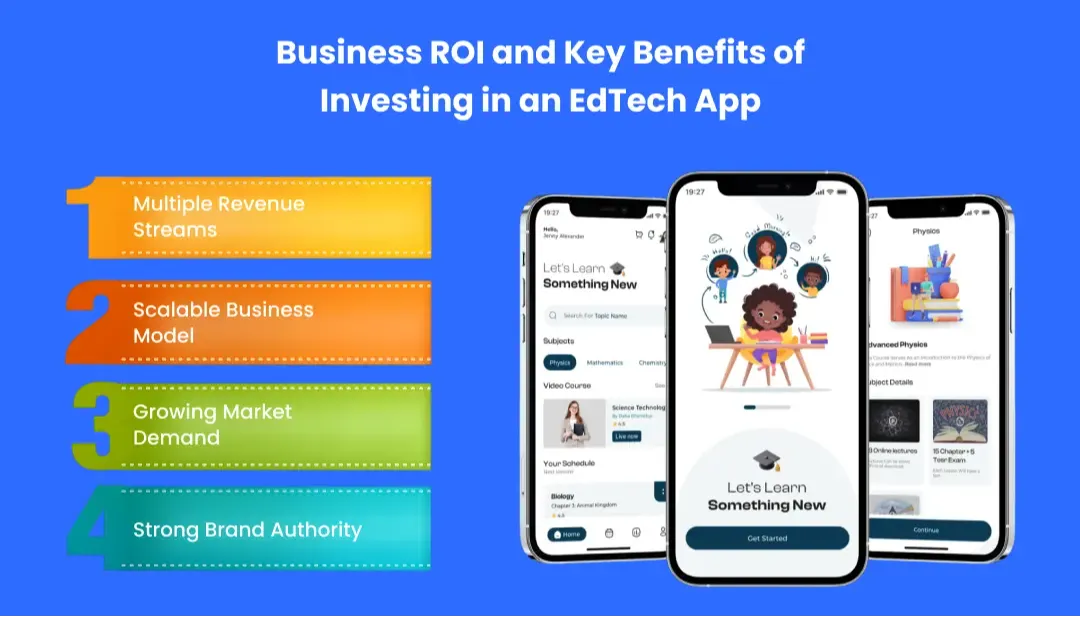
The EdTech industry requires investment, but it also gives long-term benefits with better ROI.
1. Multiple Revenue Streams
By utilizing subscriptions, premiums that generate revenue via subscription revenue, premium features, advertisements, or institutional partnerships create diversified revenue streams as well as the ability for them to recover their initial development investment more rapidly than would otherwise occur in a traditional business model.
2. Scalable Business Model
After development has been completed, the application is easily expanded to include new subject areas, countries, or even demographics with very little incremental cost, thereby increasing its profitability and providing a means for continued long-term expansion.
3. Growing Market Demand
Increasing acceptance of online learning and access to digital educational products and services has led to increased demand from consumers, thereby increasing EdTech's ability to generate steady growth, increase user acquisition, and achieve sustainable returns.
4. Strong Brand Authority
An EdTech Software Development Company creates successful EdTech applications that creates an atmosphere of trust and credibility in the educational world, thereby establishing the EdTech business's reputation as a dependable place to learn, as well as creating countless opportunities for growth in the future.
Future Trends for AI in Education Apps
The future of EdTech is deeply connected with AI innovation. These trends will shape upcoming EdTech industry models. Here are some of the trends given below.
1. Personalized Learning Experiences
AI technologies will analyze and monitor students' behaviors, performance levels, preferences, etc., to create customized learning paths that provide improved understanding, engagement, and improved academic results across all cohorts.
2. Intelligent AI Tutors
AI-powered tutors offer real-time support for student inquiries, resolving doubts quickly with adaptive explanations, replicating human-like teaching.
3. Predictive Learning Analytics
By deploying predictive data analysis tools using AI tools, we'll be able to flag any potential learning gaps earlier, anticipate how students perform and suggest solutions for closing those gaps, which can assist educators and learning platforms in maximising their potential to improve the effectiveness of the overall learning process as well as improve retention/participation rates.
4. Voice & Conversational Learning
Access to voice-enabled AI and conversational interfaces will allow students to connect and interact with technology more naturally through speech, allowing for more universal access, especially regarding engaging and nurturing younger learners and students in different countries around the world.
AI-Powered Tutoring App Development enables personalized, real-time learning support through intelligent tutors, adaptive content, and data-driven insights, enhancing student engagement, academic performance, and scalable education experiences.
CONCLUSION
Developing an EdTech app like Brainly is a lucrative business opportunity. It requires adequate planning, optimal feature selection and an adequate budget to facilitate success. Various factors must be taken into consideration when determining the cost of an EdTech app development project like the choice of platform, the complexity of the design, the inclusion of AI elements, and the scalability requirements of the app once developed.
To successfully develop and maintain a sustainable educational platform, companies can assess their own plans by studying the features offered by the Brainly app and evaluating their ability to deliver the same features, and learn and address challenges early on in the process of developing their own app, and focusing on developing their app to generate long-term return on investment (ROI). Companies seeking to develop a Custom education app or investigate How to develop an EdTech app will find that they can create a successful product within the education marketplace by investing in quality technology and user experience.
With an appropriate strategy, Custom education app development will be possible that are able to recoup the costs associated with developing their apps, while simultaneously generating consistent revenue and providing access to new and engaging methods of facilitating the learning process for students across the globe.