Have you ever watched “Iron Man”? If yes, then we are on the same track.
Remember when Tony Stark casually talks with J.A.R.V.I.S. to diagnose any problem in his arc? Well. I laughed a lot just because of science fiction, but I never thought that the same technology would exist in reality.
I remembered once Steve Jobs said, “The people who are crazy enough to think they can change the world are the ones who do.” “Interesting quote!
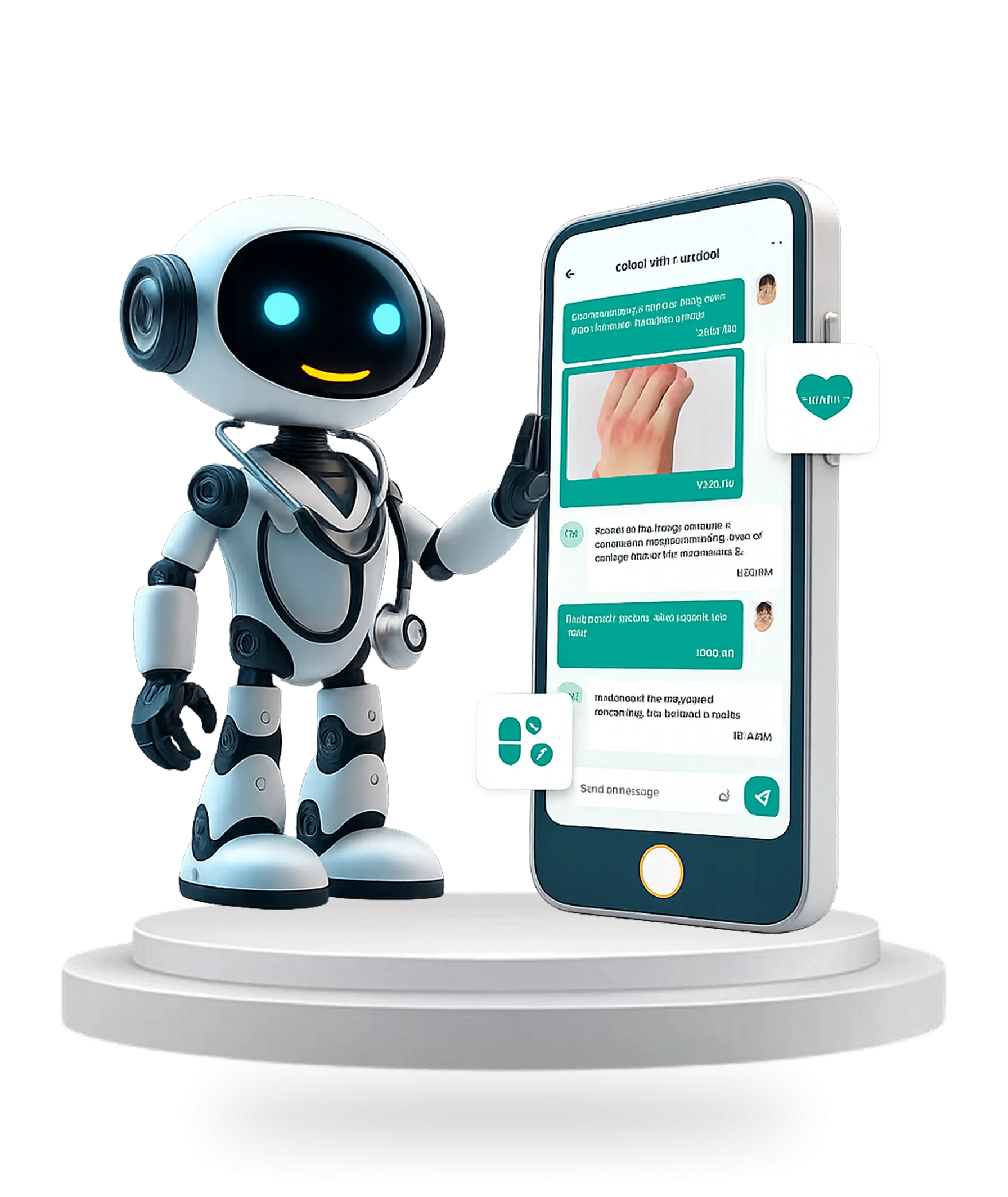
This same thing applies to the healthcare system, while others are understanding the algorithms for this industry for the AI in Doctor On-Demand Apps. The AI-powered chatbots are the main phase for doctor-on-demand apps with scalability and speed in treatments for better results.
These digital assistants handle everything from organizing to sorting out your symptoms. They never get tired or freak out, and your chart’s always right where you need it.
Imagine having a doctor in your pocket—one who’s always calm, knows an absurd amount from all kinds of medical data, and actually talks to you like a real person. Healthcare isn’t stuck in a waiting room anymore. It’s right there on your phone, ready when you are.
Understanding AI in Doctor On-Demand Apps
The AI technologies or virtual assistants are embedded in doctor-on-demand services that can help to check minimal symptoms and can also provide solutions according to the problem.
AI systems can also offer advice if emergency medical attention is needed in that particular situation in AI-powered doctor on-demand apps. AI-driven platforms have capabilities instead of depending on any other platforms. Here are some major ways that AI can aid in doctor-on-demand apps as well.
Efficiency in Telemedicine
AI-driven systems can make telemedicine operations seamless by managing the recurrent processes that include patient queuing and appointment scheduling. AI technologies can also utilize the doctor’s schedule requirements that are effectively based on current patients’ needs during consultation.
Drug Discovery and Research
AI systems can optimize the drug discovery tasks to analyze a huge amount of biomedical data. With the major help of machine learning models, the system can predict the interaction between two drugs, and then it can also examine the potential candidates for drugs that will be created in the future for the clinical trials as well.
NLP Communication
The use of AI technology in the healthcare industry can allow patients and doctors to communicate with them in the form of text and voice through recognition technologies. A virtual assistant can easily connect with patients to address their problems regarding treatment and medications that AI Is Transforming Healthcare. This kind of capability can strengthen the relationship between the patient and the healthcare providers.
Privacy and Data Security
Virtual assistants that use AI keep tabs on patient education materials and offer up tutorials when needed. They break down details about a disease, talk through treatment options, and explain cures in ways that actually make sense for each patient.
The Role of Chatbots in Doctor On-Demand Apps
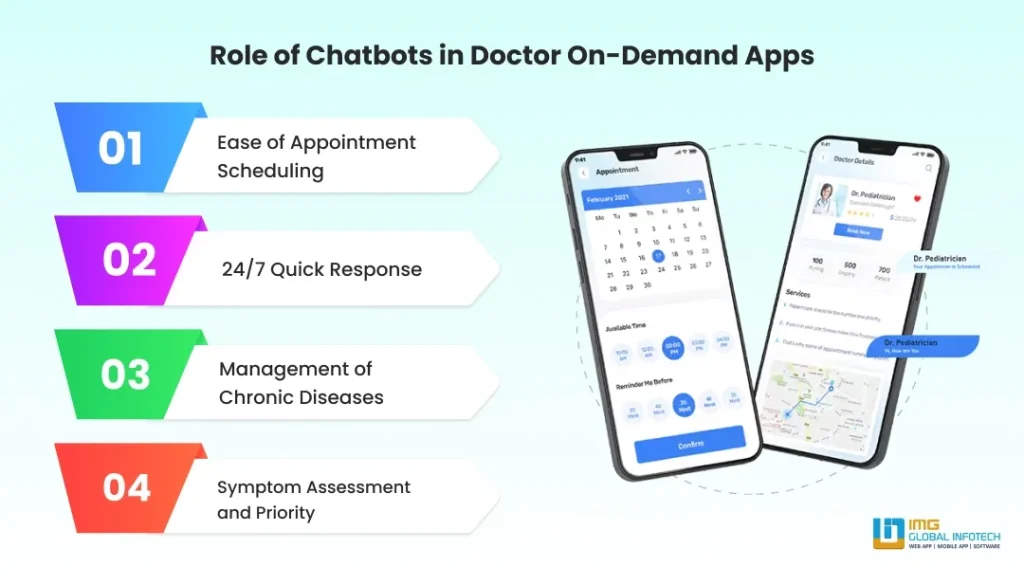
As per some reports, the latest data shows that more than 70% of healthcare services in the US have integrated chatbots in telemedicine apps. The uses of AI chatbots in healthcare services are always beyond imagination in the healthcare industry. Here are some use cases of AI chatbots in doctor-on-demand apps.
Ease of Appointment Scheduling
Nowadays, mostly people book appointments from anywhere and anytime they want. So there is a need to implement efficient systems that can maintain the schedules and availability for healthcare services that includes doctors’ timing.
AI chatbots aid you in offering scheduling, data on available slots, and easy rescheduling of appointments as well.
24/7 Quick Response
In the current situation, people need 24/7 systems that can provide fast responses to their queries about their services in Doctor on-demand app development. If you can switch to a manual process, then you can go ahead and hire many professionals to train them.
You can also find human errors, but in the process, AI chatbots in healthcare offer real-time answers for patient questions with minimal errors in the conversations.
Management of Chronic Diseases
It can help in long-term chronic conditions like hypertension, asthma, and diabetes; track medications; provide health education; and use AI chatbots to monitor symptoms that can help doctors to follow a detailed treatment for the patient.
Symptom Assessment and Priority
In order to help patients determine whether they need to see a professional, chatbots evaluate symptoms and provide preliminary diagnoses or self-care advice.
What are the Key Ways that AI is Transforming Doctor On-Demand Apps?
Healthcare apps have really stepped up in the last few years. With AI in the mix, they’re not just for tracking your medical records or booking appointments anymore. These apps are starting to feel like true partners—smart enough to actually get what you need and respond in real time.
AI-powered healthcare apps learn from every patient interaction. They sift through mountains of data and deliver care that actually fits you, not just some generic profile.
Predictive Analytics & Personalized Treatment
Here’s something that really changes the game: AI helps doctors build treatment plans that actually match each patient. Doctors have always considered your history and symptoms, but AI takes it further. It uses predictive analytics to spot potential health problems before they even show up.
AI for Ongoing Disease Management
Conditions like diabetes, asthma, or high blood pressure don’t hit pause once you leave the doctor’s office. They need constant attention. AI tools now make it way simpler to keep things in check—for both patients and doctors.
Smarter Appointment Scheduling
Booking a doctor’s appointment used to mean endless calls and waiting forever on hold. Now, with AI-driven scheduling, you can book, reschedule, or cancel your appointments in seconds. No more hassle.
Automated Billing & Claims
Let’s be real: dealing with insurance claims and medical bills usually means stress and confusion. AI is fixing that too. With healthcare chatbots, the whole process runs itself—faster, with fewer mistakes, and way less of a headache.
How Do Chatbots Improve Patient Engagement?
The Telemedicine app development company provides healthcare systems with efficient patient care through their chatbots, which deliver personalized support to patients throughout all hours of the day. The system provides better healthcare access through its patient connection system, which links patients with their medical providers.
24/7 Instant Support
Chatbots operate as 24-hour service systems, which respond to patient inquiries throughout the day without requiring users to wait for assistance. The continuous availability of their support system helps patients decrease anxiety levels while they receive superior healthcare treatment.
Appointment Scheduling Made Easy
Patients can effortlessly book, reschedule, or cancel appointments through chatbots in AI-powered virtual healthcare solutions. The streamlined System 3 process eliminates long hold times while it decreases administrative work because patients remain linked with their healthcare providers throughout their entire experience.
Medication Reminders and Adherence
Chatbots send timely medication reminders, helping patients stick to prescribed treatment plans. Better treatment compliance leads to improved health results and fewer complications and decreased hospital readmissions, which enables people to manage their personal health in a more active way.
Personalized Health Education
Chatbots deliver tailored health information based on a patient’s condition and history in Conversational AI in healthcare. Patients can understand their diagnoses better and make informed decisions about their healthcare while they take charge of their health management over the long term.
Symptom Checking and Triage
Chatbots enable patients to report symptoms, which the system uses to show them their correct medical care needs in smart chatbots for doctor consultation apps.
AI Chatbots’ Healthcare Benefits
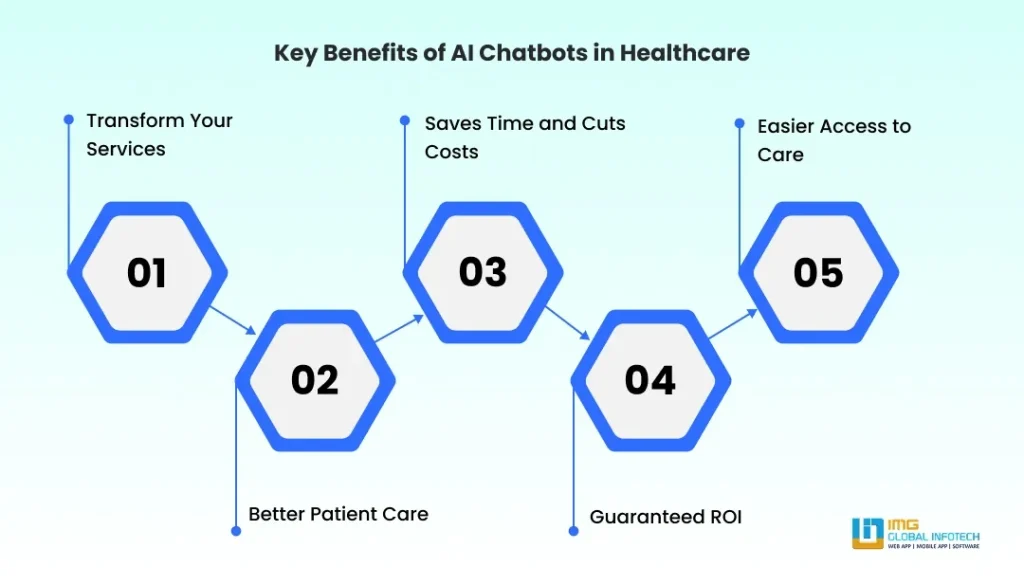
Telemedicine applications gain multiple advantages through their implementation of chatbot technology. The increasing adoption of AI chatbot technology by healthcare providers demonstrates its various beneficial applications.
Transform Your Services
The distinction between businesses that implement AI chatbots and those that do not exists as a clear and visible difference. The operational processes of healthcare organizations experience transformation through the implementation of chatbots.
Better Patient Care
You focus on delivering superior patient care, which remains your primary mission. The introduction of a chatbot achieves this objective. The system operates more efficiently because it handles inquiries immediately while enabling your staff to concentrate on critical tasks.
Saves Time and Cuts Costs
Chatbots handle all the responsibilities that consume your employees’ working hours. The company benefits from double savings because it reduces both time and financial expenses.
Guaranteed ROI
The implementation of AI chatbots generates financial benefits for businesses. The business provides you with a continuous revenue stream that exceeds your projected amounts.
Easier Access to Care
Do you want to expand your outreach to all individuals across all locations throughout all times. Through their operation, chatbots create solutions to obstacles. They provide continuous support, which enhances healthcare access for all individuals.
Cost of Integrating AI & Chatbots in Doctor On-Demand Apps
The average cost to integrate AI & chatbots in doctor-on-demand apps would be $8,000 to $15,000 or more to examine the Doctor On-Demand App Development Cost. The exact cost majorly depends on the level of integration of technologies in your doctor-on-demand app along with custom changes as well.
Challenges in Implementing AI & Chatbots
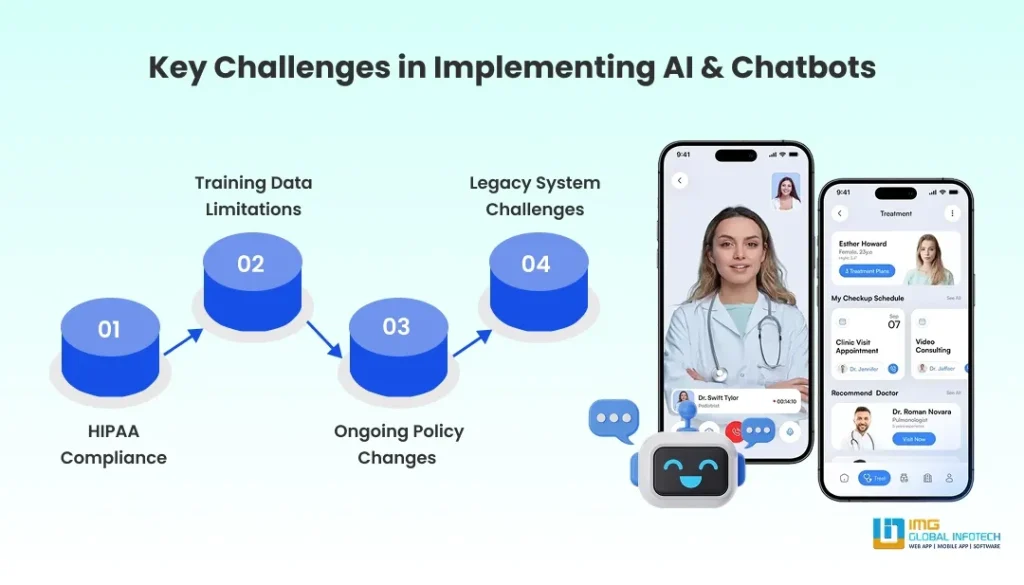
AI is shaking up healthcare, but let’s be real, it’s not all smooth sailing. This field runs on trust, so when AI steps in, it brings a whole mess of legal, ethical, and day-to-day headaches. Developers and medical teams have to stay sharp—they’re dealing with everything from tricky tech integrations to real threats like data theft.
HIPAA Compliance
Healthcare applications in the United States need to comply with HIPAA (Health Insurance Portability and Accountability Act) regulations, which control the methods of collecting, storing, and transmitting patient information in the doctor-on-demand app development guide. The organization will experience severe financial penalties because of noncompliance, which will also result in decreased confidence from patients.
Training Data Limitations
The medical field faces problems with high-quality data because particular cases do not have enough data, which leads AI systems to produce incorrect results by missing uncommon medical conditions and failing to identify early medical conditions that would endanger patient health.
Ongoing Policy Changes
Healthcare artificial intelligence keeps developing as a new field because its associated regulations change so frequently in the Healthcare App Development. Developers need to understand ethical standards and upcoming legal developments and data sharing regulations because these factors impact their ability to maintain compliance and responsibility.
Legacy System Challenges
Healthcare organizations must spend money on expensive system upgrades because their current systems do not work with AI technology in HIPAA-compliant healthcare chatbots. Smaller clinics and hospitals face difficulties because they want to use AI technology but lack the financial means to modernize their systems.
Future Trends: What’s Next for AI in Doctor On-Demand Apps?
The application of AI in healthcare now enters its initial phase because current technologies provide healthcare professionals with enhanced specific patient care delivery methods in the Future of AI in telemedicine platforms. The second phase of technological development brings greater potential for innovation because it will create more substantial changes.
The development of healthcare technology will create advanced AI applications that function as predictive tools that seamlessly integrate into everyday medical practices.
Digital Twin Technology in Healthcare
The use of digital twins in healthcare represents the most impressive advancement that artificial intelligence technology has brought to the field. A digital twin creates a digital simulation of a patient, which medical professionals build through the collection of health documentation and medical information and analytical techniques.
Shift from Reactive to Proactive Care
The upcoming version of the healthcare apps will be more dedicated to early detection and prevention. The healthcare applications that use artificial intelligence will track user activities through wearable technology while using forecasting algorithms to identify future medical conditions before users experience any health problems.
AI-Driven Preventive Healthcare Apps
The healthcare revolution now enters its next phase because AI technology develops preventive healthcare applications that enable individuals to maintain their wellness instead of waiting until they need medical intervention.
Virtual Patient Replica for Tailored Treatments
Through the use of digital twins, medical professionals can test various treatment methods on a simulated patient before they execute those methods in actual medical scenarios from verified Healthcare App Developers. This process creates custom care programs that enhance patient safety while minimizing the need for multiple treatment experiments.
Closing Statement
AI used to shake things up in healthcare, but now it’s become essential to how medical apps work and feel, according to the Doctor On-Demand App Development Company. It’s behind so much—personalized treatment plans, faster drug discovery, remote monitoring, and even virtual care.
Clinicians and patients both feel the difference. These days, AI makes healthcare run smoother, more accurately, and for more people. And it’s not stopping. New breakthroughs like digital twins and big predictive health models are set to take things even further.