
Ever noticed how Netflix knows what you’ll watch next… before you do? Every founder we know wants that level of intelligence in their app.
When an application is expected to be able to predict user preferences, that’s the pressure and magic of ML in 2026. Users don’t want apps anymore – they want apps that think, predict, and customize in real time. The problem is that no one tells you that getting an application to be smart is more than just having a few interesting ideas – it’s also about how much money you have to spend.
So what’s the real issue—technology or money? Money decides how smart your app can actually be.
Many businesses hear about successful ML applications and want to be part of developing those applications, but later find that the cost of developing those applications continues to increase.
What is driving the increase in cost – the data, the models, the infrastructure, or the quality of talent that can be hired?
This is why you need to have this guide as your resource. We will provide you with a breakdown of what you need to know about machine learning application development costs as of 2026 – no fluff or scary words.
It is an honest discussion to help you decide whether your machine learning idea is going to be a good investment or an expensive experiment.
What Is Machine Learning App Development?
So, is machine learning just fancy automation? Not quite. It’s automation that learns from experience.
A Machine Learning App Development project involves creating software applications that allow for the analysis of data, understanding of trends in the data over time, and making choices without a lot of input from people. Only through fixed programming would a traditional application work; however, with an ML Application, it can keep up with new data as it becomes available.
Examples of ML Applications could be, for instance, recommendation engines, voice assistants, predictive analysis tools, image recognition applications, or fraud detection applications. They not only perform their job functions but also improve upon them as they understand the use of the data.
Therefore, the Machine Learning App Development Cost tends to be greater than that of traditional Application Development. However, their long-term return on investment is significantly higher.
Why Machine Learning Apps Are in High Demand in 2026?
Why is every business suddenly obsessed with ML in 2026? Because data finally learned how to talk back.
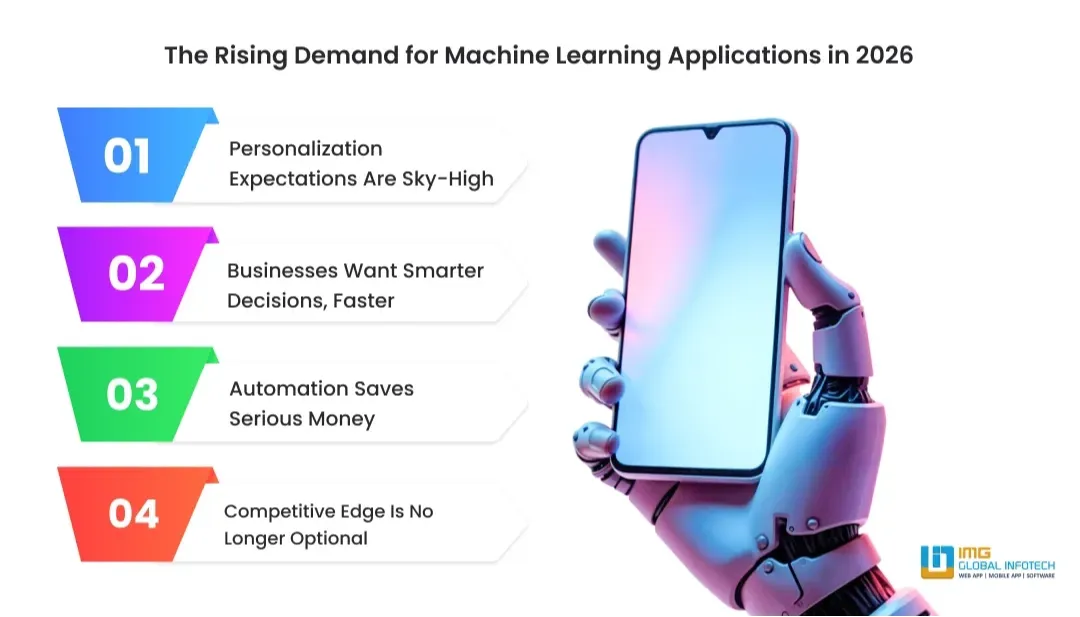
Machine learning’s Best AI apps are booming because businesses now sit on mountains of data—and ML is the only way to extract real value from it. Here’s why demand is exploding.
-
Personalization Expectations Are Sky-High
People want apps that can guess what they want. Machine learning can help understand behavior, guess what someone might want, and create "wow, how do you know that?" moments quickly.
-
Businesses Want Smarter Decisions, Faster
No more gut feelings. Machine learning apps create orderly predictions from a bunch of data to enable companies to make quick decisions instead of slow reactions.
-
Automation Saves Serious Money
Machine learning apps also make tedious tasks automated, reduce operational costs, and allow people to focus on creative and higher-value items.
-
Competitive Edge Is No Longer Optional
In 2026, if your app is not intelligent, it will be forgotten. Machine learning gives companies a way to demonstrate uniqueness, adapt quickly, and stay ahead of clever competitors.
As industries adopt Machine Learning AI Apps, the Machine Learning App Development Cost becomes a strategic investment rather than an expense.
How Much Does Machine Learning App Development Cost in 2026?
Let’s address the big question head-on.
In 2026, the Cost to build a machine learning app typically ranges from $5,000 to $15,000+, depending on complexity, data requirements, and deployment scale.
Let us now break down the cost based on the level of the app.
-
Basic App Cost
A basic app cost ranges from $5,000 to $8,000, depending on your requirements. It is a good choice for small businesses with budget issues, and for startups looking for an MVP.
-
Mid-Level App Cost
A mid-level app cost ranges from $10,000 to $15,000 dependin on the project requirements. It is something that growing businesses must explore.
-
Advanced-level App Cost
The cost of an advanced-level app starts from $15,000 and could go higher depending on your project requirements. Large enterprises with full automation uses this approach.
The Machine Learning App Development Cost varies widely because no two ML apps are built the same. A simple prediction model costs far less than a real-time recommendation engine processing millions of users.
Machine Learning App Development Cost Breakdown
Okay, but where does all that money actually go? It is one of the common question. ML costs hide in many layers.
Here’s how the Machine Learning Application Development Cost usually breaks down.
-
Data Collection & Preparation (20–30%)
Raw data can appear chaotic; therefore, it takes considerable time and effort to clean, label, remove bias, and prepare the data for use. Without high-quality data, even the best-designed model will not succeed.
-
Model Selection & Training (25–35%)
This is considered the phase of building a brain for your model. Testing and training different algorithms, adjusting models' accuracy levels, and using computing resources make this the most costly phase of the project.
-
App Development & Integration (20–25%)
Machine Learning does not operate in isolation. Therefore, models must connect seamlessly with multiple items like databases, application programming interfaces (APIs), front-end applications, etc, requiring strong engineering and good architectural design plans.
-
Testing, Optimization & Deployment (10–15%)
Models must perform quickly, fairly, and reliably. You should perform testing for accuracy, performance, and bias, as well as test against real-world scenarios, to ensure the application works the way you intend before deploying it to production.
-
Maintenance & Monitoring (Ongoing)
All models have a shelf life, and they tend to age as the user behavior changes, the underlying data changes, and their performance degrades, making ongoing monitoring, retraining, and updating critical to maintain the intelligence of the application.
Each stage directly impacts the Machine Learning App Development Cost, especially data quality and model complexity.
What are the Key Factors Affecting Machine Learning App Development Cost?
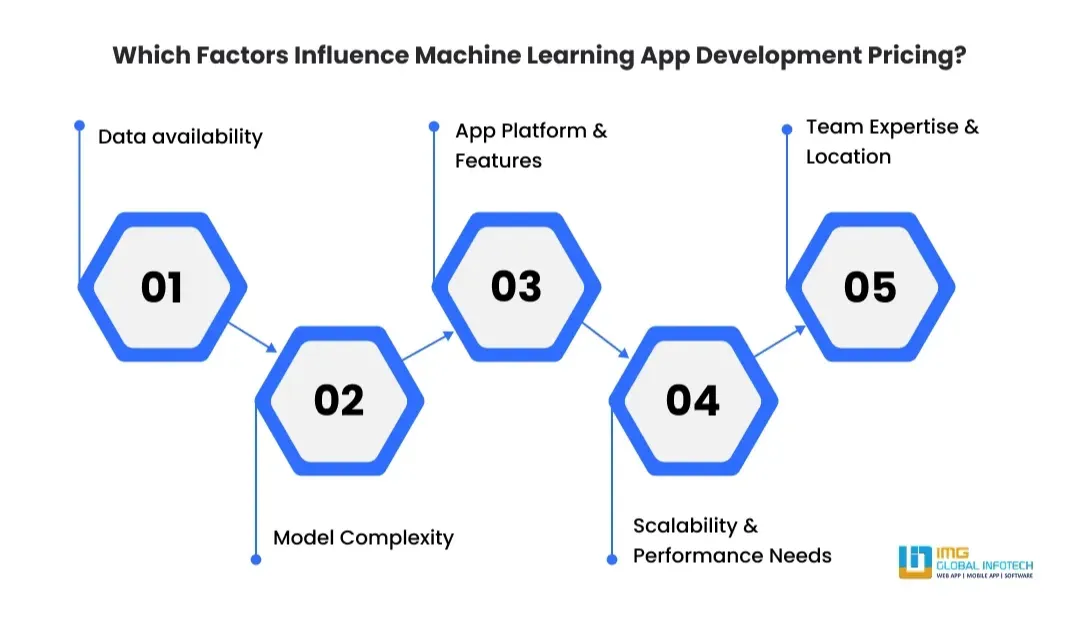
Several elements influence ML App Development Pricing, and understanding them helps you plan smarter. Here are some of them given below.
-
Data availability
Good quality data helps save money, and bad quality data wastes it. Well-organised, labelled datasets reduce amounts of reworking, whereas bad conditioned and limited datasets increase costs quickly.
-
Model Complexity
Simple predictive models are cost-effective than more sophisticated real-time models since they require additional training, computer power, and expert tuning, thus leading to higher development costs.
-
App Platform & Features
Developing a simple web application is less expensive than developing a real-time, mobile, multi-device app requiring a lot of programming effort and large budgets.
-
Scalability & Performance Needs
Provisioning for thousands of users to access your application is straightforward. But there will need to be much better infrastructure, much smarter architecture, and higher ongoing costs in order to provide access for millions of users in real time.
-
Team Expertise & Location
Highly skilled ML engineers produce the best results in the quickest time, but they charge significantly more than junior-level resources or generalists working in software engineering.
Choosing the right Machine Learning App Development Company can significantly optimize your budget without sacrificing quality.
What is the Machine Learning App Development Cost by Industry?
Do all industries pay the same for ML apps? It is almost the same. Mostly, it depends on your project’s requirements and the number of features and integrations.
Here is the breakdown of the Machine learning app development cost in 2026.
1. Healthcare
A Healthcare industry ML app cost ranges from $5,000 to $15,000 or even more depending on your requirement. Machine learning is making healthcare more efficient, intelligent, and precise through the use of predictive analysis, image recognition, and personalized treatment plans.
2. Fintech
A Fintech industry ML app cost ranges from $5,000 to $15,000 or even more depending on your requirement. Fintech applications utilize machine learning technologies to detect fraudulent activity, evaluate consumer creditworthiness, automate trading processes, provide customized banking services, and protect secure transactions.
3. Retail and Ecommerce
A Retail and Ecommerce industry ML app cost ranges from $5,000 to $15,000 or even more, depending on your requirement. Machine learning is utilized in product and service recommendations, real-time dynamic pricing, prediction of consumer demand, analysis of customer purchasing habits, and customized online shopping experiences, all of which help to increase the number of completed sales and improve customer loyalty.
4. Logistics and Supply Chain
A Logistics and Supply Chain industry ML app cost ranges from $5,000 to $15,000 or even more, depending on your requirements. Machine learning applications aid logistics companies through optimizing routes of transportation, forecasting delays, managing inventory, estimating future demand, and reducing overall operating expenses within a highly complex logistics environment.
5. Education
An education industry ML app cost ranges from $5,000 to $15,000 or even more, depending on your requirements. Adaptive learning systems employ machine learning technologies to create personalized educational pathways, predict students' levels of achievement, automate assessments, and enhance student engagement.
Industries with strict compliance and real-time data needs see a higher Machine Learning App Development Cost overall.
In-House vs Outsourced ML App Development Cost Comparison
Should we build in-house or outsource? Depends—do you want speed or long-term hiring headaches?
When you build your product internally by hiring Machine Learning Engineers or Data Scientists, it will be a more expensive option annually than using an outsourced complete project.
However, if you decide to use an experienced AI Development Company or one of the recommended AI Software Development Companies for your project, you often find that you pay less upfront and receive your completed product more quickly.
For many startups in 2026, custom machine learning app development is the more cost-effective route in 2026. Building an in-house team has iws own benefits, but requires more cost.
Here is the comparison table.
What are the Common Challenges in ML App Development & Their Cost Impact?
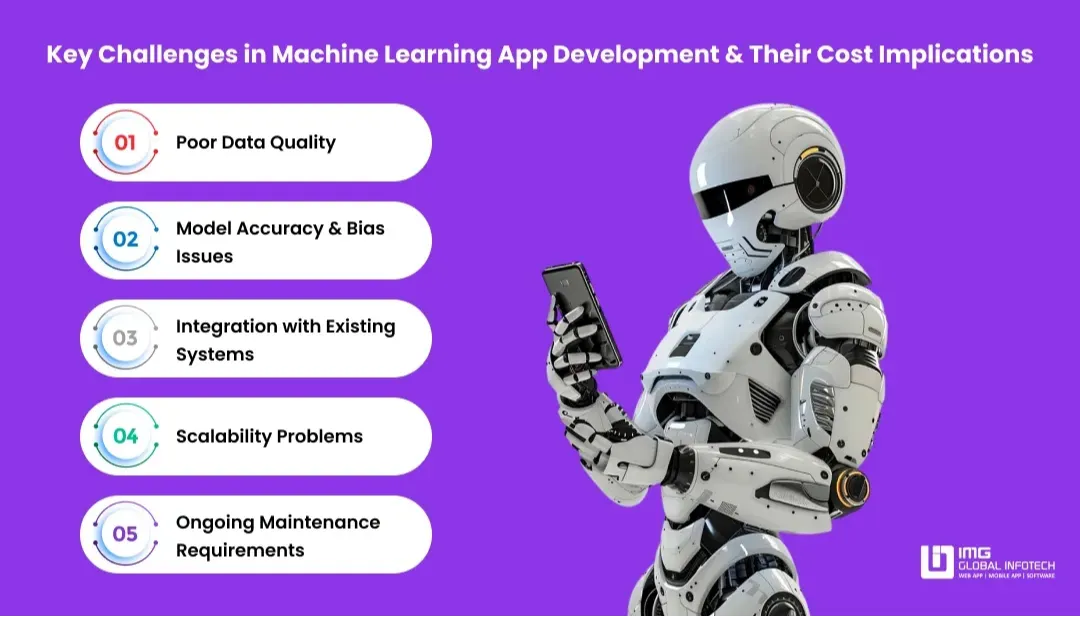
Machine learning isn’t magic—it comes with challenges that directly affect the Machine Learning App Development Cost.
-
Poor Data Quality
Continually having to make changes your models due to incomplete data is going to cause a lengthy development cycle, increased engineering effort, and thus rapidly escalate the total expense of building your ML application.
-
Model Accuracy & Bias Issues
Continually having to test your models due to either inaccurate outcomes or biased results will be an extra and unexpected ongoing expense, along with delays in getting the solutions to market.
-
Integration with Existing Systems
Integrating your ML models ith large legacy systems, APIs, and databases can be a source of difficulties that result in either delays, increased development effort or cost to integrate.
-
Scalability Problems
A model that tests successfully in a testing phase before deployment can perform poorly after deployment, consequently requiring costly upgrades and optimization of existing or new infrastructure.
-
Ongoing Maintenance Requirements
ML Models do not stay smart forever; ML Models require continuous monitoring, retraining, and upgrades adding long-term cost beyond the initial development.
Staying aligned with Top Machine Learning Development Trends helps businesses avoid expensive rework and outdated architectures.
What are the Future Trends Impacting Machine Learning App Development Costs?
Will ML apps get cheaper or more expensive? Both—depending on how smart you play it. Understanding Machine Learning vs Deep Learning helps businesses choose cost-effective solutions instead of overengineering apps
1. Automated Machine Learning (AutoML)
Using AutoML minimizes time-consuming manual modeling in order to speed up the development of models while also helping teams to train, test, and deploy their models more quickly thereby helping to reduce the cost of developing ML models.
2. Pre-Trained Models & APIs
By using existing ML models instead of building your own, your organization will save development time, lower ML model training expenditures and other associated costs, and provide access to complex ML solutions without requiring a significant upfront investment.
3. Cloud-Based ML Platforms
Many cloud providers can be utilized to provide flexible infrastructure, a pay-as-you-go pricing model, and simple scalability, allowing AI Software Development companies to manage costs effectively.
4. Edge AI & On-Device Learning
Processing data at the device level reduces reliance on the cloud; increases throughput; and decreases future capital costs associated with infrastructure investment, along with long-term data transfer costs associated with the cloud.
5. Stronger AI Regulations
Increased compliance requirements require additional testing and documentation effort and will raise some project costs marginally; however, they will increase trust, transparency, and ultimately long-term reliability.
The ML App Development Cost 2026 may feel high initially, but the ROI often compounds over time. Businesses that partner with the Best Machine Learning Development Company tend to see faster break-even points and more reliable performance.
Is Machine Learning App Development Worth the Investment in 2026?
If your business relies upon data to make decisions, wants to provide personalized experiences for customers, or uses some type of automation, investing in ML mobile applications will result in an efficient App development process in 2026 and beyond.
ML mobile applications can help predict and analyze customer behaviour, reduce operating costs, and ultimately provide smarter user experiences.
Although the initial investment in ML mobile applications may appear to be expensive, over time, you will earn back much more than your initial investment due to efficiency, scalability, and competitive advantage.
Smaller enterprises that focus on the best use cases for ML mobile applications and then grow upon success will see the quickest return on investment. Intelligent mobile applications will be a required component of doing business in 2026.
CONCLUSION
So… is machine learning just hype? Not anymore. In 2026, it’s survival tech.
The cost of developing a machine learning application in 2026 will vary depending on your goals, complexity, and execution strategy. Whether you're a new startup testing clever functionality or an established corporation building out an AI-enabled ecosystem, ML applications are changing how organizations run.
When you're able to understand funding requirements, the challenges you're likely to face, and the future trends in the industry, along with examples of some of the best AI applications on the market today, you will be able to make smarter decisions in developing an application that not only has functional capabilities but also thinks.
If intelligence is the future of applications, then machine learning is the driving engine behind that future.
Real Also: Top Machine Learning Development Trends Shaping the Future