
Nowadays, the way businesses operate, compete, and innovate has completely changed - thanks to intelligent technologies that are developing quickly. Machine Learning (ML) technology is at the centre of this evolution. ML provides the capability for computers to analyze data, learn from it, and enhance their ability to solve complex problems without needing to create an application specifically for every situation that it encounters. Many businesses now use ML technology to provide both automated processes for routine tasks as well as a hyper-personalized customer experience. ML has transitioned from an experimental technology to an essential strategic tool. Businesses are represented across multiple sectors in which organizations have built robust and scalable ML models, built systems that provide near real-time ML capabilities, and enhanced via predictive analytics, both to maintain or grow market share in an increasingly digital marketplace.
As we move toward a more data-driven future, business leaders, product managers, and technology decision-makers must understand future developments for ML. This blog will focus on the role ML will play in the continued growth of digital transformation, key milestones and trends for further development of ML, examples of how businesses use ML, and the advantages and challenges associated with developing ML systems. We will also see how organizations make informed decisions regarding who to partner with for the custom machine learning development.
How Machine Learning Is Driving Digital Transformation?
ML is changing the whole landscape of digitalization. Here is how ML is driving digital transformation.
1. Intelligent Automation of Business Processes
Organizations can intelligently automate repetitive and rule-based tasks using technology such as machine learning (ML). ML enables the system to learn from its data, improving its ability to automate successfully while also minimizing error rates, lowering operational costs, and reducing the amount of manual work required by employees.
2. Data-Driven Decision Making
Machine learning can analyze a significant amount of data to identify patterns, trends, and other valuable information that may be overlooked by humans when analyzing data. That is why ML provides businesses with greater speed, accuracy, and evidence-based decision-making capabilities for areas like marketing, finance, operations, and overall strategy.
3. Personalized Customer Experiences
The machine learning model is capable of forecasting what future sales, equipment, demand, and customer retention might look like. The proactive nature of this model allows for better planning and foresight to mitigate risk associated with unexpected marketplace shifts.
4. Continuous Learning and Improvement
Unlike traditional, static systems that do not adapt to new data, machine learning models continue to learn as they access and process new information, thus keeping their ongoing adaptation and future application as relevant as possible.
Other Things in ML that are driving digital transformation are:-
-
Predictive Analytics and Forecasting
-
Real-Time Insights and Responsiveness
-
Enhanced Operational Efficiency
-
Innovation Through Smart Products and Services
Always choose the AI development company that knows all these transformations. It will help in smooth building, which eventually leads to more successful businesses.
Top Machine Learning Development Trends Shaping the Future
Here are some of the ML development trends that are shaping the future.
1. Automated Machine Learning (AutoML)
In recent years, one of the most important trends in machine learning development trends has been the growth of AutoML. The automation of tasks such as data cleaning, feature extraction, and model selectionhas reduced the amount of time required to create a machine learning model by making it easy for anyone to construct a machine learning model using AutoML.
2. Explainable AI (XAI)
As machine learning models become more complicated, understanding how these models come to a conclusion and why they make certain predictions or decisions is an area of critical importance. Explainable AI seeks to create more transparent models that give users an improved understanding of predictions and outcomes. This trend will continue to shape the future of machine learning by providing users with a higher degree of trust, accountability, and regulatory compliance.
3. Edge Machine Learning
Combining Edge Computing with Machine Learning technologies allows for the processing of data directly on the device, rather than relying solely on the cloud for data processing. This will lead to a reduction in latency, increase privacy, and enhance decision-making in real time.
4. Industry-Specific ML Solutions
As organizations become more aware of the importance of having customized machine learning models that meet their specific business needs, they are increasingly moving from developing general-purpose machine learning models toward developing domain specific Machine Learning Applications that utilize industry data, business processes, and rules specific to that particular industry to build enhanced accuracy and relevancy for business operations.
Key Benefits of Implementing Modern Machine Learning Trends
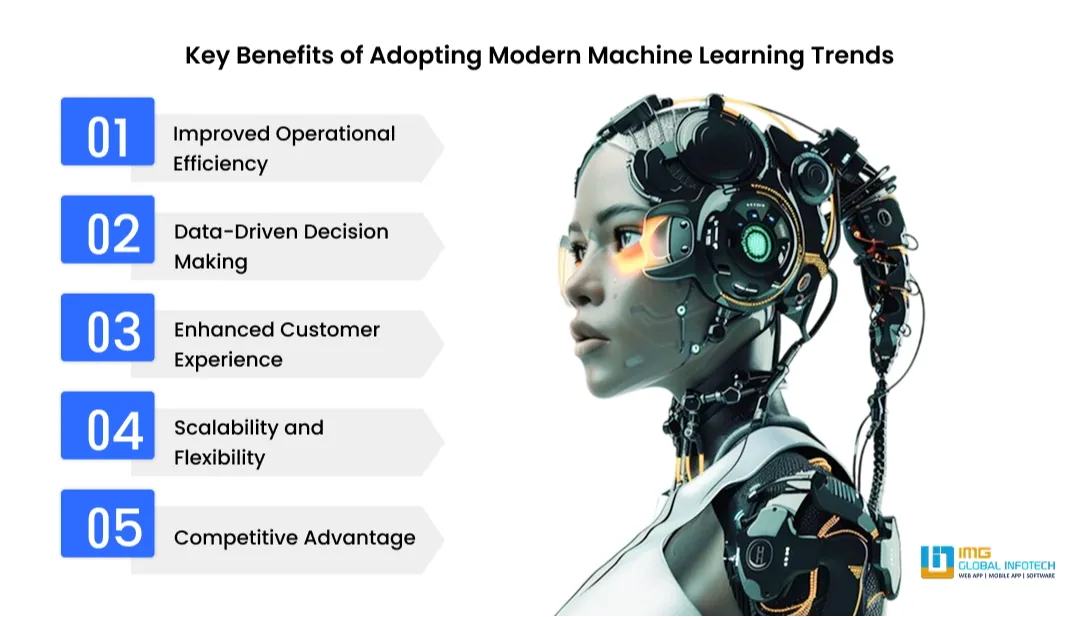
There are several key benefits of implementing new trends in ML. Here are some of them given below.
1. Improved Operational Efficiency
Repetitive processes will be automated, allowing teams to devote their time to strategic initiatives and leave routine tasks for systems to manage.
2. Data-Driven Decision Making
Timeliness and accuracy of business operations will improve due to the ability to use predictive analytics and real-time insights when making business decisions. These capabilities are a major advantage of adopting machine learning software development practices.
3. Enhanced Customer Experience
By providing personalized experiences through the use of machine learning, customers experience increased engagement, loyalty, and satisfaction. Machine learning is helping create adaptive and intelligent systems that are learning how to behave based on the way users click through their day-to-day interactions.
4. Scalability and Flexibility
Modern development models for machine learning will continue to scale as data volumes increase, providing organizations that embrace the trends and trends of AI and machine learning to grow their operations without sacrificing performance. Businesses adopting AI and machine learning trends gain flexibility to expand operations without sacrificing performance.
5. Competitive Advantage
Organizations that embrace the latest machine learning trends are better positioned to innovate faster, respond to market changes, and outperform competitors in dynamic environments.
Business Use Cases of Machine Learning Across Industries
Every industry has its own use cases of Machine Learning. Here are some of the use cases given below across industries.
1. Healthcare
The application of machine learning (ML) technologies is helping organizations to accurately predict potential disease conditions, tailor individual treatment options, streamline hospital operations, and improve patient care while maintaining lower costs than traditional treatments. These machine learning trends 2026 are there to see for everyone.
2. Finance and Banking
Financial institutions have adopted ML technologies for their many uses in combating fraud, providing better credit scores, and managing risk. Financial institutions rely on machine learning innovations to increase confidence among customers.
3. Retail and E-Commerce
Advancements in machine learning allow retailers to offer customers tailored shopping experiences through predictive analysis of their purchasing patterns, forecasting product demand, and optimizing their inventories.
4. Manufacturing
ML tools that enable predictive maintenance and Quality Control have minimized production downtime and are helping manufacturing operations to become more productive.
5. Media and Entertainment
ML model development services are enhancing user experience via content personalization and engagement strategies, which are primarily at play on streaming platforms and are developed through data analysis.
Challenges in Machine Learning Development and Deployment
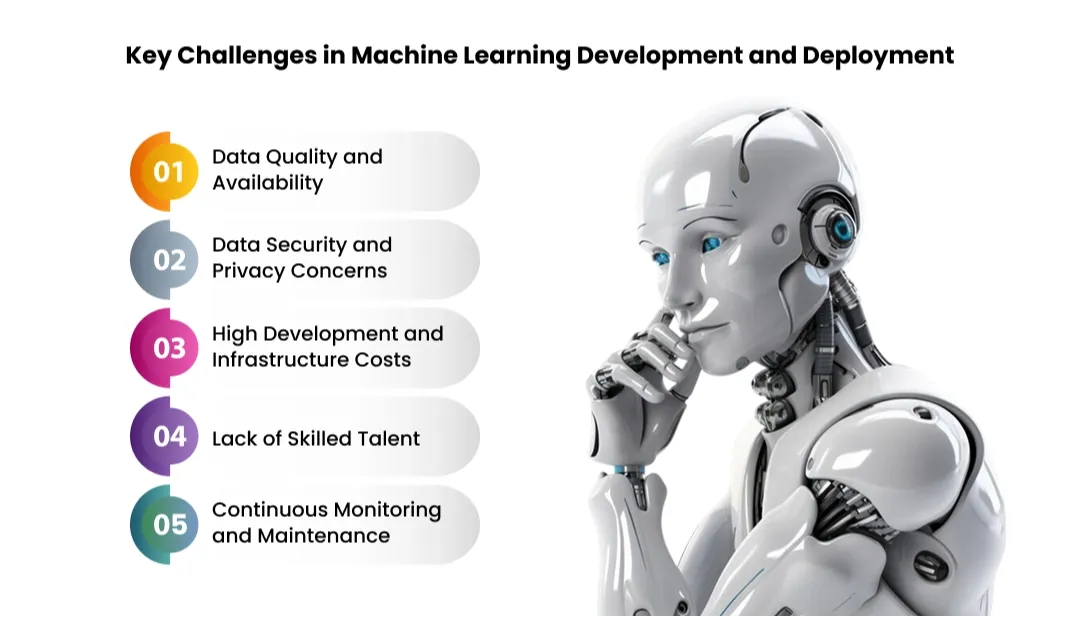
Despite its advantages, machine learning development comes with its own set of challenges. The AI software development company should be able to cope with these challenges. Here are some of the challenges given below.
1. Data Quality and Availability
The success of machine learning models hinges on the quality of the dataset used to train the model. Data that is incomplete, inconsistent, or biased will show inaccurate predictions and unreliable results, ultimately negatively impacting the performance of the model.
2. Data Security and Privacy Concerns
The management of large volumes of sensitive data results in a heightened risk of data breaches and privacy violations. Companies and organizations must ensure that they comply with the legal requirements set forth by data protection laws, while also safeguarding user data throughout the machine learning lifecycle.
3. High Development and Infrastructure Costs
A significant investment is required to build, train, and deploy machine learning models, including the investment of time, effort and resources. Smaller and mid-sized companies find it hard to get skilled employees to help with this effort.
4. Lack of Skilled Talent
The lack of available qualified data scientists, machine learning (ML) engineers, and MLOps professionals continues to create a skills gap that slows the speed at which machine learning projects can be developed, therefore increasing the amount of time and money spent developing machine learning projects, while also negatively impacting the quality of the projects developed.
5. Continuous Monitoring and Maintenance
Machine learning models will begin to degrade over time as the data they were originally trained on becomes outdated, due to changes in the data patterns. Continuous monitoring of the models, retraining of the models, and updates to the models are necessary, but these tasks will require time and money to maintain the effectiveness of the machine learning models.
Other Challenges Are:-
-
Model Deployment and Scalability Issues
-
Model Interpretability and Transparency
-
Integration with Existing Systems
-
Ethical and Bias-Related Challenges
How to Choose the Right Machine Learning Development Partner?
Choosing the right AI software development partner is a crucial stage. Any wrong foot forward and your business will be behind in the market. Before selecting the development company, consider the points given below.
1. Proven Experience and Technical Expertise
Select an organization with experience in auto-creating, training, and using machine-learning patterns, as well as expertise in algorithms, framework technology, and a proven record of creating and implementing effective real-world ML applications.
2. Strong Understanding of Your Industry
A business partner that understands your specific industry and industry trends will help you build models with more accuracy and relevance based on that understanding. They will align the creation of your organization’s ML patterns with the objectives of your organization, the appropriate regulatory requirements, and your customer expectations.
3. End-to-End Development Capabilities
Choose an organization that will support your complete machine-learning journey, including developing data strategies, designing, creating, training, implementing and monitoring machine learning patterns. Having an organization that partners with you to create and continually support your machine-learning journey means less effort in implementing, more effective deployment, and better long-term scalability for your organization.
4. Robust Security and Compliance Standards
Look for a partner that maintains security policies consistent with your business and complies with data security regulations. This will ensure that the business and personal data of all parties involved in the machine-learning lifecycle remains secure.
5. Post-Deployment Support and Maintenance
In order to maintain the performance of machine learning applications over time, they require continuous monitoring, retraining, and optimization. Select a partner that provides ongoing support that allows you to maintain your machine learning applications accurately and effectively over time.
Other Things to Consider Are:-
-
Focus on Data Strategy and Quality
-
Scalability and Deployment Expertise
-
Transparency and Explainability Approach
-
Clear Communication and Collaboration
Machine Learning Development Trends That Will Define the Future
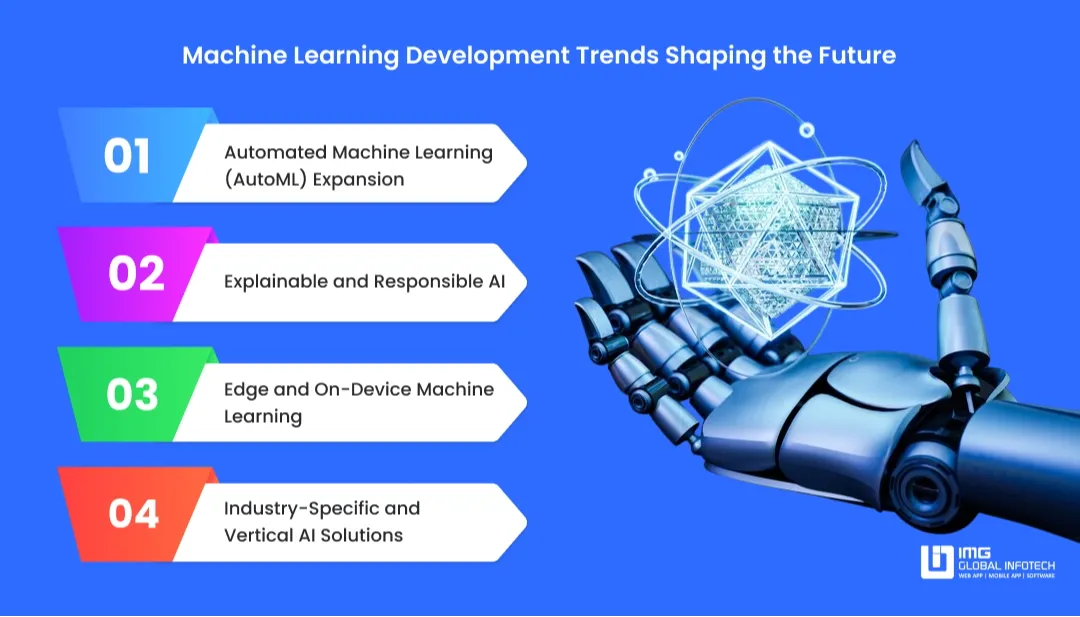
Here are some of the ML trends that will define the future landscape.
1. Automated Machine Learning (AutoML) Expansion
By automating data preparation, model selection, and model tuning, AutoML streamlines the development process for ML models. AutoML gives anyone who has no formal education in ML but has a business problem and/or a dataset the ability to create an effective solution with strongly reduced effort.
2. Explainable and Responsible AI
The growing use of AI places a higher level of importance on explainability as machine learning applications become adopted. As machine learning systems evolve, the primary focus will be on building transparency, fairness and accountability into machine learning systems. This will allow organizations to develop trusting relationships with their customers while ensuring compliance with ethical and regulatory standards.
3. Edge and On-Device Machine Learning
Enterprise machine learning solutions models will be deployed on edge devices, such as mobile phones, Internet of Things (IoT) devices, wearable technology and other devices. The significant decrease in latency between the model and its input increases the level of data privacy and allows for real-time, operational use of the model without having to continually connect to the cloud.
4. Industry-Specific and Vertical AI Solutions
Machine learning solutions will become more domain-focused. Tailored models built for healthcare, finance, retail, and manufacturing will deliver higher accuracy and stronger business impact. Also, AI chatbot development enables businesses to automate conversations and deliver instant, intelligent customer support.
Other Trends Are:-
-
MLOps-Driven Model Lifecycle Management
-
Multimodal Machine Learning Models
-
Integration of Generative and Predictive Models
-
Real-Time and Adaptive Learning Systems
-
Low-Code and No-Code ML Platforms
-
Stronger Focus on Security and Privacy-Preserving ML
AI in OTT is also evolving. It enhances content recommendations, viewer engagement, and personalized streaming experiences.
CONCLUSION
Machine Learning is evolving quickly. It is changing how we do business by changing the way we innovate, compete and grow. Automation, personalization, predictive analytics and real-time intelligence will shape the future of digital. If organizations know the trends and challenges before they happen and select the best development partner, they can maximize the ability of intelligent systems. Organizations that are willing to embrace innovative developments such as machine learning will lead the way in the digital future. AI vs Machine Learning highlights that AI is the broader concept, while machine learning focuses on learning from data. Do not waste time and start exploring the best ML development solutions company that gives end to end solution at affordable prices.