Have you added these features? I’ll do it later, or I just forget. Sometimes these statements can ruin the whole app development process. You are not the only one who has faced this same situation in the eLearning app development procedure.
In 2026, the whole scenario has changed because the eLearning app development process isn’t about selecting the right tech stack or just copy-and-pasting features from a different app. It is mainly about making decisions that can’t be undo later.
Here is a clear comparison of my upper statement, Live Classes vs Recorded Content. This whole battle is all about speed vs scalability and AI-driven experiences vs actual learner engagement.
We’ve seen teams launch with everything they thought users wanted, only to discover that most of those features didn’t improve retention or revenue. The problem wasn’t execution. It was the trade-offs made early, without understanding their long-term impact.
Most guides avoid this conversation to build an elearning app. They list features and timelines. This one exists to talk about the uncomfortable parts—the decisions that quietly decide whether your eLearning app grows, stalls, or gets rebuilt within a year.
What Is an eLearning App, and How Does It Actually Work?
An eLearning app is a software tool on which one can easily study and practice without the time and geographical constraints that have also attracted 60% of learners in the edtech industry. Through a laptop, smartphone, tablet, or computer, users can interact with the app to get an educational and training experience.
These apps use technology to the fullest to offer a variety of resources and materials for learning enhancements by 35% in the overall development to build elearning app. On top of that, these platforms for learning at one's own pace give users maximum flexibility to acquire the skills as per their convenience.
Furthermore, these app solutions are designed to manage, deliver, and track learning processes. They cater to a variety of user groups, providing each with functionality tailored to their specific needs.
Important Key Features of a Successful eLearning App
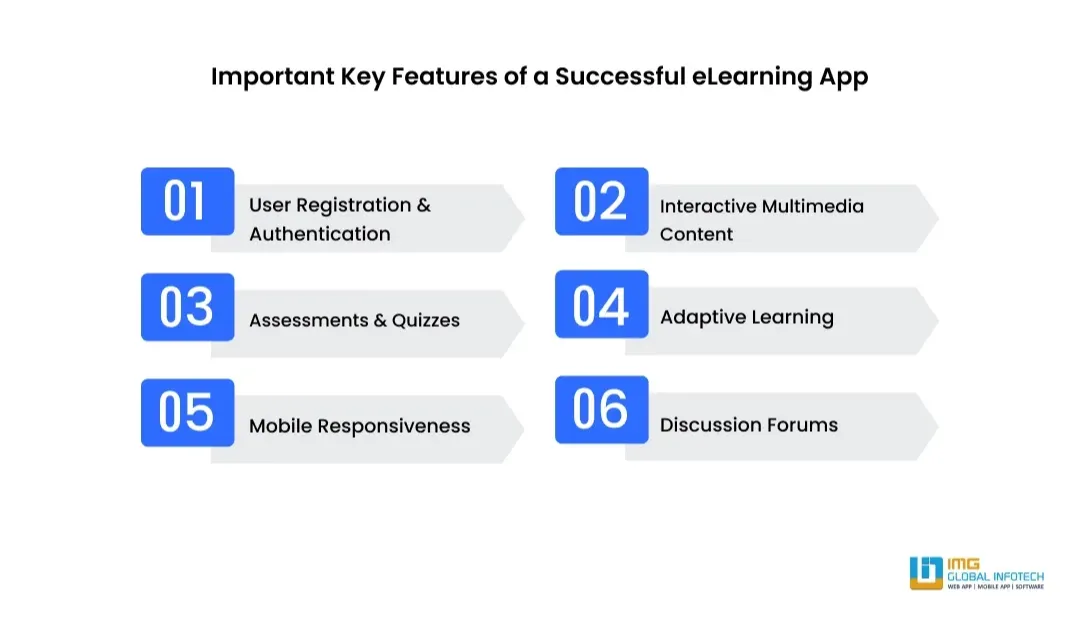
Before we dive into the development stage, it is important to know about the eLearning app features list for your e-learning platform that we have discussed in the introduction part, where this whole guide begins.
This is the major decision that can change the landscape of e-learning and that can also evolve the responsiveness of dynamic apps to build on-demand elearning app. Here are some dedicated features that can help to build a scalable e-learning app according to your terms as well.
User Registration & Authentication
Basically, this feature can allow learners to build accounts that can sign in securely and access personalized learning experiences of the user by the Best AI Education Apps. The user profiles can help to track progress and cater content to everyone's needs and requirements as well.
Interactive Multimedia Content
The e-learning apps can incorporate the interactive multimedia content that can enhance the engagement and comprehension. It mainly includes videos, animation videos, and interactive quizzes to make learning more dynamic and appealing for users as well.
Assessments & Quizzes
The assessments and quiz functionalities are important for examining the learners' understanding of the course material on how to build elearning app. The e-learning apps offer a variety of question types with instant feedback and performance analytics to help in self-assessments as well.
Adaptive Learning
E-learning apps use data analytics and algorithms to tailor content and recommendations to each learner's skill level and learning style. Adaptive learning ensures that the difficulty of the content corresponds to the learner's progress.
Mobile Responsiveness
In this mobile-first age, e-learning apps must be mobile-responsive and cross-platform compatible in AI in education. This flexibility enables users to seamlessly switch between devices, ensuring continuous learning experiences.
Discussion Forums
Many e-learning applications promote community through discussion forums and social features. Learners can participate in discussions, ask questions, and collaborate with peers and instructors to foster a supportive learning environment.
Step-by-Step Process to Develop an eLearning App
Launching the development of an e-learning app is definitely a challenging task. The abundance of options can be very exciting, yet it is important to have a solid plan for the next steps. To help you with that, we have made a summary of the main steps to start creating a fantastic educational experience for your users effectively.
Understand Your Target Audience
It is necessary for you to figure out the audience of the software before starting the developing process in MVP development for education apps. Keep in mind that the audience will decide the look, working, and features of your platform.
Who is your target audience? Is it the children in school for whom you are creating the platform, or the professionals who want to learn more, the people who are ready to follow their interests, or the experts with special learning needs? Recognizing your main audience is a great gesture that will affect the content and layout of the platform.
Select a Content Strategy
You need to create a content strategy that will connect with your audience after you have developed audience knowledge. Start the process of offering your products by selecting your products, which will provide customers with interesting and diverse options.
Evaluate Financial Resources
Financial resources need to be organized through detailed budgeting when creating an e-learning solution that functions like any other significant project in custom eLearning app development. Your spending capacity includes total spending limits but requires you to track your specific funding distributions.
Employ Specialized Software Developers
The team development process begins after you complete your initial project tasks, which require outside professionals to implement your creative ideas in eLearning app development guide. The development process of an e-learning platform becomes easier when developers work as a specialized team.
Select Fundamental Technology
Your e-learning system needs appropriate technological infrastructure because it serves as the fundamental element that enables your system to achieve both stability and growth.
Develop the Platform
Design extends beyond visual appeal since it creates spaces that users can navigate with ease. E-learning platforms require the development of an interactive user interface that supports students during their educational journey.
How Much Does It Cost to Develop an eLearning App?
The average cost to build an eLearning app is $5,000 to $15,000 or beyond. The major cost mainly depends on diverse factors and the level of the customization as well.
eLearning Apps: Monetization Models That Work
The successful eLearning applications of 2026 need multiple revenue streams to achieve their goals. The organization selects its revenue methods according to three factors: student learning patterns, the amount of material available, and their plans for maintaining student interest over time.
Subscription-Based Model
The model functions best when platforms deliver ongoing benefits to users. The system generates consistent revenue through monthly and annual subscriptions, which drive teams to improve customer retention and update content and maintain student learning over extended periods.
Freemium with Paid Upgrades
The platform provides free basic content to users who must pay to access advanced courses and certifications and premium features in the elearning app development service. The system provides a cost-effective entry point that generates revenue from dedicated students who recognize substantial benefits.
Course-Based One-Time Purchases
The platform works best for users who want to achieve specific skills or obtain certification through its courses. The platform needs users to make a single payment for each course, which creates price clarity but enables the platform to market more advanced learning modules and complete learning bundles to customers in the future.
Corporate or B2B Licensing
The system allows companies to pay for employee training programs, which they can implement across their entire organization. The business model generates valuable contracts, which create consistent income streams and result in customer relationships that last for more than one year. The model works for programs that focus on compliance training and onboarding and professional development.
In-App Purchases for Add-Ons
Students spend money on additional items such as downloadable materials and practice exams and individualized assessments to examine the Elearning app development cost. The learning model succeeds when the primary education component performs well and supplementary materials actually enhance the learning results.
Advertisement Pattern
Free learning platforms can use ads to create revenue streams, but ads should not disrupt the educational process. The system functions best when applied to popular applications that prioritize delivering excellent user experiences.
Future Trends in eLearning App Development
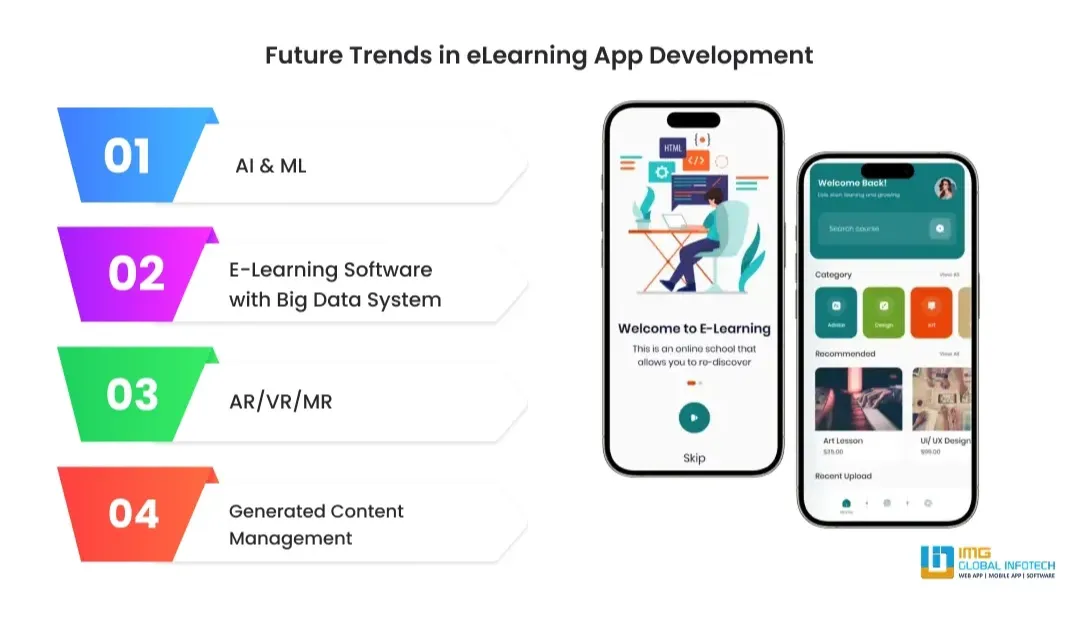
Online learning is gaining popularity in schools, colleges, preschools, and independent studies. It's no surprise that the number of free learning apps available has increased dramatically.
While researching this subject, you will come across a variety of predictions and forecasts, but we want to focus on the top e-learning software development trends for this article.
AI & ML
Artificial intelligence has enhanced the workflow of diverse industries and proved to be efficient in e-learning platforms. AI and ML technologies are being integrated into e-learning apps that can offer personalized learning experiences and automate administrative tasks, as well as offer intelligent tutoring systems.
E-Learning Software with Big Data System
In multiple ways, data analytics from big data can be used by educational apps to make learning more attractive, tailor course content, and improve student achievement. E. Learning apps can record and evaluate the huge amount of data produced by learners' usage of the platform.
AR/VR/MR
With AR in e-learning apps, it is possible to get additional information about the real-world objects or locations, thus facilitating the understanding and making the learning experience more fun to examine the Cost to Build an EdTech App Like Brainly. Besides, it can provide the users with the interactive simulations where they can perform virtual manipulations of the experiments and thereby learn better.
Generated Content Management
This feature has not been well explored yet, and I think that with the popular use of the social media apps, the educational apps can borrow some features, like the ability to generate and share with the peers, and really facilitate the learning process.
Such materials can be in the form of discussion forums where users are able to participate, inquire, and share their thoughts; collaborative projects that enable them to exchange documents; peer feedback projects that enhance the awareness and the accessibility of the app; and user-generated content libraries.
Why Hire IMG Global Infotech for eLearning App Development?
Developing a successful eLearning application isn’t just about writing clean code; it’s also about thinking like a product. As a team, our core focus is on learning outcomes, scalability, and growth, not just features and deadlines.
Proven eLearning Experience
We build eLearning apps based on actual user behavior and experience, not theories and hypotheses. From content delivery to user retention, our architectural decisions are centered around user experience and engagement.
Fully Custom Development
Every eLearning business has its own set of objectives and needs. Our development team crafts custom eLearning solutions that meet your specific needs and objectives.
Secure and Scalable Systems
As an eLearning business, security and compliance with global educational standards are topmost on our agenda. Our eLearning apps are built with security and scalability in mind to ensure seamless user experience and acceptance.
End-to-End Support
From concept development to UI/UX design and finally to the launch and optimization of your eLearning application, our team will support you at every step.
Final Thoughts
The e-learning industry is a gold mine of opportunities for business owners who want to influence education significantly. The idea of developing new and thrilling e-learning software might be quite intimidating at first. But, if you get the help of the right people, you can come up with successful e-learning software anyway.
Since many companies want to stay digitally transformed, personalized e-learning solutions could become a lucrative business. An edtech software development company like IMG Global Infotech can put together the e-learning software you need.
Our e-learning software development services experts have a background in software development and can be a great support for companies in areas of their projects that are most difficult.