“I want an app that can be used everywhere.”
“So, that is why two different teams for iOS and Android?”
“In fact, in 2026, if you’re developing two separate apps for one standard business need, you’re basically burning money.”
The conversation isn’t the same anymore. A few years ago, the term “hybrid” referred to the budget-friendly but “laggy” relative to native development. Fast forward to 2026, and the story is reversed. Now with two frameworks, such as Flutter 4.0 and React Native’s latest architecture, hybrid apps aren’t just “good enough”—they’ve become the go-to choice for both startups and enterprises alike.
However, the question remains the same: How much does it cost to hire hybrid app developers in this high-tech landscape? Whether you’re exploring hybrid app development services or trying to estimate the hybrid app developer hourly rate, this guide explains the real cost structure of the 2026 market.
Overview
In 2026, hybrid development has officially shed its reputation as the more affordable choice. We’re no longer stuck with slow, clunky web-wrappers, entered an era of cross-platform excellence. Thanks to frameworks like Flutter 4.0 and React Native’s latest architecture, hybrid apps now provide an experience that is almost native, so that 99% of users cannot differentiate between a pure Swift or Kotlin build.
With a single codebase to drive both iOS and Android, businesses are cutting their hybrid app development pricing to approximately 40–50%. However, with the technology becoming mature, the market has become tight. Hybrid mobile app developers have become in demand due to the global push towards the ‘Engineering Velocity.’ Companies do not have to wait a year for dual-platform launches when high-performance Custom Cross-Platform App Development solutions are available in half the time. In 2026, going hybrid is not only a move that will save costs—it is also a strategic move to the finish line.
Why Businesses Prefer Hybrid Apps in 2026
“We must be on the App Store and Play Store. Yesterday.”
“Alright, but we can only afford one team.”
“Perfect. Build it hybrid.”
This isn’t a compromise anymore—in 2026, it’s the winning strategy. Recent statistics in the industry have indicated that 82% of startups are opting to hire hybrid mobile app developers for their MVP launches. Why the massive shift? Since in such a competitive market, “good enough” is not an option, but “too slow” is a death sentence.
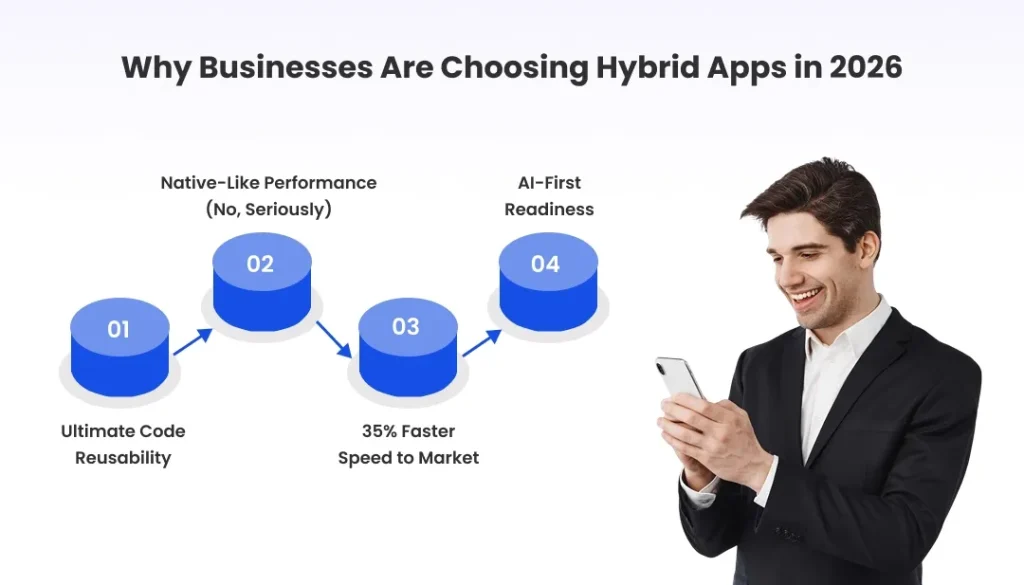
- Ultimate Code Reusability: The “Write once, run everywhere” mantra has at last hit its climax. Modern frameworks enable 90% code sharing across platforms. You aren’t just saving on initial hybrid app development cost, but you are in effect halving your long-term maintenance and quality assurance burden. One bug fix, one codebase, both stores updated.
- Native-Like Performance (No, Seriously): The “jank” and stutter of old hybrid apps are officially no more. With 2026’s advanced bridge architectures and GPU-accelerated rendering, frameworks like React Native and Flutter deliver smooth 60–120 FPS performance. Your users will have no clue the difference unless you are making a high-end 3D game; however, your CFO will.
- 35% Faster Speed to Market: In 2026, if you’re not first, you’re forgotten. Hybrid development cycles are about 35-40% faster than dual-native builds. This can enable companies to get user feedback, pivot, and iterate as native-oriented competitors continue to have a debate over their iOS vs. Android strategies.
- AI-First Readiness: Hybrid apps are just app-fitted to the AI age. They are also compatible with cloud-based enterprise generative AI solutions and third-party APIs, where it is easier to add a recommendation engine or conversational interface without significant architectural redesign.
Choosing to hire hybrid app developers means you’re choosing speed and flexibility. It is concerned with spreading the word to the largest audience using the bare minimum of resources without compromising the high-end feel that 2026 users demand.
Hybrid App Developer Hiring Models
You have to decide how you want to hire before you peek at the numbers. In 2026, the “where” is just as important as the “how.”
- Hourly Rate (Freelance): Ideal in case of small corrections or maintenance. While the hybrid app developer hourly rate may be tempting, there is no project management, and this may cause scope creep.
- Dedicated Team: It is the scalability sweet spot of businesses. You hire hybrid app developers who work exclusively on your product and are considered a part of your in-house team.
- Fixed Cost (Project-Based): Perfect for MVPs with a crystal-clear roadmap. You are paying for the destination and not the hours spent on the drive.
How Much Does It Cost to Hire Hybrid App Developers?
The cost to hire hybrid app developers is on a scale. In 2026, the global average investment for a hybrid project will be as shown below:
If you are looking for specific technology, the Flutter app development cost and React Native app development cost are incredibly competitive, but in complicated UI scenarios, Flutter tends to win.
Key Factors That Affect Hybrid App Development Cost
What really causes the needle on your invoice?
- The Framework (Flutter vs React Native): Both are affordable, but if you hire Flutter developers, that can be a little more expensive since it would necessitate the specialised knowledge of Dart, whereas when you hire React Native developers, you will access the enormous talent pool of JavaScript.
- The Intelligence Layer: Implementing Generative AI or Machine Learning modules costs about 20-30% of the total hybrid app development cost.
- UI/UX Sophistication: The pixel-perfect, custom animations on all screen sizes (even foldables, the 2026 trend!) will need high-level engineering.
How to Reduce Hybrid App Development Cost?
“We have a great idea, but we do not have a Silicon Valley budget.”
“You don’t need one. All you need to do is be smarter than the guy who thinks that by putting more money into the screen, you will make the code faster.”
To build a massive app in 2026, you do not require a giant bankroll. There is nothing in the “insider” strategy which involves cutting corners; it is strategic optimisation. Attempting to maintain your hybrid app development pricing lean without appearing cheap, then this is how the professionals do it:
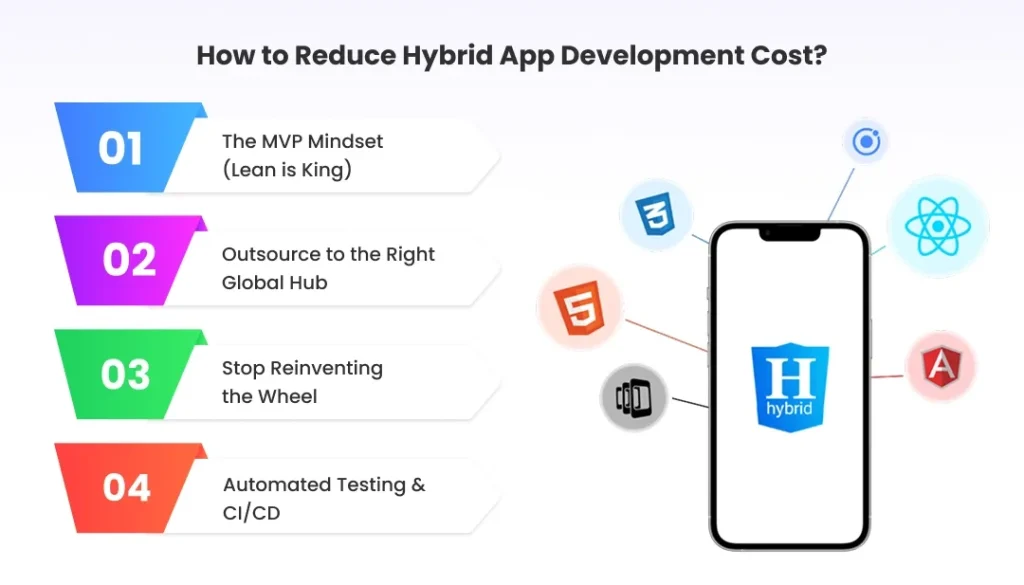
- The MVP Mindset (Lean is King): Don’t build the Taj Mahal when your users are just looking for a cosy home. Begin with a Minimum Viable Product. Focus only on the core features that solve your users’ main problem, and you reduce the initial hybrid app developer cost 2026 and get into the market months earlier. You can always add the features of “gold-plated” after you have actual user data (and revenue).
- Outsource to the Right Global Hub: In 2026, the “where” is important as much as the “how.” Incorporating a hybrid app development company in India, you will be saving up to 60% compared to Western costs. But here’s the secret: it is not merely about the lower price; it is about accessing a vast, highly specialised pool of talent that breathes and lives cross-platform code.
- Stop Reinventing the Wheel: Does it make sense to pay a developer to spend 40 hours building a custom chat or payment gateway from scratch? Use proven and tested SDKs and pre-built modules to use common functions such as auth, payments and push notifications. This significantly reduces the hybrid app development cost and ensures your app uses industry-standard security protocols when it is first created.
- Automated Testing & CI/CD: Make a slight investment now in DevOps to save a fortune later. Automation of your testing and deployment pipelines means that the number of human hours required each time you need to update is reduced, which makes the long-term hybrid app development services costs predictable and low.
These steps will not only help you save money, but you will also be creating a more sustainable and agile business model.
How to Choose the Right Hybrid App Developers?
In 2026, the wrong partner selection is what will make the difference between a high-performing product and a “buggy” investment. To make a strategic hire, search for the following important markers:
- The Tech Stack Fit: Do not simply hire a generic developer. You require experts who are aware of Flutter vs React Native trade-offs according to your business logic. If they are unable to explain why they chose one over the other, it is a red flag.
- Industry-Specific Portfolio Depth: The team that built a fitness app may not be able to cope with the rigidity of the hybrid app development services in Healthcare or Fintech. Test the success of your niche.
- Mastery of Native Modules: High-level hybrid mobile app developers should know how to build “bridges” to native Android or iOS features. Lack of this will lead to bottlenecks in your app.
- Post-Launch Support & Scalability: An app is a living organism. Make sure your hybrid app development company has strong support and a structure that is designed to support your initial 100,000 users without a total rebuild.
- Transparency & Communication: Builds based on efficiency are founded on Agile methodologies and effective updates. If they can’t explain the roadmap using plain English at this moment, the coding stage will continue to become even more disorganised.
Conclusion
“Is it worth the investment?”
“In 2026? Not only is it worth it, but it is also the only means to stay relevant.”
The cost to hire hybrid app developers is a bet on the quickness of your company. Through a hybrid solution, you are not only saving money; you are also acquiring the capacity to pivot, scale, and reach your audience regardless of which device they are holding.
The “Next Big Thing” in mobile is not a new device, but how effective a life you can lead on all of them. Whether you’re looking for the best mobile app development company to take over the entire project or you need to hire hybrid app developers to boost your team, time is of the essence.
The race is already coding. Are you?