“Wait, I can simply purchase it directly from the brand’s website?”
“Yeah, and it’s cheaper, and they have also given me a personalised discount on my next order”
“And may I guess—it arrived in two hours?”
Welcome to the retail future of 2026. If the past several years were about “going digital,” this year is about “going direct.” The intermediary—the traditional retailer that stood between you and your customer—is increasingly being turned into a ghost of the past.
For modern entrepreneurs and established manufacturers alike, the D2C business model has become not only a “bold experiment” but even a “survival necessity.” And yet what makes direct-to-consumer ecommerce so magnetic in 2026? Whether you’re looking to build D2C ecommerce app like Nykaa or you just have to get acquainted with the advantages of launching a D2C ecommerce brand, this guide is your masterclass in the direct-to-heart economy.
What Is a Direct-To-Consumer (D2C) Ecommerce Brand?
Let’s skip the jargon. A D2C ecommerce brand is any business that designs, advertises, and sells its products directly to the customer, purposely avoiding the middlemen of wholesaler, distributor and retailer. This is not just a niche strategy to start-ups anymore; in 2026, it is a $100 Billion revolution (in India alone) that has compelled even legacy manufacturers to reconsider their entire existence.
In the “old world” (pre-2020), the supply chain was a telephone game that was both long and expensive. A manufacturer would sell to one of the distributors, who would sell to one of the regional wholesalers, who would then sell to a physical shop, which would then sell the item to you. There was a “middleman tax” at each stage that increased the cost and watered down the message of the brand.
The D2C vs traditional retail has turned to the side of the “Relationship Owners” by 2026. By investing in D2C website development, you are not merely opening a store; you are taking over ownership of the whole customer story.
Ownership of the Unboxing
In D2C, a consumer does not have to feel their product first by opening it in an overcrowded supermarket shelf; they can do it in the privacy of their own home. You own that “wow” moment.
The Feedback Loop
D2C provides real-time information as opposed to the months of waiting after selling a product before the sales report comes, and you can see that a product failed. When a customer despises something, you know in a few minutes, which opens the door to the type of fast innovation that old-fashioned, slow retail cannot possibly follow.
Direct-to-Heart Marketing
In 2026, you are not selling an item of commerce, but a community. Whether it’s through a custom D2C ecommerce platform or a mobile app, you are creating a direct connection with the lifestyle, values, and everyday habits of the consumer.
Key Benefits of Launching a D2C E-commerce Brand
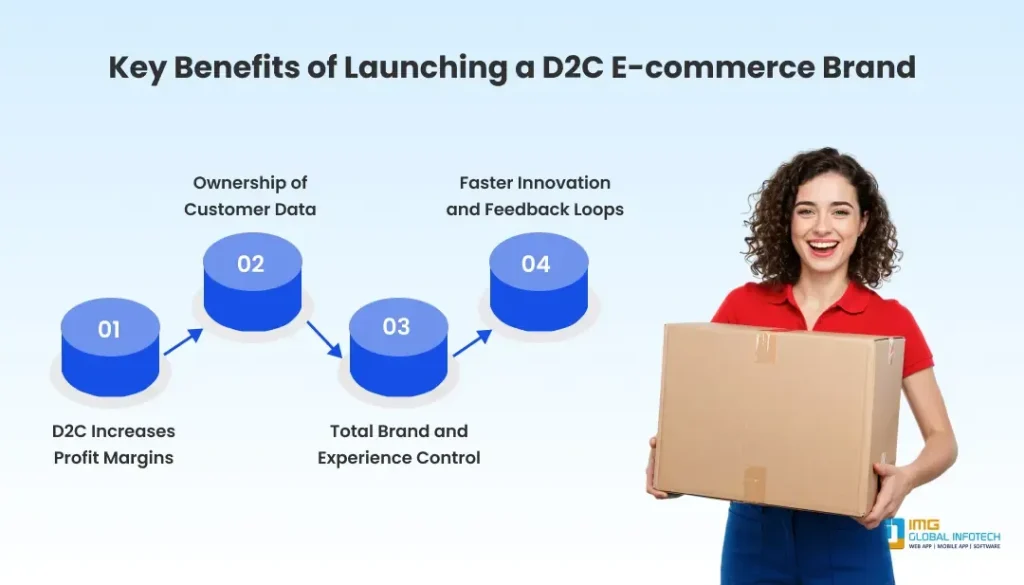
Why are both startups and giants alike obsessed with D2C ecommerce development services? The benefits are much more than that of “cutting out the middleman.”
D2C Increases Profit Margins
This is the “no-brainer” advantage. In a traditional system, it is a retailer who makes a 30-50% cut just for letting your product sit on their shelf. When you make direct sales, you keep that margin in your pocket. This enables D2C ecommerce benefits for startups for start-ups to take the form of additional funds for R&D, accelerated growth, or lower prices. That additional 30% margin in 2026, when inflation has tightened the belt of manufacturing expenses, is the difference between a successful brand and a bankrupt one.
Ownership of Customer Data
Data is the new oil in 2026. In the case of third-party marketplace selling, they own the customer. You have the goldmine when you sell directly to consumers through your own e-commerce website for D2C brand. This “first-party data” is what drives hyper-personalised marketing and keeps your acquisition expenses low. You are fully aware of your customers’ shopping time, their colour preferences, and their time to come back and buy again.
Total Brand and Experience Control
With D2C website development, you have the power of every pixel of the user experience. The soul of the brand is determined by the storytelling on your home page to the “surprise and delight” note in the packaging. This control builds brand equity in the long-term. You are not merely a “commodity” on an Amazon list; you are a destination.
Faster Innovation and Feedback Loops
Traditional retailing takes months before testing a new product. A D2C brand could release a beta product on Monday, receive customer feedback on social media on Wednesday and design around it by Friday. This is one of the biggest advantages of launching a D2C ecommerce brand.
This responsiveness is among the biggest reasons why many founders are pouring into D2C ecommerce website development for startups, to enable them to experiment, gather feedback rapidly and modify products according to the actual customer demand.
Challenges of Running an E-commerce D2C Brand
The shift to a Direct-to-Consumer (D2C) framework is demanding the overall assumption of operating accountability. Though the model does not have any intermediary costs, it requires the brand to manage every facet of the value chain, shifting the burden of logistics, infrastructure, and customer service to the manufacturer or startup.
By 2026, the era of “DIY” logistics and streamlined backend management is basically over. The sophistication of modern retail necessitates high-level, professional D2C ecommerce development services to handle the growing complexity of integration between inventory, fulfilment and customer data.
Key Operational Challenges:
Logistics & Fulfilment
When individuals anticipate a 2-hour delivery, it is an inconvenience to operate your own warehouse. To remain competitive, many D2C brands now use “Micro-Fulfillment Centers” or collaborate with Quick Commerce (Q-commerce) players such as Zepto or Blinkit.
Rising Acquisition Costs (CAC)
With the emergence of more brands going direct, the digital space becomes crowded. This is why the importance of D2C ecommerce development has the value of retention as well as acquisition. Retaining a client is less expensive than acquiring one.
Customer Support
You become the face of the brand in D2C. When a delivery is delayed, there is no one to blame. Your D2C website development should include real-time tracking and immediate support of AI.
D2C E-commerce Development Trends in 2026
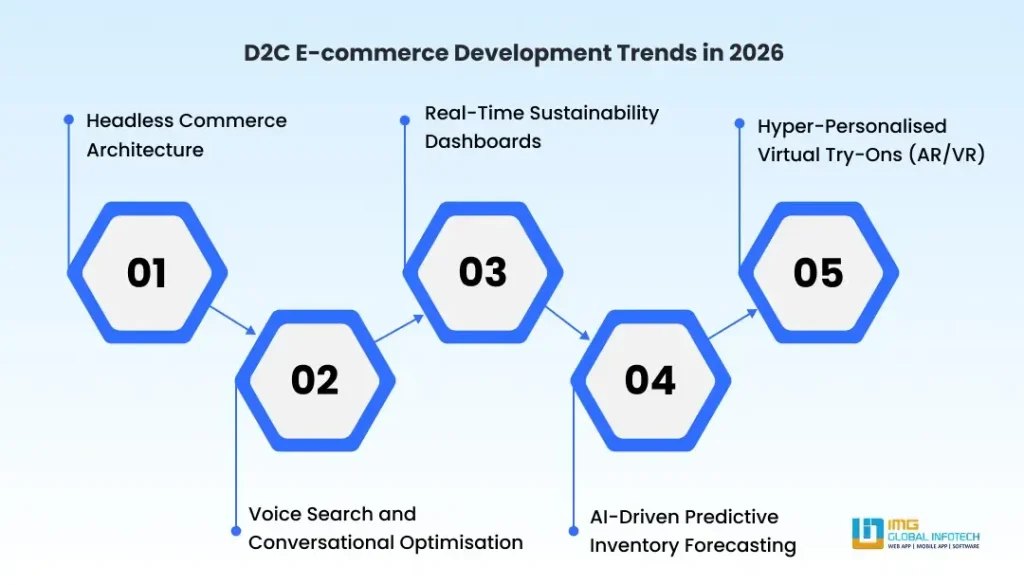
In order to have a competitive advantage in a saturated market, a strong D2C ecommerce strategy extends beyond its fundamental features and incorporates new technological innovations. The emphasis in 2026 has changed to speed, anticipatory intelligence, and radical transparency.
Headless Commerce Architecture
It has now become a standard requirement of high-performance brands to decouple the front-end layer of presentation from the back-end layer of commerce logic. Lightning-fast loading speed is possible in this architecture, and normally, site response times are less than 1.5 seconds. Even 3 seconds load time, in the current landscape, is associated with an 80% bounce rate, and thus, headless commerce is required to support retention in direct-to-consumer ecommerce.
Voice Search and Conversational Optimisation
With smart speakers and AI-driven personal assistants becoming the main shopping agent consumers will encounter in their lives, the D2C website development will have to shift to Natural Language Processing (NLP). Voice optimisation is about arranging data based on long-tail, conversational searches, instead of using keywords, so that when a user requests his or her AI assistant to find a particular product, your products are listed as the first result.
Real-Time Sustainability Dashboards
In the year 2026, consumer psychology will be greatly shaped by the impact on the environment. Modern D2C ecommerce brands are incorporating sustainability dashboards that give a visible image of the carbon footprint of each order. Such radical transparency is an effective instrument of loyalty since contemporary shoppers put priority on the brands which provide verifiable information about their ecological impact.
AI-Driven Predictive Inventory Forecasting
Machine learning has now been implemented to offer hyper-localised demand forecasting. Through examining future local festivals, weather conditions, and social media buzz, AI tools for e-commerce business will be able to forecast a run on a certain product (lost yellow linen shirts before a spring festival). This prevents the twin pitfalls of stockouts (lost revenue) and overproduction (sunk capital) and will have a lean and profitable supply chain.
Hyper-Personalised Virtual Try-Ons (AR/VR)
Augmented Reality has become a tool that has a high conversion rate. In addition to mere overlays, 2026’s D2C ecommerce development services will also have Virtual Closets where a customer, based on their biometric data, can see exactly how a garment would fit their body shape. This lowers the Return to Origin (RTO) rates, which are common with fashion-forward D2C start-ups.
Conclusion
Let’s be honest—is traditional retail dead?
No. Definitely, it is certainly defensive.
The future of retail is in the brands that can look their customers in the eye (digitally) and say, “I made this for you.” Adopting the D2C business model means that, when you are selling a commodity, you are not only doing so, but you are also forming a community.
The future of retail belongs to brands that build direct relationships with their customers. For emerging businesses, investing in D2C ecommerce website development for startups is no longer optional—it is the foundation for long-term growth.
You can count how many times the e-commerce website development cost or dream about the next success of the “Nykaa-level” success, the path is clear: Go direct, or go home. The “next big thing” is not a new product in 2026, but rather a relationship you establish with the buyer of the product.
Get back your margins and own your customer journey? In IMG Global Infotech, the way we do it is not to build sites, but D2C empires. Being one of the most popular e-commerce website development companies, we are offering the D2C e-commerce development services that provide you with a complete picture of how to transform your brand vision into a digital giant.