Everyone’s talking about D2C brands lately. Is it really that big of a deal? Absolutely. Selling directly to customers has flipped traditional ecommerce on its head.
Ever noticed how some new brands pop up and instantly feel… everywhere? And funny thing is, most of them aren’t even on big marketplaces.
Now imagine if an emerging skincare company has launched on a large ecommerce site and has generated some sales, but only with lower than expected profit margins. They are unable to access their customer data, and discounts are consistently offered to acquire new customers — frustrating, right?
Now flip the script. Look at the same brand after launching d2c ecommerce platform. They now have insight into who buys, why they buy, and how to get them to continue to purchase from them.
So you’re saying owning the website changes the game? Completely. A D2C website isn’t just a store—it’s your brand’s home, data hub, and growth engine.
If your business is an emerging business, and you want to understand how D2C businesses are able to grow faster, market smarter, and create loyal customer communities, you have landed in a place. We will break it down for you with no jargon, no fluff, and plenty of real talk.
What Is D2C Ecommerce?
Okay, but what exactly does D2C mean? Simple—brands sell straight to customers, no wholesalers, no marketplaces in between.
Brands have total control over the customer experience when they use the D2C Model of Ecommerce, which includes marketing, checkouts, deliveries, and customer engagement following the completion of the purchase.
Your best asset would be your eCommerce website rather than a third-party marketplace.
Startups can take charge of branding, pricing, customer data, and personalisation by utilising a D2C eCommerce website. As a result, instead of using third-party marketplaces, many entrepreneurs nowadays decide to build their own D2C eCommerce platform.
D2C Ecommerce Website Global Market Overview
Is the D2C market actually growing, or is this hype? The numbers say it’s very real.
Due to escalating customer acquisition costs associated with marketplaces, global companies are quickly transitioning to D2C retail via ecommerce channels. As per current D2C ecommerce market trends, today’s consumers want to purchase directly from manufacturers. That’s because it includes price advantage over retailers, improved product quality assurance through direct access to brand authenticity, and dedicated product support services when dealing directly with a manufacturer rather than another company selling their products.
New D2C ecommerce startups are disrupting established retailers by offering niche products, brand-centric approaches to building community-based brands, and delivering hyper-personalized e-commerce shopping experiences. These D2C ecommerce trends show one clear thing—brands that own customer relationships win in the long term.
What are the Benefits of Building a D2C Ecommerce Website for Startups?
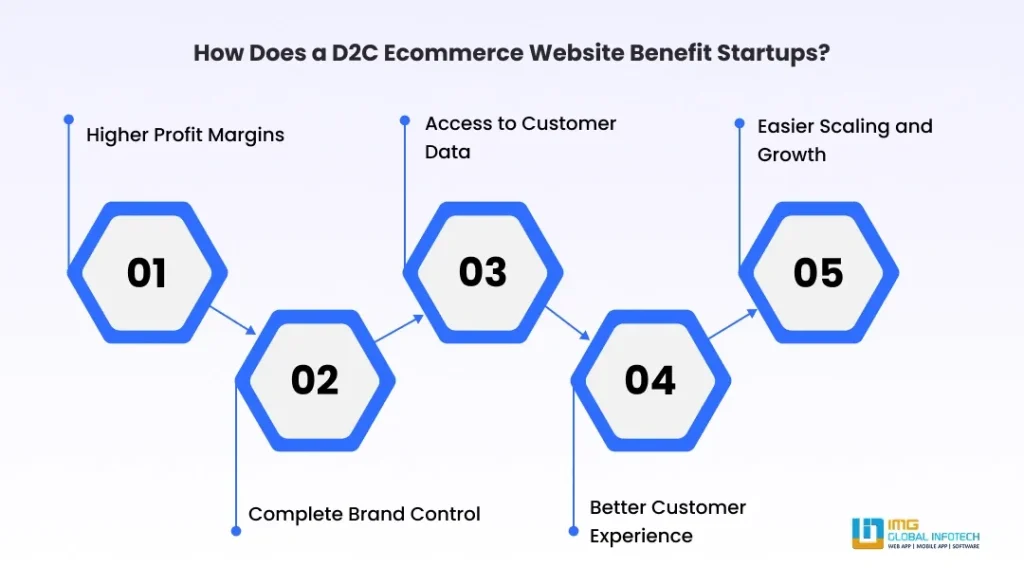
Why shouldn’t startups just sell on Amazon or Flipkart? Because control beats convenience in the long run.
Here’s why startups are investing in D2C ecommerce platforms.
Higher Profit Margins
By selling directly, the startup has more control of its pricing and fewer commissions, allowing for larger margins that enable the startup to reinvest in itself and grow faster.
Complete Brand Control
With your own website, you have control over how your customers perceive, feel, and remember your brand through the design and messaging you use, without limitations of marketplaces or enforced templates.
Access to Customer Data
Understand who your customers are, why they buy from you, and how to reach them. Email communication, tracking customer behavior, and preferences will allow you to provide personalized offers, retarget your customers more intelligently, and create long-term relationships rather than simply one-time purchases.
Better Customer Experience
Since direct websites allow customers smooth transitions from browsing to purchase. They also allow for faster response to customer inquiries, customized product recommendations, and loyalty programs.
Easier Scaling and Growth
If the startup has built a solid foundation, it can easily end up introducing new products, growing internationally, adding features to the product line, and building up its customer base. They do not have to rely on marketplace rules and changes in their algorithms.
What are the Key Features of a D2C Ecommerce Website Development?
What features actually matter in a D2C website? To answer this question, think from a customer’s point of view, not just with the cart-first approach.
A powerful d2c ecommerce website platform should include
User-Friendly & Mobile-First Design
Visitors are drawn to a smooth, mobile-friendly interface. By offering simple navigation, fast load times, and prominent CTAs, you can easily convert casual visitors into confident purchasers with minimal effort.
Secure & Flexible Payment Options
Offering multiple payment options provides customers with instant confidence in your brand. Providing a flexible checkout process. It makes checking out easy and decreases the likelihood of someone abandoning their shopping cart.
Smart Product Management System
All products can be managed from one location. This ensures that they can be updated on time and that they do not oversell themselves. It enables startups to quickly launch new lines of products without the headache of operational issues.
Customer Data & Analytics Dashboard
The built-in analytics allow businesses to see the things their customers enjoy. By tracking customer behaviour, sales trends, and conversion rates, businesses can make more informed marketing decisions – rather than simply guessing which methods will work.
Marketing and Personalization Tools
By implementing email automation and loyalty programs, startups are able to build lasting relationships with customers, increasing their repeat purchases and organically growing their brand love.
Modern D2C ecommerce development solutions focus on performance, personalization, and scalability—because startups grow fast.
How to Develop a D2C Ecommerce Website?
So how does development actually start? It starts with a proper step-by-step approach. No shortcuts.
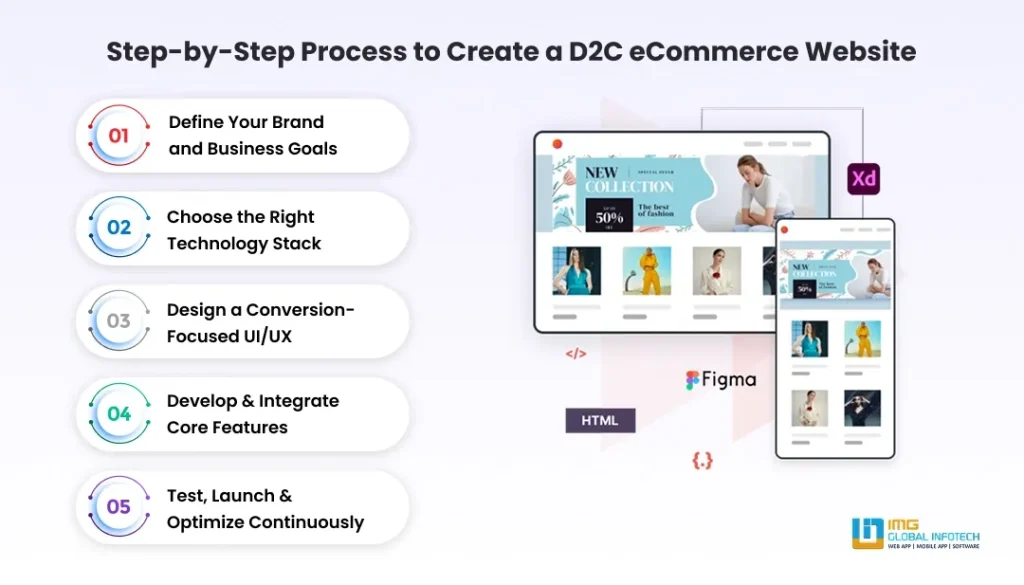
Define Your Brand and Business Goals
Establishing clarity is key. To create a purposeful D2C online store, you need to know who your audience is, where you’re positioning your product, what pricing strategies you are considering, and your growth goals.
Choose the Right Technology Stack
Select a scalable technology option that will foster your growth efforts. Whether you choose custom or CMS-based options, you want to ensure you have a technology stack that is fast, secure, and flexible so your startup can grow.
Design a Conversion-Focused UI/UX
Your direct-to-consumer ecommerce website must be intuitive, fast, and conversion-friendly, allowing for simple navigation, attractive imagery, and straightforward CTAs. It incentivizes users to move smoothly through the process—from browsing to checkout with minimal confusion.
Develop & Integrate Core Features
Develop the critical features of payment processing, inventory, customer relationship management (CRM), and logistics in your D2C store. Integrating smart systems will provide a better experience for customers, from the moment they place their order to the delivery of their order. This is where d2c ecommerce website development turns designs into a working product.
Test, Launch & Optimize Continuously
Conduct pre-launch testing of all aspects of your new online store. Once your store is live, continuously monitor its performance, resolve any issues, and continue to optimize for the best user experience, and to improve your store’s conversion rate and growth potential.
Partnering with a reliable d2c ecommerce website development company ensures the process stays smooth and scalable.
How Much Does It Cost to Develop a D2C Ecommerce Website?
Coming to the money part, it depends on features, scale, and customization.
So what’s the budget range?
Let’s break it down.
Basic-Level Website Cost
A basic or simple Ecommerce website development cost ranges from $5,000 to $8,000. It is a good choice for small businesses and startups. Some of the features include:-
- Responsive design
- Product catalog
- User registration & login
- Basic checkout
- Contact form
Medium-Level Website Cost
A mid-level website cost ranges from $10,000 to $15,000. It is a good choice for growing businesses that are looking for expansion. Some of the features include:-
- Advanced search & filters
- Multiple payment gateways
- Order tracking
- Customer reviews & ratings
- CMS for content management
Advanced-Level Website Cost
An advanced-level website cost ranges from $15,000 and will go higher as per your needs. It is an ideal choice for large businesses. Some of the features include:-
- AI-based product recommendations
- Marketing automation tools
- Real-time analytics dashboard
- Multi-language & multi-currency support
- Third-party API integrations
Basic sites cost less, while advanced d2c ecommerce development solutions in India offer scalable and cost-effective options for startups.
For comparison, brands inspired by projects like build an app like Nykaa often invest more due to advanced personalization and omnichannel features.
What are the SEO & Marketing Strategy for D2C Ecommerce Websites?
Building is one thing—but how do customers find you? That’s where smart SEO and marketing step in.
A successful D2C ecommerce company focuses on:-
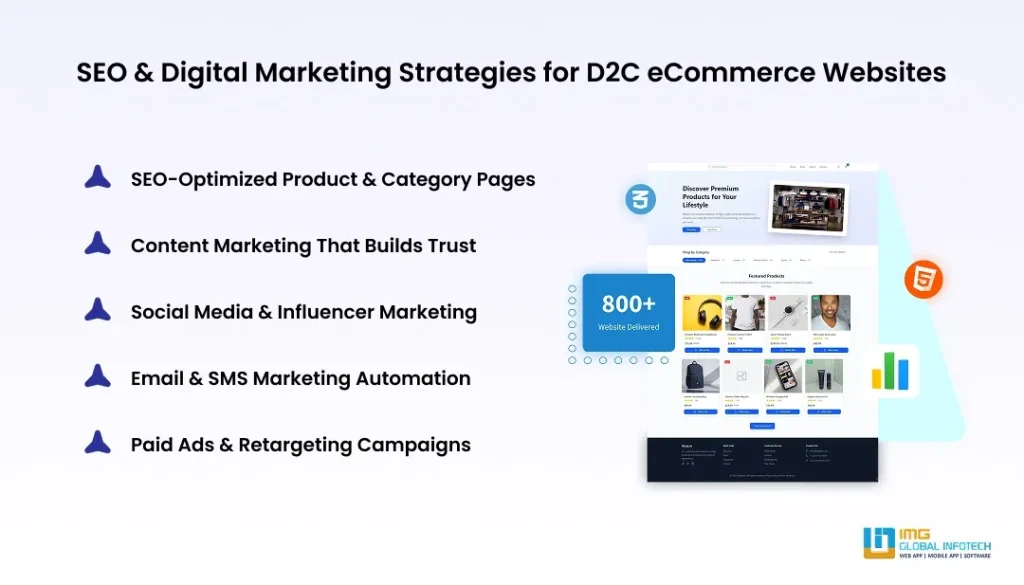
SEO-Optimized Product & Category Pages
Make sure to include the appropriate keywords, cleanly formatted URLs, and quick page load times to ensure both search engines and consumers can easily find your product without having to scroll for endless amounts of time and never getting lost on the website.
Content Marketing That Builds Trust
Blogs, guides, and videos respond to real questions from customers, establish authority, and create organic traffic. All of these are long-term benefits that continue to grow indefinitely once advertising stops. Some startups also use an AI link exchange platform to collaborate with relevant websites and expand their organic reach through strategic partnerships.
Social Media & Influencer Marketing
Connect with customers where they spend their time hanging out online. Social media posts and influencers will generate excitement and fuel conversations, as well as encourage more inbound traffic than outbound sales.
Email & SMS Marketing Automation
Auto-generated emails and text messages bring customers back into your store through sales notifications and product updates, all without requiring you to continuously create new email campaigns.
Paid Ads & Retargeting Campaigns
Smart retargeted Facebook ads remind potential buyers about products they liked, by providing them with another opportunity at the time of their decision to buy.
A strong D2C ecommerce platform paired with SEO creates sustainable traffic and long-term growth. For a Fashion-related business, a Fashion Ecommerce Development Company should be ideal, because they know the market and the industry inside out.
How Startups Can Scale Their D2C Ecommerce Website?
What happens when traffic grows? You scale—or you break.
Scaling tips for d2c ecommerce solutions are as follows:
Upgrade to Scalable Technology
Transition to a cloud-based system. Cloud hosting allows for smooth handling of a surge in user traffic, reducing chances for crashes in the event of a sudden increase in site visitors from your brand going viral.
Optimize Website Performance Regularly
Speed is key. The faster the website loads, the lower the bounce rate and the higher the likelihood of converting sales as compared to large retailers, keeping the customer from getting frustrated and leaving your site to shop at other retailers.
Expand Marketing Channels Smartly
Don’t just use one channel. Use SEO, social media, e-mail, and paid ads to create a stream of traffic from multiple sources, preventing growth from stagnating when you rely on a single channel.
Use Customer Data for Personalization
Understand how your customers behave and what they like. By providing personalized offers, recommendations, and content, you will enhance the customer’s sense of belonging and increase their chances of purchasing from your business again.
Add New Features Gradually
Grow your business gradually. Utilize applications, loyalty programs, and automation as they are needed in your business to maintain smooth operations without becoming a burden on either your employees or customers.
Many startups collaborate with Ecommerce website development companies in India to handle scaling smoothly without technical chaos. They offer an end-to-end solution at affordable prices without compromising on the quality.
How to Choose the Right D2C Ecommerce Website Development Company?
How do you pick the right development partner? Look beyond price. Think partnership.
Look for:
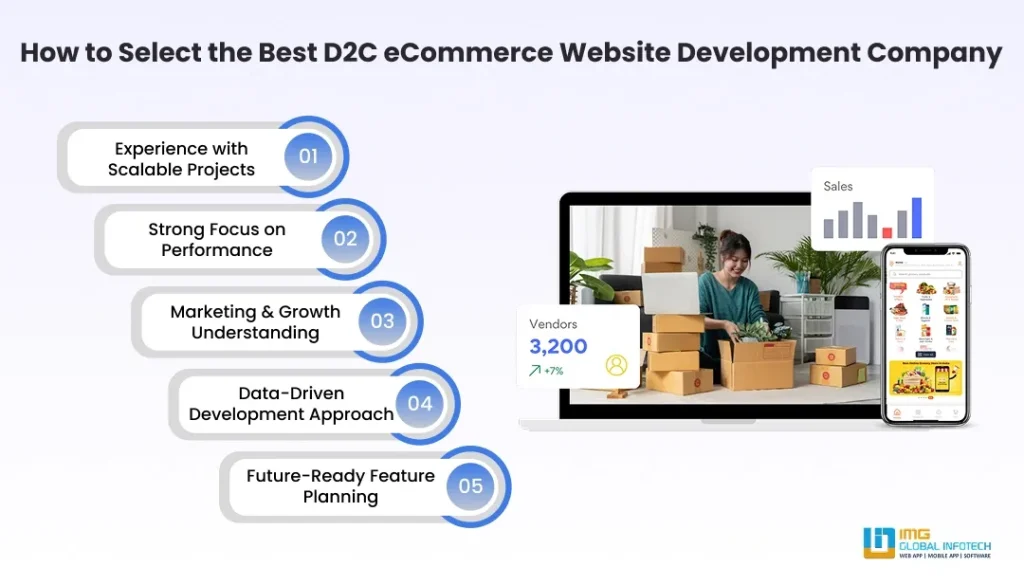
Experience with Scalable Project
Select an organization that develops a scalable solution using a cloud-based solution that can provide a fast, stable, and dependable website for traffic surges & high growth. They must have a proven D2C ecommerce app development or website development experience.
Strong Focus on Performance
The ideal partner is focused on optimising performance, like page speed and seamless navigation, through the reduction of your site’s bounce rates. It will lead to a higher conversion rate as your business scales.
Marketing & Growth Understanding
The best organisation understands search engines, social media, email, and advertising, and will prepare your site for multi-channel marketing rather than planning for growth after-the-fact.
Data-Driven Development Approac
Select a partner that values customer data and analytics, enabling them to offer an experience that is relevant and desirable to your customers, leading to repeat purchases and long-term loyalty to your brand.
Future-Ready Feature Planning
The best businesses will create a plan that will include gradual enhancements like a loyalty program and automation on your website, so the growth is seamless for your customers and your internal teams.
The right D2c ecommerce development company doesn’t just build, but it helps you grow.
CONCLUSION
So, is building a D2C site worth it for startups? If growth, control, and branding matter—100% yes.
Honestly? It makes more sense than ever.
A Direct to Consumer (D2C) website is an opportunity to build your brand, your customers and your future. Why spend the time building a business based on a platform that controls your audience, your margins, and your exposure when you can create a website that’s completely yours?
But isn’t it risky to go solo? Only if you do it without a plan.
With a strong strategy, scalable tech, smart marketing, and a trusted development partner, D2C can become your greatest asset instead of a risk you take. You can have direct contact with your customers, customize their experience, and grow at your own pace.
As trust, speed, and experience become increasingly important, ask yourself: would you rather rent your audience or own them?