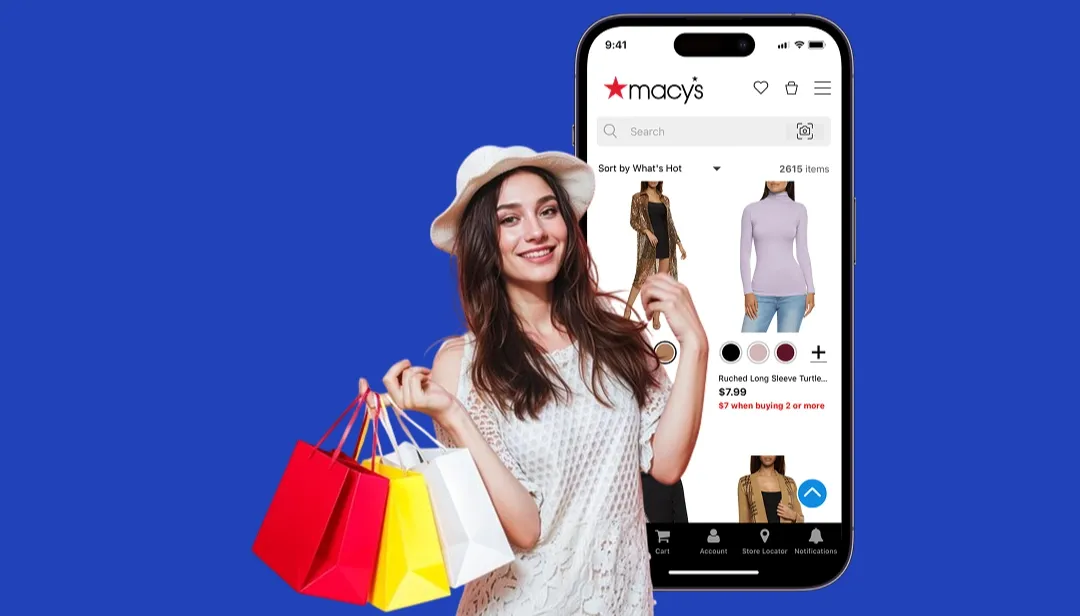
As the retail industry undergoes significant changes due to the increasing popularity of mobile commerce, customers' expectations of how they shop have changed as well. In this fast-paced world of technology, the consumer of today expects to be able to browse, receive recommendations that are tailored specifically to them, make purchases, and have their items delivered quickly from one application. Through a well-designed online shopping application similar to Macy’s, retailers will have the ability to keep up with the rapidly changing consumer demand while competing against established retailers.
The reason for Macy’s continued success is its combination of a solid brand image built over many years of customer service, along with the ease of using the mobile application. Retailers, both large and small, can benefit from opening their own online shopping applications similar to Macy’s to take full advantage of the opportunities for growth in online retailing through digital technology. In this article, we will provide you with all of the information necessary to understand Macy’s business model, as well as the requirements for developing, pricing, and future trends for an online shopping app like Macy’s.
Understanding the Macy’s App Business Model
In order to create a similar online shopping application for Macy, it is important to understand how the app generates revenue and how it retains customers. Macy's utilizes an omnichannel retail model, which connects both their physical stores and digital platforms seamlessly. This allows customers to view products online, check availability in-store, place orders to be delivered to their home or pick them up in stores. This hybrid approach not only adds convenience for the consumer but also maximizes sales opportunities across multiple channels.
The ecommerce app like Macy’will have to provide a lot of opportunities for customer engagement through their respective loyalty programs, app-only deals or sales, personalized offers based upon customer preferences, and seasonal discounts. Macy’s Star Rewards program is a significant motivator for repeat purchases.
Advertising partners, featured brand placement, and utilizing the data to influence upsells can all contribute to generating revenue for your ecommerce mobile app. Understanding these methods will help you in establishing a successful and scalable retail application similar to that of Macy’s.
Core Features of an Online Shopping App Like Macy’s
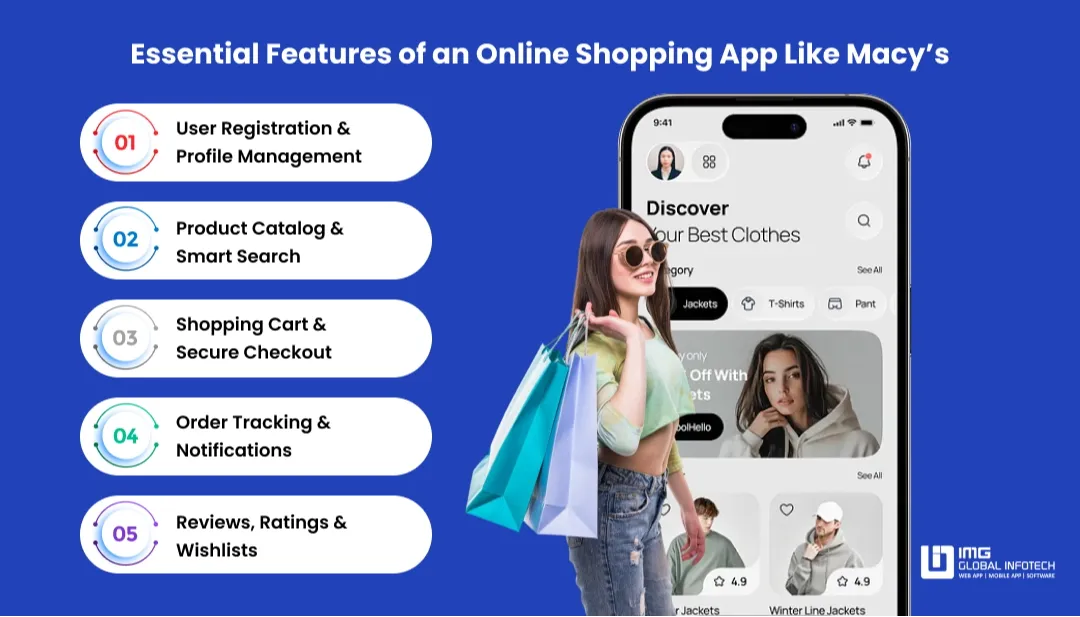
To create a successful online shopping app like Macy’s, you must deliver a smooth, intuitive, and feature-rich user experience. There are Ecommerce app features for different platforms. Here are some of the core features given below.
1. User Registration & Profile Management
A simple sign-up via email, social media profile, or phone number makes the process easier and helps create fewer barriers to entry for customers in getting started. Once customers are signed up, they can create a user profile, add their personal preferences, order history, shipping address, and payment methods for fast checkout when making future purchases.
2. Product Catalog & Smart Search
To help customers find products quickly, the online store should have a structured catalog with the ability to utilize multiple categories, filters, and a keyword search function. The online store should also include high-quality photographs and videos of products and detailed descriptions of the products.
3. Shopping Cart & Secure Checkout
The persistent cart feature allows customers to add items to their carts and check out whenever they wish. The online store should offer a variety of payment options, including cards, UPI, and wallets, as well as buy now, pay later, as this will increase conversions.
4. Order Tracking & Notifications
Providing customers with real-time order tracking, notifications via push notifications, and status updates throughout the shipping process builds customer engagement and informs the customer of the status of their order after the order has been placed.
5. Reviews, Ratings & Wishlists
Customer-generated reviews and wish lists encourage future purchasing behaviour and support the creation of personalized product recommendations.
All these components are key to build an online shopping app like Macy’s that users love returning to.
Advanced & AI-Powered Features for Scalability
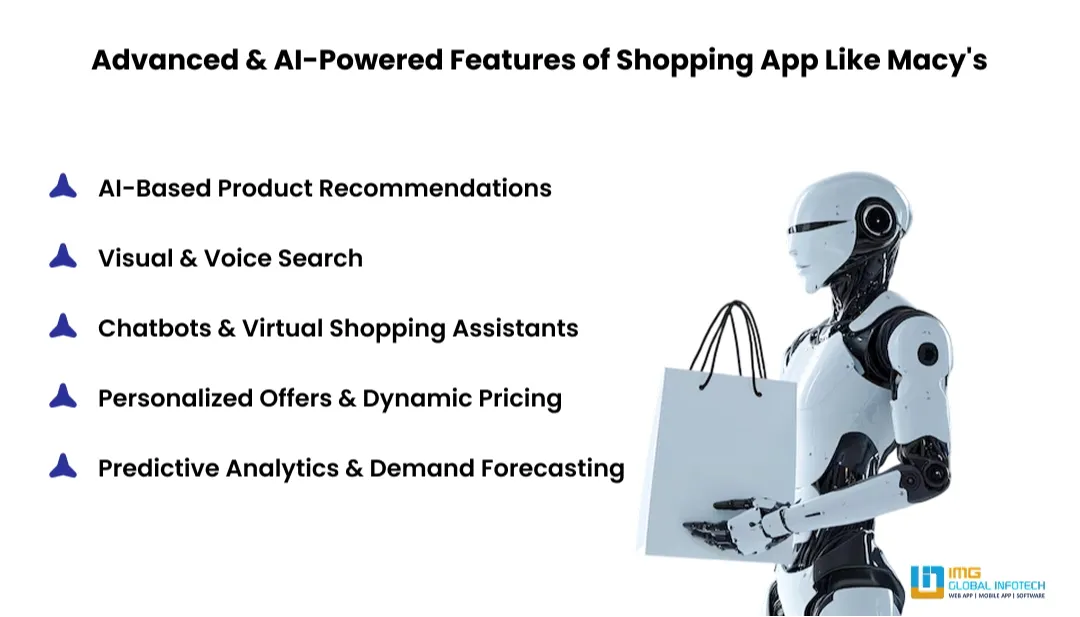
To truly differentiate your online shopping app like Macy’s, advanced and AI-driven app development features are essential for long-term scalability.
AI-Based Product Recommendations
Machine learning algorithms utilize data regarding a user's actions, online shopping habits, and buying patterns to create personalized recommendations and thus encourage increased participation, higher conversion rates, and an increase in average order value through personalization.
Visual & Voice Search
AI-based voice and visual search technology helps people locate the items they want, either through verbal queries or through photographs or screenshots of what they are looking for, improving the efficiency of product discovery and providing a more streamlined shopping experience.
Chatbots & Virtual Shopping Assistants
AI chatbots offer 24/7 customer assistance and respond to customers' queries, recommend products, assist customers in placing orders, provide cost savings on customer assistance, and greatly improve the satisfaction and loyalty of customers.
Personalized Offers & Dynamic Pricing
AI analyzes the patterns of buyer preference, geographic location, and the trends in available consumer demand and then offers discounts and a wide variety of pricing strategies to match demand, increase sales, improve consumer loyalty, and sell-through potential.
Predictive Analytics & Demand Forecasting
AI-based predictive analytics will assist retailers with determining future demand for products, determining the proper level of inventory to have on hand, decreasing the chances of stock-outs, and providing retailers with better data to make decisions regarding scalable retail sales growth.
These innovations elevate the Macy’s like app development experience while ensuring your platform scales efficiently with growing users.
Step-by-Step Development Process of Macy’s Like Shopping App
Building an online shopping app like Macy’s requires a structured development approach. Here’s a step-by-step breakdown.
Market Research & Requirement Analysis
Investigate your competition, create a profile of your ideal customers, and find out what your competitors aren't doing that you can do to fill that gap. You need to determine if your app will be focused on fashion, lifestyle, or have multiple categories.
Feature Planning & App Architecture
Create a comprehensive list of features you want in your app, how users will move through it, what technologies will support it all, and how you plan to grow as a company and the app grows and develops.
UI/UX Design
Develop a clean and easy-to-use interface and user experience that represents your brand well; a positive user experience means more loyal customers.
Frontend & Backend Development
Create your app using today's modern development tools, with a backend that handles product inventory, order processing, payment acceptance, and secure data storage of your users.
Third-Party Integrations
Integrate a payment processing gateway, automated shipping system, web analytics, CRM systems, and a push notification system for your customers.
Testing & Quality Assurance
Fully test every version of your app across as many devices as possible for performance, security, and function; you want to launch the app with no bugs.
Launch & Post-Launch Support
Once you have launched your app on various app stores, monitor its performance continually and make updates as necessary.
Following these steps will help you develop a Macy’s-like shopping app that will meet your users' needs and achieve your business objectives.
Cost to Build an Online Shopping App Like Macy’s
Cost to build an app like Macy’s could range between $5,000 to $15,000+. It depends on various factors like complexity, features, integrations, and development location. Let us now break down the price by app level.
Basic App Cost
The basic app cost ranges from $5,000 to $8,000. It is a suitable choice for startups and small and medium-sized businesses.
Mid-Level App Cost
The mid-level app cost ranges from $10,000 to $15,000. It is an ideal choice for growing businesses or expansion.
Advanced-Level App Cost
The advanced-level app cost is quite a lot, but it gives better ROI. Its cost goes up to $15,000+. The advanced app is good for large enterprises with full automation.
A basic version of the ecommerce app will typically be less expensive than an enterprise-level version that utilizes AI technology, AR technology, and advanced analytics technology, which will increase the cost substantially. A number of factors impact the cost of developing an ecommerce application. For instance, the Macy’s like ecommerce app development cost ranges between $5,000-$15,000+. The overall cost of developing a retail ecommerce application will vary according to the business's scalability and security requirements.
If a company is going to develop a high-quality online shopping app like Macy’s, then it should consider this project as a long-term investment with significant potential for return.
How to Choose the Right Shopping App Development Partner?
Choosing the correct partner is crucial to achieving success. An Ecommerce mobile app development company experienced in developing mobile applications provides guidance regarding any technical complexities of building your application while also maximizing your costs and decreasing your application's overall time-to-market.
When evaluating potential partners, look for those that have a history of creating successful retail applications, including a strong history of UI/UX capabilities and an excellent post-launch support team. By partnering with experts, you can greatly reduce your risk and ensure that your online shopping application is ready for the future, just like Macy's.
Here are some of the considerations:-
Industry Experience & Portfolio
Find a software development company that can provide a mix of eCommerce applications. Choose a developer who has experience in developing numerous successful apps.
Technical Expertise & Technology Stack
A skilled development partner for your business’s long-term success should know about cross-platform application development, cloud-based application services, AI-based integrations, and the use of the latest technologies.
UI/UX Design Capabilities
The UI/UX design of the application should be designed for ease of use and as a visually appealing and engaging experience to encourage users to interact and ultimately make purchases. A good UI/UX design allows for improved customer retention and increased conversion rate.
Post-Launch Support & Scalability
Choose an application support/maintenance partner who offers continuous maintenance, performance monitoring of the application, and support for updates and additional features.
Other Considerations are:-
-
Transparent pricing model
-
Clear communication process
-
Agile development methodology
-
Strong data security practices
-
Positive client reviews and testimonials
-
Dedicated project management team
Future Trends in Shopping App Development
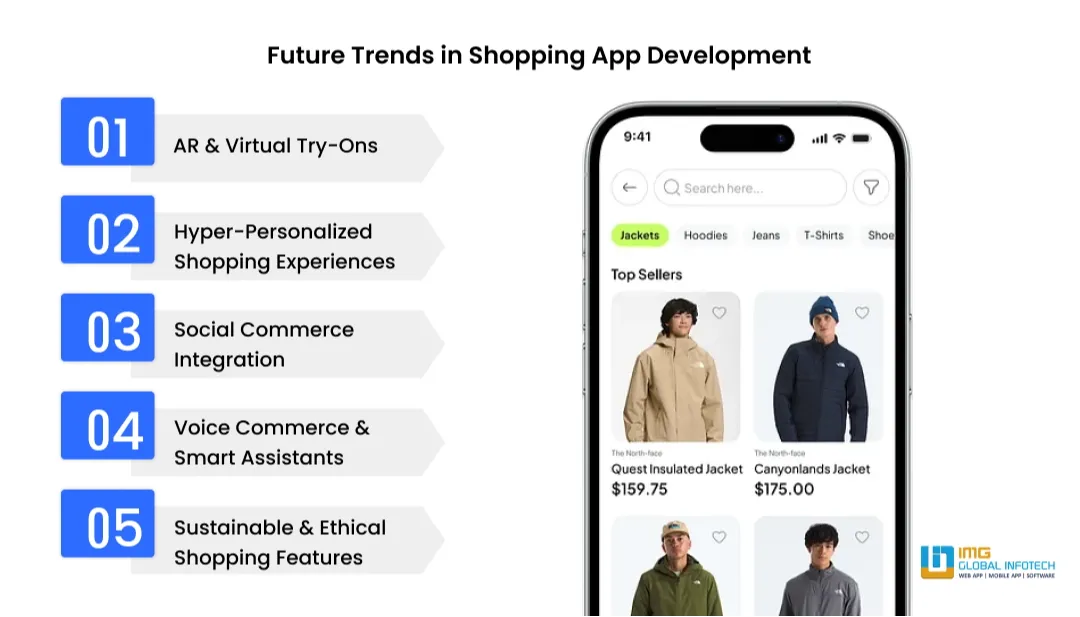
The future of online shopping apps is driven by innovation and personalization. Here are some of the trends given below.
AR & Virtual Try-Ons
Augmented reality gives consumers the ability to try on clothing, accessories, and makeup virtually prior to making a purchase. This helps to lower return rates, boosts the consumer's confidence when shopping online, and provides an interactive and immersive shopping experience.
Hyper-Personalized Shopping Experiences
AI-powered personalized recommendations and content recommendations are driven by analyzing a user's real-time behaviour. As a result, AI-driven personalized recommendations will increase the level of customer engagement, satisfaction, and conversion.
Social Commerce Integration
Shopping applications have gradually begun to integrate social media features, enabling in-app purchasing via live-streaming and social sharing of influencer content to promote brands and create brand exposure.
Voice Commerce & Smart Assistants
Voice-enabled shopping enables users to search for products, order products, and track packages using their smart assistants, thus making them more accessible, convenient, and providing a hands-free experience for the shopper.
Sustainable & Ethical Shopping Features
Shopping apps have a growing emphasis on products that are eco-friendly and ethically sourced, and display sustainability scores to help conscious consumers make good choices when purchasing products. By highlighting these features of an app, companies are creating trust in their brand and increasing their level of brand loyalty.
Retailers investing in Fashion app development services and next-gen technologies will gain a competitive edge in crowded markets.
CONCLUSION
When creating an app for online shopping similar to that of a large retailer, such as Macy's, there is much more than just the programming of features associated with the shopping process. You must also take care to build in the ability to provide exceptional value, ensure convenience, support personalisation, and help them make shopping decisions easier for themselves. Other aspects of app development include understanding the business model and features of your competition, the technology used to support your app, and who will develop your app.
Your online shopping application could potentially generate tremendous growth for your business, create a loyal customer base, and help your brand achieve sustainable business growth by using the proper strategic plan, current available budget, and timely implementation. If you want to start creating your retail concept into a mobile shopping application similar to Macy's, now is the time to begin. Look for Ecommerce app development companies that provide end-to-end solutions at affordable prices.