The role of AI in businesses has been huge in the last few years. It has already started to reshape the way digital businesses operate. Today, AI is not just being utilized for automating tasks, but has become a key component of most digital transformation strategies to provide highly personalized customer interactions. Two of the most commonly used AI-powered tools are machine learning apps and generative AI apps. These two types of applications are both classified as part of the overall category of artificial intelligence, but provide very different benefits and use cases. Business leaders are often faced with making a decision about which type of application meets their needs, budget, and industry.
If you are considering investing in generative or machine learning applications, gaining an understanding of the advantages, disadvantages, and actual uses of these tools is important. You must also know how these tools can benefit your business, which will be essential. This blog will find everything you need to know regarding machine learning and generative AI. You will be able to select the best solution for your organisation. So let’s begin.
Overview of Machine Learning Apps
The purpose of a machine learning application is to analyze data, detect patterns, and forecast events or create conclusions using algorithms that do not require the manpower to create a new algorithm for every possible situation. This is achieved by consistently improving via the combination of historical data and current events through the training of the application over the life of the application.
Machine Learning is very much about the ability to learn from existing data rather than develop new content from scratch. They have many benefits for businesses that rely on structured data to generate output, resulting in substantial efficiencies and competitive advantages for those companies.
How does it work?
Machine learning systems are trained on large datasets. Once trained, they can:
-
Predict future outcomes
-
Detect anomalies
-
Segment users
-
Automate decision-making
For Instance, the eCommerce sector's examples of how they use machine learning (ML) to produce recommendations based on users' activity included an example of how ML could be utilized by the finance sector to detect fraud.
Some of the common use cases of ML apps are:-
-
Sales forecasting and demand prediction
-
Customer churn analysis
-
Credit scoring and risk assessment
-
Inventory optimization
-
Predictive maintenance
Why Businesses Choose Machine Learning?
Businesses utilize ML applications because they want to leverage their customer data to gain insights, improve operational efficiencies, and build long-term strategies to optimize future business growth. They typically use ML applications when they want analytics-driven insights, accuracy, and long-term optimization; whereas, they use generative AI applications for business for their creative potential.
One of the key areas of focus in AI strategy today is the differences between machine learning (ML) and generative AI. Understanding these differences can only be achieved if it is first understood that ML is mainly an analytical process and not a creative one.
Overview of Generative AI Apps
Generative AI apps for enterprises create new types of outputs like text, images, video, code, music, etc., using large language models (LLMs) and diffusion models. It is not the case in conventional machine learning systems, that designed to analyze previously collected datasets.
How Generative AI Apps Work?
The generative AI applications are based on large collections of data to identify the patterns that exist within that data. Generative AI applications do not predict outcomes. They create unique responses based on the user's input. Some of the examples include:
-
Chatbots are creating realistic conversations.
-
Tools that help users generate marketing material or product descriptions.
-
Systems that create images based on the text prompts given to the AI.
Some of the use cases of Gen AI are:-
-
AI chatbots and virtual assistants
-
Content and copy generation
-
Image and video creation
-
Code generation and software assistance
-
Personalized marketing campaigns
Why Businesses Are Adopting Generative AI?
The Gen AI apps are useful for speed, creativity, scalability, and improved user engagement. These tools are especially impactful in marketing, customer support, HR, and product design.
Machine Learning vs Generative AI: Key Differences
The debate around AI vs Machine Learning often comes down to what a business actually wants to achieve. Here are the differences in table form.
Choosing the Right AI App for Your Business
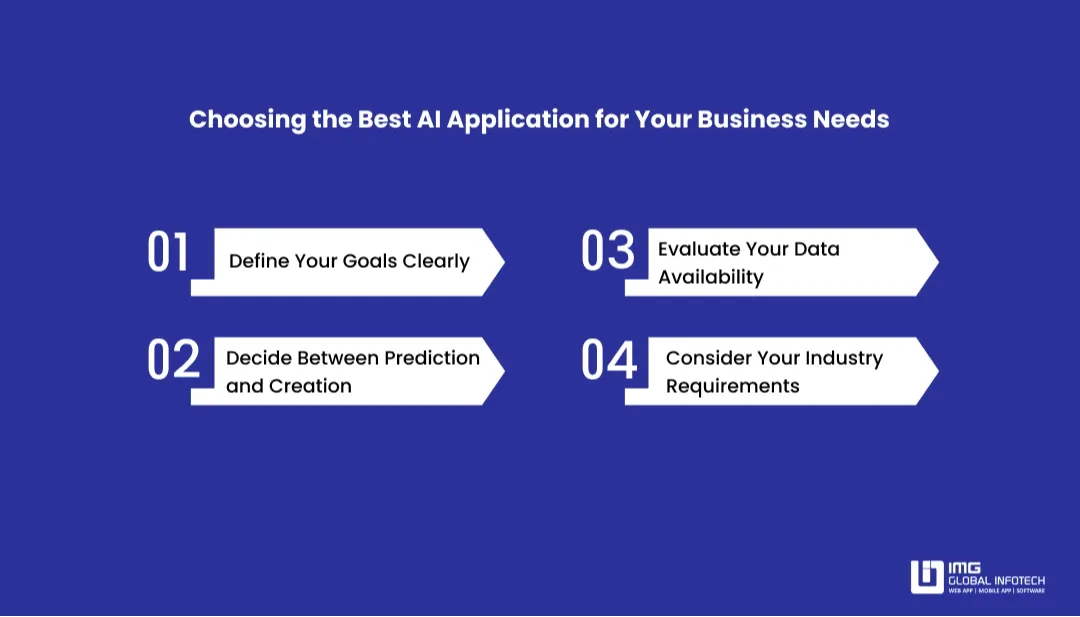
Choosing the right AI application should be based on business objectives, data availability, and expected Return on Investment (ROI). Some businesses select the apps based on hype, which is not the right thing to do.
1. Define Your Goals Clearly
Whether it’s improving customer support, increasing sales, reducing costs, or automating operations, knowing your goals clearly helps you choose the right AI approach instead of adopting technology just because it’s trending.
2. Decide Between Prediction and Creation
The choice to leverage data analytics to predict or generate content depends on the type of predictive or creative capabilities the user requires. Predictive Analytics can provide forecasts, recommendations, and determine potential risks by following a traditional Machine Learning approach.
3. Evaluate Your Data Availability
If there is an over-volume of structured, historical data, a Machine Learning model can provide a reliable prediction based on the given data. If there is not sufficient historical data to be classified as structured or unstructured, Users can still gain value from using a Generative AI without having to invest time and effort in preparing the data for machine-learning.
4. Consider Your Industry Requirements
In the Finance, Logistics, and Manufacturing industries, Companies require the accuracy and compliance of their outputs from predictive AIs. Companies in these industries have a more significant need for Generative AIs to produce new content to engage with customers than companies in Marketing, eCommerce, and SaaS.
Other Things to Consider Before Choosing the Right AI Solution Are:-
-
Focus on User Experience
-
Assess Integration with Existing Systems
-
Understand Scalability Needs
-
Analyze Cost vs Return on Investment
-
Address Security and Compliance
-
Decide on Custom vs Ready-Made Solutions
-
Plan for Future AI Expansion
Key Benefits of Implementing the Right AI Solution

Understanding the benefits of machine learning apps for business helps organizations justify long-term AI investments. Another question businesses ask is - how to choose between machine learning and generative AI? It depends on the benefits of particular tools. Here are some of the benefits given below.
1. Improved Operational Efficiency
The right AI software development company automates repetitive tasks and optimizes workflows, helping businesses save time, reduce manual effort, and allow teams to focus on higher-value strategic activities.
2. Better Data-Driven Decision Making
Businesses make smarter decisions with more confidence because of the use of AI. They can analyze large volumes of data accurately, getting actionable insights.
3. Cost Reduction
AI helps businesses save on costs, resources, and human resources by automating tasks and reducing the chance of mistakes made by humans through automation. These savings can create long-term profitability for companies.
4. Enhanced Customer Experience
AI-powered products enhance users’ experience by being responsive and personalizing communication while delivering a consistently high standard of service. This results in better customer retention, greater customer involvement with the brand, and improved overall loyalty.
Other Benefits of Implementing the Right AI Solutions Are:-
-
Increased Productivity
-
Scalability and Business Growth
-
Competitive Advantage
-
Improved Accuracy and Reduced Errors
-
Faster Time-to-Market
-
Long-Term Business Value
Challenges and Risks in AI App Implementation
AI app solutions and new technologies have benefits, but they also come with a few challenges. Choose the AI Development Company who knows how to cope up with these challenges. Here are some of the difficulties given below.
1. Poor Data Quality
There are chances of unreliable results and incorrect AI-driven decisions if the data is incomplete or inaccurate. Because AI systems depend on data, any outdated data can lead to poor results.
2. Data Privacy and Security Risks
AI app development services can deal with sensitive information. Poor security protections create vulnerability to data breaches, legal consequences, and a decrease in client confidence. For example, Generative AI in healthcare is important because the industry demands security in sensitive data.
3. High Initial Investment
The development and deployment of AI applications involve substantial expenses related to preparing datasets, establishing database infrastructure, and hiring qualified, talented professionals. This could be a major challenge for small business owners.
4. Lack of Skilled Talent
Successful implementation of AI requires skilled developers, knowledgeable data scientists, and experienced domain experts. There is a shortage of qualified talent, which has the potential to delay AI application development and raise project risk.
Other Challenges Businesses Face Are:-
-
Integration with Existing Systems
-
Model Bias and Ethical Issues
-
Limited Explainability
-
Inconsistent AI Performance
-
Over-Reliance on AI
-
Scalability Challenges
-
Maintenance and Continuous Updates
Future Trends in Machine Learning and Generative AI
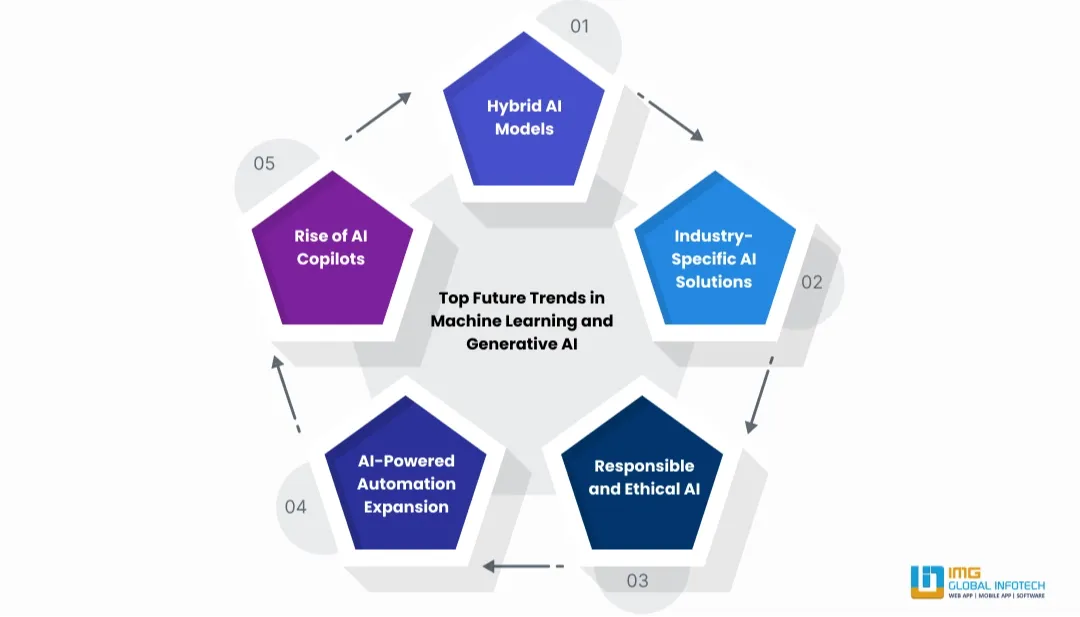
The ML and Gen AI will continue to evolve rapidly, and the future trends will be there to see. Some of those are:-
1. Hybrid AI Models
Businesses will utilize both machine learning and Generative AI to create more solutions for processing and interpreting data, as well as creating output that resembles human thinking.
2. Industry-Specific AI Solutions
The AI models will be designed specifically for industries such as Healthcare, Finance, Retail, etc. They can provide a greater level of accuracy and increase the value of these models to business operations.
3. Responsible and Ethical AI
Increasing emphasis will also be placed on creating AI solutions that are fair, transparent, and minimize bias. It will ensure AI systems utilized are ethical and copyright compliant, as well as providing the business with trust and assurance.
4. AI-Powered Automation Expansion
AI will automate the most complicated of processes within all areas of an organization, allowing greater operational efficiency. It will also reduce cost and the need for the manpower.
5. Rise of AI Copilots
AI copilots integrated in business software will assist employees in real time, improving productivity, and decision-making. It will also helps in task execution and helps in smooth functioning.
Other Future Trends Are:-
-
Explainable AI
-
Multimodal AI Adoption
-
Real-Time Learning and Adaptation
-
Edge AI Growth
-
Increased Focus on Data Quality
-
Cost-Optimized AI Development
-
Wider Enterprise Adoption
Businesses that stay flexible and adaptable will gain the most value from these advancements. Always hire AI app developers that are up to date with modern trends.
CONCLUSION
Every business has its own requirements as far as choosing the right tools are concerned. A particular tool might not be useful for another business. That’s why, choosing between Machine Learning apps and Generative AI apps is not about picking the better technology. If your business requires ML tools, choose Machine Learning Development Company. It is more about choosing the technology that aligns with your business goals. ML tools should be an ideal choice if your aim is optimization, prediction and data-droven decision-making. If you want to focus on creativity, engagement, and productivity, go with Generative AI tools. It will deliver faster and more visible results.
Most successful organizations utilize both approaches together. When organizations align their AI strategy with their business goals, data readiness, and long-term vision, they can generate sustainable growth and continue to be competitive in the growing market of AI-enabled organizations. So what are you waiting for? Start exploring the professional custom AI app development company. With their support, take an early advantage in the highly competitive space.