Large Language Models have been changing the whole landscape of intelligent systems. They have transitioned from being simply tools for answering questions and generating content to being systems that can interpret, plan, act autonomously, and adaptively. Companies are moving away from providing static AI tools for employees, towards creating autonomous agents that can interface with other tools, process complex workflows, make decisions, and act as an extension of the human workforce in digital environments. LLM development for agent use is changing the way companies work and scale.
In this guide we will outline all the aspects you need to know about developing LLM agents from a simple, practical and conversational perspective, no matter if your position is as a founder of a startup, a product manager or an executive within a large corporation, there is information that will help your understanding in creating, developing and growing a successful LLM agent for real life applications. Let’s start this comprehensive LLM guide.
What is an LLM Agent?
An LLM Agent is an AI program that utilizes a large language model applications as its primary source of intelligence to understand and respond to requests, as well as to plan actions and utilize tools such as databases and code execution to autonomously achieve advanced goals. It does much more than provide basic conversational interactions. LLM Agents can do all of this without having to be continually instructed or monitored by humans. They are very useful for tasks like data analysis or customer support. An LLM Agent would be able to process and analyze large amounts of data, generate reports, and produce other similar types of documentation.
Unlike chatbots developed traditionally, LLM Agent Development is focused on creating AI systems that act upon intentionality rather than responding. All in all, LLM agents are the evolution of automation driven by artificial intelligence (AI) that brings reasoning, history, and decision-making together in a unified form. LLM AI Agent Development has become a priority for all digital companies in this modern era.
Key Benefits of Building LLM Agents for Businesses
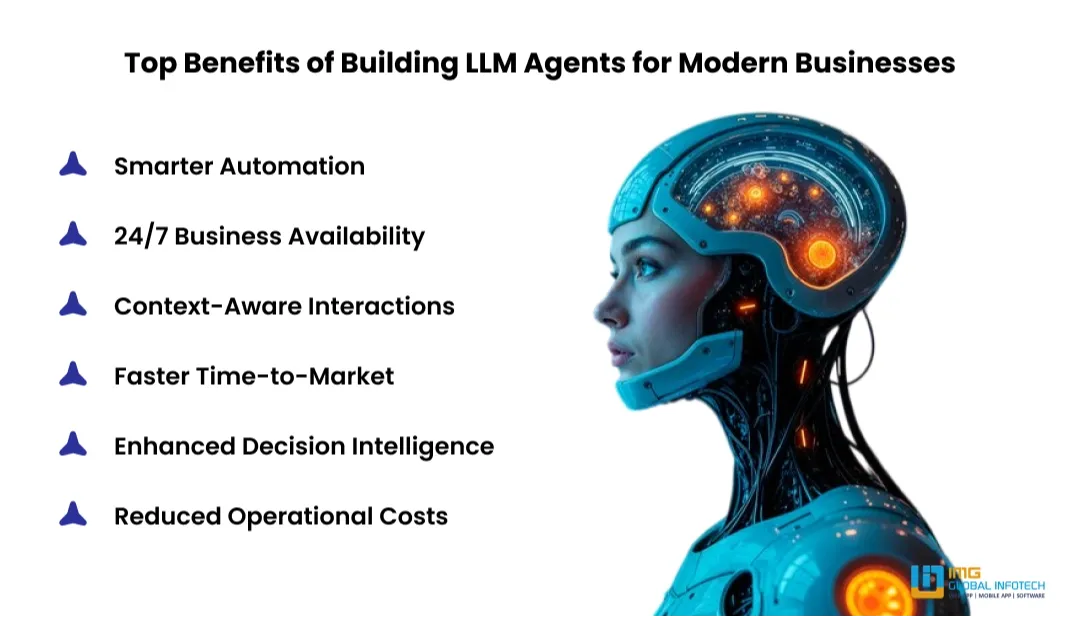
Businesses, in this modern era, are investing in LLM’s Development Company to gain much-needed advantages in this highly competitive market. Here are some of the key benefits given below.
1. Smarter Automation
LLM agents reduce the need for manpower by automating complex workflows. It will improve speed and accuracy, leading to more perfect results. These things help businesses to scale and gain a competitive edge over others in the market.
2. 24/7 Business Availability
LLM Agents provide companies with 24/7 customer service, data processing, and operational support regardless of the time zone. Due to this, businesses feel secure, and they know that even if there is any mishap, we have someone to support.
3. Context-Aware Interactions
LLM Agent Development provides agents with the ability to utilize memory and reasoning skills, which allow agents to retain information such as previous conversations and understand user intent and preferences, providing more relevant and consistent responses.
4. Faster Time-to-Market
Companies using LLM Agent Development can deploy intelligent solutions faster because development cycles are shortened, allowing for quick product launches and feature rollouts. Always choose an AI Development Company that has a faster time-to-market.
5. Enhanced Decision Intelligence
LLM Agents monitor both structured data and unstructured data in real time, allowing companies to make better, more accurate, and confident data-driven decisions.
6. Reduced Operational Costs
By replacing manual processes with intelligent automation, LLM agent development significantly lowers labor costs while maintaining consistent performance at scale.
Other Benefits Are:-
-
Seamless System Integration
-
Personalized User Experiences
-
Scalable Business Growth
-
Continuous Learning & Improvement
Real-World Use Cases of LLM Agents
The demand for LLM agent development is driven by its wide applicability across industries. Here are some of the real-world cases of LLM agents.
1. Customer Support & Virtual Assistants
Through the development of LLM Agents, businesses can deploy intelligent support agents capable of understanding queries, resolving issues as appropriate, accessing their knowledge base, and escalating complex cases with all available context from the conversation.
2. Enterprise Knowledge Management
By searching, summarizing, and reasoning over their internal documents, policies, and reports, LLM Agents enable employees to find accurate information quickly. It improves productivity across departments.
3. Sales Enablement & Lead Qualification
Sales teams will be able to engage prospects, respond to product questions, determine lead qualification, and schedule meetings without manual intervention thanks to the creation of LLM Agents who can perform these tasks automatically.
4. HR & Employee Assistance
By developing LLM Agents, businesses create AI agents to assist employees during onboarding, clarifying internal policies regarding leave management, processing internal inquiries, and more.
5. Financial Reporting & Analysis
LLM agents are quite useful in analyzing financial data. After analysis, it summarizes the data, detects any kind of anomalies, and then tries to fix them. It also supports budgeting, forecasting, and compliance activities at a higher speed and accuracy.
6. Education & Personalized Learning
LLM agents act as intelligent tutors, adapting content to learner needs, answering questions, and tracking progress to deliver personalized education experiences. Personalized learning helps users to improve and achieve better results.
Other Real-World Cases Are:-
-
Healthcare Workflow Automation
-
E-commerce Product Discovery
-
Supply Chain & Operations Management
-
Legal Document Review & Compliance
-
Marketing Content & Campaign Planning
-
IT Support & DevOps Assistance
Step-by-Step Guide to Building an LLM Agent
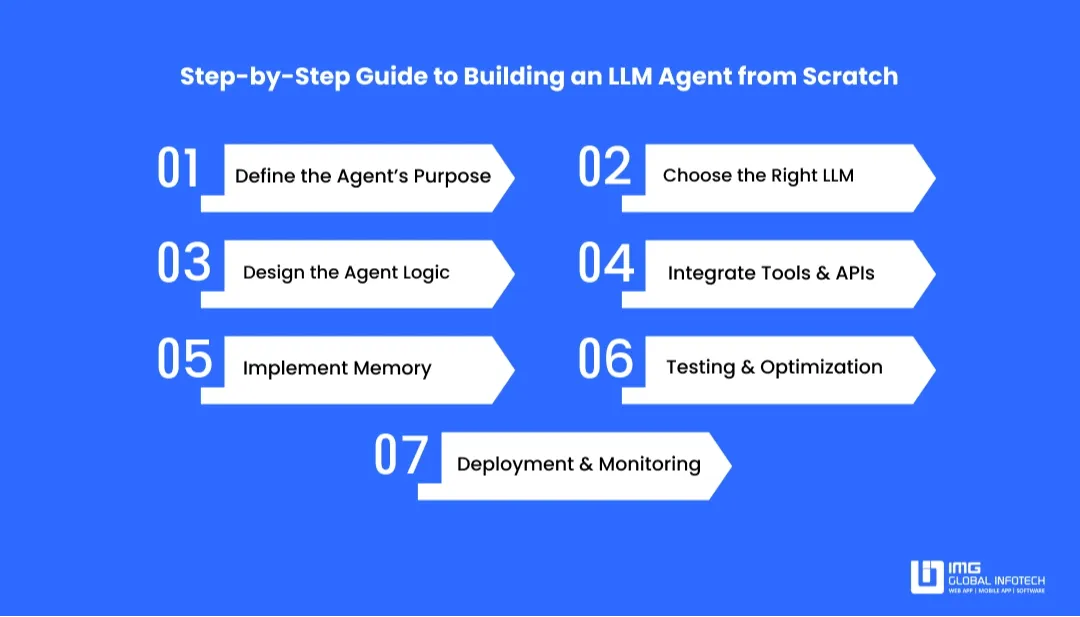
Building an LLM requires full-proof planning and strategy. One wrong step and it will take more time than usual to complete the process. The cost will also be high if there is any miscommunication. An AI Software Development Company will help you to guide the steps. Let us now see the steps to build an LLM Agent.
1. Define the Agent’s Purpose
It is important first to identify the tasks your agent will perform, whether answering questions, completing tasks, or organizing workflows. The better your goal is defined, the higher your chances of success during the development of an LLM Agent.
2. Choose the Right LLM
Pick a model that works well with your particular application. Performance levels, costs, latency times, and how well it can grow or shrink to meet demand for LLM agents are all important factors to decide how to build an LLM agent.
3. Design the Agent Logic
The businesses need to consider how you will reason about tasks, how you will determine your agents' direction, and how your agents will plan work. At this stage, how to develop LLM agent strategies becomes critical.
4. Integrate Tools & APIs
Connecting to databases, CRMs, payment gateways, and analytics tools gives agents more power. It allows creating LLM-powered AI Agents that function beyond text understanding.
5. Implement Memory
The use of short-term memory and long-term memory allows agents to retain studio context and improve with time through performance. It will help the tool in generating better results that eventually lead to scalability for the businesses.
6. Testing & Optimization
Testing for accuracy, safety, bias, and performance is critical as part of the iterative refinement that is necessary in the LLM Agent Development Process.
7. Deployment & Monitoring
Develop LLM agents and deploy securely, while continuously monitoring for & conducting improvements in reliability and ROI. If the deployment is not smooth, it will hinder the scalability process of the business.
Core Components of an LLM Agent Architecture
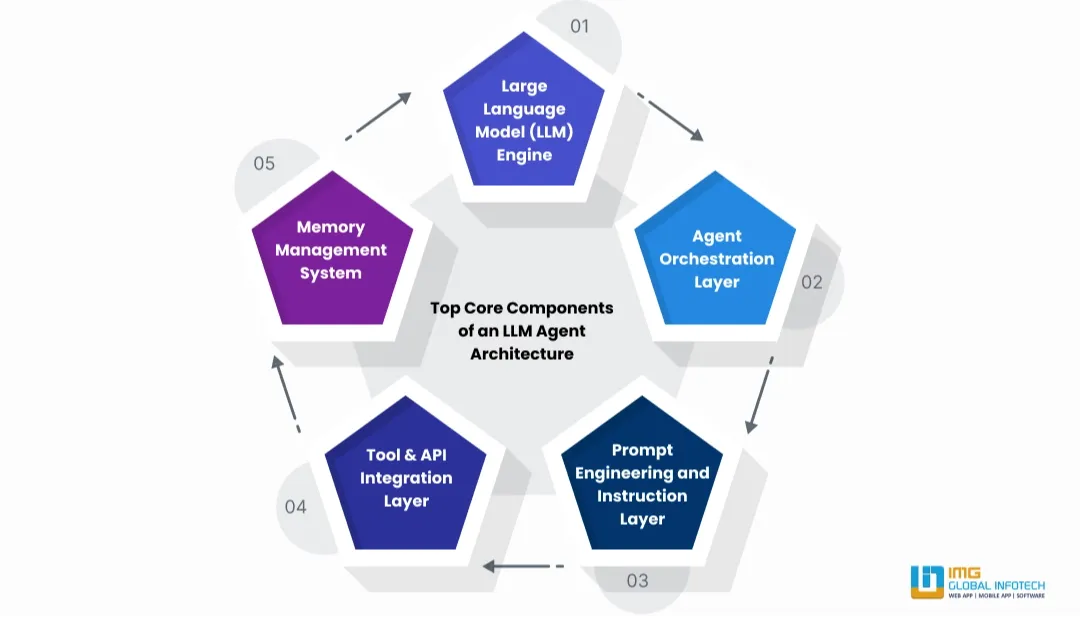
A seamless architecture is important for successful LLM agent development. A Custom LLM agent solution ensures some of the key components to build a robust product. Here are some of the key components.
1. Large Language Model (LLM) Engine
The LLM engine is crucial for developing an LLM Agent System. It processes user inputs, understands context, reasons through tasks, and generates intelligent output during the development of the LLM agent.
2. Agent Orchestration Layer
The LLM engine controls what the agent does by determining the task being performed, the sequence in which tasks are completed, decision-making associated with the completion of a task, and how to respond next.
3. Prompt Engineering and Instruction Layer
Prompts are used to guide the agent's behavior, tone, and constraints. This layer of the LLM agent development process is critical for producing high-quality, accurate, goal-oriented outputs.
4. Tool & API Integration Layer
This layer of the LLM agent development process allows the LLM agent to complete tasks outside the conversation and interface with other systems like CRMs, ERPs, database services, and third-party APIs.
5. Memory Management System
Memory stores conversation history, user preferences, and contextual data. It enables the agent to deliver personalized and coherent responses across multiple interactions.
Other Core Components Are:-
-
Knowledge Base & Retrieval System
-
Reasoning & Planning Module
-
Context Management Layer
-
Security & Access Control Layer
-
Feedback & Learning Loop
-
Monitoring & Analytics Module
-
Deployment & Scalability Infrastructure
Common Challenges in LLM Agent Development and How to Overcome Them
Here are some of the challenges that businesses need to face while building an LLM agent.
1. Hallucinations and Inaccurate Responses
The outputs we receive from LLM agents could be inaccurate or misleading. To mitigate this concern regarding the generation of faulty information by LLM agents, implement mechanisms that ground an LLM agent's answers through validated resources.
2. Lack of Context Awareness
The businesses have to implement short-term and long-term memory mechanisms for consistent, contextual, and personalized responses. If it is not implemented, agents may forget interactions.
3. Complex Multi-Step Reasoning
Basic agents do not handle complicated workflows. By employing a task planner or reasoning module in conjunction with the development of an LLM agent, it is possible to break apart the overall problem into manageable tasks or steps.
4. Tool Integration Failures
LLM agents might have difficulty interacting with other APIs or external systems. Grounding through a modular integration layer increases both availability and maintainability.
5. High Latency and Slow Responses
Large models take longer to complete than smaller ones; by optimising prompts, caching results, and creating a comprehensive model size selection process, LLMs improved their operating efficiency.
Other Challenges Are:-
-
Scalability Issues
-
Security and Data Privacy Risks
-
Model Bias and Ethical Concerns
-
Difficulty in Evaluation and Testing
-
Cost Management Challenges
-
Maintenance and Continuous Improvement
-
Regulatory and Compliance Constraints
Cost to Build an LLM Agent: What Businesses Should Expect
The cost to build an LLM agent depends on various factors. Those factors are:-
-
Features Requirement
-
Complexity of the Agent
-
Number of Integrations
-
Tech Stack
-
Customization
-
Location of the Developer
-
Expertise and Experience of the Developer
Let us now break down the LLM Agent Cost based on the level.
1. Basic LLM Agent
A basic LLM Agent cost is lower than usual, which is a good thing for small businesses. Its cost ranges from $8,000 - $10,000, depending on the requirements. Some of the key features of a basic LLM agent are a single LLM-powered conversational interface, prompt-based responses without task planning, no long-term memory or learning capability, and Rule-based or static prompt behavior.
The basic agent is suitable for:-
-
FAQs and simple chatbots
-
Content generation and text summarization
-
Early-stage MVPs and prototypes
-
Low-cost experimentation with LLM agent development
-
Internal assistants with a limited scope
2. Mid-Level LLM Agent
A mid-level LLM Agent cost ranges from $10,000 - $15,000. Some of the key features of mid-level LLM agents are Context-aware conversations with short-term memory, Basic task execution and workflow automation, and improved prompt orchestration and response control.
It is good for expansion and suitable for:-
-
Customer support automation
-
Sales and lead qualification assistants
-
Knowledge base and enterprise search agents
-
SaaS products requiring intelligent automation
-
Growing businesses are adopting LLM agent development
3. Advanced-Level LLM Agent
The advanced-level LLM agent is highly complex and used by large-enterprises. Its cost ranges from $15,000+. The advanced level LLM agents are suitable for:-
-
Enterprise-scale automation systems
-
Complex decision-making and analytics platforms
-
Agentic AI in enterprise workflows
-
AI-driven operations, DevOps, and finance
-
Large organizations are investing heavily in LLM agent development
Future Trends in LLM Agent Development
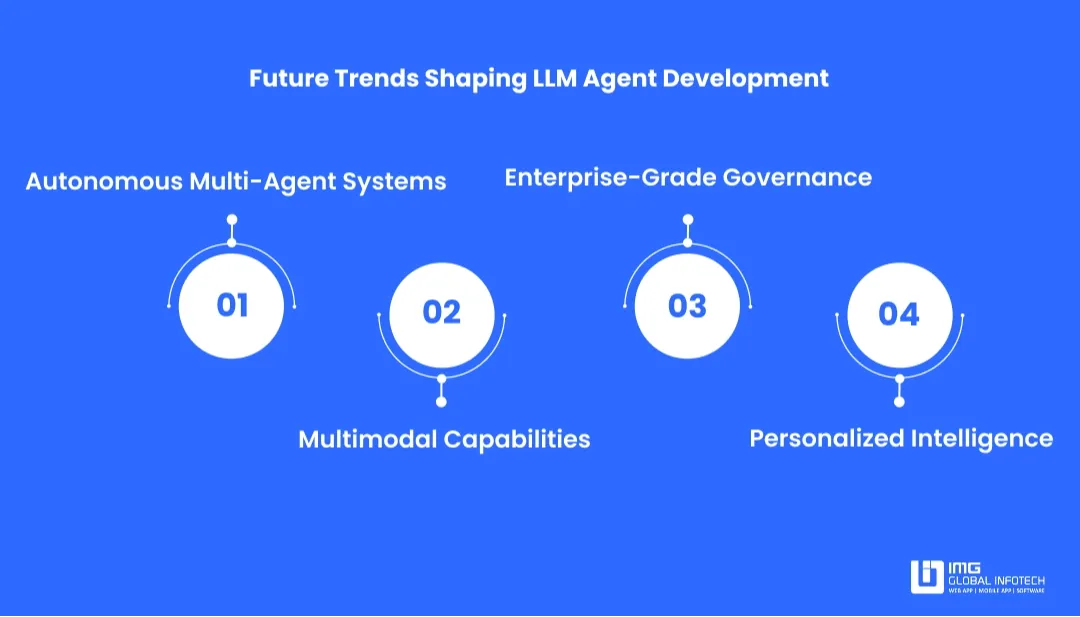
The future of LLM agent development is exciting and transformative. Here are the possible future trends given below.
1. Autonomous Multi-Agent Systems
LLM agents of the future will work collaboratively, dividing and sharing tasks and context, and will work independently to solve complex problems, leading to increased efficiency and decision-making throughout large-scale business operations.
2. Multimodal Capabilities
LLM agents will have the ability to process text, voice, images, and videos simultaneously, allowing for richer interactions and greater opportunity to build a better understanding of these modalities. Interaction between users and digital platform providers will be made more user-friendly through the greater ease with which LLM agents can interact with those users.
3. Enterprise-Grade Governance
The use of advanced governance frameworks will help ensure that LLM agents are developed in an environment that is secure, compliant with regulatory requirements, and promotes transparent operations, audits, access control, compliance, and responsible use of AI in an organization.
4. Personalized Intelligence
LLM agents will be able to adjust based on user behaviour, preferences, and previous experiences, resulting in hyper-personalized responses, recommendations, and automation, and will deliver tailored responses and recommendations for each user and business.
Why Partner With IMG Global Infotech For LLM Agent Development?
Choosing IMG Global Infotech as your development partner will be one of the best decisions a business will make. The company has built a reputation in the development sector, and its proven track record and client reviews are enough to trust them. Over the years, they have worked with various industries across the globe. We also operate as a trusted LLM’s Development Company, helping organizations design, deploy, and optimize intelligent agents aligned with their goals.
What you will get at IMG Global Infotech are:-
-
Proven Track Record in Industry
-
LLM Agent Development Expertise
-
Dedicated Project Manager
-
Affordable Prices
-
Transparency and Regular Report
-
Flexible Model
-
Long-Term Support and Maintenance
-
End-to-End Solution
IMG Global Infotech’s expertise extends to advanced solutions like Build an AI Voice Agent, enabling conversational AI experiences across voice platforms.
CONCLUSION
As AI systems become increasingly autonomous, developing LLM agents represents a strategic imperative for all companies. With LLM agents, businesses can take advantage of new levels of automation, increased productivity, greater innovation, and the potential to rapidly scale their operations. Organizations can invest in LLM Agent Development more profitably when they fully comprehend the process, architecture, costs, and difficulties of LLM Agent Production that translate into substantial business results.
Now is the right time to be part of the next generation of AI through LLM agents, whatever level you choose to begin. Do not hesitate, and feel free to contact the trusted AI Agent Development Company, like IMG Global Infotech, for services.