The most promising healthcare business ideas for startups in 2026 are AI medical scribes, remote patient monitoring, mental health platforms, women's health (femtech) services, home care for older adults, specialty telehealth, medical billing services, online pharmacy, nutrition coaching and health data integration for clinics. Each one answers a pressure the industry feels right now: clinician burnout, an aging population, chronic disease and paperwork that eats into care time. Some need clinical licenses, others need only software skills and a clear niche.
This guide compares all ten on capital, regulation and time to first revenue, then explains how each one makes money and what to check before you launch.
Why Healthcare Is Worth Exploring in 2026
Healthcare is one of the few sectors where demand grows almost regardless of the economy. In the US alone, national health spending grew 7.2% to $5.3 trillion in 2024, or 18.0% of GDP, and the Centers for Medicare & Medicaid Services projects that share will reach 20.6% by 2034.
Three forces make 2026 a good entry point for new businesses:
- An aging population. The World Health Organization expects 1 in 6 people worldwide to be aged 60 or over by 2030, which raises demand for chronic care, home care and monitoring.
- Clinicians now use AI. In Doximity's 2026 State of AI in Medicine survey of 3,151 US physicians, the share using AI in clinical practice rose from 47% in spring 2025 to 63% by early 2026.
- Care is moving out of hospitals. Payers now reimburse more remote and virtual services, which opens room for smaller providers with good software.
Healthcare Business Ideas Compared
Use this table to shortlist ideas that match your skills and budget. Capital ranges are typical 2026 figures for a lean first version and vary by country and scope.
10 Innovative Healthcare Business Ideas for Startups in 2026
1. AI Medical Scribe and Clinical Documentation
Doctors spend hours each day on notes. Ambient AI scribes listen to the consultation, with consent, and draft a structured note the clinician reviews and signs. Adoption is climbing quickly: Doximity found 29% of physicians used voice-based documentation tools such as ambient listening or AI scribes in January 2026, up from 20% in April 2025.
The big vendors sell to hospital systems, which leaves room for scribes built for one specialty or one market: physiotherapy, dentistry, veterinary clinics, or clinics outside the US that need local languages and note formats. Charge per clinician per month. If you are planning one, our guide to the cost to build an AI medical scribe breaks down the speech, language model and EHR integration work involved.
2. Remote Patient Monitoring Services
Remote patient monitoring (RPM) uses connected blood pressure cuffs, glucose meters, scales and pulse oximeters to track patients at home, with nurses reviewing readings and escalating problems. Grand View Research values the global remote patient monitoring system market at about $26.0 billion in 2025 and projects $110.7 billion by 2033.
Reimbursement also improved. For 2026, Medicare added codes for patients who transmit data on fewer than 16 days a month (CPT 99445) and for shorter monthly management time (CPT 99470), according to the CY 2026 Physician Fee Schedule final rule. A startup can run monitoring as a service for small practices: supply devices, staff the monitoring desk and handle the documentation clinics need to bill.
3. Mental Health Platforms for a Defined Group
The WHO reported in September 2025 that more than a billion people live with mental health conditions and that most do not receive adequate care. Grand View Research expects the mental health apps market to reach about $17.5 billion by 2030.
General meditation apps are crowded. Focused services are not: therapy for healthcare workers, support for new parents, programs for university students, or employer plans for shift workers. Combine licensed therapists, guided exercises between sessions and clear crisis escalation. Teams building in this space usually start with mental health app development that handles therapist scheduling, secure messaging and consent from the first release.
4. Women's Health and Femtech Services
Women's health has been underfunded for decades. A McKinsey Health Institute and World Economic Forum study found that women spend 25% more of their lives in poor health than men, and that closing the gap could add about $1 trillion a year to the global economy by 2040.
Opportunities include menopause care programs, fertility and pregnancy support, endometriosis and PCOS management, pelvic health physiotherapy and postpartum mental health. Many of these combine a virtual clinic with an app for symptom tracking and education. Read our overview of femtech app development for the features and privacy safeguards these products need.
5. Home Care and Aging-in-Place Services
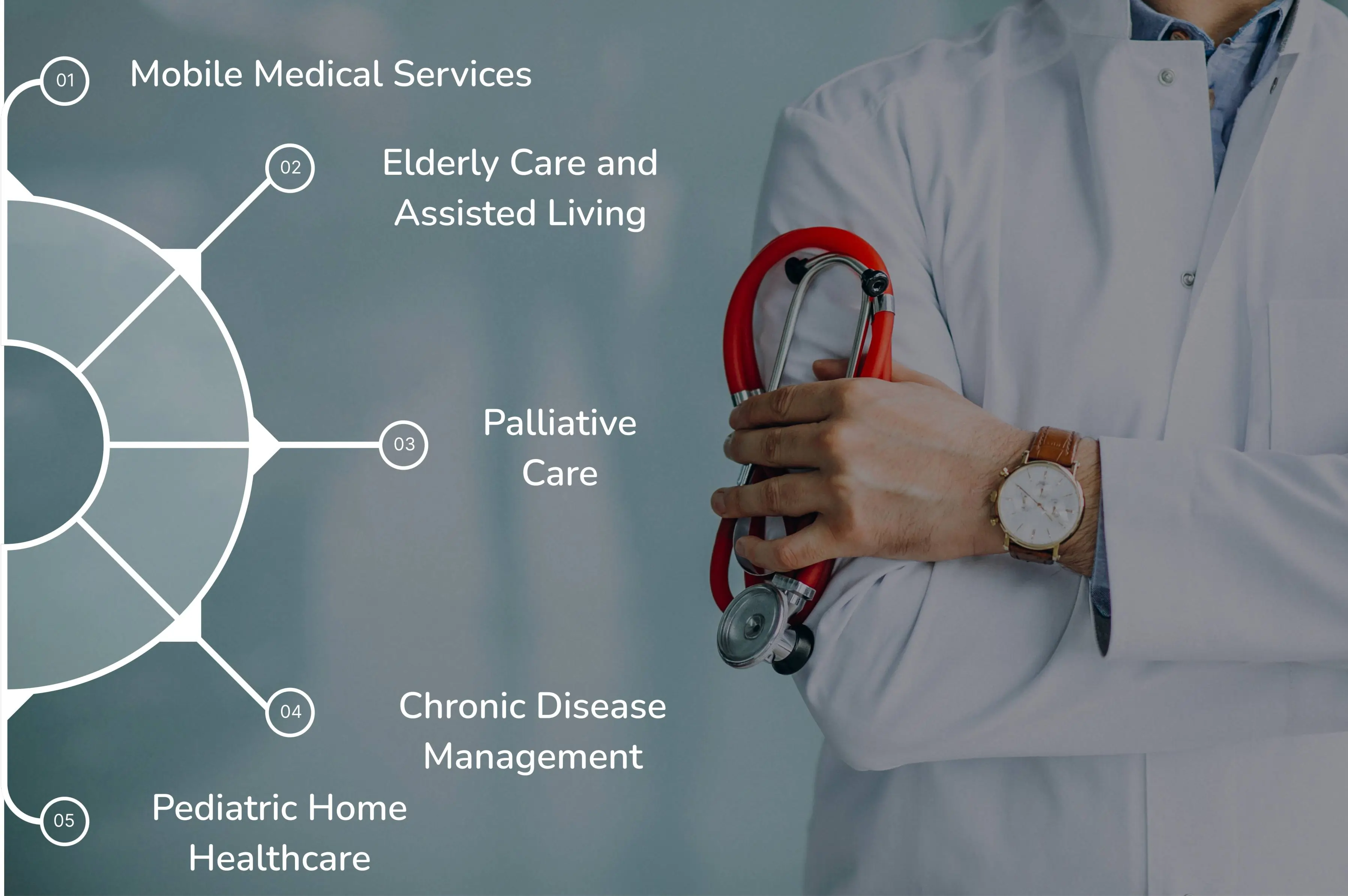
Home care covers patients just discharged from hospital, people with chronic illness and older adults who want to stay in their own homes. Services range from nursing visits and physiotherapy to elder companionship, medication support and mother-and-baby care.
The business runs on trust and scheduling. An app that matches verified caregivers to families, records each visit, shares updates with relatives and handles payments turns a local agency into a scalable brand. Check home care agency licensing in your state or country before you hire your first caregiver.
6. Specialty Telehealth Clinics

General virtual consults are a crowded market. Specialty clinics are not: dermatology by photo, sleep medicine, ADHD assessment, sports injuries, hair loss or chronic disease follow-ups. A narrow focus lets you design intake forms, care pathways and follow-up schedules that fit the specialty, which improves outcomes and repeat visits.
Revenue comes from consult fees, monthly care plans and contracts with employers or insurers. Clinicians must be licensed where the patient is located, so plan your launch regions around licensing. Doctor on demand app development covers the video, scheduling, e-prescription and payment flows a clinic like this needs.
7. Medical Billing and Revenue Cycle Services
Small clinics lose money to denied claims, coding errors and slow follow-up. A billing service that handles coding, claim submission, denials and patient statements solves a painful problem, and clinics pay a percentage of collections or a monthly fee.
This is one of the most capital-light ideas here. Start with certified coders and an established practice management system, then add your own tools: AI checks that flag missing documentation before submission, dashboards that show each clinic its denial reasons, and automated reminders for unpaid patient balances. Because you handle patient data, you will need a business associate agreement with each US clinic.
8. Online Pharmacy and Medicine Delivery
Grand View Research puts the global ePharmacy market at about $120.7 billion in 2025. Patients on long-term medication reorder every month, so retention is high when the service is reliable.
You do not need to own a pharmacy to start. Partner with licensed pharmacies and build the patient side: prescription upload, pharmacist verification, refill reminders, delivery tracking and teleconsults for renewals. Medicine delivery app development should put pharmacist checks inside the order flow so no prescription item ships without approval.
9. Nutrition and Weight-Management Coaching
Demand for personalized nutrition keeps growing, driven by diabetes, heart disease and the popularity of weight-loss medication programs that need diet and muscle-preservation support alongside them. A dietitian-led service can start with a few clients and scale through group programs and an app.
Dietitian licensing rules vary by state and country, so check what you can offer before you advertise "medical nutrition therapy". Useful app features include meal logging by photo, plans that adjust to glucose or weight data, and chat with a coach. Diet and nutrition app development can connect these to wearables and lab results.
10. Health Data Integration and Records Services
Clinics drown in records spread across old systems, paper and spreadsheets. A records and integration business migrates data, connects systems and keeps records searchable for staff and patients. Standards make this more practical than before: in the US, certified health IT moved to USCDI version 3 as the baseline standard on January 1, 2026, and most modern systems expose HL7 FHIR APIs.
Services to offer include EHR data migration, FHIR integration between apps and EHRs, patient portal setup and records retention management. This idea suits technical founders more than clinicians.
Lower-Capital Healthcare Business Ideas
If you want to start smaller, three ideas from earlier lists still work in 2026:
- Medical scrubs and uniforms. A direct-to-consumer brand with better fit, fabric and sizing for nurses and doctors. Hospitals also buy in bulk.
- Health education content. A clinician-reviewed blog, newsletter or video channel that explains conditions in plain language, earning from sponsorships, courses and referrals. Accuracy and medical review are non-negotiable.
- Complementary wellness services. Licensed massage, physiotherapy-led exercise classes or acupressure, offered at home or in workplaces, with online booking.
Regulations to Check Before You Launch
Healthcare rules shape your product, costs and timeline. Check these early:
- Patient data rules. In the US, the HIPAA Security Rule requires administrative, physical and technical safeguards for electronic health information, and covers vendors that handle it on a provider's behalf. In the EU, the GDPR treats health data as a special category with stricter conditions for processing.
- Software that acts as a medical device. The FDA regulates some apps as device software functions, depending on what the software claims to do. Diagnosis or treatment features can trigger review; general wellness and admin tools usually do not.
- Professional licensing. Doctors, nurses, therapists, pharmacists and dietitians must hold valid licenses where the patient is, not only where your company is based.
- Facility and agency licenses. Home care agencies, pharmacies and rehabilitation centers need their own permits and inspections.
Budget for a healthcare lawyer before launch. It costs far less than rebuilding a product that fails a compliance review.
How to Start a Healthcare Business: A Practical Sequence
- Pick one patient group and one problem. "Blood pressure monitoring for clinics in one region" is a business; "digital health" is not.
- Find a clinical partner. Even software-only ideas need a practicing clinician to shape workflows and review content.
- Map who pays. Patients, clinics, employers, insurers or government programs. The payer decides your pricing and sales cycle.
- Run a pilot. Serve 10 to 50 patients or 2 to 3 clinics manually or with simple tools, and measure outcomes and time saved.
- Build the product around the pilot. Automate the steps that took the most time, and design security in from the start.
- Collect evidence. Outcomes data, clinician feedback and retention numbers are what convince larger buyers and investors.
Where Technology Fits
Almost every idea above depends on software: a patient app, a clinician dashboard, integrations with EHRs and devices, and secure data storage. You can build this with an in-house team, a development partner, or a mix. What matters is that the team understands healthcare data rules, interoperability standards and clinical workflows.
Our healthcare app development team builds telehealth, monitoring, pharmacy and wellness products for startups and clinics. If you prefer to grow your own team, our guide on how to hire healthcare app developers covers the skills, rates and engagement models to look for.
Conclusion
The best healthcare business ideas for 2026 follow where care is going: into the home, onto the phone and toward less paperwork for clinicians. AI scribes, remote monitoring, focused mental health and women's health services, and specialty telehealth all have clear payers and growing adoption. Lower-capital options such as billing services and nutrition coaching let you start with less risk. Whichever you choose, start with one patient group, a clinical partner and a pilot, and treat compliance as part of the product rather than an afterthought.
Planning a healthcare product? with our team to scope your first version.