
Time has changed everything in this world. For instance, AI technologies have developed according to time and users' preferences and demands. In the initial time, it was introduced as a tool but now it's like a complete network or a different industry in the market in AI Trends 2026. The percentage of this industry in profitability is higher as compared to any other industry in the market. From websites to mobile apps, AI is dominating every development sector with its various kinds of technologies.
Websites like Black Box and Leonardo AI deliver impactful results in the business scene phases from Artificial Intelligence Trends 2026. The AI development series always continues as per the users' demands and specifications. Let's look at the business scene across industries that view this topic as Top AI trends in 2026 that can transform businesses across industries. We will also discuss some major topics that are related to this blog as well.
How AI Is Redefining Business in 2026
Almost every type of company utilizes AI to implement intelligent automation today. This uses both predictive and analytical insight to make the most significant savings of time for companies.
Data-Driven Decision-Making
Intelligent systems gather data and learn directly from it in order to provide real-time feedback. Companies that use intelligent systems to make their data-driven decisions appreciate the ability to take a calculated chance.
Enhanced Customer Engagement
Customer engagement has also changed due to AI. With the development of natural language processing, companies are able to offer constant assistance thanks to chatbots. Recommendation engines allow companies to customize user experiences.
As per the report of Cargoson. Here is a list of some important statistics of the AI market in 2026 as well.
-
The global AI market reached $244 billion in 2026 and is projected to hit $827 billion in 2023.
-
The AI market growth rate stands at 27.7% annually between 2026-2030.
-
Europe's AI market is valued at €42 billion in 2026 and is projected to reach €190+ billion by 2030.
-
Generative AI reached $33.9 billion in 2024 and will account for 33% of AI software spending by 2027.
-
32% of German businesses use AI tools. while 33% of UK marketers have integrated AI.
Emerging AI Trends in 2026 Reshaping Every Industry

Here is a list of Top AI Trends in 2026 that can reshape every industry in terms of technology and convenience for the users as well.
1. Generative AI
Generative AI is one of the most creative and innovative fields in the AI network. Now it is not limited to generating images and code snippets in the Future of AI in 2026. In 2026 the generative AI systems can easily collaborate with enterprise workflows, from drafting contracts to generating technical documentation, to align data-driven marketing assets at a larger scale for any kind of business in Generative AI trends. It can also automate visual tasks like remove background processing for product images, saving time and improving creative efficiency. For the B2B business model, it is a golden opportunity to enhance their operational integrations with embedded productivity that can transform business operations as well.
2. Multimodal AI
Moving to the next AI trend is Multimodal AI. These modals can easily understand and integrate the various data forms like sound, speech, visuals, and structured data that can develop more comprehensive holistic insights into the AI Industry Trends. In manufacturing, it can also combine smart sensors that provide accurate readings with image recognition for the real-time report in the business. Same thing applies to a retail business that can merge voice and text data that can enhance customer experience by fusing AI modalities in the business as well.
3. Agentic AI with Multi-Agent Systems
2026 is an unstoppable year for Agentic AI systems that can easily gather the AI system plan with specific reasons and that can act autonomously with digital co-workers in their projects. It can also manage projects by coordinating with logistics that can increase the ability to make decisions across sectors in AI Transformation in Industries. For B2B business models these systems can also handle the complex workflow, while the humans can mainly focus on creativity and leadership in the projects as well.
4. AI + Edge Computing
Artificial Intelligence (AI) must be used in combination with edge computing to bring intelligence closer to where information is created, such as on devices, machines, or field systems, as opposed to back in the cloud or a centralized data processing environment in AI technology trends. This change results in lesser latency, improved privacy protection, and the ability to do nearly real-time analyses in low-bandwidth applications.
The biggest beneficiaries of this technology will be those industries that rely heavily on responsive operational processes, such as logistics, health care, and manufacturing. The integration of Artificial Intelligence and Edge Computing will provide the building blocks for the creation of adaptive enterprises.
5. Quantum AI
Quantum AI is an advanced form of AI that can handle complex calculations, which is next to impossible for the standard systems in AI for Businesses 2026. In early versions of Quantum AI are redefined models with forecasting and optimization of resources in different industries like finance and logistics along with Generative AI. Quantum AI is also popular for its experimental approach in different businesses that can transform a startup into a mainstream business in the market that integrates with innovation and creativity as well.
6. Digital Twins with AI-Driven Simulation
Digital Twin technology enables real-time testing with Artificial Intelligence, providing a new way to visualize, create, and enhance simulation models through experimental testing and Predictive capabilities.
With Digital Twins, manufacturers, energy producers/Users, and transportation companies now have a way to reduce costs and minimize equipment downtime in AI Transformation in Industries, and see previously unimagined efficiencies that are hidden from standard analytical methods. Digital Twin technology combined with the power of AI will change how companies create their plans and make new products.
7. Robotic Process Automation with AI Technologies
The AI-driven RPA systems can easily automate the repetitive tasks, also embracing cognitive capabilities like NLP and ML technologies that can handle complex scenarios by the AI software development. It can also analyze the large datasets that can enhance user interactions with RPA solutions that can examine the incompetencies in business operation to recommend optimization for enhanced efficiency for cost-saving solutions in the businesses as well.
8. AR/VR Technologies with AI Network
AI algorithms can enhance the AR/VR experiences that can enable real-time object recognition that includes NLP processing with voice interactions and personalized content recommendations in business operations in the Latest AI Innovations. AI-powered simulations in a VR atmosphere can offer realistic training scenes for multiple industries that include healthcare, logistics, and manufacturing as well.
9. Low-Code and No-Code AI-Driven Platforms
The growth of AI democratization is reshaping the way businesses operate. Low-code/no-code platforms create opportunities for non-technical users to develop predictive applications, automate workflows, and visually represent their findings without needing advanced programming skills.
This democratization allows for increased innovation and creates an environment where every business unit can utilize data for AI trends shaping industries in 2026. In order to ensure compliance, security, and quality, organizations must adopt new governance models. Successful organizations will balance the ability for employees to experiment and innovate with appropriate governance techniques.
10. Internet of Things (IoT) with AI Technologies
AI algorithms can analyze data from IoT sensors that can optimize the energy flow and consumption of AI in IoT that can improve safety systems and enhance user experience in smart cities, industries, and homes in How AI will impact businesses in 2026. By integrating AI with IoT sensor data along with predictive maintenance models that can anticipate equipment failures, businesses can eliminate downtime in maintenance costs as well.
Industry-Wise Impact: How Each Sector Is Transforming with AI
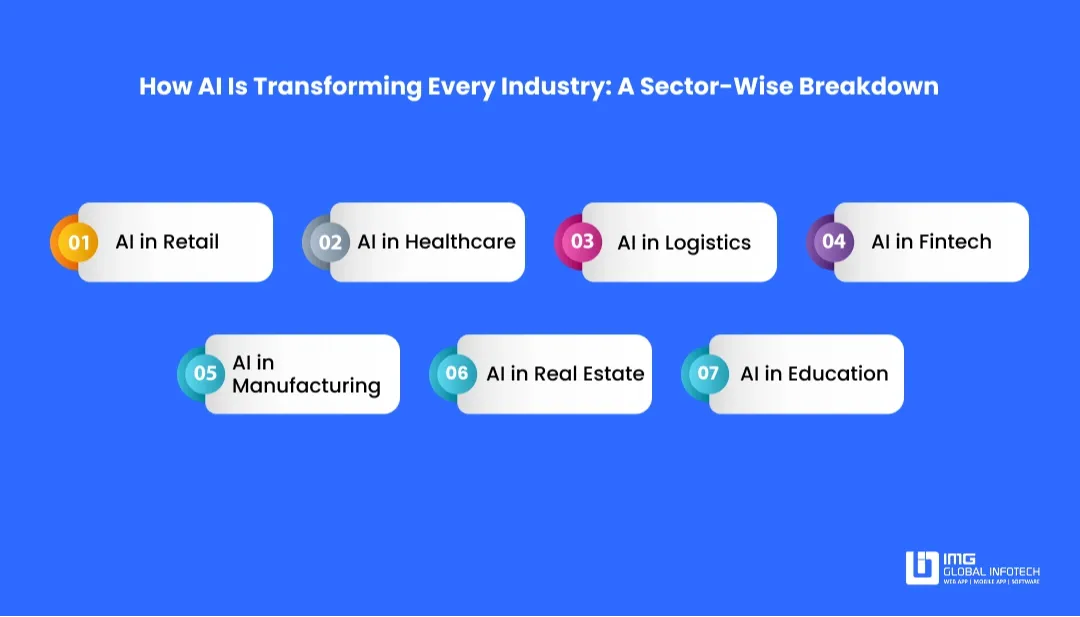
The New AI industry trends are revolutionizing businesses, helping them embrace intelligent automation that achieves efficiency and drives innovation. It can also reach greater heights in the business. Let's explore the most impactful use cases of AI trends in various industries as well.
AI in Retail
AI in the retail sector is optimizing the inventory management and customer personalization in impactful ways. The AI integration into the retail businesses in their ecosystem as well.
-
Inventory Management: AI for inventory management helps foresee demand, reduce wastage, and optimize the stock levels in the market.
-
Visual Search: AI can enable the customers to search the products by integrating the images, which leads to enhancing the online shopping experience.
-
Personalized Marketing: AI technologies can analyze the customer behavior and preferences that are based on their recommendations. This strategy can enhance customer engagement and also improve ROI and customer retention rates, especially when brands create personalized videos using AI video makers to deliver more relevant and impactful messages.
AI in Healthcare
AI is transforming healthcare and expanding the healthcare business. This technology can help enhance diagnostics and patient care by the Generative ai in healthcare. Here is the overview of AI in healthcare that has been utilized to improve the efficiency of outcomes as well:
-
Treatment and Diagnosis: AI can help diagnose the medical conditions through the image analysis (MRI, X-rays) because it can recommend the personalized treatment plans as well.
-
Remote Monitoring: The AI-powered wearables help the medical professionals that can monitor patients' health in real time. It can also help in instant action to detect any peculiarities in any business operations as well.
-
Drug Discovery: AI can also help in drug development that can easily predict the molecular interactions so that it can identify the certain drug candidates in business operations as well.
AI in Logistics
The AI technologies are making logistics safer and more reliable. From the traffic management and autonomous vehicles. Here are the advanced AI strategic bases for the logistics sector as well:
-
Traffic Management: AI can optimize the traffic flow to analyze the data from various sources that can transform the traffic sensors into intelligent agents that can use cameras in urban mobility in the business operations as well.
-
Digital Number Plates: The recent trends in AI interestingly enable the smart technology to transform the number plates into the digital ones. It can help the logistics industry to get instant notifications in case of GPS location and accidents.
-
Autonomous Vehicles: AI can enable the realization of the vision of autonomous or self-driving cars that safely zoom around and navigate, which can enhance road safety and reduce congestion in business operations as well.
AI in Fintech
AI is reshaping the fintech industry to enhance the decision-making to increase the security management of an agent in artificial intelligence. Here are some main AI applications that are transforming the fintech sector:
-
Fraud Detection: AI in the fintech industry integrates the machine learning that can recognize the unusual patterns and customer behavior. It can help to prevent deceptive transactions in the business operations.
-
Credit Risk Assessments: AI in the fintech industry can help to keep records of the customers that can be utilized in payoff loans and credit card procedures as well.
-
Safe Trading: AI can also analyze the market data that can enable the several organizations and individuals to trade seamlessly. It can also optimize the investment strategy to reduce the unanticipated risks in buying and selling shares and stocks in the businesses as well.
AI in Manufacturing
AI is being increasingly adopted by the manufacturing industry to provide increased productivity levels and a higher degree of quality in manufactured goods. Below are three different uses of AI in manufacturing:
-
Predictive Maintenance—AI technologies utilize sensor data to allow manufacturers to forecast when equipment will fail, minimizing downtime and repair costs.
-
Supply Chain Optimization—Currently, the leading trends in AI within the manufacturing industry allow for improved optimization of supply chains through analysis of data to identify ways to optimize logistical routes and reduce delays, providing greater efficiency.
-
Industry 5.0 - Industry 5.0 represents a new development methodology for manufacturing utilizing AI algorithm development and refers to a bottom-up method for manufacturing products that uses both quantitative data and a holistic perspective of product quality, process efficiency, and customer satisfaction that are supported by the use of AI algorithms in the manufacturing process.
AI in Real Estate
The real estate sector is integrating artificial intelligence (AI) to improve its processes for efficiency and increase profits, while simultaneously enhancing the experience for clients. The following examples outline how AI is currently being utilized throughout various stages of the real estate transaction cycle.
-
Smart Property Valuation: AI predictions include using historical sales, property characteristics (ground area, building size, etc.) and physical location to produce more precise valuation estimates for properties.
-
Predictive Market Insights: An investor or developer is able to identify trends in market demand and pricing through machine learning. By understanding these predictions, an investor(s) or developer(s) can better evaluate investment opportunities.
-
Intelligent Property Management: AI assisted building systems can control energy consumption, schedule maintenance tasks automatically and monitor equipment conditions.
AI in Education
The use of AI technology in the education sector has changed how educators teach, how students learn, and how educational institutions operate by most Popular AI Apps. Below are several significant ways that AI technology has influenced the education industry.
-
Personalizing Individualized Learning: AI platforms allow educators to customize instructional materials based on students' competencies, learning preferences, and pace. This means that each student's understanding of a particular concept can be individualized.
-
Automated Support Via Virtual Tutoring: Students can now get answers to their questions and assistance with their work 24 hours a day through chatbots and virtual tutors.
-
Automation of School Administration Tasks: AI technology can save time for educators by automating various time-consuming administration tasks. For example, AI can help with grading assignments and keeping track of students' attendance.
How Businesses Can Implement AI Quickly in 2026
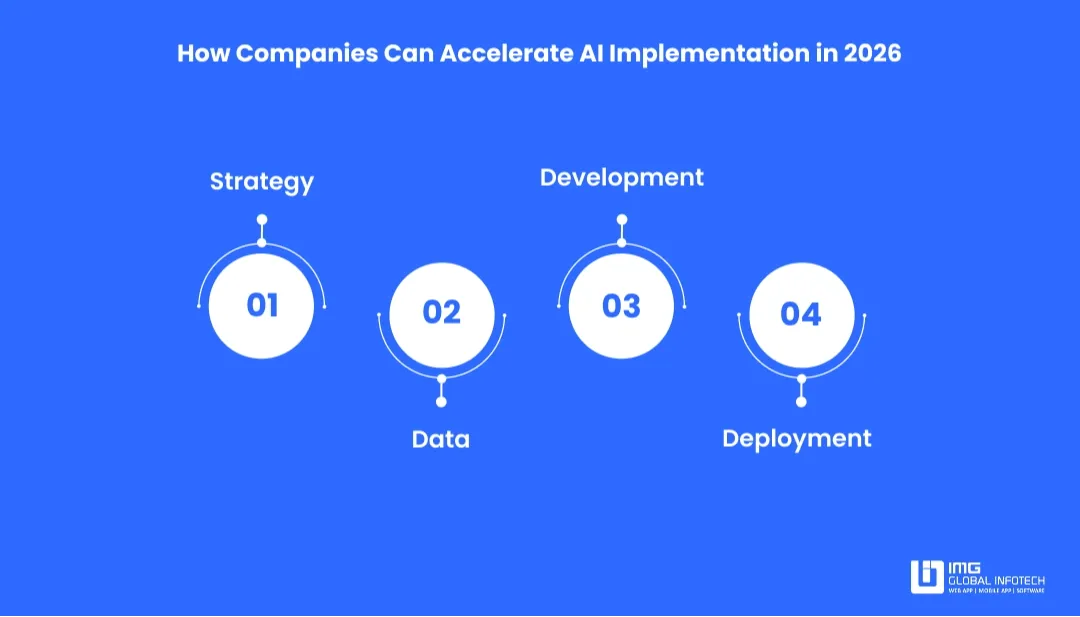
Businesses can rapidly implement AI in 2026 by following a practical roadmap focused on strategy, data, development, and deployment. In so doing, it ensures measurable outcomes, minimizes risks, and aligns AI initiatives with business goals for rapid transformation.
Strategy
Start with an AI readiness assessment that identifies high-impact use cases aligned with business objectives. Define clear KPIs for each project and secure leadership buy-in to ensure resources and suppor that Top artificial intelligence trends transforming businesses in 2026. Focus on "quick win" projects that demonstrate value early, such as automating repetitive tasks or enhancing customer service with AI assistants. A well-defined strategy ensures AI adoption is business-driven, not just technology-led.
Data
Audit existing data sources and consolidate these sources into a unified architecture. Audited, structured, and accessible data is fundamental to the performance of AI models. Invest in robust data pipelines and storage, and make data quality and governance a key priority. Ensure compliance with all necessary privacy regulations and clearly define ownership for data management in AI Adoption Trends. Data readiness is foundational; without it, even the best AI models won't deliver results.
Development
Start with focused pilots, selecting the use cases offering clear ROI and manageable complexity. Build and train AI models using modern tools and platforms; rigorously test for bias, security, and performance. Collaborate with cross-functional teams to ensure user needs are met. Utilize agile methodologies to iterate quickly and gather feedback. Such a partnership accelerates the development, lowers risks for organizations lacking internal expertise, and trains employees in modern technologies.
Deployment
Deploy the AI solutions in phases, starting with small user groups in order to prove the impact. Improve security, logging, and observability. Integrate the AI systems with your existing workflows. Create operational playbooks for monitoring, escalation, and continual improvement. Measure business KPIs and capture users' feedback for refinement and scaling of successful initiatives. Continuous monitoring and iteration ensure that AI remains effective and aligned with evolving business needs.
Cost of AI Development in 2026
In 2026, the overall development costs of AI will vary considerably depending on the project's scope; for example, an MVP will start from $8000, while an enterprise-level AI solution could exceed $15k or more. In terms of time to complete an MVP, the average is between 4-5 Weeks, whereas enterprise-level deployments will take approximately 5-12 Weeks. Additionally, teams may consist of data scientists and/or artificial intelligence engineers, as well as project managers.
Why Partnering with an AI Development Company Accelerates Growth
Partnering with a reliable AI development company is a very good strategic move to enhance the business growth. It is also required from the research to the development process to maintain the infrastructure. Here are some reasons why a business will collaborate with a scalable AI development company to enhance their business growth and presence as well.
Leveraging AI Expertise
Working with specialized companies in AI provides companies with access to the best skills in certain areas of artificial intelligence. This cooperation gives organizations an opportunity to focus more closely on core business goals, which increases overall efficiency.
Partnering for Success
Instead, many proactive companies prefer to partner with leading AI consulting firms rather than develop internal capabilities from scratch, a move that helps them stay ahead in a rapidly changing landscape.
Benefits of AI Consulting
AI consulting serves as a game-changer for businesses seeking to unlock the full potential of artificial intelligence. By partnering with AI consultants, companies can foster innovation, streamline operations, and consequently edge out their competitors in their respective industries.
The Value of AI Development
AI consultants and developers bring a lot of expertise to the table in order to help businesses tackle the complications that arise during AI adoption and ensure successful implementation.
Unlocking Artificial Intelligence's Potential
Realizing the full potential of AI requires a strategic approach, and that's where AI consulting comes into play. AI consultants help businesses identify areas where AI can bring in substantial value into operations and drive innovation.
How IMG Global Infotech Helps Businesses Build Future-Ready AI Solutions
IMG Global Infotech empowers organizations to build future-ready AI solutions by leveraging the latest technologies and industry expertise. Their end-to-end approach ensures scalable, secure, and tailored AI solutions that drive growth and innovation across diverse sectors.
End-to-End AI Expertise
Our experts provide the entire cycle of AI development, from concept to deployment. Their team ensures solutions are forward-thinking, scalable, and aligned with particular business goals. With a structured process that covers discovery, design, development, and launch, they deliver robust AI systems that adapt to evolving needs.
Tailored, Scalable Solutions
Our company designs AI solutions for each industry's peculiar problems. Be it healthcare, fintech, or eCommerce, Our dedicated team of developers creates systems that evolve with your business. The flexible architecture and scalable models ensure long-term success and adaptability.
State-of-the-Art Technologies
Our professionals leverage generative AI, NLP, predictive analytics, and machine learning to deliver the latest in AI. Their use of modern frameworks and tools is focused on making solutions efficient, secure, and future-ready. Continuous innovation keeps customers ahead of the competition.
Quality and Security Assurance
Our company adheres to best practices in code development, data privacy, and QA processes. IMG Global Infotech believes in robust security measures while delivering full-scale, high-performance Artificial Intelligence systems. Such qualities turn this organization into a trustworthy partner for AI transformation.
Final Thoughts
Artificial Intelligence does not become a solution provider immediately; it was developed by humans who experimented and created many complex algorithms over the years, learning from the many math, science, and technology fields. For this reason, 2026 marks a true emergence of AIs from a nice-to-have to what people consider necessary, from being limited to a particular application, such as driverless cars or robots, to where AI will be everywhere in our everyday lives. We will be using AI in multiple ways, such as enhancing our creativity through collaboration with the highest thinkers and most successful people.
Your future may not be linked to AI; instead, it will be determined by how well you continue to adapt with a reliable AI Development Company to the new technologies being developed, traditionally in ways that most are not even familiar with yet. People who are open to change, hesitant to take on risk and willing to innovate will help shape what comes next.