There is a rapid growth in food delivery apps in the on-demand industry in recent years. These businesses are adapted by all sectors, whether they are small, medium-sized, or major multinationals that are adopting this kind of tactic to attract new users that can enhance the service quality.
In the midst of this rush, the majority of businesses are turning to on-demand food delivery services to speed up their market entry in the food delivery app development trends. However, in an increasingly crowded market, capitalizing on new and emerging trends is critical for maintaining a competitive advantage.
Through this blog we will discuss the food delivery app development trends 2026. We will also discuss some major topics in this guide, and let's discuss food delivery app development trends to follow in 2026 as well.
Food Delivery App Development Trends to Follow in 2026
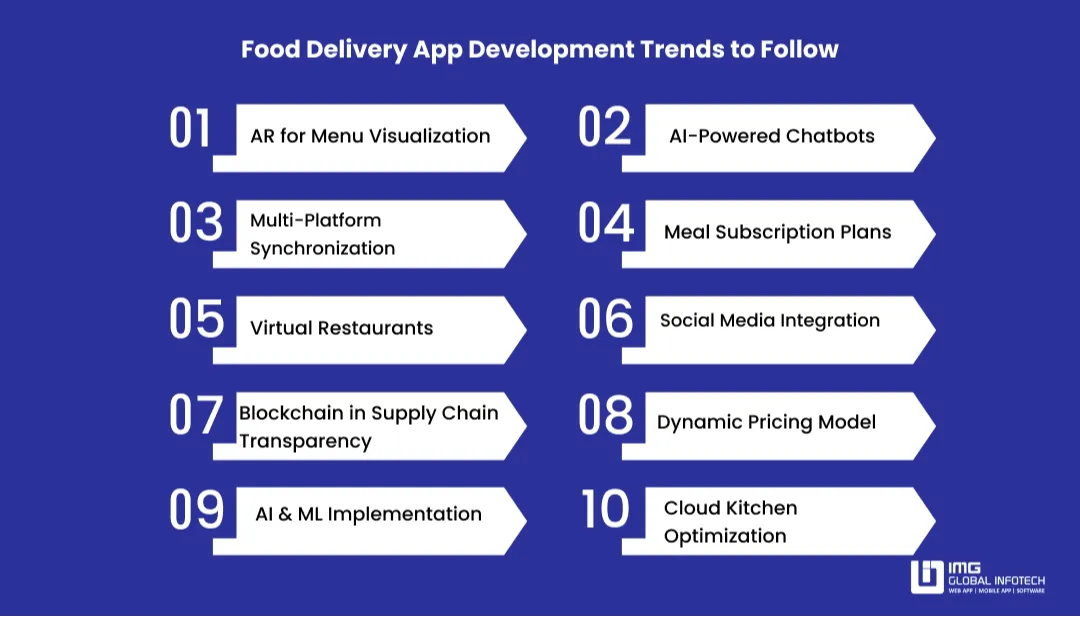
Here is a list of food delivery app development trends to follow in 2026
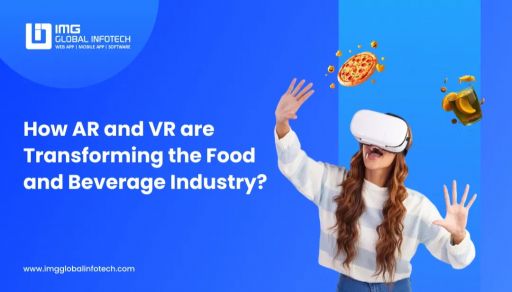
AR for Menu Visualization
AR has a significant impact on menu interaction because it allows users to view the meals in 3D on their gadgets before making an order in the food delivery app development 2026. It helps the customers to make a wise and better choice by showing the size and the way the food is served. Therefore, you can create a food delivery application that will raise user engagement.
AI-Powered Chatbots
AI-built chatbots monitor an order, respond to the most common queries, and provide customer service instantly in the food delivery app trends. They reduce the cost of human assistance by offering help around the clock in the Food delivery app development companies in India. Smart bots can also assist in cross-selling and upselling by making personalized recommendations.
Multi-Platform Synchronization
The synchronization in food ordering applications is exceptionally smooth across various devices, including wearables, tablets, smartphones, and smart TVs in the trending food delivery apps. This ensures a fluid user experience, allowing customers to initiate their orders on one device and effortlessly transition to another, maintaining continuity and convenience throughout the entire ordering process without any interruptions.
Meal Subscription Plans
When it comes to those who have opted for subscription services, added benefits such as unlimited delivery as well as special menus for meals might have an additional charge.
This not only helps create steady incomes for businesses in the food delivery app trends 2026, but it also results in the acquisition of loyal subscribers in the best food-delivery apps digital trends. It is an intelligent approach to designing a food delivery application targeting those who have various activities to attend to.
Virtual Restaurants
Virtual restaurants, also known as ghost restaurants, function without a traditional dining space, relying solely on app-based delivery services in the food and diet app trend. This innovative model significantly reduces startup costs for food businesses, enabling them to experiment with new menu offerings in the food and diet app trends. By operating in this manner, brands can quickly adapt to consumer preferences and market trends, enhancing their overall competitiveness.
Social Media Integration
The app integrates various social features that empower users to effortlessly share their food photos in On demand app development, compose detailed reviews, and place orders directly through the platform. Furthermore, it incorporates influencer marketing tools and user login functionalities, which greatly improve the app's visibility and foster increased user engagement within the community.
Blockchain in Supply Chain Transparency
Blockchain technology provides a comprehensive and transparent record of ingredient sourcing and procurement methods in the food app long term trends. This transparency fosters consumer trust, as individuals can verify the origin and quality of products. Such a robust system is particularly crucial for premium products, ensuring that consumers receive the highest standards of quality and authenticity.
Dynamic Pricing Model
eCommerce retailers often utilize dynamic pricing as a way to increase profits for food delivery companies. Dynamic pricing helps food delivery businesses maximize profit potential through the capability to alter pricing during peak hours depending on how many customers are ordering, what time it is outside, and whether a holiday or festival is occurring in on-demand food delivery app trends. By using dynamic pricing, restaurants and delivery services can generate the highest revenue available while offering competitive pricing.
AI & ML Implementation
Today, food delivery services are changing rapidly due to major advances in artificial intelligence (AI) and machine learning (ML) in food ordering app development trends. These two types of technologies allow companies to analyze and process large amounts of data quickly and efficiently so they can make predictions based on people's behavior and optimize delivery routes, as well as identify potentially fraudulent behavior.
AI and ML will allow food delivery apps to create a more customized and effective user experience.
Cloud Kitchen Optimization
Cloud kitchens, often referred to as ghost kitchens, are changing the way restaurants operate because cloud kitchens operate primarily online in the future of food delivery apps. Cloud kitchens do not have dine-in space, which means that they can reduce the overhead associated with the restaurant business in the food delivery startup trends. Entrepreneurs as well as businesses that are well established can utilize a cloud kitchen to reach out to a larger customer base without incurring the high infrastructure costs related to having a brick-and-mortar restaurant.
Cloud kitchens operate from a centrally located facility, preparing the food that they sell solely by delivery in the food delivery app market trends 2026. The use of data analytics gives cloud kitchens an advantage in determining plate offerings and predicting future sales as well.
How Businesses Can Prepare for Food Delivery Trends in 2026
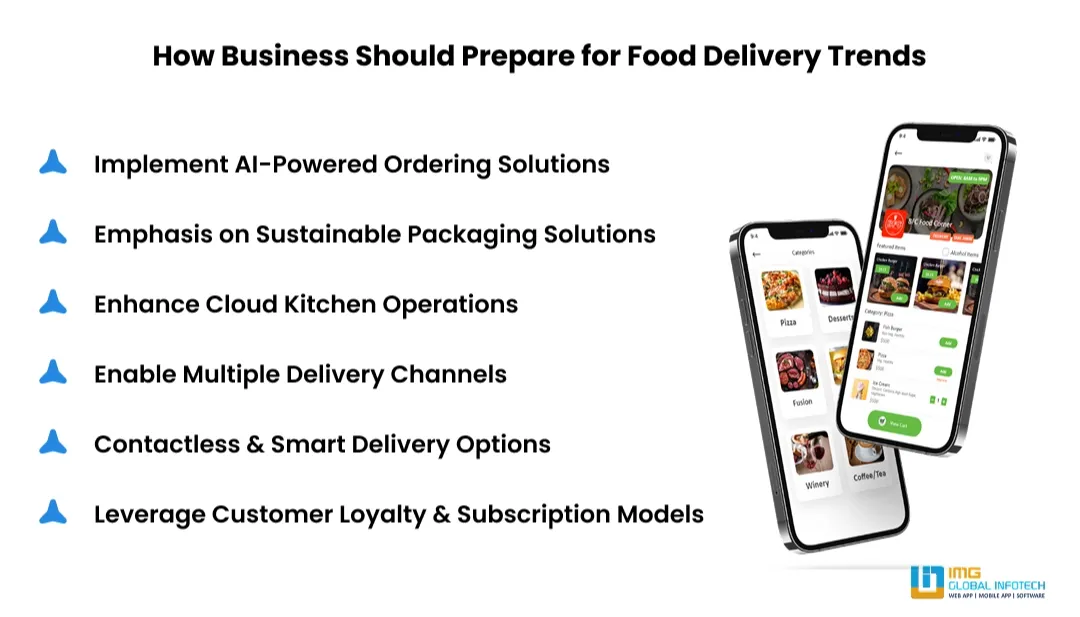
The food delivery industry is also experiencing rapid transformations in light of adapting consumer behavior, intelligent technologies, and sustainability needs.
It will result in better customer loyalty for businesses that are able to prepare for the food industry by 2026.
Implement AI-Powered Ordering Solutions
Personalization will also be brought by artificial intelligence in suggesting food, demand forecasting, and minimizing order mistakes in Mobile app development company. In order for businesses to make use of these technologies, they must invest in smart recommendation systems, chatbots, and predictive analytics.
Emphasis on Sustainable Packaging Solutions
Eco-friendly packaging is going to be in high demand among eco-conscious customers. Restaurants need to opt for biodegradable, recyclable, and reusable packaging solutions to lower carbon emissions, comply with norms, enhance their image, and acquire eco-conscious customers.
Enhance Cloud Kitchen Operations
Cloud kitchens allow brands to scale without much infrastructure expenditure. Enterprises need to fully leverage cloud kitchens in Food delivery app features, test new menus specifically for delivery orders, and analyze consumer data to develop new food offerings and enter new geographies quickly.
Enable Multiple Delivery Channels
Integrations Leaning on one platform can generate risks to the business. It would be ideal to incorporate platforms and ordering applications to widen the reach and also to ensure that the flow of orders is not interrupted during peak times.
Contactless & Smart Delivery Options
By 2026, customers will demand fast, secure, and contactless delivery in the digital transformation in food delivery. To meet that, the businesses will need to look into the development of other technologies such as QR payments, automated lockers, drone pilots, and route optimization.
Leverage Customer Loyalty & Subscription Models
Meal subscription services and digital loyalty cards will all help towards retaining customers. The restaurants need to provide customers with reward points, exclusive offers, and personal offers to attract repeated business, guarantee fixed revenue in the future, and build long-term relationships with regular food delivery customers.
Diverse Options for Startups and Small Businesses
Before investing in any business, an entrepreneur can have several questions and look out for strong reasons to invest in them to Build a food delivery app like Zomato. Following are the major reasons why a startup or small business must enter into an on-demand delivery business.
Reach a Larger Audience
This would help the companies in on-demand delivery reach a bigger audience than they traditionally could with their physical location. Moreover, it would increase brand exposure along with customer exposure, allowing them to spread awareness at many more places.
Streamline Complete Process
On-demand delivery apps might organizationalize efficiency by automating the ordering and delivery processes. It will reduce errors, increase productivity, and unblock resources that might be utilized to focus on other business aspects.
Keep Pace with Competitors
On-demand delivery is becoming the new normal, and most customers consider it a routine option. Small businesses and startups can keep up with this trend and meet customer demands by adopting on-demand delivery apps.
Information and Analytics
On-demand delivery apps can offer insight into consumer behavior, preferences, and shopping habits in the Food delivery apps. This knowledge can help in decision-making and maximizing business plans accordingly.
Cost-Effective Solutions
On-demand delivery applications can be very affordable for small businesses and startups that cannot afford to build and maintain their own delivery infrastructure.
Conclusion
There have been many changes in the food delivery industry, especially with respect to technological innovation and new customer demands by the Food delivery app development company. The biggest challenge for everyone who wants to be successful in this sector will be to keep up with food delivery app development trends, which will definitely help you.
Ultimately, by adding functionality such as AI-powered recommendations, dynamic pricing, and easy-to-use graphical interfaces, food delivery applications will be able to create greater loyalty from customers by creating a more customized and effective experience for their users.