
Saas, a cloud-based model, has been growing rapidly over the years. One of the prime examples of it is Netflix for apps. It is useful for Salesforce, Oracle, HR Software, and more. It was started as a simple cloud-based software. However, businesses now view it as an intelligent, adaptive, and deeply personalised approach. Along with SaaS, there is a massive boost in the usage of AI tools. AI is present, AI is the future, and AI is here to stay. There is another element, or we can say a subset of AI, that is Agentic AI. And to integrate the technology with SaaS, it is now called Agentic AI in SaaS. It is something that allows software to act independently, make decisions, and continuously optimise workflows without the need for manpower.
With Agentic AI, SaaS applications can proactively think, plan, and complete tasks on their own. The applications now have a greater level of independence from human intervention, which will lead to greater efficiency and a more user-focused experience. The example of how SaaS applications have changed is by shifting the way that they build, operate, and grow. This blog will go deep dive into the transformation of modern software applications, their usage and benefits, implementation strategies, challenges, and what’s ahead. We will also take some real-world cases to understand the case a bit more. So let’s start.
What is Agentic AI?
Agentic AI is a system that focuses on a goal and can make decisions. It is designed with autonomy, and rather than relying on instructions, the system analyzes the situation and, based on that, sets sub-goals. The system chooses actions and learn from outcomes. The agent can monitor the app’s performance, predict users' needs, and adapt behaviour in real time. They can also execute workflows automatically. It shows that the SaaS platforms are more proactive rather than reactive. It is self-directed, and businesses are adopting it to move beyond basic automation and toward intelligent, self-operating software ecosystems.
How Agentic AI Differs from Traditional AI Models?
As said earlier, traditional AI systems do not have the ability to be proactive. They rely only on predefined inputs and are restricted to operating within fixed boundaries. With Agentic AI coming into play, it brings autonomy and reasoning. Here are now agents in AI that stand apart:-
1. Decision-Making Autonomy: Traditional AI system can only suggests, while Agentic AI can decide and then act.
2. Continuous Learning: Traditional AI relies on a set database. Agentic AI, on the other hand, learn from real-world interactions.
3. Goal-Oriented Behaviour: Agentic AI is more goal-oriented, which is not the case in traditional AI. Traditional AI executes tasks, while agents pursue outcomes.
4. Context Awareness: Traditional AI are less potent in terms of understanding user intent, system state and external factors. Agentic AI is more capable in this aspect.
This evolution is why Agentic AI for SaaS applications is becoming a cornerstone of AI-driven SaaS platforms and Intelligent SaaS applications.
Difference between Traditional AI and Agentic AI (In Table)
Key Features of Agentic AI That Transform SaaS Applications
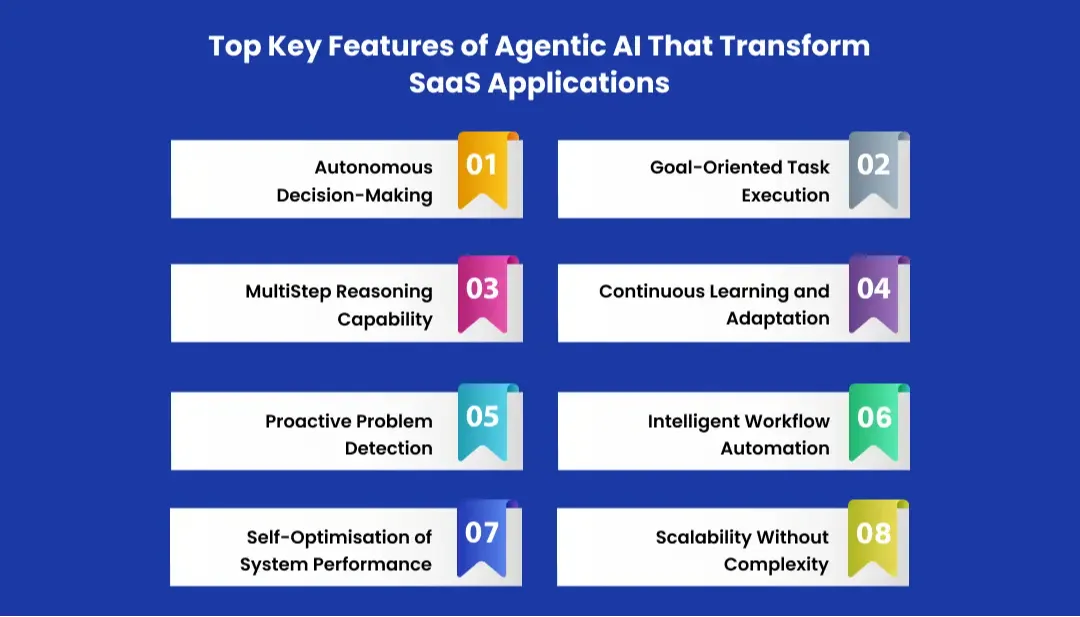
Several key features of Agentic AI change the whole landscape. Here are some of them given below.
1. Autonomous Decision-Making
Agentic AI helps SaaS platforms to make independent decisions without the need for human input. It analyses multiple data, assesses outcomes and takes the most effective action. Due to that, there will be faster responses, reduced dependency on manual intervention. It is an intelligent system behaviour, something that businesses look for.
2. Goal-Oriented Task Execution
Agentic AI is more of a goal-oriented approach, which we cannot see in traditional AI. It works on predefined goals by breaking complex objectives into small goals. The agent also prioritises tasks and adjusts its approach constantly for the desired outcome.
3. MultiStep Reasoning Capability
Agentic AI can handle multiple tasks, like complex reasoning and multi-layered problems. With this approach, SaaS applications can execute end-to-end workflows without human supervision. They can do things like user login, billing or customer support smoothly.
4. Continuous Learning and Adaptation
Agentic AI systems learn continuously from user behaviour, operational data, and outcomes. Instead of retraining models manually, SaaS platforms evolve automatically, improving performance, accuracy, and efficiency as usage grows.
5. Proactive Problem Detection
Agentic AI believes in the ‘prevention is better than cure’ approach. They do not react to failure, but rather identify issues and rectify them before escalation. It helps SaaS products to heal themself, and they do not have to rely on others. This is possible because the agent monitors system health and predicts potential disruptions.
6. Intelligent Workflow Automation
With an intelligent ability to orchestrate processes, Agentic AI can generate an optimal order of activities by using its ability to analyse real-time conditions. In addition, Agentic AI maintains the integrity of all process flows across many systems by adjusting to any changes that occur.
7. Self-Optimisation of System Performance
Agentic AI keeps a constant eye on response time, resource usage, and user engagement. They help the businesses to optimise configurations, improving scalability and speed. It also allows businesses to reduce costs. All these things are possible because of the continuous analysis of performance metrics.
8. Scalability Without Complexity
As SaaS platforms develop, agentic AIs will grow on their own while still providing the same level of quality that SaaS platforms do. Agentic AI handles any internal complexity and allows companies to expand their user base, features and Geography without adding extreme amounts of operational pressure. Agentic AI's concentration on scalability to maintain high-quality agencies.
Other Key Features are:-
-
Ethical & Rule-Aware Decision Making
-
Cross-System Intelligence
-
Personalised User Experiences
-
Autonomous Resource Management
-
Human-AI Collaboration
-
Contextual Awareness
These features allow AI-enabled software solutions to operate more like intelligent collaborators than static tools.
Core Benefits of Agentic AI for SaaS Businesses
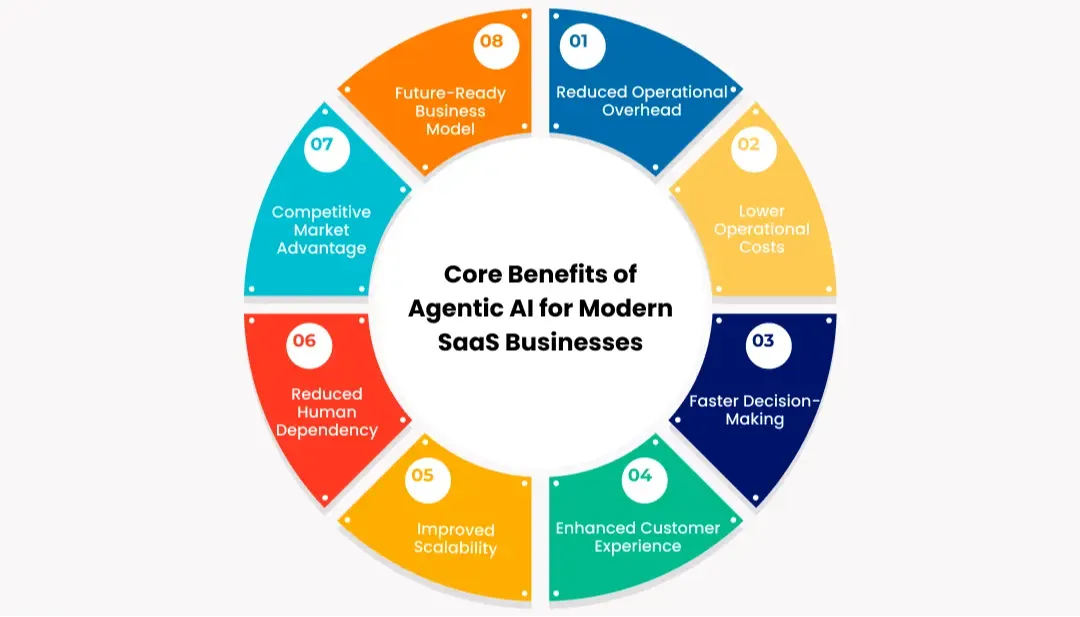
There are several benefits of Agentic AI in SaaS. Here are some of them listed below.
1. Reduced Operational Overhead
With advanced technology, there is no need for or less requirement of human intervention. Agentic AI automates complex tasks and multi-step processes, which reduces manual workloads. It also eliminates process bottlenecks and ensures faster execution. The best part is, all of these things are possible without compromising on consistency and accuracy.
2. Lower Operational Costs
Agentic AI manages workflows, support tasks, and infrastructure that helps in reducing labour and cloud expenses. The SaaS companies can optimise resource usage and scale efficiently without proportional increases in operational costs.
3. Faster Decision-Making
Agentic AI takes quick action after analysing a large volume of data. They analyse data in real time, and SaaS businesses get the benefits of faster, data-driven decisions. It improves responsiveness to market changes, customer needs, and system performance issues.
4. Enhanced Customer Experience
SaaS companies can increase their customers' experience by analysing user needs and solving issues automatically. Agentic AI is proactive and focuses on personalisation. They deliver smoother and more relevant user interactions.
5. Improved Scalability
Scalability is one of the main aims of any business. In SaaS businesses, agentic AI helps them to scale by managing workloads autonomously. The system does not have to restructure complex operations or require more manpower after the user demand grows.
6. Reduced Human Dependency
The businesses do not have to be concerned about day-to-day operations. They can focus on strategic initiatives, innovation, and high-value decision-making because Agentic AI automates routine and repetitive tasks that require human dependency.
7. Competitive Market Advantage
SaaS companies that are taking advantage of agentic AI’s capabilities are gaining a competitive advantage that allows for the development of intelligent, efficient, and automated products. This unique differentiation provides unique opportunities for customer acquisition and retention, as well as enhanced visibility in highly competitive SaaS industries.
8. Future-Ready Business Model
The businesses that are not adapting to Agentic AI are losing the competitive battle in the market. They are still using the obsolete technologies that give a competitive edge to their competitors. With the use of autonomous operations, AI-driven personalisation, and intelligent enterprise solutions, SaaS businesses can find themselves in a good position in the market. Long-term growth is possible for those businesses.
Other Benefits of Agentic AI are:-
-
Improved Compliance & Governance
-
Smarter Resource Management
-
Accelerated Product Innovation
-
Data-Driven Business Optimisation
-
Higher System Reliability
This is why How Agentic AI transforms SaaS operations has become a critical topic for modern product leaders. Agentic intelligence will power the most Popular AI Apps of the next decade
Practical Use Cases of Agentic AI in SaaS Applications
There are several use cases of agentic AI in logistics and SaaS applications. Here are some of them given below.
1. Customer Support Automation
The agents understand issues, resolve common queries and escalate complex cases. It learns from interactions that improve response times, reduce support costs and ensure consistent customer experience across platforms.
2. Intelligent User Onboarding
Agentic AI creates onboarding journeys tailored specifically to the user according to the user’s job function, usage patterns and short-term goals. A key feature is that Agentic AI will change its tutorials and recommendations based on how the user is interacting with the product, thus allowing for a higher likelihood of continued use and retention after the first few sessions.
3. AI-Driven Sales Automation
Agentic AI assists sales teams in qualifying potential customers, predicting the likelihood of converting those customers into buyers, scheduling follow-up activities, and personalising interactions with customers. SaaS businesses use Agentic AI to manage their sales pipelines more effectively.
4. Workflow and Automation
Agentic AIs autonomously structure and carry out intricate multi-departmental workflows. They modify how tasks are performed in response to changes as they occur, so that processes and systems can stay efficient no matter how business rules change.
5. Personalised Feature Recommendations
Agentic AI will use past user behaviour and preferences to suggest relevant features, updates or integrations. It will help in increasing user engagement, increasing product adoption, and eventually lead to more revenue.
6. Fraud Detection and Security
The Agentic AI can see the potential threat and, based on that, take actions to maintain data protection standards. They automatically start the security measures after continuous monitoring on any suspicious patterns.
Other Practical Use Cases of Agentic AI are:-
-
Predictive Churn Management
-
Self-Healing System Operations
-
Smart Pricing & Subscription Management
-
AI-Powered DevOps Automation
-
Intelligent Data Management
-
Cross-Platform Integration Management
-
Automated Compliance Management
-
Revenue Forecasting & Business Intelligence
-
Agentic systems integration with Generative AI.
The role of Agentic AI in modern SaaS products is very crucial, as discussed in the above section.
How Agentic AI Enhances Product Development & Deployment?
Agentic AI reshapes how SaaS apps are developed. Here are the examples given below.
1. Smarter Development Cycles
The agents help the product to improve after knowing the feedback from the users and how they adopt the features. It also analyses performance data to keep the product high-performing.
2. Automated Testing and QA
The platform requires bug fixes, updates, and more tool integration for the future. Agentic AI made sure that all these aspects are possible as they identify bugs, run tests and suggest rectifications.
3. Faster Deployments
Faster deployment helps businesses make intelligent release decisions. The pipeline for deployment should be smooth, and it benefits from AI development company frameworks.
4. Proactive Bug Detection
The Agentic AI ensures that there will be no impact due to bugs or other issues, as it monitors system behaviour just after the deployment to detect any suspected activity. They initiate corrective measures immediately after the scanning.
5. Faster Feedback Loops
The product team will receive actionable insights quickly, allowing for quick iteration and constant improvement. Agentic AI collects, analyses and correlates feedback from users, logs, and analytics tools.
Other Ways how Agentic AI Enhances Product Development and Deployment are:-
-
Data-Driven Feature Prioritisation
-
Continuous Requirement Discovery
-
Intelligent Test Case Generation
-
Faster CI/CD Pipelines
-
Predictive Release Management
-
Self-Optimising Deployment Strategies
-
Automated Rollback & Recovery
-
Environment & Infrastructure Optimisation
-
Improved Collaboration Between Teams
-
Continuous Product Optimisation Post-Launch
Agentic AI for SaaS Operations & Back-End Efficiency
Agentic AI continues to shine everywhere, especially in the back-end operations. Here are some of the points given below.
1. Autonomous Infrastructure Monitoring
Agents help in stable performance by monitoring the problems and taking corrective measures. They regularly keep an eye on servers, databases and networks. The agent also reduces the need for manpower.
2. Dynamic Resource Scaling
Agentic AI automatically adjusts computing resources based on real-time demand. This keeps cloud expenses under control, avoids over-provisioning, and keeps performance at its best during periods of high usage.
3. Intelligent Cost Optimisation
The Agentic AI shuts down the resources that are not in use at that particular moment. They make sure that the workloads are optimised, and without compromising on the quality, the cost will be lower.
4. Predictive Performance Management
Agentic AI solutions anticipate performance problems before they affect consumers by evaluating past and current metrics. With fewer reactive interventions, SaaS teams are able to maintain consistent service quality.
5. Smart Load Balancing
The Agentic AI smartly distributes traffic across servers. There will be a distribution based on workload and performance conditions. It helps in the proper utilisation of resources and prevents overload during traffic spikes.
Other Pointers are:-
-
Self-Healing System Architecture
-
Automated Incident Management
-
Database Optimization
-
Security Threat Detection
-
Automated Backup & Recovery
-
Configuration Management & Drift Control
-
Operational Workflow Automation
-
Real-Time Operational Insights
-
Improved SLA Management
Challenges & Considerations of Implementing Agentic AI in SaaS
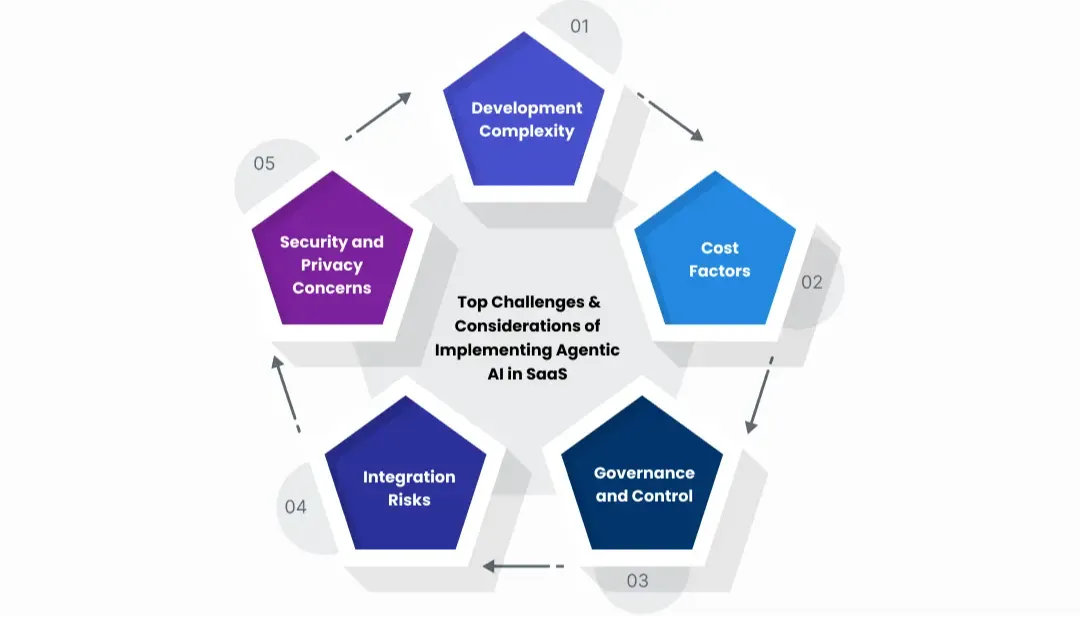
There are quite a few challenges while implementing Agentic AI in enterprise operating SaaS. The businesses have to consider a few points before implementation. Here are some of them given below.
1. Development Complexity
Agentic AI tools are not easy to handle. It requires proper planning, strategy, and advanced architecture, and only an expert in this field can handle the situation effectively.
2. Cost Factors
Traditional AI is cheaper than the AI agent development cost. Understanding the requirements is critical as agentic systems are more resource-intensive.
3. Governance and Control
The behaviour and transparency in Autonomous AI systems is important, but challenging at the same time. Ensuring ethical behaviour and transparency should be the objective of every business.
4. Integration Risks
An experienced developer who does not have technical know-how about Agentic AI and SaaS will find it difficult to integrate tools in the product. The agent must align with workflows and compliance requirements.
5. Security and Privacy Concerns
The businesses should not give full access to their sensitive data and critical operations to the agentic AI tools before checking. It ensures robust security, access control, and data privacy protections and prevents misuse.
Other Challenges are as follows:-
-
Data Quality & Availability
-
Explainability & Transparency
-
Risk of Unintended Actions
-
Integration with Legacy Systems
-
Compliance & Regulatory Readiness
-
Skill & Talent Gaps
-
Testing & Validation Complexity
-
Monitoring & Observability Requirements
-
Ethical Considerations
-
Change Management & User Trust
How to Integrate Agentic AI into Your SaaS Product?
A successful integration is important for SaaS businesses to have an upper hand in the market. Here are the steps given below.
STEP 1: Define Business Goals
Know your business’s goals and aims before starting the integration process. See what problems agentic AI can solve and focus on measurable outcomes.
STEP 2: Identify High-Impact Use Cases
Focus on areas where autonomous decision-making delivers immediate value.
STEP 3: Assess Data Readiness
Ensure your data is clean, reliable, and accessible for agentic AI.
STEP 4: Select the Right AI Architecture
Based on your product complexity, choose between a single or multi-agent system.
STEP 5: Choose the Technology Stack
Choose models and frameworks that integrate easily with SaaS.
Step 6: Start with a Pilot Implementation
Test agentic AI on a small feature or module before rolling it out
STEP 7: Integrate with Existing Systems
Connect agentic AI to your APIs, databases, and third-party tools for seamless operations.
STEP 8: Test in Real-World Scenarios
Validate how agentic AI behaves under different user actions.
STEP 9: Monitor & Measure Performance
Track efficiency, accuracy, and business impact to ensure agentic AI delivers value.
STEP 10: Plan for Long-Term Scalability
Design agentic AI systems that grow easily with users, data, and feature expansion.
Future Trends: What Agentic AI Means for the Next Generation of SaaS
The future of SaaS with Agentic AI is very bright. Here are some of the promising signs for the future.
-
Generative AI will combine with agentic systems.
-
AI agents will act as digital employees.
-
SaaS platforms will be self-managing.
-
Decision-making inside SaaS tools will happen in real time
-
Enterprise SaaS will adopt stronger governance and explainable agent AI development frameworks.
-
Agentic AI will define the competitive edge for next-generation SaaS companies.
-
Less or no requirement of manpower.
-
SaaS platforms will evolve into fully autonomous, self-managing software systems.
CONCLUSION
With the introduction of Agentic AI, SaaS has moved beyond being an upgrade to an evolution. Agentic AI allows users to create autonomous intelligent programs that continuously learn while interacting with their system. What's more, these applications work independently to evolve into 'proactive' and self-operating platforms. In addition, the introduction of Agentic AI has resulted in improved workflow efficiency, improved user experience, improved process optimization, and enhanced organizational future readiness. Investing in Agentic AI in SaaS will be a game-changer for the enterprises as AI technology trends are in boom period. The question is no longer if SaaS will adopt agentic AI, but how fast.