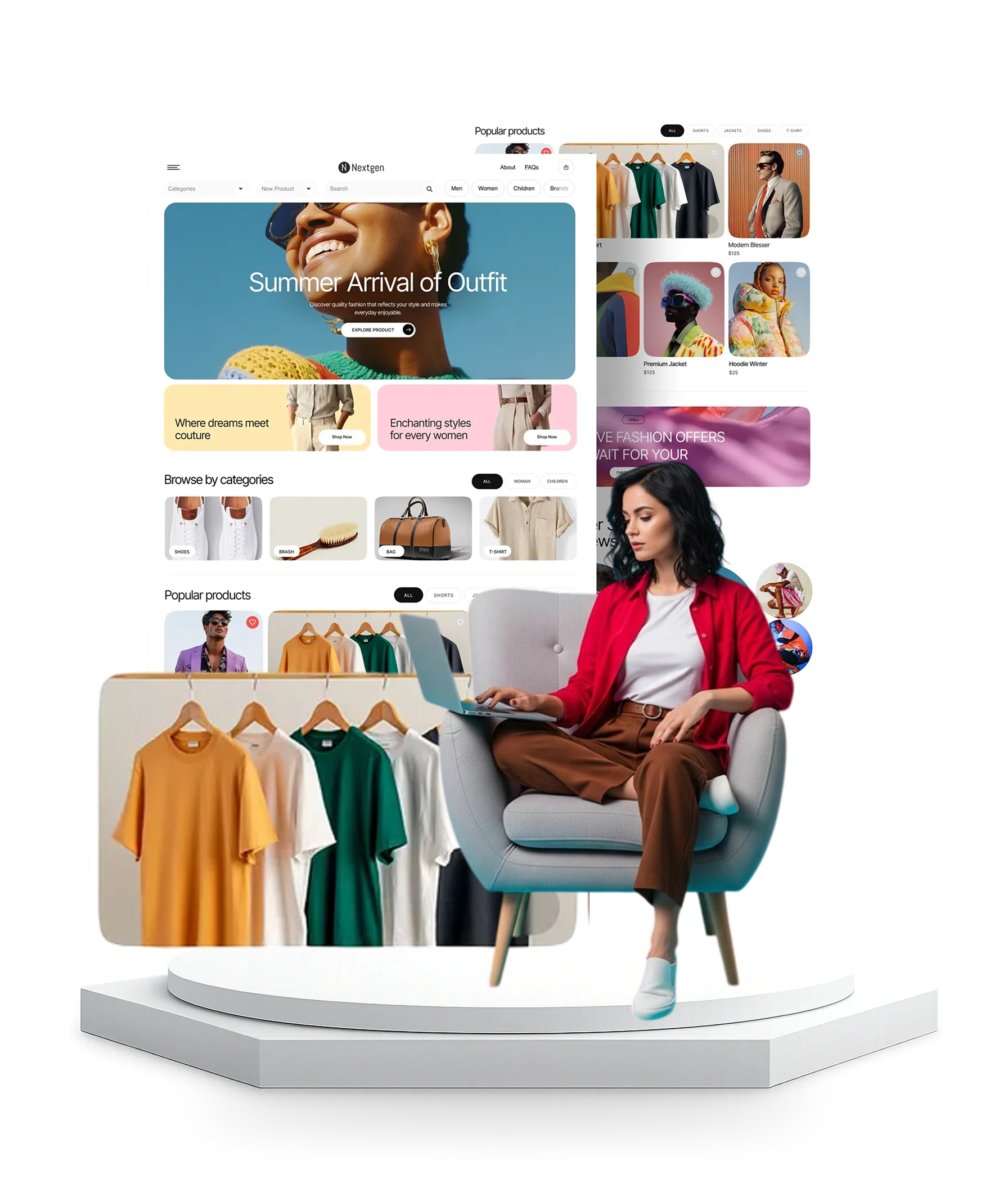
As the fashion sector continually moves toward online platforms, ecommerce sites are becoming more critical to brands that want to broaden their audience and increase sales. In India, as smartphones, digital payment methods, and the desire to shop online grow, so will the ability of fashion retailers to create a significant web presence.
A good fashion eCommerce site will allow you to show your products in a highly effective manner and to keep the customer engaged with your brand through personalized shopping experiences, secure payment methods, and easy-to-navigate sites. As a result, whether you are a new fashion line, a small boutique, or an established clothing business, investing in an ecommerce site design can keep you competitive in an ever-changing marketplace.
This guide will provide detailed information about fashion ecommerce website development guide, along with key development drivers, development costs and benefits, and development trends in creating a successful fashion eCommerce site in India.
Fashion Ecommerce Market in India: Opportunities for Brands
The rapid evolution of fashion ecommerce website development in the Indian market is creating new and lucrative opportunities for brands wishing to grow their presence in the fashion market. All brands will be able to take advantage of the rapid growth of the online fashion business in India by maximizing their revenue and customer engagement through the opportunities below:
1. Rapid Growth of the Online Fashion Business in India
India’s online fashion marketplace continues to grow at a rapid pace due to increased Internet access and the greater use of smartphones, making it easier for users to have access to the fashion eCommerce industry. Brands can use the rising number of online shopping consumers to reach many shoppers, beyond just stores, and get more sales over the web.
2. Growing needs of Tier 2 and Tier 3 city residents
People in small cities are very often the ones who buy fashion items online to determine the cost to build a fashion ecommerce website in India. This brings a great chance for brands to not only sell to new people but also to develop brand awareness in different regions.
3. Expansion of social commerce
Shopping on social media platforms is becoming the main shopping choice for many people. Fashion brands can engage their audience, get their products known, and convert without going to a physical store, all through interactive content, live shopping, and social commerce features.
4. Personalization and using AI for Shopping
The new shopper is very much into getting personal suggestions and shopping tailored to their needs. Fashion brands can use AI-based utilities to understand customer liking, suggest the most fitting product, and increase customer satisfaction as well as conversion and retention rates.
5. Rise of sustainable fashion
Environmentally aware shoppers are actively looking for fashion products that are sustainable the full fashion ecommerce website development cost breakdown. Brands that are into ethical sourcing, environmentally friendly materials, and transparency of making can stand out from other brands in the market and win over customers who are concerned about the environment.
6. Omnichannel Retail Opportunities
A combination of online and offline shopping to provide increased convenience. Aspects such as click-and-collect, real-time inventory checks, and seamless across all touch points to enhance customer loyalty, as well as drive operational efficiencies.
7. Growth of Digital Payments
The growing usage of UPI, mobile wallets, and net banking has streamlined the process of online shopping. For fashion brands, this would translate to improved checkout completion rates, a secure payment environment, and increased customer trust in online platforms.
Fashion eCommerce Business Models & Key Website Features
An excellent fashion eCommerce business relies on an appropriate business model as well as a feature-rich website. With an appropriate business model and required functionality, the business can achieve improved customer experience, enhanced sales, and consistent growth.
Fashion eCommerce Business Models:
1. Inventory Model:
In this model, the business buys and stocks the fashion products on hand before listing them for sale on the website. Brands have full control over product quality, pricing, stock, and delivery. Although capital-intensive, it provides good profit margins, brand loyalty, and better control over the quality of stock.
2. Marketplace Model:
This is a business model where several sellers come together to display their fashion brands. This business operates through a list fee subscription, or commission on sale. In this manner, an extensive product catalog can be generated without having to stock products; customers will also be able to browse a wider range of fashion brands.
3. Dropshipping Model
The dropshipping model enables sellers to sell products without the burden of keeping them in stock. Suppliers directly ship orders to customers upon receiving orders. This requires little investment and operational risk, while enabling startup ventures to build a fashion inventory management system quickly and affordably.
Top Essential Features of a Fashion eCommerce Website:
1. Advanced Product Search & Filters.
It lets shoppers find products quickly by using different search filters, i.e., size, color, brand, price, categories & availability.
2. Mobile-Responsive Design.
Make sure that all the customers get a smooth experience when browsing and purchasing your product from their specific device, i.e., mobile (smartphones), tablet, and desktop.
3. High Quality Product Images.
Provide images, zoom functionality and 360 view of a product image so that customers feel easy and comfortable purchasing the products.
4. Personalized Recommendations.
AI-based recommendation engines should display trendy products on user’s preferred categories & based on user behavior.
5. Secure Payment Gateway Integration.
Integrating multiple types of payment and security features like cards, wallets, UPI, buy-now-pay-later options, will make payments faster and easier for the shoppers.
6. Wishlist Functionality.
Help the shoppers save the products in their wishlist, which could later increase engagement and purchase.
7. Real-time inventory Management.
Provides real-time inventory updates to the user to help avoid overselling and increase customer confidence during purchase.
8. Customer Reviews & Ratings.
Enable the system for authenticated customers to submit reviews/ratings, which helps buyers decide whether to buy their products for buying.
9. Easy Returns & Exchange System.
Design a very easy and user-friendly interface for returns and exchanges to increase customer satisfaction and build loyalty for the brand.
10. Order Tracking and Notifications.
Customers will always remain updated about their order status during the whole purchasing process through automated notifications and order tracking.
Fashion Ecommerce Website Development Process
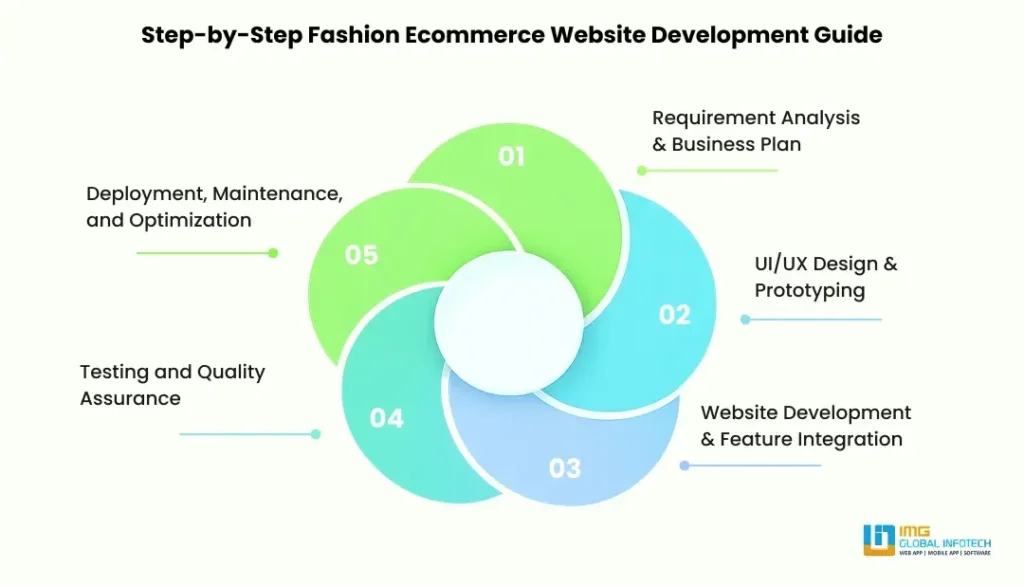
Development of a fashion eCommerce site involves a structured design, development, and implementation process. The process of developing a fashion eCommerce website can seem to be a daunting task, so teaming up with a professional ecommerce app development services provider can help you get a scalable, intuitive, and feature-rich online shopping site that will propel your business forward.
1. Requirement Analysis & Business Plan
At this point, the Shopify fashion store development company will learn more about your business needs and requirements in relation to its target audience, products, brand, and market requirements. It involves analyzing the market competitors, determining the scope of the project, determining the business model, and planning a development process according to your business needs.
2. UI/UX Design & Prototyping
At this stage of design development, the professional D2C ecommerce website development company will provide the appropriate wireframes and prototypes that match to your fashion brand’s identity. The main objective is the customer-friendly ecommerce app features, responsive layout design, engaging design of product page, and customers’ browsing and transaction process to attract potential customers to browse and make their purchase.
3. Website Development & Feature Integration
The front-end and back-end architecture of the website is designed and developed, and various functionalities like product catalogs, payment gateways,inventory management, wishlists, AI recommendations, order tracking, etc. The website has been optimized for speed, scalability, and security by the leading ecommerce app development company in Jaipur.
4. Testing and Quality Assurance
The team thoroughly tests the website in order to eliminate bugs, errors, security vulnerabilities, and performance-related issues before the launch of the website to examine the fashion ecommerce website cost in India (2026). Functionality, usability, compatibility, and mobile responsive tests are done to ensure that the website is working in the right manner across all devices, browsers, and users and in all possible scenarios.
5. Deployment, Maintenance, and Optimization
The website is then deployed in the live environment once it is verified by the client. The ecommerce development company keeps the website under maintenance, provides security updates, monitors performance, and offers feature upgradation. Constant optimization to deliver improved user experience, search engine ranking, and high overall performance in the competitive fashion sector.
Fashion Ecommerce Website Development Cost In India
The cost of a ecommerce website in India depends on complexity, functionalities, design, d2c ecommerce development agency hourly rates, and technology stack. A small online fashion store development can be built cost-effectively, while a sophisticated one with AI, AR features, and unique functionalities would be expensive to build.
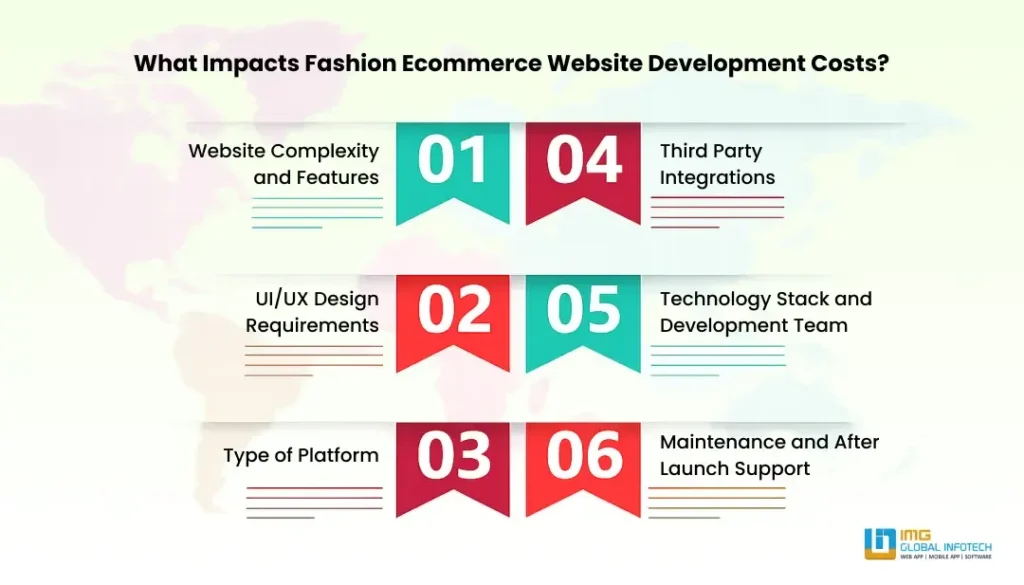
Factors Affecting Fashion Ecommerce Website Development Cost
1. Website Complexity and Features
The number of features will dictate the amount of development effort and costs to build them; therefore, an increase in the number of features, like, for example, AI Product Recommendations, Augmented Reality Try-ons, Rewards Program, Multi-vendor capabilities, etc., will require more time and resources to develop, thus increasing your overall custom fashion ecommerce development costs.
2. UI/UX Design Requirements –
The user interface (UI/UX) design of an ecommerce fashion website will require a significant amount of custom fashion-focused design development with multiple interactive elements (e.g., animated interfaces), which will also contribute to the overall increase in the fashion ecommerce website cost.
3. Type of Platform –
The platform that you choose to have your eCommerce fashion website built on (i.e., Shopify vs. WooCommerce vs. Magento vs. fully custom developed) will have a direct impact on the overall ecommerce mobile app development cost and will also greatly determine how expensive it will be to maintain, change, and scale your ecommerce product in the future.
4. Third Party Integrations –
The more you integrate with third-party companies (i.e., Payment Gateway, Shipping Partners, CRM, Inventory Management, Google Analytics, Marketing Automation, etc.) will add to the overall ecommerce app development cost, and often lead to substantial recurring costs.
5. Technology Stack and Development Team –
Thesoftware stack that your eCommerce fashion website is developed upon (i.e., Framework) and the level of expertise of the b2c ecommerce development company will result in varying costs to develop your eCommerce fashion website. A higher level of expertise will incur higher costs, which allows your eCommerce fashion website to be more secure and higher quality than if a lesser-experienced development team developed it.
6. Maintenance and After Launch Support –
The overall cost of maintenance/support of your ecommerce fashion website will consist of costs associated with performing updates, security monitoring, correcting bugs, maintaining the server, developing enhancements, and providing technical support after your eCommerce fashion website is launched.
Also Read – How Much Does It Cost To Build A Fashion Website Like FARFETCH?
Latest Trends in Fashion Ecommerce for 2026
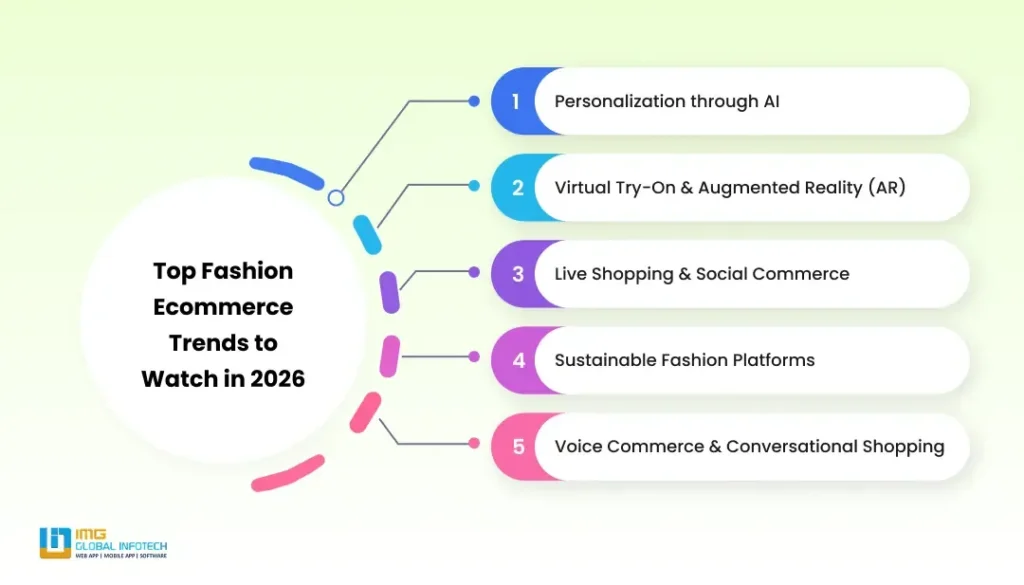
The fashion ecommerce industry is exploding with new technologies and ways for companies to understand their customers better, as well as how they can improve customer experience by providing better value.
1. Personalization through AI
Through artificial intelligence (AI), fashion retailers will be able to provide customers with personalized product recommendations, dynamically changing prices based on a customer’s purchase history, and creating custom marketing promotions built around each customer’s historical buying behavior. Using all of this data to provide customers with shopping experiences that are unique to them (as opposed to every other shopper) will ultimately lead to higher levels of customer engagement and loyalty.
2. Virtual Try-On & Augmented Reality (AR)
Customers no longer have to guess if the clothing, shoes, watches, or eyeglasses they want to buy will look good before buying them. Virtual Try-On and AR will help customers gain confidence to buy more products, which will translate into fewer returns because of poor fit or appearance, and provide a better shopping experience that merges the online fashion retailer and the traditional retail store experience.
3. Live Shopping & Social Commerce
Social media channels are increasingly becoming a place to directly sell products to customers through the use of live streaming events. Brands can easily showcase their products interactively using influencers and other means, and provide customers with an immediacy to purchase the products. This will grow the ability for brands to engage with customers and increase their chances of converting customers into buyers.
4. Sustainable Fashion Platforms
More and more shoppers are leaning toward brands that provide eco-friendly choices. As a result, fashion businesses are reacting to the rising need for ethical and environmentally conscious shopping by using green (sustainable) materials in their products/package designs, producing secondhand marketplaces, and allowing for traceability throughout their supply chain.
5. Voice Commerce & Conversational Shopping
Artificially intelligent (AI) voice-activated features enable customers to easily purchase products online. Customers are able to discover products, receive personalized recommendations, track their packages, and finalize their purchases all with the sound of their voice. This leads to far quicker and more comfortable shopping experiences for all customers.
Common Challenges & Solutions in Fashion Ecommerce Development
Fashion eCommerce faces ongoing technical and operational problems that inhibit the ability of ecommerce to reach its full growth potential and deliver superior shopping experiences to its customers. If both types of difficulties are acknowledged and suitable custom fashion ecommerce development solutions are applied to each type of issue, a superior shopping experience can be established, which will also lead to a considerably more successful eCommerce environment for all parties concerned.
1. High Cart Abandonment Rates
More than half of all online purchasers who leave items in their shopping cart find the buying process cumbersome and frustrating. As a result, they abandon their order. The following are all possible methods of improving checkout conversion rates and reducing abandoned shopping carts: Streamline your checkout process, offer multiple forms of payment (credit or debit), create a guest checkout/guest account option, and provide better pricing/fees information to the consumer at the point of checkout.
2. More Returns at Fashion Retailers
Fashion retailers have many more products returned for their size than any other type of retail product. This is primarily due to the fact that consumers are unable to ‘try on’ the clothing before they make a purchase. Within this context, fashion retailers can: provide very accurate and detailed size charts; utilize software that allows consumers to virtually ‘try on’ clothing before they purchase; and provide a method for consumers to view other customers’ reviews and ratings of the clothing they want to buy, in addition to providing accurate product descriptions.
3. Complexity in Inventory Management
Retailers that use multiple channels to sell their products are increasing the difficulty of managing inventory due to the differences in how much “available” inventory there is for each channel. All real-time inventory systems must have the appropriate channel of sale integrated so that when products are sold or received, the inventory database will update those records automatically, reducing the likelihood of overselling and increasing operating efficiency across the organisation as a whole.
4. Website Functionality & Scalability
A slow website means missed sales opportunities and a reduction in overall customer satisfaction. Improving your website can be accomplished by increasing site speed, by deploying a cloud-based infrastructure, using Content Delivery Networks (CDNs), and by building/creating the necessary infrastructure (both hardware and software), to create an environment that can handle much higher volumes of traffic when they occur.
5. Customer Retention vs Competition
Customers have a difficult time retaining a loyal relationship with a retailer due to the highly competitive nature of the retail (fashion) industry. Retailers can create a long-lasting relationship and build loyalty with their customers in many ways: through advanced technology (AI Personalization), loyalty programs, targeted promotions, and engaging content strategies.
Why Choose IMG Global Infotech for fashion ecommerce website development
IMG Global Infotech specializes in building scalable, functional, and visually attractive fashion e-Commerce websites for today’s consumers. Our extensive experience developing e-Commerce solutions allows us to create customized solutions for each client, including but not limited to AI-based product recommendations, secure payment processing integrations, inventory control (backend), and mobile-first design. Our goal is to create a simple, customer-focused shopping experience that drives consumer engagement and maximizes conversion. We provide complete b2b ecommerce development services in jaipur, offering coverage of all aspects of your e-Commerce operation, including, but not limited to, strategy development, UI/UX design, development, deployment, and post-deployment support to help brands build a solid online presence and achieve sustainable business growth.
Final Thoughts
Creating a fashion e-Commerce website provides an incredible opportunity for brands doing business in India’s rapidly growing online retail marketplace. Hire ecommerce app developers for the right e-Commerce business model/class of fashion e-Commerce website type, proper features integrated into their new website, following a structured method for creating the new website, and maximizing current global trends; retailers can develop a unique shopping experience that will build consumer loyalty while ultimately increasing their bottom line via increased sales.
Having a scalable, secure, user-friendly website developed uniquely to meet the ever-evolving needs of consumers equals eCommerce Success. Once you engage an experienced ecommerce web development company in India to assist you in building your brand’s site, they will work closely with you to develop a productive site that will allow you to compete effectively in the ever-evolving marketplace.