
Modern companies are moving away from their traditional business structures and toward an online e-commerce environment to expand their market reach, increase customer loyalty, and increase their profitability. However, in addition to the resulting increase in profit, they also face challenges as their businesses grow. One of the greatest challenges faced by companies of all sizes—from small retailers operating on a single sales channel to large retailers with many different selling channels, is how to best manage the vast amount of products they sell. They wanted to keep a track of stocks, orders, suppliers, and warehouses. Looking at this complexity, it is important for businesses to develop an ecommerce inventory management software nowadays.
Ecommerce inventory management software is more than just a spreadsheet. The software can automate tasks, streamline operations, and provide scalability to businesses. It makes life easier for the businesses, consumers, admins, operations managers, and distributors. This blog will delve deep into inventory management software for ecommerce, its styles, benefits, development process, and features. We will also see the cost to build ecommerce inventory management software and why choosing the right development company matters the most. So without any further ado, let’s begin.
What is an Ecommerce Inventory Management Software?
Before going ahead, let us know what the ecommerce inventory management software is. It is a digital solution for businesses to monitor, track, and manage their product stock across various channels. It makes life simple for businesses as they can update their stocks, handle the returns, sync orders, and manage the supplier. The software also ensures real-time reporting and purchase orders. With this software, you will get to know about:
-
Number of products in stock.
-
What needs to be restocked?
-
Best-selling products.
-
Where to store inventory?
-
About the demand cycle.
The aim of the Inventory Management software development is simple. Customers should get the products whenever they want. It also ensures the prevention of excess stockouts, wastage, or losses. This system is even more important for businesses that are selling across multiple platforms like Amazon, Shopify, WooCommerce, Myntra, Facebook Marketplace, or offline stores.
Types of Ecommerce Inventory Management Systems
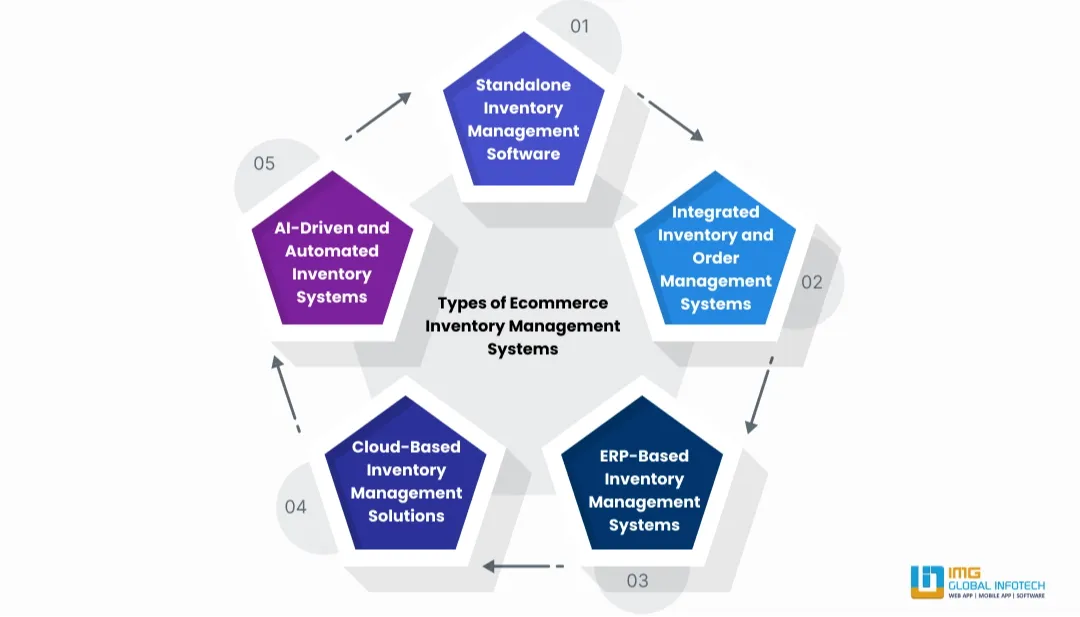
There are different types of management systems that businesses are using. It depends on the business size, complexity, and other requirements of the business. Here are some of them listed below.
Standalone Inventory Management Software
It is a system that focuses only on inventory tracking and stock control. This ecosystem is suitable for small businesses or startups that do not require big inventory management. Businesses integrate this software with their online stores or marketplaces to simplify their operations.
Integrated Inventory and Order Management Systems
Now, imagine if you are a business, and more than expected returns have happened in the last few days. To manage these returns, businesses integrate this software. It also helps in stock tracking with order syncing and fulfilment tracking. Growing ecommerce brands always look for this system to make things easier.
ERP-Based Inventory Management Systems
This system is ideal for enterprises that have complex workflows. You can track the day-to-day operations, and it can be integrated with inventory with accounting, HR, supply chain, CRM, and more. Big businesses use ERP-based apps for smooth day-to-day functioning.
Cloud-Based Inventory Management Solutions
An ecommerce business that has multiple teams, operating remotely with multiple warehouses, uses the cloud-based inventory management solutions. It provides access from anywhere, faster updates, and scalable options.
AI-Driven and Automated Inventory Systems
It is suitable for high-volume ecommerce brands. The system uses AI, automation, and analytics to predict demand, avoid stockouts, automate purchase orders, and optimise warehouse space.
Benefits of Building Custom Inventory Management Software
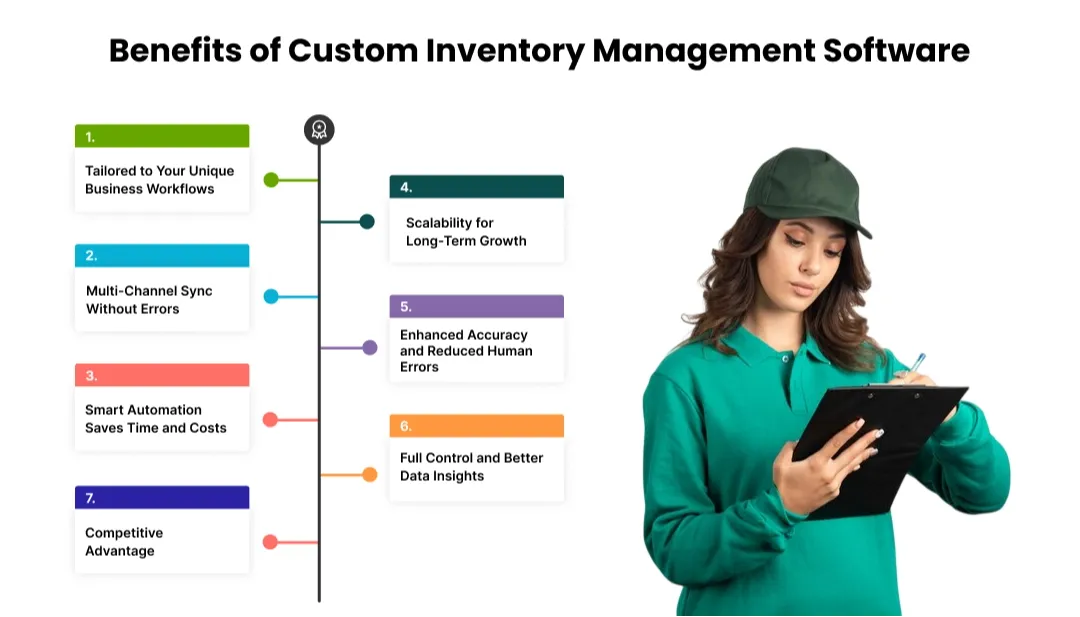
The Ecommerce development company can customise your inventory management software for personalisation, and operation management. Here’s why building a custom inventory management software ecommerce is a game-changer.
Tailored to Your Unique Business Workflows
Every business has its own ecosystem and a way of handling its operations. The best ecommerce inventory management software can customise your exact processes, product categories, fulfilment rules, and warehouse setup.
Multi-Channel Sync Without Errors
Custom software helps in seamless integration with online marketplaces, ecommerce platforms, POS systems, and logistics APIs. It ensures real-time stock sync and eliminates overselling.
Smart Automation Saves Time and Costs
Customising software reduces the need for manpower, eventually leading to a decrease in errors. There is ecommerce order management software for order management. Features like automated purchase orders, low-stock notifications, smart SKU mapping, and real-time tracking significantly reduce time and cost.
Scalability for Long-Term Growth
You need software for sustainability and scalability. Once your sales grow, warehouse expands, or orders increase, custom ecommerce inventory management software development will help you scale without performance issues.
Enhanced Accuracy and Reduced Human Errors
Custom software allows businesses to automate stock management and reduce miscounts. It also helps in duplication, returns, and financial losses. Reducing human errors and achieving accuracy will help in making more profits, the end goal of every business.
Full Control and Better Data Insights
Businesses can get advanced reporting dashboards with insights on best-selling items, non-moving items, seasonal demand, warehouse performance, and profitability. You can get full control over the operation and better data to analyse what is going right or wrong.
Competitive Advantage
Businesses that are not using technology in this era are falling behind in this highly competitive ecommerce space. By using personalised features and advanced forecasting, you can stay ahead of your competitors.
Development Process for Ecommerce Inventory Management Software
To ensure high performance solution, your software building partner will be involved in several important steps in ecommerce inventory management software development. Here are the steps given below.
Requirement Analysis
The development company will analyse your business requirements, conduct a meeting to know your product categories, warehouse count, stock rules, and more before starting the process. They will also know your automation goals, integration needs, and features required to build the software.
UI/UX Planning
A good and well-structured design engages the users, whether it is a buyers, sellers, or managers. Design a simple, user-friendly dashboard, making stock monitoring easy for businesses.
Backend Architecture and Database Planning
Having a backend architecture is important for handling real-time data, multi-channel sync, thousands of SKUs, and warehouse-level controls. It helps the businesses in database planning, eventually a robust architecture that is capable of handling all the above-mentioned aspects.
Core Module Development
After developing a backend system, the next step is to build the core modules. Some of the core modules include order sync, stock tracking, purchase management, forecasting, reporting, and supplier handling.
Third-Party API Integration
Businesses go for 3rd-party apps and integrate platforms like Shopify, Amazon, Shiprocket, and payment gateways. Taking an example, a platform requires payment options like PayPal, PayTM, Google Pay, etc, for users’ satisfaction. These apps are 3rd-party apps.
Testing and Quality Assurance
Ensure that the software works seamlessly without any errors, mismatches, or sync delays. A lot of testing is required from the development company’s side, and they will also ensure quality
Deployment and Launch
One of the last stages in the process is launching the system on a preferred cloud server. Make it available for your team and for your users as well. This is the process where software goes live and is ready to function.
Support, Maintenance, and Updates
The step does not end just after launching and deployment. Software requires continuous upgrades, improvements, and performance optimisation to ensure long-term sustainability, scalability, and support.
Cost to Develop Ecommerce Inventory Management Software
The Ecommerce inventory management software development cost ranges between $5,000 to $15,000+, depends on various factors. Changes in requirements mean changes in cost as well, either an increase or a decrease. Some of the factors that affect the cost are:
-
Number of Features
-
Functions
-
Integration Requirements
-
Complexity of the Software
-
Complexity of Automation
-
Number of Dashboards
-
UI or UX Design complexity
-
Tech Stack
-
Location of the Development team.
-
Experience and Expertise of the development team
-
Project Timeline
These factors affect the ecommerce inventory management software development cost. Let us now break down the cost (estimated) as per the level of the system. Some businesses also search for ecommerce inventory management software free, but you have to pay some amount evn if you are building a basic system.
Basic System
A basic system is an ideal choice for small businesses or startups that do not require complex tasks. It comes with basic features that are enough to run day-to-day operations. The cost of a basic system ranges from $5,000 to $8,000, depending on the above-mentioned factors.
Mid-Level Software
A mid-level software includes a few more features like payment gateways, maps, etc to make things easier for the management. It is an ideal choice for those businesses that are looking to expand. The cost of a medium-level system ranges from $10,000 to $15,000, depending on the project requirement.
Advanced Level System
An advanced-level system comes up with full automation, along with AI integration and Machine Learning. It is suitable for large enterprises that operate with full automation. The cost of an advanced-level software ranges beyond $15,000, depending on the business’s requirements.
The cost of developing a multi-channel, fully automatic system connected to multiple marketplaces will generally be at the high end of the scale. As you can see from the chart above, this should give you an indication of the cost to develop ecommerce inventory management software. If you are looking for low-budget development, you should consider outsourcing your ecommerce inventory management software development to countries like India. They have a highly skilled workforce and an abundance of developers at very low rates.
>>>Also Read: Ecommerce App Development Cost in 2026
Essential Features of Ecommerce Inventory Management Software
The inventory management software ecommerce features depend on the requirements of the business. Some systems require advanced features while some can be made through just basic features. Here are some of the essential features listed below.
Real-Time Tracking
One of the essential features of software is real-time tracking. With the use of this feature, you can see live stock updates across all channels. It helps in avoiding overselling or underselling.
Multi-Channel Stock Sync
Be aware of the automated syncing with platforms like Amazon, Shopify, WooCommerce, Flipkart, offline POS, and more.
Smart SKU and Variant Management
The system must include a feature that helps in managing product variations, batches, barcodes, and SKU mapping seamlessly. Having this feature helps in smooth operation and robust functioning.
Automated Reordering
Now imagine your platform is in a situation where a consumer needs a product in bulk, and it is not enough in stock. That is where these features come into play. This feature helps in automatically generating the purchase orders when stock levels drop below a threshold.
Warehouse Management
This feature helps in tracking stock across multiple warehouses, shelves, and bins. It enables efficient picking, packing, transfers, and storage management.
Order Management
The platform can manage its orders regularly with this feature. It shows all the orders at one place and can track the step-by-step process from purchase to delivery. The feature is quite useful in managing returns, cancellations, and order status updates.
Supplier and Purchase Management
Online stores have to deal with suppliers' details, pricing, and product availability. This feature helps in tracking purchase orders, delivery timelines, and supplier performance. At this stage, inventory receiving software plays a key role by ensuring incoming stock is accurately logged, verified against purchase orders, and reflected in inventory levels without manual errors.
Inventory Forecasting
With the help of this feature, your business can predict future demands and what needs to be restocked. The system uses past sales data and trends and avoids excess or shortage.
Reports and Dashboards
This feature helps enterprises make informed decisions. It provides detailed insights into sales, revenue generation, and the items that are slow-moving.
Barcode and QR Code Support
With just scanning a QR code, you can add, update or check inventory. It reduces errors and allows speeding up warehouse operations. A lot of manpower is not needed to streamline these operations.
Alerts and Notifications
It helps businesses to get alerted about everything that is happening in the day-to-day functions. If there is a need to restock some products, the system automatically gives an indication. It also sends notifications regarding delayed orders, sync failures, and shipment issues.
User Role Management
This feature allows controlled access to the team members. The team members will only get access to those things that are relevant to them. For example, an admin will only get access to the admin panel and not to the manager dashboard. It ensures security, and everyone feels safe about their privacy.
Mobile App Access
Even if you are not on site, you can check stock, manage orders, and track reports just by using your smartphone. It is perfect for the managers on the go.
Cloud Backup and Security
It helps in keeping your business data stored securely with encryption and backups. It stores all the data on the cloud and ensures your information remains protected and accessible anytime and from everywhere.
Why Choose IMG Global Infotech for Ecommerce Inventory Management Software Development?
If you are planning to develop an inventory management software, choosing the right partner is a must for your business. At the IMG Global Infotech, you will get access to dedicated ecommerce developers for hire who ensure fast development and error-free implementation. The company has years of experience in building advanced web and mobile solutions for ecommerce businesses. Here is what you will get at the IMG Global Infotech.
Expertise in Custom Inventory Solutions
The company has specialization in building inventory management software for ecommerce with tailored features for all types of businesses, whether it is a small business or a large enterprise.
Multi-channel Integration Expertise
We have an expert team of developers who knows everything about seamless integration with top ecommerce platforms, logistics providers, CRMs, and payment systems.
Experienced Dedicated Developers
We have a dedicated and certified team of developers who are experienced in designing, integration, complexity, and industry. They ensure fast development and error-free implementation.
Cost-Effective Pricing
Businesses search for ecommerce inventory management software India for cost effective services. We provide all the services at affordable price, without compromising on the quality.
Ecommerce Industry Experience
We have an experience in building ecommerce software, and over the years, have catered different clients in this sector across the globe. Our strong portfolio is enough for you to rely on us and choose us as your next development partner.
Scalable and Future-ready Development
We build platforms and systems that are future-ready, and provides scalable opportunity. With long-term support, growth, automation, and expansion, we ensures you stand out against competitors in this space.
Post-launch Support
If you are wondering that we only provide services till the deployment, you seems to be in a wrong mindset. We will support you long-term, provides maintenance, updates, and regular fixes, if needed.
Whether you want to build a basic inventory tool or an advanced AI-driven system, IMG Global Infotech delivers high-performing solutions tailored to your business.
CONCLUSION
If you run a digital storefront at any time within today's business, you'll want to invest in e-commerce inventory management software to make your life easier as well as the lives of your customers. These software applications will enable you to run more smoothly on a day-to-day basis, automate workflows, and increase the chance that your store will produce what the customer wants and in what form/size/quantity. Therefore, choosing the proper e-commerce inventory management system that has the correct features will drastically change how you monitor your inventory, how you deliver your customers' orders, and ultimately how big your e-commerce company becomes.
For those looking to find the best ecommerce inventory management software or want to know about the costs related to building out an ecommerce inventory management system, having your own tailored solution is always a wise investment and will be the best way to prepare for success in today's rapidly evolving digital landscape.
IMG Global Infotech is one of the best Ecommerce website development companies. They have a team of experts that can assist you throughout the entire project lifecycle, from strategy to deployment, with a comprehensive end-to-end methodology for developing your custom ecommerce inventory tracking solution. Build inventory management software for ecommerce so that your online store stands out in this competitive space.