Like Morpheus says in The Matrix—“Free your mind.” Simple, right? But online, freedom always comes with a price.
The wellness world’s changing fast. People everywhere are ditching constant chaos. Instead of endless scrolling, they’re turning to breathwork apps and guided meditation. Marcus Aurelius nailed it: “You have power over your mind, not outside events.” These days, entrepreneurs are cashing in by turning that old wisdom into a business model.
Building a meditation app like Headspace isn’t just about coding. You’re taking calm and weaving it straight into the technology to examine the headspace like app development cost.
It’s kind of wild—imagine Eat Pray Love colliding with Silicon Valley. You get spiritual ambition mixed with sharp-edged tech hustle.
Behind the scenes, it’s not simple. The backend, the AI-driven recommendations, the whole infrastructure—investing in this space is a maze.
Doesn’t matter if you’re just starting out or you’ve been investing forever. If you want to create something that actually makes a difference, you have to know what it costs.
Ready to dig in? Let’s go.
What Is Headspace?
Headspace is one of the top meditation and mindfulness apps created specifically to assist users in managing stress, increasing concentration, and boosting their general well-being by means of guided meditation practices and the provision of mental health resources.
The company was established in 2010 by Andy Puddicombe and Richard Pierson, and since then, the app has been recognized worldwide for its ability to bring meditation to millions of people.
The app is designed with visual components that are simple to understand and programs that are carefully structured. Therefore, it is an ideal application not only for those who are new to meditation but also for seasoned meditators.
Market Overview of Meditation Apps
As per the report of Grand View Research, the global meditation management apps market size was estimated at $2.20 billion in 2025 and is projected to reach $6.99 billion by 2033, with a CAGR of 14.67% from 2026 to 2033.
Key Market Trends & Insights: –
- With a 43.22% revenue share in 2025, North America dominated the market.
- In 2025, the market for meditation management apps in North America was dominated by the United States.
- In 2025, the iOS segment had the biggest share based on the platform.
- In terms of deployment type, the segment with the biggest share in 2025 was the cloud-based deployment type.
- In terms of services, the segment with the biggest share in 2025 was free services.
Key Features of Meditation Apps Like Headspace
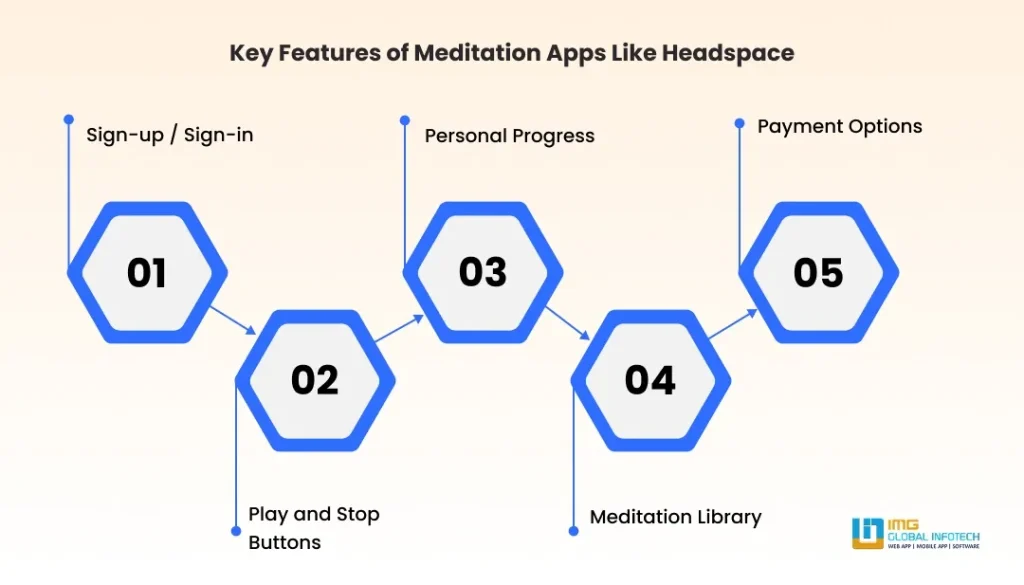
Here’s what you’ll need to build a meditation app people actually want to use. Here is a list of features of meditation apps like headspace.
Sign-up / Sign-in
Start with the basics. Make signing up as quick and painless as possible. Nobody wants to get stuck filling out forms for ages—keep it short, get them meditating fast.
Play and Stop Buttons
Don’t underestimate the power of a big, bright play button. It’s not just about looks—it invites people to dive in and try a session right away. Make it obvious, make it tempting.
Personal Progress
Let people see how far they’ve come. Progress trackers, streaks, badges—these little rewards push users to keep going in Healthcare app development services. Apps like Headspace do this well. When people see their meditation streak or finish a whole course, they feel accomplished.
Meditation Library
Content is king. The more sessions and styles you offer, the longer people stick around. A big, varied library keeps users exploring and coming back for more.
Payment Options
In-app purchases and subscriptions keep your app running. So make payment simple—clear options, easy checkout. At Purrweb, we always pick the most user-friendly payment methods for clients building meditation apps like Headscape.
Cost to Build a Meditation App Like Headspace in 2026
The average Cost to Build a Meditation App Like Headspace in 2026 would be $5,000 to $15,000 or more. The final cost will depend on various factors and the level of custom changes in app complexity in the development process.
Factors That Affect Meditation App Development Cost
Here is a list of factors that can majorly affect the meditation app development cost in the business as well:
App Complexity
The complexity of the mobile app determines the amount of time a developer or mobile app development company requires to Build a meditation app like calm or Headspace. An app with a simple architecture and layout will not take the developers a lot of time, and consequently, the cost will be lower.
Number of Features
The price of a mobile app really comes down to how long it takes to build everything you want. More features mean more time, and more time means you’ll pay more.
If you’re building something like a meditation app—think Headspace—you’re looking at a bunch of different features and up-to-date tech in Headspace like app development. Sometimes, you’ll need to plug in different APIs to make certain services work. It all adds up.
Selection of Mobile OS Platform
Right now, Android and iOS pretty much run the show when it comes to mobile operating systems. Each one has its own rules for building apps to Build a meditation app like headspace. So, you have to decide which platform you want to target. This choice matters, since building an app for Android isn’t the same as building one for iOS—the costs can be totally different.
App Design Complexity
App design plays a big role in how much it’ll cost to build a meditation app like Headspace. If you go for a complex design with lots of custom features, get ready to spend more. But if you stick with something simple and clean, your budget breathes easier.
Development Team Size
The size of your development team matters too. Hiring a whole app development company costs more than working with a freelancer. Where your developers live changes the price as well—someone from Silicon Valley isn’t going to charge the same as someone in Eastern Europe or India.
Technology Stack Selection
The technology stack consists of diverse programming languages, tools, and technologies. The more power-packed the technology stack is, the more robust the app performance is, which can also impact the development cost for your meditation app as well.
Monetization Models for Meditation Apps like Headspace
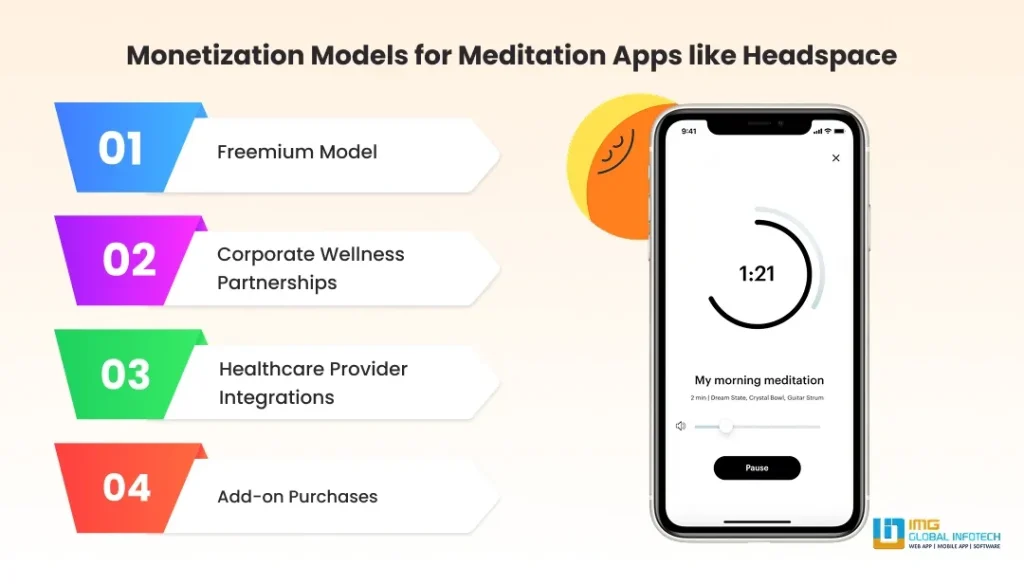
Clients and investors always ask me, “Are meditation apps even profitable?” Yeah, they are—if you pick the right way to make money.
Honestly, building a mental health app only pays off when you’ve got a solid plan to bring in revenue to Build mental health chatbot. Over the years, I’ve seen a few monetization models that really work for apps like Headspace. Let’s get into those.
Freemium Model
Give people free access to basic meditation sessions or simple journaling tools, but keep the good stuff—like the full library, sleep stories, or AI-powered personalization—behind a paywall.
Corporate Wellness Partnerships
More companies want to help their employees manage stress, and they’re willing to pay for it. Offer bulk subscriptions or custom deals, and you can open up a solid B2B channel.
Healthcare Provider Integrations
Some mental health apps team up with hospitals, clinics, and therapy platforms to bring patients structured meditation programs.
Add-on Purchases
Take Headspace as an example—they sell celebrity-led sleep stories and exclusive audio content. Charging extra for these kinds of features boosts your app’s revenue, even as you keep the basic subscription price attractive. That’s a smart way to stay competitive as app prices shift in 2026.
Future Trends in Meditation App Development
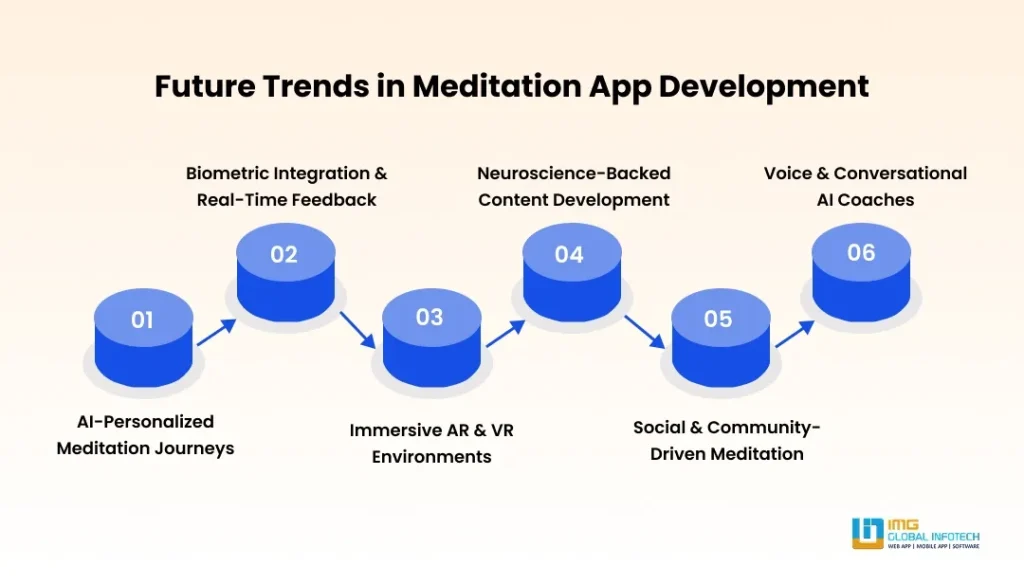
The meditation apps market is constantly transforming and is becoming increasingly modern as it incorporates traditional mindfulness with the latest technology.
AI-Personalized Meditation Journeys
Artificial intelligence is going to be used to customize meditation sessions based on the stress level, sleep patterns, and emotional state of the user to Build a Smart Healthcare AI Chatbot. The apps will be able to analyze the behavior and suggest the best meditation method that can be the most beneficial to the user.
Biometric Integration & Real-Time Feedback
Future apps will be able to integrate with devices such as smartwatches and EEG headbands to track the user’s heart rate, brain waves, and breathing patterns. This will enable the apps to provide the best possible experience with real-time feedback.
Immersive AR & VR Environments
Augmented and virtual reality will be used to create environments such as the top of a mountain, the beach, or the forest, which will be beneficial as it will be easier to meditate in such environments, especially for beginners who find it difficult to meditate in quiet places.
Neuroscience-Backed Content Development
App developers will increasingly work in collaboration with neuroscience experts and clinical psychologists in the development of content for meditation programs in AI in healthcare. This will ensure that the content provided within the app is backed by clinical trials and provides the user with the best and most effective methods for reducing anxiety and improving cognitive abilities.
Social & Community-Driven Meditation
The inclusion of group meditation and other social features such as live sessions and community challenges will revolutionize the way in which people engage in mindfulness and meditation as a community. Social accountability tools and community networks will encourage and bring together communities all over the world in the practice and pursuit of mindfulness.
Voice & Conversational AI Coaches
Voice-based AI technology will be more advanced and allow the user to engage in personalized sessions with the coach. The technology will be able to respond and engage in a more empathetic and natural way and will be able to change its tone and pace according to the user’s mood and other factors.
Final Thoughts
Nowadays, the need for meditation apps like Headspace has increased substantially, offering a great opportunity for healthcare-oriented firms to launch their services with our leading Mental health app development company. Developing such a wellness app depends on a careful strategy that blends functionality, delightful user experience, and cost effectiveness.
Knowing exactly how much it costs to develop an app like Headspace and the factors that determine this price will give you a good position to plan and deliver premium service that meets people’s needs.
Whether you decide to build a meditation app from scratch or your goal is to re-engineer an existing one, this is the chance for you to make a significant impact on people’s mental health and, at the same time, achieve financial growth.