Artificial Intelligence (AI) is rapidly dominating the world, whether in the entertainment sector, the business sector, or any other field. It is a powerful tool, and in the business sector, it has quickly become a priority for modern enterprises. Whether your business wants to improve operational efficiency, decision-making, personalizing customer experiences, or streamline workflows, AI is now there that businesses rely on nowadays. AI is not an option but a requirement in this modern era. Now one thing is clear: AI is important and a need for businesses to scale. But now another question arises: Should the businesses rely on just an external partner or build their own in-house development team? There is a lot of debate going on around AI partner vs in-house development in the market. It is one of the biggest strategic crossroads for enterprises in 2026.
AI partner or in-house development, both have their own benefits, but come with different challenges, too. A startup might need an AI partner, but it might not work for large enterprises. Same way, what works for large enterprises might not sit well for the startups or small or medium-sized businesses. In this blog, we will talk about both approaches in simple terms. We will also compare them across key factors, and help you decide which way you must go and what makes sense for your company. So let’s begin.
What Is an AI Partner?
Before going further, let’s know what an AI partner means. An AI partner is an external business partner, like an AI Consulting company, development agency, or a firm specializing in tech. It is an external organization for businesses that provides expertise, resources, and an end-to-end solution for AI projects. From ideation and development to deployment and maintenance, they can handle every aspect of your business. It is like an external AI department.
Businesses use an AI partner when they do not have individuals internally who are experts in AI. Whenever businesses want faster delivery, want access to advanced tools and skilled talent, and require scalable enterprise-grade AI development, they call for an AI partner. New businesses prefer an AI partner as they act like a trusted guide for them, with experience in different industries.
What is In-House Development?
An in-house development means you are building your own team of AI engineers, data scientists, Machine learning Developers, analysts, and product strategists. Rather than having an external partner, you manage your own internal team that operates within your organization, working exclusively on your projects. It helps in gaining maximum control and planning long-term AI investments.
Enterprises go for In-house development when there is a need for high-volume data, to protect sensitive IP, and require constant updates or AI-driven R&D This is the case where the enterprise is not purchasing services from outside. It turns AI into a core internal capability.
AI Partner vs In-House Development: Key Differences
AI Technology trends are changing the whole ecosystem. There are a few key differences to see when it comes to the AI partner vs in-house development debate. When it comes to speed, the AI partner implements faster. The in-house AI team is slower due to hiring and setup. As far as cost is concerned, the AI partner cost is predictable and scalable, while the in-house AI team cost is high upfront, along with operational costs. Here is a simple breakdown of these two approaches.
Understanding the differences is important before you make a final call between these two approaches.
Advantages of Working With an AI Development Partner
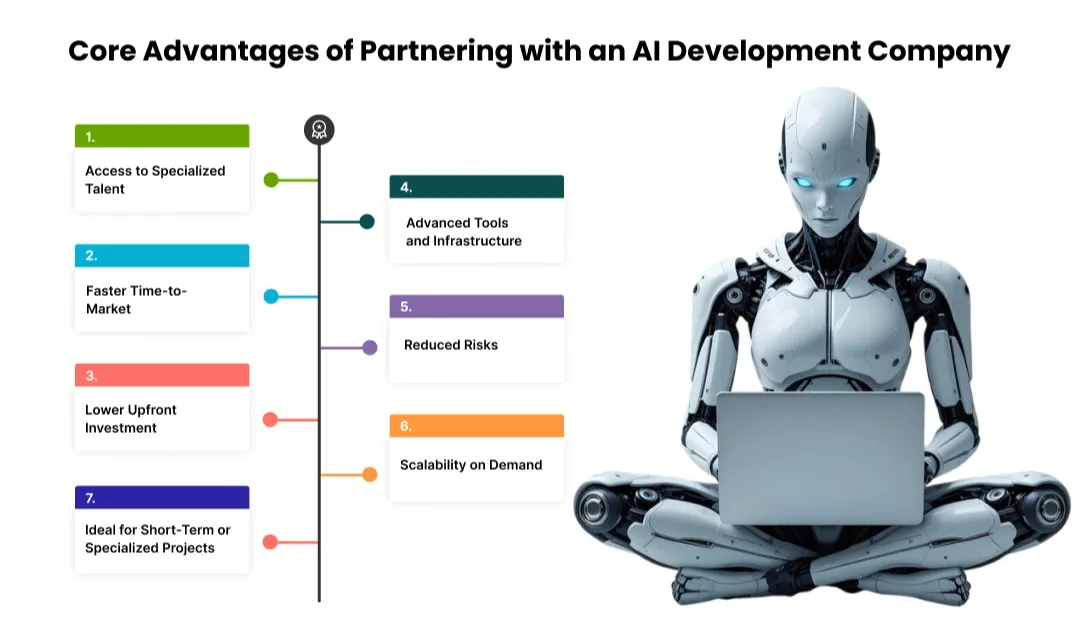
Partnering with external sources for AI development for enterprises has many benefits. Here are some of them listed below.
1. Access to Specialized Talent
You will get the benefits of a seamless development process as an AI partners already has the team, tools, and frameworks in place. The business does not have to take time in hiring, which eventually leads to cost reduction. You do not have to hire them for a full-time role.
2. Faster Time-to-Market
AI partners consist of a team a full of NLP engineers, deep learning experts, and other highly skilled specialists that help in the faster development process. They accelerate the development process dramatically.
3. Lower Upfront Investment
If you hire a full-time team, you will have to bear the cost of hiring, onboarding, training, and retention. It is not the case with AI outsourcing for businesses, as you will only have to pay for the services you need.
4. Advanced Tools and Infrastructure
AI partners know how to produce a high-quality product for your business. They use enterprise-level platforms, accelerators, datasets, and cloud setups that give quicker and better outcomes.
5. Reduced Risks
The AI partners are well aware of what type of practices to be done, what to expect in terms of risks, and what is required as far as regulatory compliance is concerned. They have worked and executed AI projects across industries, and can reduce risks in your project as well.
6. Scalability on Demand
Sometimes, a business needs the support of AI Development Services just for a few days, like 5 to 8 days. Next month, they might need a team for 25 days. AI partner offers flexibility as well, providing scalability without long-term commitments.
7. Ideal for Short-Term or Specialized Projects
Outsourcing can be done if your business is looking for an AI developer for a short project, or wants a single product built, or a specific model. In this case, hiring an entire team does not make sense.
Advantages of Building an In-House AI Team
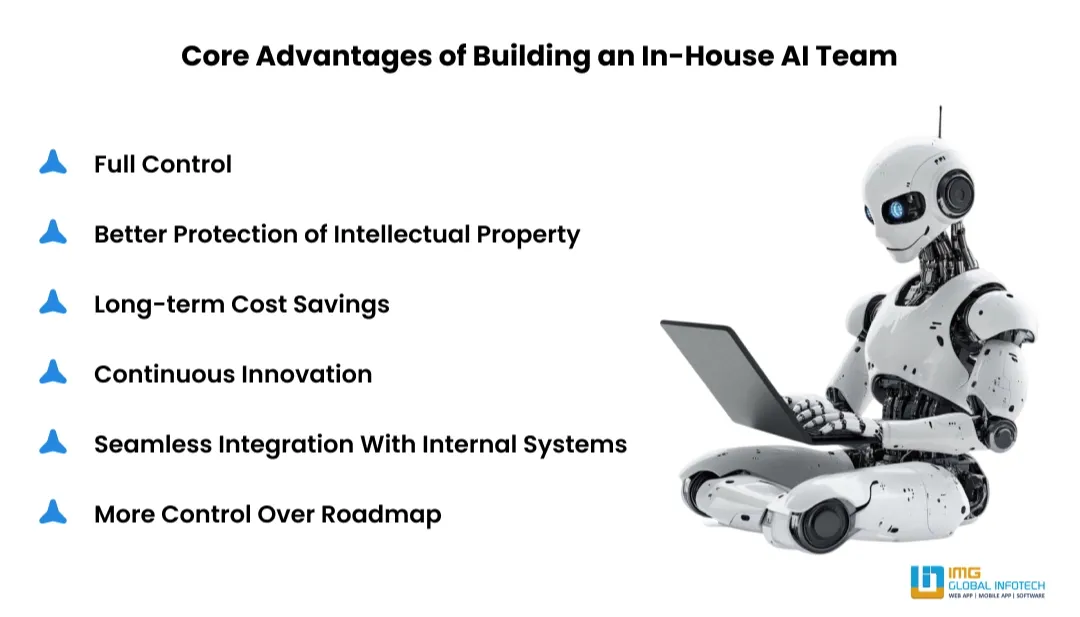
There are several benefits of AI partners, as they provide convenience. They also help in the AI Interior Design app. But having your own team has strong long-term benefits. That is why enterprises want to build an in-house AI team. Here are some of the In-house AI team advantages.
1. Full Control
Your business does not have to depend on external sources for support. The in-house team works exclusively on your business goals, workflows, and vision. The external team might have other clients to cater to as well.
2. Better Protection of Intellectual Property
Having your own team is important because sometimes, companies have to deal with sensitive data. Important data regarding healthcare, finance, or defense should be protected, and you cannot trust external sources in this case.
3. Long-term Cost Savings
An AI partner might be cost-effective, but having an in-house team reduces long-term costs. In internal team building, the initial expenses might be higher, but long-term AI R&D becomes more cost-efficient with an in-house team.
4. Continuous Innovation
An outsourcing partner might only work on the given project, and does not prioritize creativity and innovation. Your own AI team will regularly do experiments, prototypes, and improve systems.
5. Seamless Integration With Internal Systems
The own team understands the workflow, standards, architecture, culture, and domain of the enterprise. If there is any problems arise, the team can solve them as they have dealt with them in the past, and might know the solution. This is the case where the internal team is preferred over an external agency.
6. More Control Over Roadmap
Your team knows what the roadmap is, what to prioritize first, and what the deadlines are. They can also rank sprint cycles and experiments without negotiating externally.
Challenges of Hiring an AI Partner
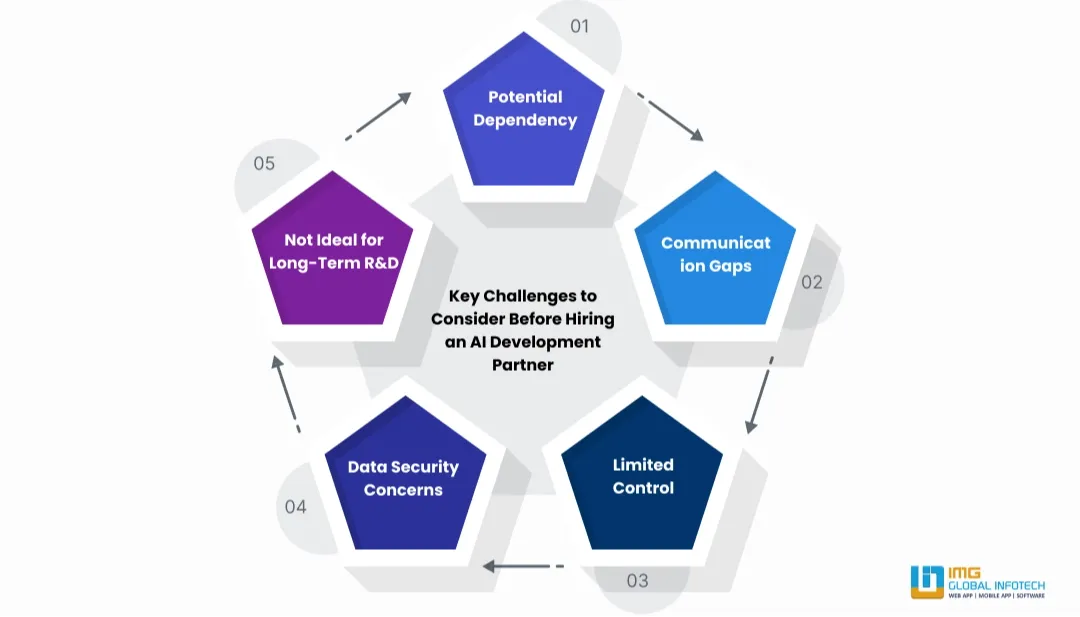
AI in Construction looks good, but comes with a few challenges. An AI consulting company provides value, but businesses must consider these challenges before going ahead.
1. Potential Dependency
You are too dependent on AI project outsourcing. In case of an emergency, when external sources are not available, your enterprise may suffer short-term or long-term problems. Being overly dependent on external teams for updates and maintenance is not a good thing for businesses.
2. Communication Gaps
There could be a misunderstanding or miscommunication at the initial stages, as the external team may not fully understand your business aims. You will have to make an effort to coordinate with the external team.
3. Limited Control
You have restricted control over the project after assigning it to external sources. The business has to rely only on a partner’s processes, timelines, and structure. Having limited control makes businesses feel insecure as well.
4. Data Security Concerns
Large enterprises have large and sensitive data to deal with. When you are outsourcing AI development services for large enterprises, there is always a risk of sensitive data leaks, even with NDAs and compliance measures.
5. Not Ideal for Long-Term R&D
When the project is for the long term and requires continuous experimentation and creativity, it is better to have an in-house team. These things are better handled internally rather than outsourcing the project.
Challenges of In-House AI Development
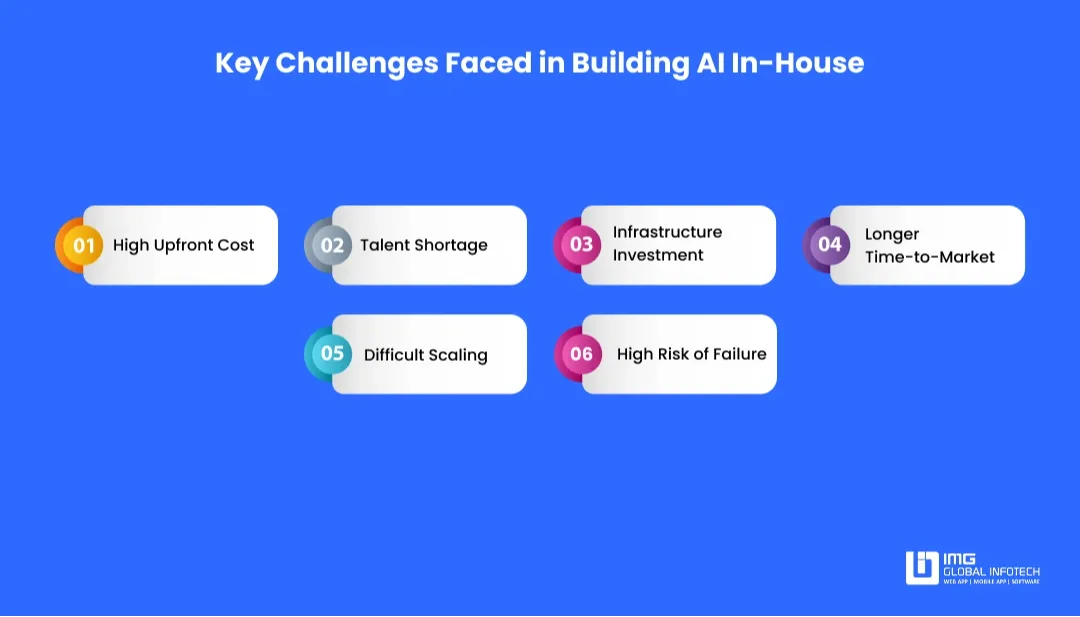
AI implementation for enterprises that operate with full automation requires an in-house team. Building an internal AI team sounds good, but the business has to deal with some serious challenges. Here are some of the challenges given below.
1. High Upfront Cost
Hiring your own team is good, but you need specialists in AI engineers, data scientists, architects, designers, and analysts. You have to incur the salaries of all these individuals, which often costs more annually.
2. Talent Shortage
AI is still new to the scene, and the global AI talent pool is limited. It makes the hiring process a bit slower, and the effort will be more. In this scenario, your competitor with more resources stands out and gets things done.
3. Infrastructure Investment
Building an in-house team requires powerful systems, GPUs, cloud infrastructure, and an MLOps pipeline. All these things are costly to set up and maintain.
4. Longer Time-to-Market
It takes time to build a whole team, setting up the process, and aligning workflows. This time investment is a challenge in itself for businesses, as it may take months or even years. The team has to gel up and should know the goals and objectives of the company.
5. Difficult Scaling
Sometimes, the project demands more effort and manpower. But scaling an internal team to meet project demands is quite challenging. You have to go for outsourcing rather than in-house AI development strategies.
6. High Risk of Failure
If a team is not experienced with enterprise-scale AI, it may require rework. The chances of project failure go high, and it could be costly for the businesses. Eventually, when choosing between AI partner and in-house team, you will have to go for the AI partner.
Cost Comparison: AI Partner vs In-House Team
Cost is something that businesses closely look at. The cost of both approaches depends on the requirements of the project, business size, timeliness, salaries for data scientists, ML engineers, etc. It also requires generative AI tools and more. Let us now see the cost of AI partner vs in-house development.
Cost of Hiring an AI Partner
The cost of hiring an AI partner depends on the scope. It includes project-based pricing, a monthly retainer, hourly resource-based model. One of the major advantages of an AI partner is predictability and controlled spending.
The AI app development cost in an outsourced project ranges from $8,000 to $15,000 or more. It depends on the level of the project and complexity. If the project is small and simple, the cost might range from $8,000 to $10,000. The cost ranges from $10,000 to $15,000 for a medium-level project. For an advanced-level project, the charges could be more than $15,000.
The AI partner also allows flexibility, and you can hire them on an hourly basis. A general hourly charge for an AI partner ranges from $12 to $25, depending on the project requirement.
AI Partner Cost (Full Time) (In Table)
Cost of Building an In-House AI Team
The cost of building an In-house AI team depends on the salaries of individuals, hiring and onboarding costs, cloud computing, and infrastructure. It also involves tools, licenses, MLOps pipelines, and retention bonuses. In most enterprises, the Cost of AI partner vs in-house development strongly favors outsourcing at the beginning and shifts toward in-house only when scaling long-term.
The range of costs for developing an AI application will vary based on how advanced or complex the project is, and whether it is an outsourced project. For example, if the project is small, then costs will likely fall between $10000 - $15000. If it's a medium project, the costs are between $15000 - $20000. If the project is advanced, then costs could go higher than $20,000.
Cost of In-house Team (In Table)
Which Approach Is Better for Enterprises? (Decision Framework)
Here is the simple and easy framework given below. Use this framework to make an informed decision.
Other than this framework, you can also make decisions based on:-
-
Budget: If the budget is less, you can go for outsourcing. You can choose in-house if you have a good budget.
-
Talent Availability: If the talent pool is limited in your own team, go for outsourcing. Otherwise, choose the in-house route.
-
Security Requirement: If your business has sensitive data, go for an in-house team. Otherwise, choose outsourcing.
-
Speed Expectations: If you need speed, going for outsourcing is a good choice. Otherwise, go for the in-house team.
-
Data Complexity: If the data is complex, choose in-house. Go for outsourcing if it is less.
-
Long-term strategy: If you have a larger picture in your mind regarding your business goals, having an in-house team is good. Otherwise, for short projects, you can outsource.
When to Choose an AI Partner?
Selecting an AI partner is suitable when:
-
The businesses want faster results.
-
Your own team does not have full AI expertise.
-
When you are experimenting with new AI use cases.
-
Want predictable development costs.
-
Needs Regular changes
-
Want Specialized enterprise-grade AI models
-
Building POCs, MVPs, or short-term AI products.
If you are entering the AI world for the first time, choosing an AI partner might be a good choice. They provide guidance and a safer, faster, and more cost-effective route.
When to Choose In-house Development?
Having your in-house AI development team is best for:
-
Long-term AI innovation.
-
Proprietary data and intellectual property
-
Continuous improvements and Experiments
-
Strategic AI-driven transformation
-
High-volume data.
-
AI is becoming core to business operations.
If AI is your competitive advantage, internal capacity becomes essential.
Hybrid Approach: The Best of Both Worlds
The Hybrid approach has many advantages:
-
A quicker time to Market.
-
An avenue to engage and utilize specialist knowledge.
-
Provides long-term control.
-
Cost-effective.
-
Minimises risk.
As such, the Hybrid model is fast becoming the preferred option for enterprise-wide implementation of AI.
Final Verdict: What’s Best for Your Enterprise in 2026?
The AI partner vs in-house development is a never-ending debate. It does not have a universal answer. Some businesses choose outsourcing, while some prefer an in-house team. There are also the enterprises that look for both, or a combination of both. It is a subjective topic, and the right choice depends on your goals, resources, timeline, and long-term vision. If you want speed, flexibility, and short-term ROI, an AI partner is good. But if you need control, security, and long-term innovation, go for building an in-house team. Choose a hybrid option if you need both. Enterprises in 2026 are increasingly leaning toward hybrid strategies for maximum agility, innovation, and efficiency. Some of the most popular AI apps are built with the combination of both approaches.
CONCLUSION
The choice made by a contemporary business when deciding to use outside assistance or to build an internal team is a critical one. Both approaches come with substantial advantages but also a number of drawbacks. The business's ongoing goals, financial limits, human resources, and the overall AI development framework must be aligned with the level of the route taken.
If you plan to use AI for development, to use new enterprise-level solutions leveraging AI, or to look for third parties to assist with your next AI project, remember that the number one goal is to strategically adopt a path that maximizes your opportunity for growth today and, as a result, prepares you for growth in the future.