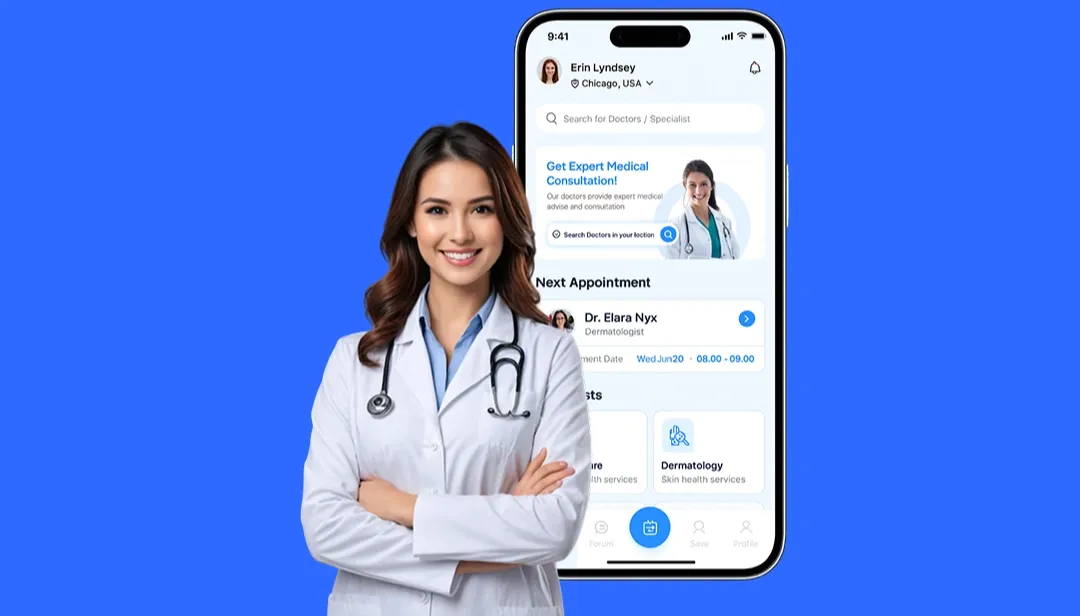
The health care industry is being transformed by a digital revolution and one of the main drivers of this change is mobile apps. Patients have become so accustomed to ordering food or booking a cab through an app that they now expect nothing less from healthcare. Hence, they use apps for doctor consultations and, in turn, managing their prescriptions.
By 2026, mobile technology will be doing more than just simplifying appointments; it will be changing the whole healthcare ecosystem in telemedicine app development trends. To renew themselves, hospitals and startups, and even local clinics, are adopting app-based solutions that allow them to become more efficient, to enhance patient experience, and to increase the level of trust.
We first hear about the future trends in telemedicine app development in the mobile app industry that lead to big changes in healthcare, and then we discuss what effects they have on patients, practitioners, and healthcare businesses.
Market Value of Telemedicine Apps
As per the report of Grand View Research, the global telemedicine market was estimated at $141.19 billion in 2026 and it is projected to reach $380.33 billion by 2030 with a growing CAGR of 17.55% from 2026 to 2030.
Key Market Trends & Insights
- The North American telemedicine market held a dominant revenue share of 33.36% in 2026.
- The U.S. telemedicine market accounted for North America's largest telemedicine market share in 2026.
- Based on component, the product segment accounted for the largest revenue share of 51.57% in 2026.
- Based on modality, the real-time segment accounted for the largest revenue share of 38.23% in 2026.
- Based on application, the teleradiology segment held the largest revenue share of 24.30% in 2026.
Top Telemedicine App Development Trends for 2026

Here is a list of top telemedicine app development trends for 2026.
1. Telemedicine Platforms in Virtual Care
Virtual care has become a new practice that can allow patients to connect with healthcare professionals anytime and anywhere in telehealth app development trends 2026. These apps can offer on-demand consultations with secure video calls along with e-prescriptions that can also dominate the telehealth space.
In 2026, the trend will shift to AI-powered triage assistants that analyze symptoms before connecting patients to doctors, making healthcare faster and more accessible globally. Focus on intuitive UI/UX design to make video consultations, appointment scheduling, and in-app navigation easier for users to find the help they need.
2. Chronic Disease Management Platforms
Imagine an application that supports diabetics, COPD, hypertensive patients, or individuals suffering from kidney diseases in managing their daily lives by telehealth trends 2026. It could be providing medication reminders, diet logs, activity tracking, device data integration, and in-app coaching.
Through the integration with remote patient monitoring apps, the workflow becomes more transparent and comprehensive for both the patient and the clinician in Doctor on-demand app development. This is one of the most powerful healthcare app concepts that can be successful in the long term.
3. Gamified Health Challenge Apps
If you are thinking that treatment sessions can't be fun, this will not be true. The gamification can keep users engaged in various ways in the future of telehealth apps. It mainly includes health challenges, social sharing, leaderboards, and insurance incentives that can make treatment more reliable and seamless.
One compelling healthcare app concept is to collaborate with insurers or wellness programs to reward actual healthy behaviors such as walking, hydration, and consistent sleep. You receive engagement, user retention, and data. They acquire healthier habits for a better lifestyle as well.
4. AI-Powered Diagnosis Apps
Imagine if users could upload a picture of a skin lesion and your app could indicate whether it might be cancerous, or if a retina scan could be used to identify diabetic retinopathy. Such AI healthcare tools have the capability to process imaging data, patient history, and population models to provide the first signs of a disease.
5. Prescription Management on Refill Reminder Apps
Missed doses and prescription errors have always been the major factors leading to patient noncompliance. So, a mobile application that can scan prescriptions, set reminders, order refills, and alert users about the drug interactions is definitely a great tool.
Why not put in voice assistance or big fonts for the elderly people? Also, allow the pharmacy APIs to facilitate the refill orders automatically in digital health trends 2026. It is just a straightforward healthcare app with a huge positive impact potential.
6. Assisted Living Apps in Elderly Care
India is no different than most countries in the world with an aging population that is increasing year after year. Apps based on healthcare tailored for the elderly have great success potential. Imagine fall detection (with the use of accelerometers and AI), emergency alerts, medication reminders, caregiver dashboards, and easy video calling.
It would also be nice to have the "family view" feature where distant relatives can check in. Incorporate voice-first UX for users who are not very tech-savvy.
7. Emotional Support Apps
Mental health is a major problem concern and these apps can deliver the guided CBT modules along with mood journals and AI chat support to therapist matching to gain traction. It can also fit squarely into the trend of AI healthcare solutions. It can also include conversational agents' emotional health continuously as well.
8. Blockchain-Based Medical Apps
Privacy and the question of who owns the data have been major concerns. Through a medical record platform that utilizes blockchain technology, the patients can be provided with the power to decide who gets to see their data to examine the Telemedicine app development cost. Besides being decentralized, it can also be resistant to tampering and easily verifiable.
Such a system can be pitched as a feature that enhances the current clinical systems or as an identity layer overlay. This concept completes your catalogue of healthcare app ideas by including the elements of patient confidentiality and trust at the infrastructure level.
9. Remote Patient Monitoring Applications
That's the place where it works like a charm when you combine IoT, sensors, and the app for remote patient monitoring in Healthcare app development. Think about it: machines monitoring heart rate variability, glucose, blood pressure, and oxygen saturation, all sending the data to a centralized visualization. Automatically, messages are sent when the measuring reaches dangerous levels.
10. Wearable-Integrated in Health Apps
Wearables used to be just step counters, but now they can record ECG, SpO₂, stress, and sleep cycles. A deeply integrated app with Apple Watch, Garmin, Fitbit, or any other brand allows users and clinicians to understand that data.
Such an app usually goes hand in hand with the logic of a remote patient monitoring app, which takes in data streams and enables interventions. Besides, it is also a potential healthcare AI solution that can put analytics over the ongoing data.
Future of Telemedicine Apps
Telemedicine applications continue to evolve into smart, ever-on care platforms that integrate virtual visits, remote monitoring, and in-clinic follow-up for seamless and continuous care. Powered by AI, 5G, wearables, and supportive regulations, they are likely to become an important pillar of mainstream healthcare delivery across the world.
AI-Powered Virtual Care
AI is being quickly integrated into telemedicine apps for symptom assessment, triage, decision support, and predictive analytics, aiding clinicians in diagnoses with higher degrees of accuracy and lessening their workload. From chatbots that field routine queries to algorithms flagging high-risk patients, AI makes virtual care faster, more precise, and highly scalable for diverse populations.
Remote Patient Monitoring at Scale
Remote patient monitoring extends beyond chronic care to post-surgery follow-up, maternity, elder care, and mental health through connected wearables and home devices in healthcare app development trends. Continuous vital tracking powered by AI-driven alerts enables early intervention with fewer hospital visits and better long-term outcomes, especially among high-risk and aging patients.
5G, IoT and Immersive Tech
High-speed 5G networks, coupled with IoT devices, power real-time HD video, rapid sharing of imaging data, and low-latency interactions to support critical consultations. Use of AR and VR, as well as their many emerging applications for the upcoming telehealth trends in 2026, supports remote training, guided procedures, and richer virtual examinations, which are narrowing the gap between in-person and digital care.
Hybrid and Personalized Care Models
Hybrid models, where patients fluidly move between teleconsultations and in-person visits depending on clinical needs, are increasingly being used in hospitals and clinics in Telemedicine app features. Telemedicine apps can provide personalized care plans, reminders, and lifestyle by integrating data from EHRs, behavior patterns, and sometimes genomics, thereby enhancing adherence and outcomes.
Security, Regulation And Global Reach
As telemedicine goes mainstream, regulations are focusing on reimbursement parity, cross-border practice, and quality standards as a means of fostering trust and adoption. Investments in encryption in AI in telemedicine apps, blockchain-backed records, and compliance frameworks are hardening data security while enabling secure borderless access to specialists across regions and health systems.
How to Monetization These Trends in Telemedicine App Development
Implementing cutting-edge technology in telemedicine apps is insufficient unless it can have a significant impact and provide meaningful value. We outline the five strategic focus areas for healthcare mobile app development to stay ahead of the most significant industry shifts.
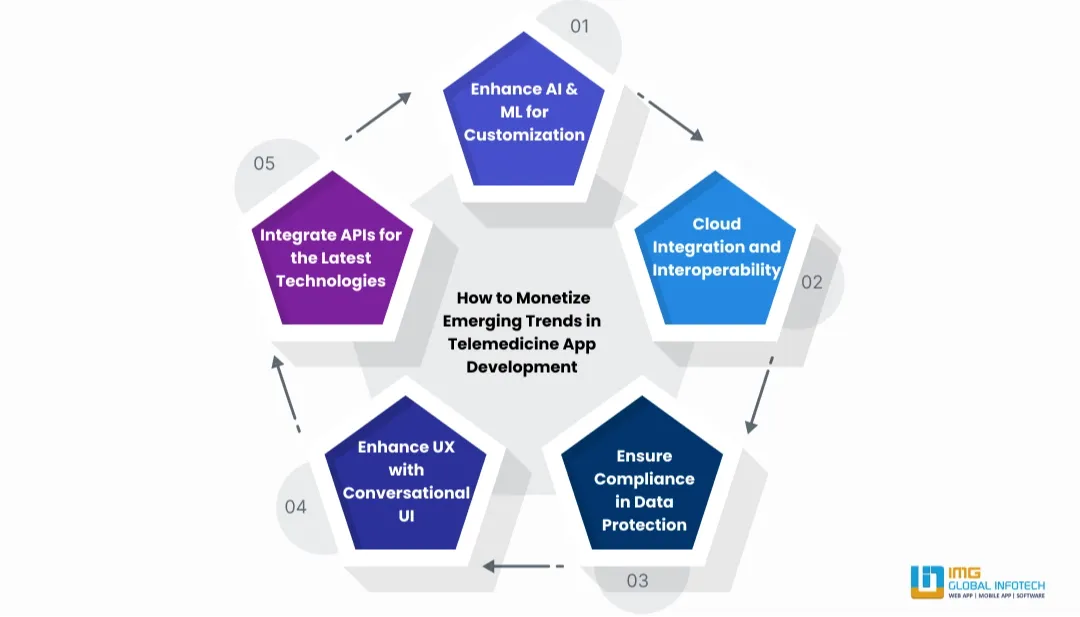
Enhance AI & ML for Customization
AI and ML technologies can help hospital teams for anything beyond generic medical operations, from custom-made evidence-based treatment for the patients to the future-ready telehealth features. AI-driven algorithms can also analyze the patient health data and recommend treatment plans in real-time symptom checking under their treatment sessions.
Cloud Integration and Interoperability
Make sure your healthcare app is designed to be able to communicate with other systems. The goal here is that your app should work smoothly with other systems throughout your healthcare IT network, for example, EHR platforms or cloud storage.
Interoperability enables the exchange of information between different care providers, labs, and patients in a very efficient way; telehealth workflows are also facilitated, and it provides a complete view of every patient.
Ensure Compliance in Data Protection
Hardwire robust data protection into your system from the very beginning with features such as end-to-end encryption, secure user authentication, and data anonymization in virtual care trends. To add an extra layer of security around medical records, provide a more transparent audit trail, and deter fraud or duplication, you might also want to think about blockchain integration.
Enhance UX with Conversational UI
The use of voice-assisted technologies opens up more possibilities for achieving additional personalization, intuitiveness, accessibility, and engagement in emerging technologies in telemedicine. Thus, you are able to broaden the reach of your app and deliver great care services to different patient groups.
Integrate APIs for the Latest Technologies
Fully utilize the capabilities of smart wearables, hospital record systems (EHR), and IoT devices by linking them to your app through APIs in Telemedicine app development. The way to do this is to allow patients to share their health data with care providers in real time so as to have better remote monitoring or chronic disease management.
Closing Thoughts
The realm of healthcare applications is full of endless possibilities, such as artificial intelligence for diagnosis, platforms for chronic diseases, remote patient monitoring, wellness games, mental health, elderly care, blockchain records, prescription managers, and telehealth regulations in Telemedicine app development companies in india. The common factors that connect these are user value, regulatory discipline, and intelligent monetization.
In case you want to materialize your concept, clearly measure return on investment, and deftly handle the intricacies of healthcare app development, IMG Global Infotech would be glad to collaborate with you. Drop us a line and let’s make 2026 the year your solution changes lives.