The field of Machine Learning has advanced past being seen as something imaginary to the reality of being used in every industry around the globe as a base technology for creating innovation. Applications that bring machine learning to life include custom recommendations, predictive analytics, intelligent automation, and fraud detection to name just a few ways businesses can leverage machine learning to make better decisions, and provide an incredible experience to their end-users. As organizations continue to adopt AI at an increasing rate leading up to 2026, organizations of every size will be investing in machine learning-based solutions as a means of gaining a competitive advantage, creating greater efficiencies within their organizations, and discovering new revenue sources.
Developing a successful machine learning app requires careful consideration of planning, technology stack(s), as well as development costs and challenges. This complete guide will provide valuable insight for machine learning app development cost in 2026 (including much of the technology available to build your app), the step-by-step process for how to develop your app (including associated technology requirements and their costs), as well as the overall best practices for successfully launching a machine-learning application in 2026.
What Is Machine Learning App Development?
Machine Learning App Development is the process of building applications that use machine learning algorithms and data-driven models to analyze information, identify patterns, make predictions, and automate decisions. These applications continuously improve performance through data training, enabling intelligent features such as personalization, recommendation engines, predictive analytics, fraud detection, and process automation.
Market Overview: Why Businesses Are Investing in Machine Learning Apps in 2026
Machine learning apps are growing rapidly as more companies use data-centered technology not just to increase productivity but also to improve the customer experience and rise over their competitors. With the help of AI infrastructure, cloud computing, and prediction analytics, machine learning software has become a key business tool in all sectors of the economy. The following are the major reasons why machine learning software will be widely used by 2026:
1. Rapid Growth of the AI & ML Market
Machine learning is now on a rapid growth path globally to a large extent because different industries desire intelligent software/equipment to automate processes, make better decisions, and be more competitive in the digital market.
2. Increasing Demand for Personalized User Experiences
Machine learning is becoming a part of businesses especially when it comes to providing customers with product choices that they will likely be satisfied with, running marketing campaigns that are more effective and attractive, and creating customer experiences that will be meaningful and lead to not only engaging the customer highly but also retaining the customer and finally satisfying the customer completely.
3. Rising Need for Operational Automation
Machine learning software is one of the most effective and popular tools leading to automation of repetitive work, streamlining of work processes, reduction of errors made by human workers, and better use of resources, which simultaneously leads to increased productivity and a decrease in operations costs and upsets.
4. Growing Importance of Predictive Analytics
Companies rely on machine learning-assisted prediction data analysis in the first place to help them understand customers better including their potential actions, market trends, demand changes and business risks as the main things that will guide the companies in making data-based strategic decisions that are not only well-thought-out but also proactive.
5. Advancements in Cloud and AI Infrastructure
The rise of machine learning application development is mainly attributed to the widespread access to variable cloud platforms, sharing of pre-trained AI models, and reasonably-priced computing power which together have made it not only possible but also financially viable and a good business idea for even the smallest companies.
Key Benefits of Machine Learning App Development for Businesses
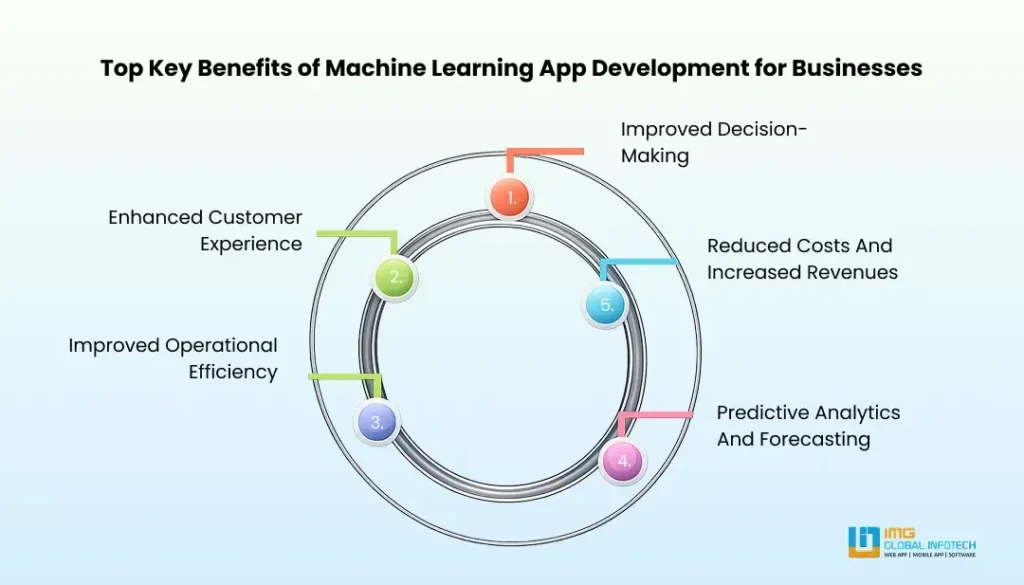
Machine learning is a powerful tool for companies to use data-driven insights, automate complicated workflows, and make better decisions. Adding ML features in their work, businesses could not only increase their operational efficiency but also get better customer satisfaction and higher profitability in the long run.
1. Improved Decision-Making
Machine learning goes through heaps of both structured and unstructured data to find patterns and extract knowledge to determine the machine learning app development cost breakdown. Thanks to these data-driven suggestions, companies can decide even quicker and more accurately, cut down on risks, and discover new business opportunities by leveraging different aspects of their operations.
2. Enhanced Customer Experience
The capability to build personal recommendations, unique content, smart chatbots, and pinpoint marketing to an amazing extent is made possible by machine learning. By learning customer actions and preferences, organizations have the opportunity to not only improve customer engagement but also create stronger customer loyalty, and gain higher customer satisfaction.
3. Improved Operational Efficiency
ML automation eliminates manual labor through simplifying and automating mundane tasks, leading to improved work processes and reduced human errors. Therefore workers can focus more on complex and higher-value tasks and improve not only their efficiency but also operational efficiency and overall output.
4. Predictive Analytics And Forecasting
Machine learning algorithms make predictions about the behavior of customers, the direction of market trends, demand for stocks, potential risks etc. Such predictions help companies to prepare in advance, use their resources more efficiently, reduce operational costs, and gain a lead over the market.
5. Reduced Costs And Increased Revenues
ML applications remove manual work, improve resource management to a significant extent and deliver unique user experience and these together lead to reduction of operational costs for the business. It can also identify potential new sources of revenue, thereby resulting in the revenue generation and profitability of the business.
Essential features of a machine learning application:
An ML application is more than just a set of intelligent algorithms. It includes essential features that provide accuracy in predictions, a good user experience, a high degree of scalability and security, as well as a capacity for ongoing improvement. Here is the list of required features that every ML application must possess:
1. Data Collection And Processing
An ML application should be able to quickly gather, clean and manage data from structured and unstructured sources to support the ML models to produce the most effective outcome.
2. Predictive Analytics
Uses existing data and patterns to predict future business scenarios, market trends, customer behavior, market risk, etc., with highest accuracy.
3. Real-Time Data Processing
Allows instant and real-time processing of data providing real-time insights, speedy decision making, adaptability and flexibility in changing environments.
4. Personalization Engine
Enables the delivery of tailor-made user experience and personalized content or recommendation, with appropriate suggestions, for individual users, by understanding individual behavior, past actions, choice, etc.
5. Automated Decision Making
Allows automated business decision making process to support ML models thereby reducing manual involvement and enhancing operational efficiency.
6. Natural Language Processing (Nlp)
NLP provides a platform to facilitate user interaction in natural language to build features like chatbots and virtual assistants which understand and respond in natural language.
7. Model Training And Retraining
Training and optimizing the ML models on a regular basis to keep them accurate and provide the best result for new inputs.
8. Data Visualization Dashboard
Helps in providing actionable business insights, predictions, performance indicators, etc., in the form of interactive charts and graphs to assist business decision making.
9. Security And Data Protection
Provide highest standards of security and data protection of business and customer data by use of cryptography, authentication and adherence to legal compliance.
10. Scalability And Cloud Integration
Use cloud architecture with high scalability and easy deployment options for large user sets and datasets.
Step-by-Step Machine Learning App Development Process
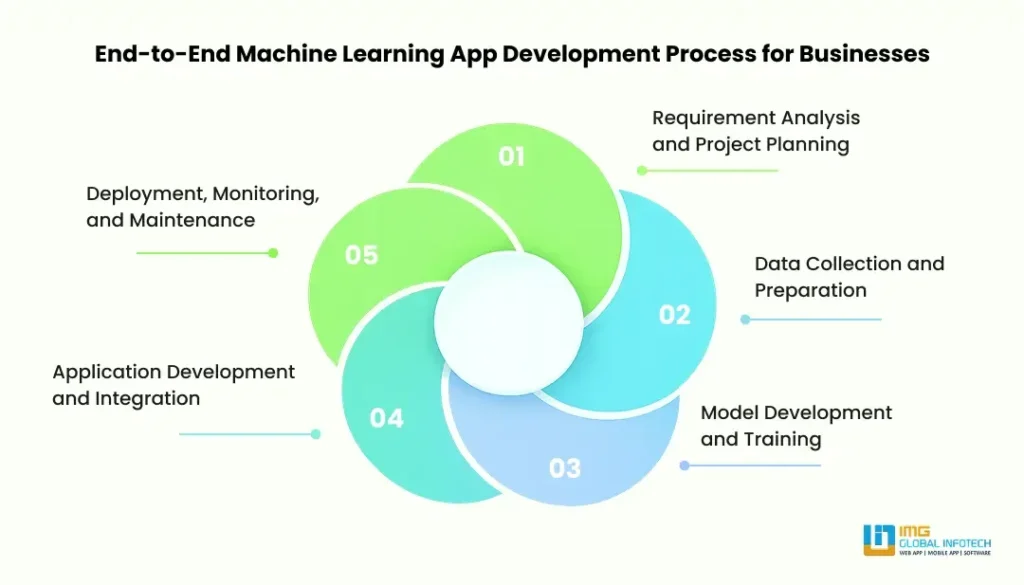
Working with a professional custom machine learning app development company is the best way to ensure that your project will be handled thoughtfully from start to finish. Every machine learning app development process phase, from strategizing and data-ready tasks to launching and supporting the system, is crucial for the success of delivering machine learning (ML) solutions.
1. Requirement Analysis and Project Planning
Initially, an AI and machine learning app development company would get a good grasp of your business plans, who your customers are, what use cases you have, and what are your technical requirements. They will then find ML opportunities, set the boundaries of the project, decide the appropriate technologies, and lay out a plan that is in line with your business aims and budget.
2. Data Collection and Preparation
Machine learning engineers acquire, structure, and scrub large amounts of data sets coming from various sources. This process includes eliminating data inconsistencies, dealing with missing entries, assigning data labels when required, and making sure that the final data is of high quality. Without good data preparation, no machine learning model can perform well.
3. Model Development and Training
Programmers and data scientists design, build, train, and refine machine learning models with the help of appropriate algorithms and frameworks. They compare different models to identify the most effective one. Continuous fine-tuning and group verification lead to improvement in the prediction accuracy, timeliness, and overall performance of the model.
4. Application Development and Integration
Once the model is approved, developers put it into action as an element of the overall machine learning application development concept. They not only design attractive user interfaces and secure backend services but also ensure the smooth integration with existing company platforms, databases, and third-party services to provide excellent user experience and comprehensive functionality.
5. Deployment, Monitoring, and Maintenance
After the machine learning software development has successfully passed the last tests, it gets released to the production environment. The software house continuously checks the performance, monitors model accuracy, fixes bugs, rolls out updates, and re-trains models to ensure the business’s long-term reliability, scalability, and success.
Technology Stack for Machine Learning App Development in 2026
Machine Learning App Development Cost in 2026
The machine learning app development cost varies from $8,000 to over $15,000 in 2026 due to differences in the complexity of the software design requirements, the types and number of AI capabilities/modules supported, amount of data processed/integrated with other systems, and the methods of installation to examine the cost to build a machine learning app. In addition, this type of project requires several major production items that must be included to establish an adequate budget; therefore, businesses should plan wisely to avoid going over budget.
1. Complexity Of The Project & Feature
One of the most significant parts of determining the machine learning app development cost utilizing machine learning is the complexity of each function within the application being developed. Additionally, the number of functions performed within an application also determines the total cost due to the amount of time required for the developer.
2. Data Acquisition And Data Preparation
When developing a machine learning based application, accumulating a sufficient amount of quality data is critical in order to create an efficient and accurate machine learning algorithm, and therefore, a business will incur high costs associated with acquiring, cleaning, labeling, and preparing data for usage if it does not have enough historical or present data readily available to generate a high quality machine learning algorithm.
3. Machine Learning Model Development And Training
The time it takes to train a machine learning algorithm is also very expensive from both an engineer’s perspective as well as from a business perspective with regard to using various computing resources to complete the engineering work that how much machine learning app development costs. The amount of time it will take to develop a machine learning algorithm will depend upon the level of complexity of each algorithm and the amount of computing resources needed for the engineer to have access to complete their work.
4.Third Party Services And Integrations
The addition of other software and/or systems to existing enterprise machine learning applications will also have an impact on the total cost of the implementation of that application. The cost of software applications developed by third parties will also impact the total cost of an existing machine learning application by changing the level of complexity and the amount of engineer’s time required to implement the third party software into the machine learning application.
5. Deployment, Maintenance And Scaling Of The Application
The cost of a machine learning application once built and running may consist of costs such as hosting services, maintenance, monitoring the model accuracy and securing the application against threats etc. The higher the volume of data or application usage, the more infrastructure that will need to be available.
Also Read – How Much Does It Cost To Develop An AI App?
Challenges in Machine Learning App Development and How to Overcome Them
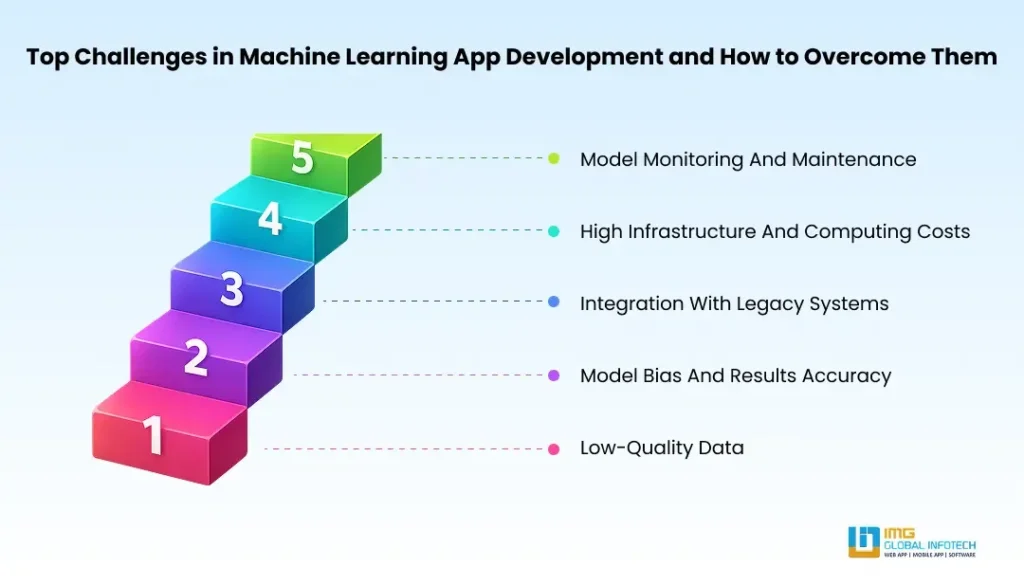
While machine learning offers many advantages to businesses, organizations may encounter numerous operational and technological problems associated with implementing and developing ML applications. To ensure successful project implementation and ongoing use of ML applications, businesses should understand and address these challenges by implementing best practices.
1. Low-Quality Data:
Quality data is critical to developing effective models; without enough high-quality data, models will not perform well. High-level data quality employed through proper data governance, acquisition, and preparation prior to creating the model will help resolve data quality issues.
2. Model Bias And Results Accuracy:
Some organizations seek ML applications that produce highly accurate, unbiased results. When organizations develop models based on machine learning app development trends, inaccurate data may have been inaccurate, skewed, or biased. The accuracy and performance of ML applications can be significantly improved by repeat training, utilizing a variety of training datasets, and evaluating each dataset.
3. Integration With Legacy Systems:
Not infrequently, implementing machine learning applications in a billing system and usually through a combination of both transactions and accounting systems can prove difficult on older database and business applications. Leveraging scalable APIs, adopting microservices architecture, and having skilled development teams can help companies make their ML applications more compatible with other platforms.
4. High Infrastructure And Computing Costs
Training ML models demands a lot of cloud computing resources and hardware that are expensive in machine learning app development cost guide. Using cloud services, choosing training algorithms with less resource consumption, doing transfer learning or building cloud infrastructure that can be scaled are some of the ways to lower the cost of a ML model.
5. Model Monitoring And Maintenance
As new ML app development trends and user behaviors come to light, the performance of an ML application model can decline, so it’s vital to keep track of the ML application model performance regularly and perform automated or manual updates.
How to Choose the Right Machine Learning App Development Company?
Choosing the best machine learning app development company is very important if you want your project to succeed. A trustworthy technology partner will not only help you develop scalable, precise, and cheaper ML solutions but also make sure that the implementation goes smoothly and that you derive long-term business value from them.
1. Evaluate Industry Experience
Choose a machine learning app development services provider that has prior experience working with companies in your desired sector. With their understanding of your sector, developers can more effectively tackle your specific business problem, regulatory and ethical considerations, customer needs, and optimal AI solution.
2. Analyze Their Portfolio & Case Studies:
Thoroughly examine the company’s existing portfolio, relevant case studies, and past ML projects. Seeing what work they have done in the past will provide you a good idea of their technical capabilities, approaches to solving problems, how they manage complex projects, and their ability to build great AI powered apps.
3. Verify Their Technical Skill Set:
In order to build accurate, efficient, scalable, and Future-Ready Machine Learning Solutions the company’s developers must also be fully proficient with the right machine learning frameworks, cloud service providers, data engineering, machine learning operations and AI tools.
4. Understand Their Data Security And Compliance Procedures:
In many scenarios, ML apps typically handle a significant amount of sensitive business and customer data. Prioritize an ai development company that follows solid security procedures, data protection measures, and compliance standards in order to minimize all risks and ensure development is always done safely.
5. Comprehend Their Development Workflow:
Having a clearly laid out workflow will ensure accountability, effective communication and on-time delivery. Prioritize companies that follow an Agile process, report on the project status at regular intervals, implement strict testing measures and always keep the client relationship transparent.
6. Identify Post Launch Support And Maintenance:
ML systems are computationally intensive, require long term updates and maintenance to function efficiently after launch. Ensure you choose a development partner that is fully equipped to support and maintain your application after launch including model re-training, continuous monitoring, and ongoing technical assistance.
7. Compare Price Points And Business Models:
Money is one aspect you should never compromise, though there are still the two other aspects – quality and expertise. Make sure to research the different price points and business models that various ai software development companies offer to ensure that you find a solution that can offer the greatest value to your business within your budget.
Conclusion
Designing machine learning apps was nothing more than a fantasy built on the assumption of Googling feature items lists and Google Tech Stack Calculator or Whole gaming Implementation Costs Development costs of Machine Learning app from scratch! However, the future is bright as AI technologies are constantly reinventing how we work, communicate, and live. It seems businesses are aware of this fact, the drive for development has been pushed forward by the increasing business emphasis for automation, data analysis, and the identification of user experiences to gain personalized user engagement in 2026. Investing in AI applications can actually be a game-changer resulting in increased competitive advantage and business value in coming years. We at IMG Global Infotech are committed to develop scalable and secure, and intelligent machine learning applications which exactly meet the specific business requirements. Our machine learning development company works with businesses transforming their complex data into smart applications delivering enhanced business growth, efficiency, and rapid digital transformation.