The advent of the instant gratification economy has completely changed the way people shop online. The expectation is no longer days for the delivery of groceries, medicine, food, and other everyday items. It has also led to the growth of the hyperlocal ecommerce model, which is an online marketplace that connects local sellers to local customers through rapid delivery services. Unlike traditional ecommerce models, a hyperlocal ecommerce model focuses on delivering products to a customer’s geographic radius, helping the business to be able to deliver to customers more quickly and decrease logistics costs. Many different types of businesses, from small startups to large enterprises, are looking at how to create scalable and profitable hyperlocal solutions.
In this comprehensive guide, we will take you through the operations of a hyperlocal ecommerce model, what is hyperlocal marketplace, the benefits of utilizing a hyperlocal ecommerce model, the features of a hyperlocal ecommerce model, steps to create a hyperlocal ecommerce model, and the cost of building a hyperlocal ecommerce model. We will also see future trends of hyperlocal ecommerce and why it is essential to select a quality development partner when creating a hyperlocal solution. So let’s begin.
How a Hyperlocal Ecommerce Marketplace Works?
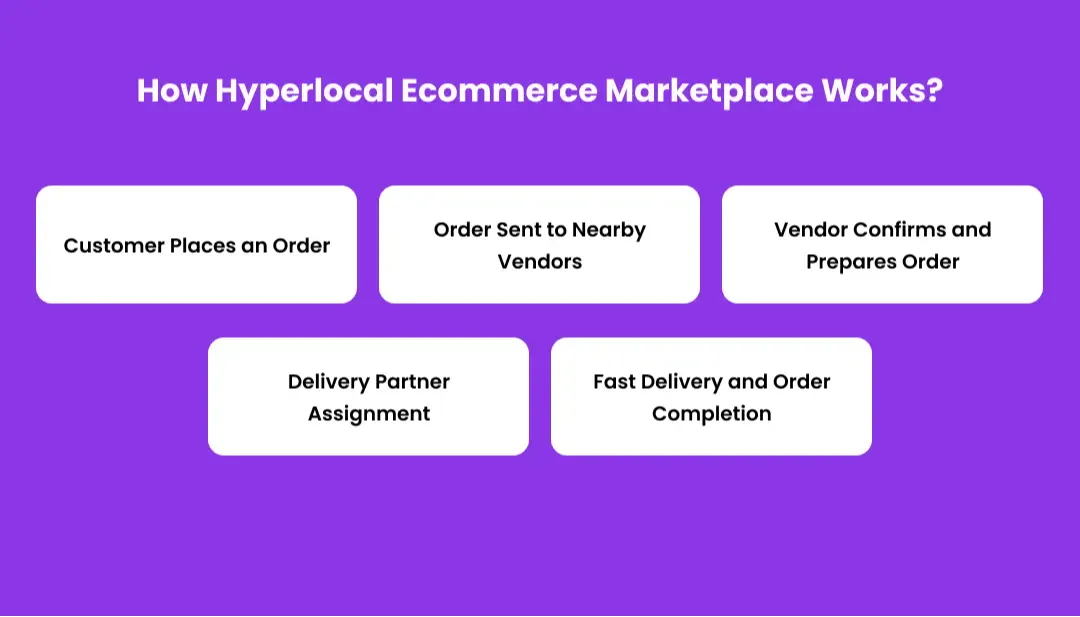
A hyperlocal ecommerce platform operates on a simple but powerful workflow that prioritizes speed and proximity. Here’s how it works.
1. Customer Places an Order
The hyperlocal platform allows users to find local sellers, view what they have nearby, select items for delivery, define how they want the products delivered, and create their orders through the geo-local search and real-time inventory of items in their area
.
2. Order Sent to Nearby Vendors
The system automatically forwards the order to relevant local vendors within a defined radius, ensuring faster acceptance, accurate fulfillment, and efficient hyperlocal order processing.
3. Vendor Confirms and Prepares Order
The sellers within the local area will verify that the items that the customer is ordering are available, accept the order, package it up to ship or deliver, and provide live updates to the customer on the status of the order via the seller portal.
4. Delivery Partner Assignment
The delivery person will be assigned to the nearest available seller utilizing GPS navigation, thus optimizing the quickest route for the pick-up and delivery of all items within the hyperlocal area.
5. Fast Delivery and Order Completion
The delivery driver will pick up and drop off the customer's order on time and provide live tracking, notifications, and feedback options to the customer after the order is placed.
Benefits of Building a Hyperlocal Ecommerce Marketplace
Building a hyperlocal ecommerce platform offers significant advantages for both businesses and consumers. A reputed development partner will help you launch innovative Instant delivery app development solutions. They will also help in on demand hyperlocal marketplaces. Here are some of the benefits given below.
1. Faster Delivery Experience
By serving a limited geographic area, businesses can ensure ultra-fast deliveries, which directly improves customer satisfaction and retention.
2. Lower Operational Costs
In addition to lowering the overall cost of warehousing and long-distance logistics associated with e-commerce, local sourcing can also reduce warehouses' operating costs and logistics.
3. Strong Local Vendor Network
Hyper-local e-commerce allows local vendors to sell their products and help smaller retailers transition to an online presence and reach potential customers within their local markets.
4. Higher Conversion Rates
Consumers are more willing to buy from a local vendor than from a retailer, knowing that products from a local vendor can arrive at their doorstep quickly.
5. Scalable Business Model
As long as the service has the right technology, a hyper-local e-commerce platform can quickly grow city by city without the need for heavy capital investment in infrastructure.
Popular Hyperlocal Ecommerce Marketplaces
Multiple examples exist of brands that have successfully leveraged a hyperlocal ecommerce model to dominate their local markets. These hyperlocal ecommerce startups have created benchmarks in both speed and overall user experience. Some of the marketplaces are:
1. Blinkit
Blinkit is a popular hyperlocal grocery delivery platform that uses dark stores, local vendor partnerships, and a well-optimized last-mile delivery system to deliver daily necessities in minutes through a popular hyperlocal grocery delivery service.
2. Zepto
Zepto offers ultra-fast grocery delivery by utilizing micro-fulfillment centers within a residential community, enabling them to process orders quickly, manage their inventory in real-time, and offer seamless hyperlocal experiences to customers.
3. Swiggy
Swiggy Instamart uses strategically located dark stores and Swiggy's extensive logistics infrastructure to deliver groceries and essential items with fast delivery times and reliable service throughout major cities.
4. Dunzo
Dunzo connects customers with nearby stores, pharmacies, and other providers to offer on-demand hyperlocal delivery of items and provides options for flexible pickups, instant deliveries, and task-based convenience solutions.
5. BigBasket
BigBasket combines local vendors and micro-warehouses in a hybrid hyperlocal ecommerce model to deliver grocery and household products, providing same-day delivery, express delivery, and scheduling options.
Each successful hyperlocal marketplace emphasizes convenience, speed, and a seamless digital experience, with the result proving the potential power of this model when done properly. The best online ecommerce apps are built by using these development techniques and become popular across the globe.
Key Features of a Hyperlocal Ecommerce Marketplace
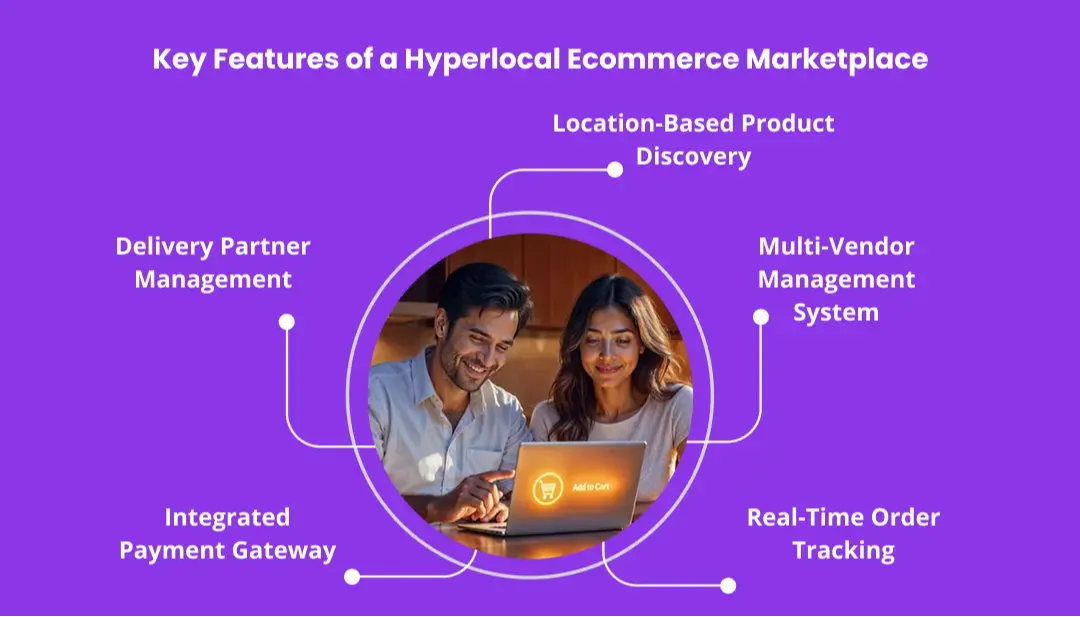
To build a competitive hyperlocal ecommerce service platform, you need a feature-rich ecosystem that supports customers, vendors, and delivery partners. People also search for build app like Blinkit, because the platform has some of the key features. Here are some of the key features given below.
1. Location-Based Product Discovery
Our platform leverages GPS and real-time location to display nearby vendors and the products that are in stock. This allows for speedy delivery and makes the shopping process more relevant and enjoyable at the hyper-local level.
2. Multi-Vendor Management System
By allowing multiple local sellers to register, maintain inventory, receive orders, and track earnings via a centralized dashboard, we enable the seamless growth of local marketplaces.
3. Real-Time Order Tracking
Customers and vendors can view the status of their order from the time they place it to the time it is delivered, providing increased transparency and trust between customers and vendors, and a better overall experience on hyper-local ecommerce platforms.
4. Integrated Payment Gateway
There are several payment options available to users of the marketplace, including UPI, card, wallet, and cash on delivery, making it easy and safe for all marketplace users to transact.
5. Delivery Partner Management
It helps to streamline deliveries by assigning the nearest delivery agent, optimally optimizing the route, and tracking agent performance, all while ensuring that deliveries reach their destination on time within the hyper-local service.
Step-by-Step Guide to Create a Hyperlocal Ecommerce Marketplace
The Marketplace development company ensures every step is followed while building an app. Here are the steps to build hyperlocal ecommerce marketplace solutions that scale.
1. Define Your Niche and Business Model
Determine if you want to focus your on-demand local marketplaces around grocery products, food delivery, medicine purchases, etc., or a combination of different types of products.
2. Select Platform Type
Your options include either a mobile application, a web application, or both. Most companies prefer a hyperlocal delivery app, as it allows for more interaction with their customers.
3. Design a User-Centric UI/UX
Having a clear, easy-to-use interface is necessary if you're developing hyperlocal delivery apps in India. Customers want to see a simple way to do things quickly.
4. Create Core Functionality
For hyper-local ecommerce applications, your core features should include vendor registration, order processing, payment processing, and live tracking of orders.
5. Incorporate Advanced Technologies
You should be utilizing technologies like GPS technology, Artificial Intelligence (AI) based recommendation systems, analytical software, and cart recovery solution to create better solutions within your hyper-local marketplace software.
6. Test, Launch, and Optimize
Once your hyper-local marketplace platform has been thoroughly tested for performance, security, and scaling, you can launch it and begin optimizing it further.
Cost to Build a Hyperlocal Ecommerce Marketplace
The hyperlocal marketplace development cost depends on multiple factors. Those are:
-
Platform complexity and features
-
Mobile app and web development
-
Third-party integrations
-
UI/UX design
-
Maintenance and scalability
Let us now break down the cost to build a hyperlocal ecommerce app based on the levels.
1. Basic App Cost
The basic ecommerce app costs range from $5,000 - $8,000. It is a good choice to start online ecommerce businesses or startups looking to initiate their operations. Some of the features include:
-
User registration and login
-
Product listing and categorization
-
Basic search and filters
-
Shopping cart and checkout
-
Standard payment gateway integration
-
Order management system
2. Mid-Level App Cost
A mid-level app cost ranges from $10,000 - $15,000. It is a good choice for growing businesses. Some of the features include:
-
Advanced search and smart filters
-
Multiple payment options
-
Order tracking and notifications
-
Customer reviews and ratings
-
Discount coupons and offers
-
Basic analytics and reports
3. Advanced-Level App Cost
An advanced-level app cost can range up to $15,000 or more. It is a good choice for large enterprises. Some of the features include:
-
AI-based product recommendations
-
Real-time inventory synchronization
-
Multi-vendor marketplace management
-
Hyperlocal and instant delivery integration
-
Advanced analytics and business intelligence
-
CRM and marketing automation tools
The Ecommerce app development cost is different for every business. Choose wisely to avoid any complications later.
Future Trends in Hyperlocal Ecommerce Marketplaces
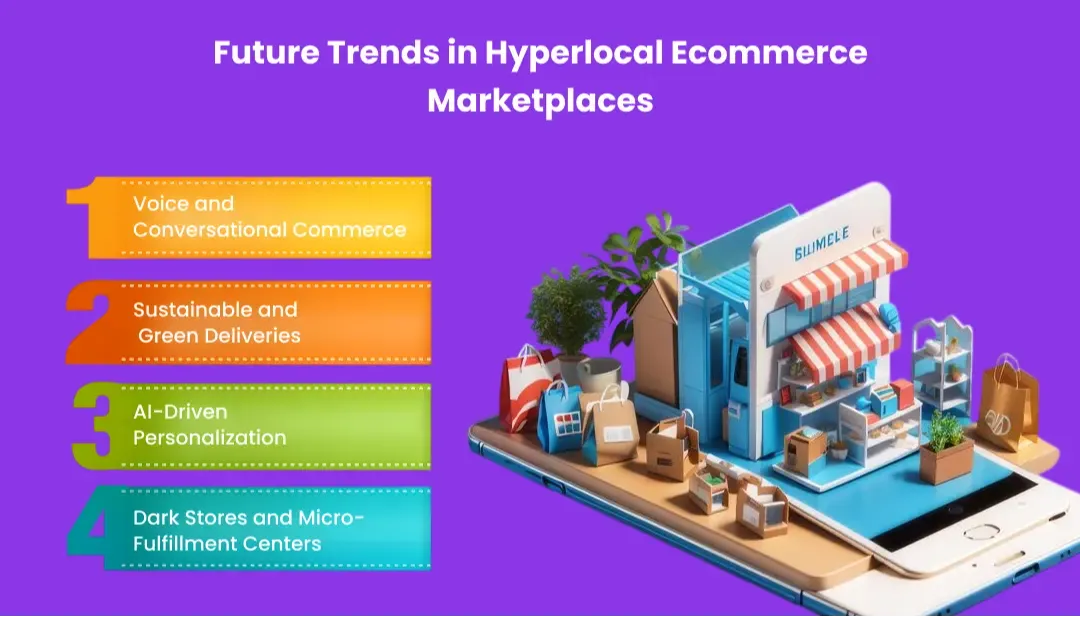
The future of the hyperlocal ecommerce website or app platforms looks promising, driven by innovation and evolving consumer expectations.
1. Voice and Conversational Commerce
The use of a voice assistant or chat-based ordering will enable users to easily search for and buy products. It enables users to make hyperlocal purchases by using natural language with smart devices and messaging platforms.
2. Sustainable and Green Deliveries
Many hyperlocal in Ecommerce platforms will have to utilize sustainable packaging, electric-delivery vehicles, and optimal delivery routes as part of their efforts to provide a low-carbon footprint and meet customer expectations for sustainability.
3. AI-Driven Personalization
Artificial intelligence will enable hyperlocal eCommerce marketplaces to analyze a user’s behaviour, geographical location, and past purchases so that they can suggest products that users might like. It will also provide them access to view products with dynamic pricing, in addition to smarter search results.
4. Dark Stores and Micro-Fulfillment Centers
Dark stores and micro-warehouses are going to become more commonplace in hyperlocal marketplaces as a means of providing faster delivery times. Having these facilities closer to residential areas will maximize the speed of getting an item into the hands of the customer.
Why Choose IMG Global Infotech for Hyperlocal Marketplace Development?
The right technology partner will be key to successfully creating a scalable hyperlocal ecommerce platform. IMG Global Infotech is one of the best Ecommerce app development companies with extensive experience developing secure, user-friendly, and high-performance applications designed for meeting your business objectives.
As an experienced developer of ecommerce applications, IMG Global Infotech provides a complete range of services from strategy, user interface and experience design through to deployment and scaling. Their pricing model is entirely transparent, which aligns with the cost of developing ecommerce applications. They can help you create applications similar to Blinkit or develop your innovative instant delivery platform.
What you will get at the IMG Global Infotech are:-
-
Dedicated hyperlocal ecommerce business development experts
-
Custom and scalable hyperlocal marketplace solutions
-
User-friendly web and mobile app design
-
Secure payment gateway and API integrations
-
Real-time order tracking and delivery management
-
Cost-effective development with transparent pricing
-
Ongoing support, maintenance, and upgrades
-
Proven experience in on-demand and instant delivery apps
CONCLUSION
Hyperlocal ecommerce is much bigger than just being a passing trend. In fact, hyperlocal ecommerce is the future of fast, easy, and localized digital retail, and as such is a huge investment opportunity with the increased demand from customers for immediate delivery and localized shopping experiences.
To launch and grow a successful hyperlocal marketplace, you need to know your business model, have the right features, develop within your budget, and partner with the right team of experts. When doing this correctly, you will create a platform that is a key component of your customers' everyday lives as well as a highly profitable long-term business. The right Ecommerce app development company is important for businesses to build a scalable platform that is also future-ready. Choose the right partner for smooth functioning and proper coordination.