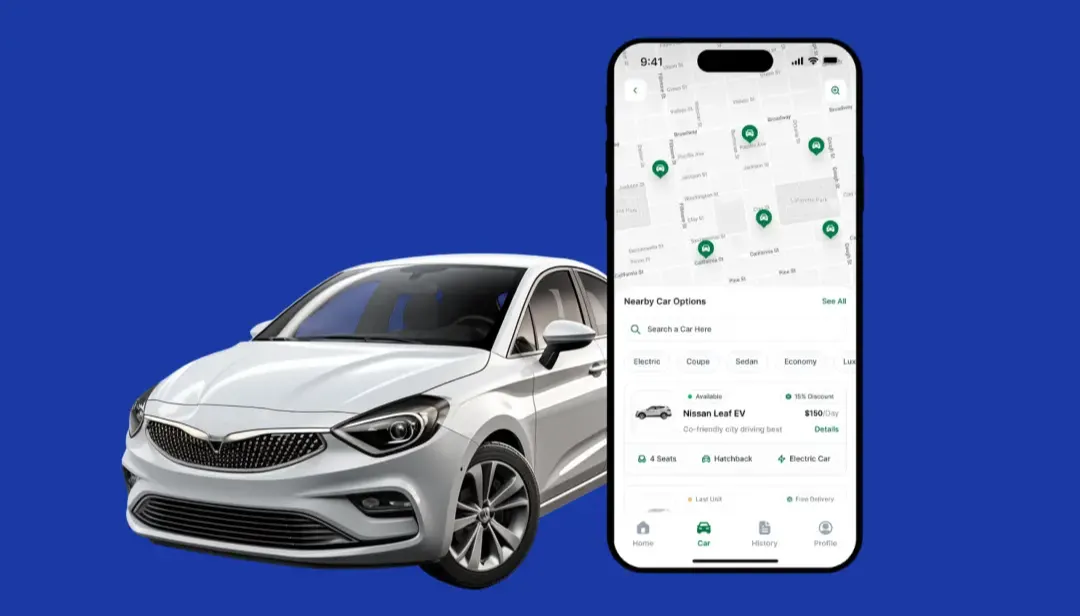
Turo, formerly RelayRides, launched in 2009 as a website only. However, this startup was successful in its beginnings and added an application in 2011 to enhance customers’ experience while using this service.
The introduction of the application was strategic; the use of applications makes things easier to use and provides innovative features (such as GPS tracking, photographic capabilities, and real-time notifications) that improve the overall customer experience in apps like turo. A similar mobile application can help you expand your audience and improve your service if you are interested in launching your own car rental business.
In this article, we will show you what to include when you are designing an application similar to Turo and the basic features your application needs, as well as how to go about developing it and the estimated cost for doing so.
Car Rental Apps Market Stats
As per the report of Grand View Research, the global car rental market size was estimated at $149.87 billion in 2024 and it is projected to reach $278.03 billion by 2030 with a CAGR of 10.5% from 2026 to 2030.
Key Market Trends & Insights:
-
Car rental industry in the U.S. is expected to grow at a CAGR of 8.7% from 2026 to 2030.
-
By application, Car rentals for the airport transport segment held a revenue share of over 71% in 2024.
-
By booking mode, the online bookings segment held a revenue share of over 71% in 2024.
-
By vehicle, the economy car rentals segment held a revenue share of over 32% in 2024.
-
The car rental market in North America accounted for a share of 36.39% of the global market revenue in 2024.
Key Features of a Car Rental App Like Turo
Here is the list of some Taxi booking app features of Turo like app for your business as well.
-
User Management: The feature of user management, like viewing all user profiles and their history of bookings and payments that have succeeded or failed in car rental apps like turo, is important in a P2P car rental marketplace.
-
Rental Security Management: This module comes with features to collect rental security and deduct reimbursements to cover costs for any car damages.
-
Booking Management: View existing and new orders, track the status of bookings, and view rental periods, customer details, and car owner details.
-
Booking Calendar: A UI-based functionality to assist customers in choosing rental dates in car rental app like turo. A booking calendar also helps in invoicing and checking the availability of vehicles.
-
Custom Information Fields: Required to collect and display the most relevant information about the cars from car owners to Build an app like blablacar or Turo. These fields can be edited, added, or removed anytime. Some examples of these fields are ‘pet-friendly,’ ‘non-smoking,’ ‘snow tires,’ etc.
-
Product Comparison: Let customers compare several rental cars based on make, model, fuel type, engine, seating capacity, boot space, and even admin-created custom fields.
-
Product Inspection: This is required to inform the admin and car owner of any damages already present in the car at the time of pickup/delivery.
-
Document Verification: Collection and verification of essential documents, like customers' driving licenses, vaccination certificates, etc.
Step-by-Step Car Rental App Development Process
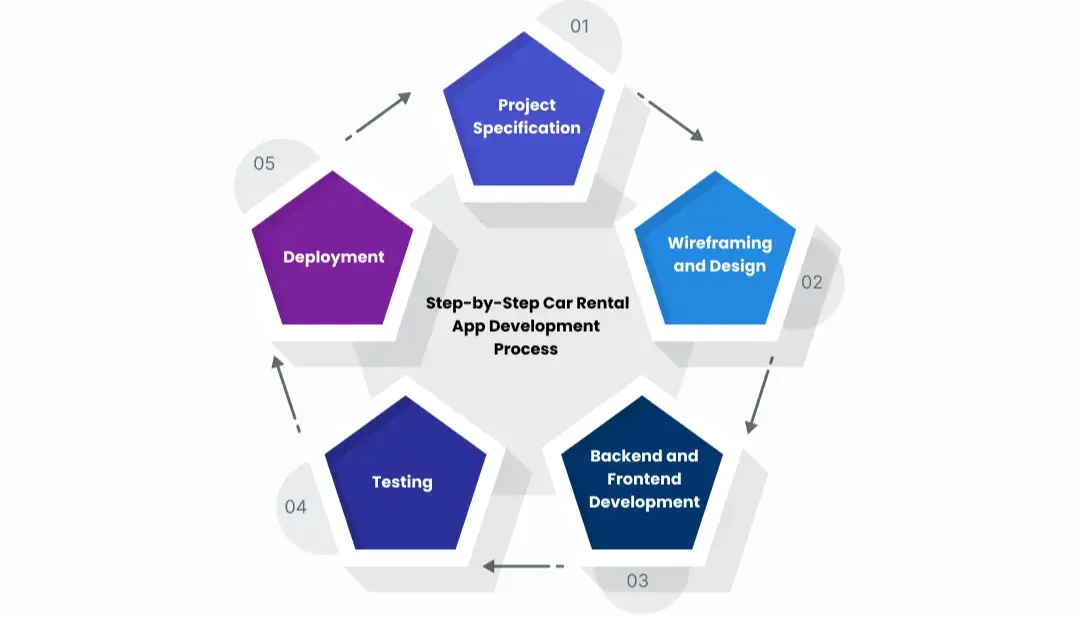
Here is the step-by-step guide to develop a car rental app like Turo for your business as well.
Project Specification
The first step is the specification of the project, which describes the application's needs and features. You need to determine key features such as user registration, car listing, booking systems, payment processing, and communication features in the best car rental apps like turo. This sets a very solid base for the entire project, as everyone knows the goals of the app.
Wireframing and Design
During this stage, the design and layout of the application are created. Wireframes provide basic visual guides that convey how an application is structured and how users will navigate through it in ride sharing apps like turo.
Once approved, designers go on to make detailed mockups and prototypes, at this stage mostly focusing on visual elements, color schemes, and the general user experience.
Backend and Frontend Development
This stage entails the development of the server-side and client-side parts of the app.
Back-end development also involves structuring databases, servers, and APIs for data storage, user authentication, payments, and other server-side functions that can also examine how to build an app like turo . Front-end development involves coding the UI of the app to ensure it is responsive and friendly for its intended end-users.
Testing
Following its development, it undergoes various testing phases to ensure that the application works as expected or is there another app like turo. This involves the testing of the components of the app individually, testing that the different parts of the app work together under the Mobile app development, testing with actual users to find usability issues, and finally, testing the speed and stability.
Deployment
The application, upon completion of testing, is deployed into app stores like Google Play and the Apple App Store, where it is made available for public usage. Deployment includes setting up all necessary infrastructures, like cloud hosting services, needed to ensure the smooth operation of the system in a motorcycle rental app like turo. And those are the steps involved when one chooses to use custom development to build an app.
Equally important, post-launch, regular app updates fix not only bugs and security issues but also add new features according to user feedback in apps like turo but cheaper. This provides for a constantly changing customer-centric app experience.
Cost to Develop a Car Rental App Like Turo
The Cost to build an app like turo mainly depends on various elements, app complexity, and customization level in how much does it cost to develop app like turo. Here is an average cost breakdown to build an app like Turo for your business as well.
Important Technology Stack to Develop an App Like Turo
Monetization Strategies for Car Rental Apps
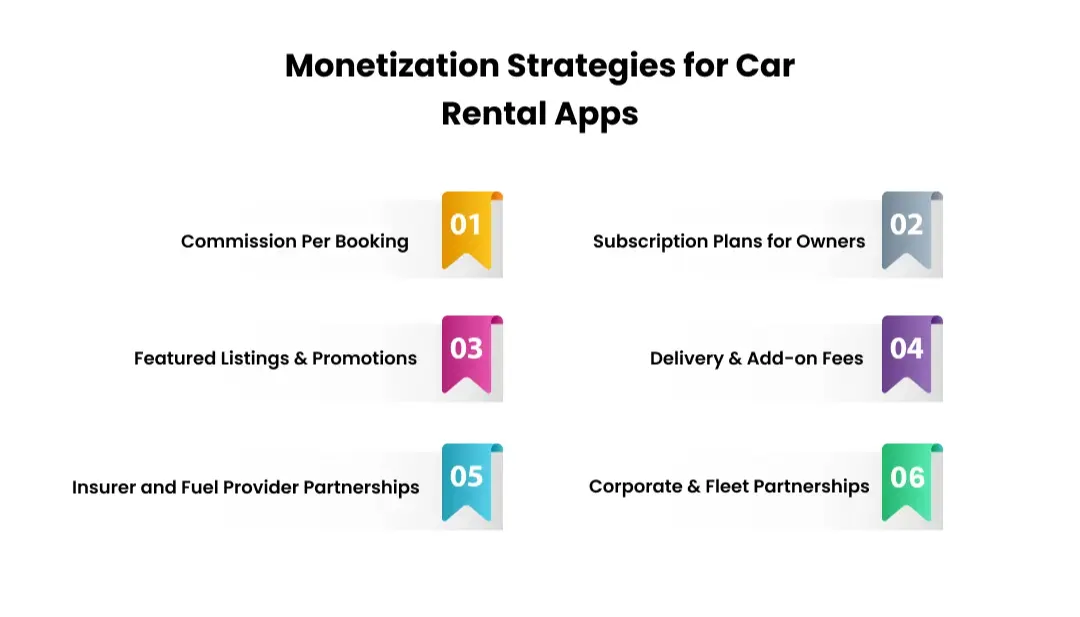
Once the build is efficient, it's time to make it profitable. Following are the monetization models that can fuel sustainable growth for your Turo-like car rental marketplace development:
Commission Per Booking
Your bread and butter: Charge about 10–25% per trip, according to insurance tiers and location. It ensures recurring revenue from each transaction.
Subscription Plans for Owners
Offer monthly packages to fleet owners, with benefits such as premium visibility or reduced commissions, to find the Taxi app development cost. This adds steady recurring income and improves owner retention.
Featured Listings & Promotions
Paid visibility for car owners who want more bookings may generate as much as 15–20% of additional revenue every quarter.
Delivery & Add-on Fees
Let the owners charge for services such as doorstep delivery, GPS devices, or child seats in Turo app development. The platform takes a small cut, multiplying microtransactions into big gains.
Insurer and Fuel Provider Partnerships
Affiliate-like revenue streams where for every policy sold or car refueled, a certain percentage would come through to examine the Car rental app development cost. This diversifies your income beyond bookings.
Corporate & Fleet Partnerships
Tie up with hotels, tour agencies, or corporations needing bulk rentals; these contracts bring in predictable high-volume revenue.
Future Trends in Car Rental & Sharing Apps
If you want your car rental app to be relevant in the coming years, you need to understand how the industry is evolving. New technologies, user expectations, and mobility trends show the way for rental platforms in the future.
Electric Vehicle Rentals on the Rise
More travelers are choosing electric cars for cleaner and cost-efficient mobility, which clarifies how to make an app like turo. Car-rental apps will expand their EV fleets, offer charging station maps, and show real-time battery status for smoother trips.
Autonomous and Self-Driving Rentals
As self-driving technology continues to improve, the rental apps of the future will host autonomous fleets that guarantee a safer ride in Turo like car rental app development, hands-free navigation, and a more comfortable ride without human driving.
AI-Based Fleet Optimization
AI-powered development services will play a major role in predicting demand, adjusting pricing, planning maintenance, and enhancing route efficiency in Turo clone app development, and therefore cutting costs for rental companies while delivering a more reliable experience.
Increased Interest in Ecological Mobility
Renters increasingly prefer eco-friendly options in other app like turo. Apps will showcase EVs, hybrids, and information on carbon emissions to appeal to users who seek greener and more responsible means of travel.
Smart Parking and Connected Infrastructure
Car rental applications will integrate with intelligent parking, indicating availability in real time and making it easier for users to search for and book their parking spots, thus facilitating movement within the city.
Closing Thoughts
The creation of a Turo-like rental program may represent an excellent opportunity for businesses today, as people continue to seek mobility options. Providing platforms where consumers can locate vehicles conveniently, affordably, and flexibly will allow your company to stand out within the car rental marketplace.
Developing a Turo-like rental program can be very rewarding; however, to do so successfully, you must partner with a reliable Taxi app development company and take a slow, methodical approach. Listen to your customers and use their feedback to shape the development of additional functionalities for your program. Safety, trust, and ease of use should always be your guiding principles.