Remember that scene from 3 Idiots where Virus shouts, “Life is a race!”? Quick commerce took that line to heart—and they’re out in front, with AI doing the heavy lifting behind the scenes.
Seriously, think about those moments when your mom suddenly says at 11 PM, “We’ve run out of curd.” There’s no time to argue. You just reach for your phone, and only Blinkit| Zepto| Swiggy Instamart can save the day. It’s almost as final as Shivagami in Bahubali laying down the law—“Aise hi hoga!”
That’s exactly how AI runs in quick commerce. It doesn’t hesitate or wait for you to make up your mind in ai in quick commerce. These algorithms already know what you need, sometimes before you do, making decisions in the background, while you’re still opening the app.
Whether you’re in the middle of Mumbai’s messy traffic or dodging Bangalore’s next rainstorm, AI keeps things running—tracking local stock, piecing together delivery routes, and tweaking everything moment by moment.
A 10-minute delivery doesn’t feel like a hack anymore. It’s just a smart move for the business.
What Is AI in Quick Commerce?
AI in e-commerce isn’t just about robots taking over—it’s more like a toolkit for online shops, mixing things like machine learning, natural language processing, and computer vision to make everything run smoother. These technologies crunch piles of data, spot trends, and help businesses figure out what works (and what doesn’t).
With the right AI, stores can track how shoppers behave and use that info to recommend products you’ll actually like, personalize deals, and tweak their pricing in quick commerce ai.
Computer vision helps you search with pictures, while natural language processing gives chatbots the ability to handle your questions without sounding like robots in Ecommerce vs quick commerce. Predictive analytics? That’s the secret behind smarter inventory and more accurate demand forecasts — so you’re less likely to see “out of stock” messages.
Key Use Cases of AI in Quick Commerce
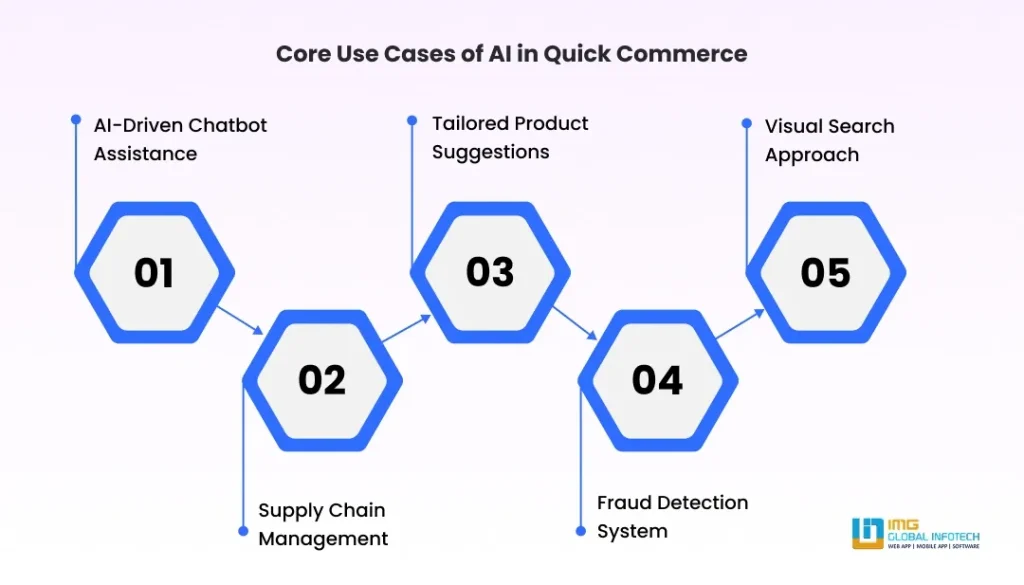
Here are some reliable use cases of AI in the quick commerce industry; let’s take a closer look at these use cases:
AI-Driven Chatbot Assistance
AI-driven chatbots have specific access to customer support at any time of the day. The chatbots can answer the question along with showcasing tracking orders to assist with customer needs and filtering and selection of products in artificial intelligence in quick commerce. Chatbots can also integrate AI language processing to respond to the customer’s question in a conversational style as well.
Supply Chain Management
Managing inventory along with supply chains is a significant task in the retail industry, especially in eCommerce operations in Instant delivery app development. Using AI technologies in supply chain management can optimize the workflow in warehouse management that is practically used in prediction in high demand and prevent overstocking or understocking as well.
Tailored Product Suggestions
The personalized recommendations are an extensive major application of AI in eCommerce. AI technologies can analyze the shopper activities that include purchasing behavior with website preferences and browsing history or more to suggest products according to the customer’s choice to buy. AI tools can also enhance value that can increase the browsing experience as well.
Fraud Detection System
Customer safety becomes a concern when products can be purchased with a single click. AI tools can help to examine fraud in the eCommerce sector by spotting the signs of suspicious and unusual transaction methods in ai in delivery apps in ai use cases in quick commerce.
With the perspective of AI, this is a way to secure businesses and their clients. It can also help to eliminate the chargebacks and enhance customer safety during the digital payment process.
Visual Search Approach
AI has changed the way people shop online. Now, product searches and crawling happen faster and feel a lot smoother in Ai in ecommerce. With visual search, you just snap a photo of something you like, and the system pulls up similar items right away.
Voice shopping is another game changer. You can just tell Alexa or Google Assistant what you want, and they handle the order for you in ai in quick commerce apps. These tools make buying things a lot easier and suit how people use their phones for just about everything these days.
Benefits of AI in Quick Commerce
Here are the benefits of AI in quick commerce as well:
Enhanced Customer Experience
AI steps in at every stage, from the moment someone discovers your brand all the way to checkout. It makes shopping smoother and just a bit more enjoyable for everyone due to the role of ai in quick commerce. The whole idea is to speed things up and take the hassle out of buying.
Increased Sales and Conversions
AI knows how to match the right products with the right people. That means more sales and higher conversion rates—so, in the end, better profits in AI in grocery delivery apps.
Operational Efficiency
When AI handles the repetitive stuff, teams spend less time on busywork and more on big-picture strategies and growing the business in AI in hyperlocal delivery.
Data-Driven Decision Making
AI digs deep into marketing, pricing, and inventory data. With sharper analytics, companies make smarter choices and get better results from benefits of ai in quick commerce.
Cost Reduction
AI helps cut costs by fighting fraud and streamlining operations. That means fewer risks and a healthier bottom line.
What are the Challenges of Using AI in Quick Commerce?
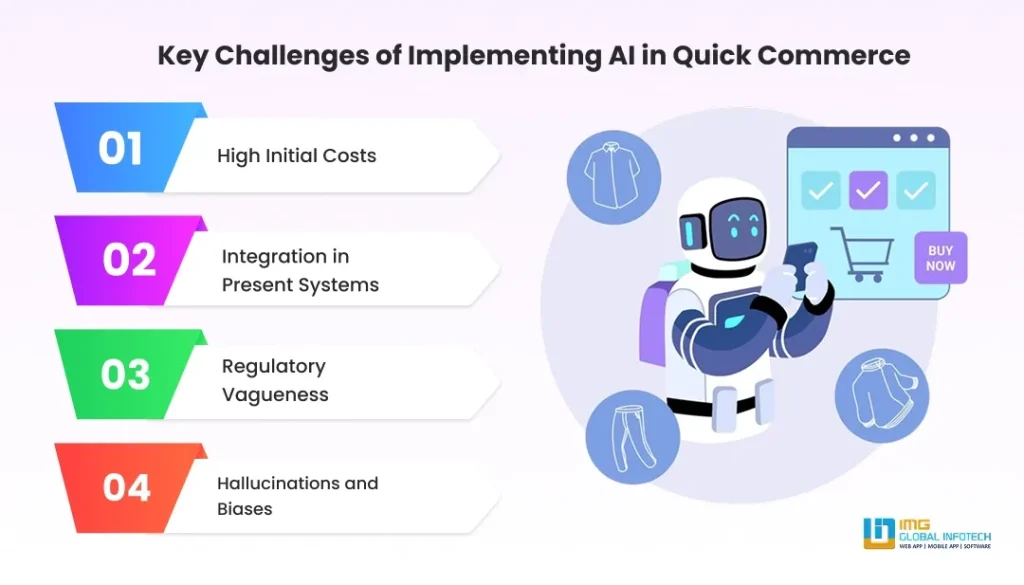
AI is shaking up e-commerce—making shopping more personal and streamlining how things work behind the scenes of Ai tools for ecommerce business. But it’s not all smooth sailing. Adopting AI comes with its own set of headaches, like bad data and tricky system integrations.
These aren’t small problems; you need solid strategies to get past them and actually make AI work for your business. Let’s dig into the biggest challenge:
High Initial Costs
Establishing AI technologies in e-commerce demands substantial upfront investments in hardware, software, and skilled talent, which can build up a barrier, especially for small and medium-sized enterprises (SMEs) in AI chatbot for ecommerce. The cost mainly depends on complexity that is based on long-term benefits as well.
Integration in Present Systems
The integration of AI technologies with legacy eCommerce systems is a kind of complex challenge, especially in outdated platforms, because they often lack compatibility with modern AI tools that require heavy cost and time-consuming processes. This major scene can also disrupt operations, especially in larger enterprises with deep-rooted systems as well.
Regulatory Vagueness
The rapidly shifting regulatory landscape for AI majorly includes GDPR and CCPA, which creates uncertainty in e-commerce operations along with complicating compliance efforts in tasks in ai in ecommerce and quick commerce.
The non-compliance risks can lead to significant fines that can also do reputational damage, especially for global retailers that are navigating diverse legal frameworks in the business as well.
Hallucinations and Biases
AI systems sometimes make things up—they “hallucinate,” spitting out wrong answers or echoing the biases baked into their training data to build AI-powered quick commerce apps. When this happens in e-commerce, people lose trust fast. Think about shoppers getting bogus product info or recommendations that seem unfair or just off.
That can turn customers away and damage a brand’s image. Research points out that nearly 30% of AI’s outputs can include these made-up glitches. The best way forward? Run frequent checks, feed the AI diverse data, and use smart strategies to keep results honest and accurate—because in e-commerce, trust is everything.
Future Trends of AI in Quick Commerce
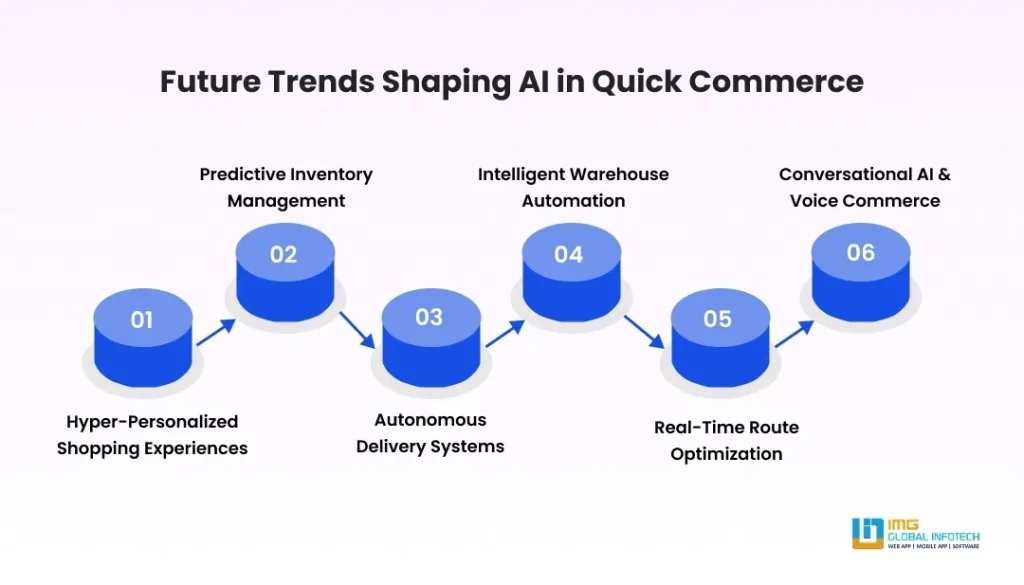
Artificial intelligence is changing quick commerce by being able to deliver goods faster than ever before, making operations more efficient, and making personalized delivery solutions possible in the future of AI in the quick commerce industry. Changes are coming that will change the way people shop because they will get their purchases in minutes.
Hyper-Personalized Shopping Experiences
AI will analyze real-time consumer behavior, purchase history, and preferences to deliver tailored product recommendations, dynamic pricing, and personalized offers, which will create a distinct shopping experience for each customer.
Predictive Inventory Management
Q-commerce platforms will use advanced AI algorithms to predict demand because these algorithms study trends, weather patterns, and local events to determine which products should be stocked.
Autonomous Delivery Systems
AI-powered drones and self-driving robots will execute complete last-mile delivery tasks without requiring human control, which results in faster deliveries and lower delivery costs while enabling 10-minute delivery service throughout city areas.
Intelligent Warehouse Automation
AI-controlled robotic systems will execute the tasks of sorting, picking, and packing operations inside dark stores at high speed because they achieve precision, which results in quick order processing throughout all business operations.
Real-Time Route Optimization
AI will use traffic, weather data, and order density information to create optimal delivery routes, which improves delivery speed and reduces fuel usage and carbon emissions.
Conversational AI & Voice Commerce
AI-powered chatbots and voice assistants will easily take orders, answer questions, and suggest products. This will change how customers interact with quick commerce platforms by making conversations more natural, intuitive and smooth.
Closing Statement
AI in e-commerce meets new human needs constantly on the go for a variety of reasons: offering personalized product suggestions, using AI chatbots for customer engagement, implementing variable price mechanisms, performing data analysis for sales forecasting, etc in Quick commerce app development. All these pave the way for improved customer experiences and making business operations more efficient.
The introduction of generative AI, computer vision, and other technologies is capable of transforming content generation and visual search, while sustainability-focused AI minimizes waste and energy consumption.
While there are issues like the quality of data and steep costs, a well-planned execution based on strong data foundations, pilot projects, and staff training can lead to maximum ROI.