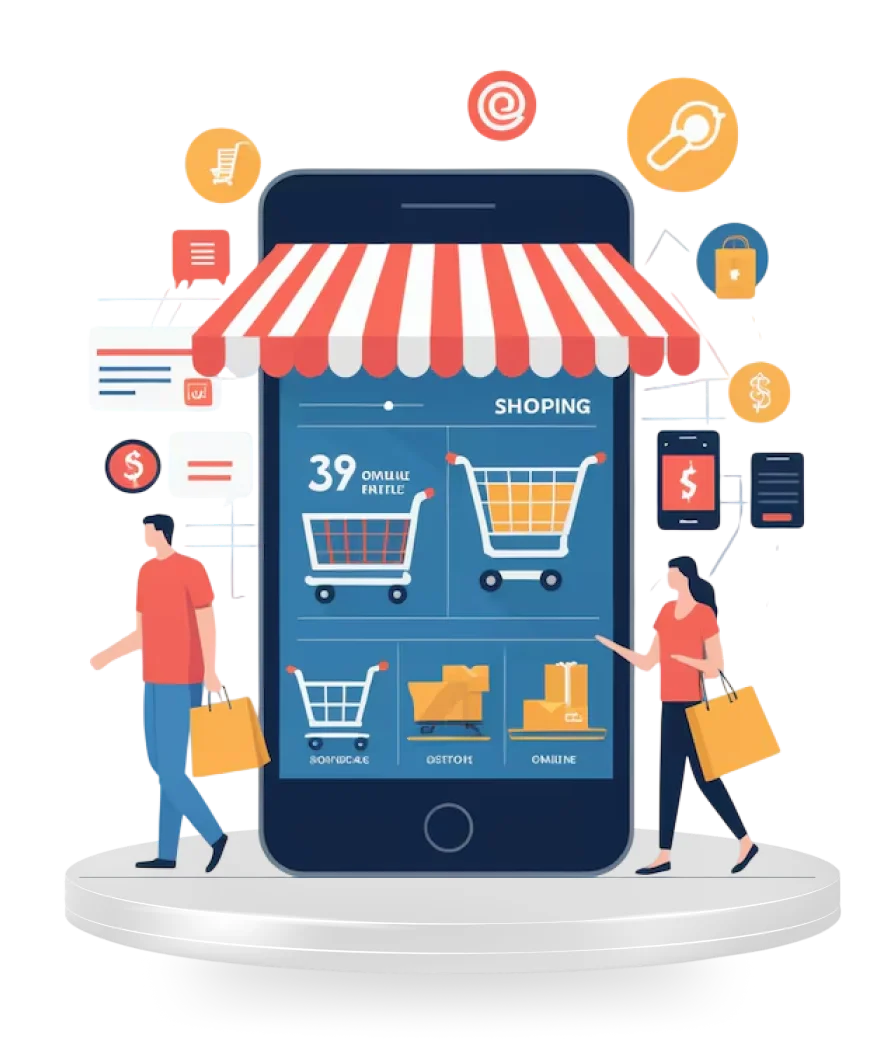
Today’s digital market is extremely competitive and customers expect a streamlined shopping experience from various touchpoints such as web stores, mobile apps, social networks, online marketplaces and physical stores. This change in consumer buying behavior made omnichannel ecommerce an important strategy for brands and retailers seeking to gain engagement from customers, boost revenue and create long-term loyalty.
Omnichannel marketing differs from multichannel ecommerce in the sense that it connects all the touchpoints to establish a unified and personalized shopping experience for a consumer. From shopping for a product on the web store to buying it at the physical store, and then obtaining customer service across various channels-the consumer demands convenience at each and every step of the process. Here’s everything that the brands and retailers should know about the concept of omnichannel ecommerce development guide including its benefits, essential elements, implementation strategies, challenges involved and best practices that business could adopt to achieve steady growth.
What Is Omnichannel Ecommerce And Why Does It Matter In 2026?
Customer expectations are rapidly increasing so businesses should facilitate them with multiple touchpoints throughout their buying journey. In 2026, Omnichannel marketing has become the most relevant strategy for retailers and brands who want to establish coherence in the customer communication, increase engagements, and acquire long-term customer loyalty.
Omnichannel ecommerce refers to a retail strategy in which all the sales and communication channels, which may include websites, mobile applications, social media pages, online marketplaces, electronic mails and physical stores, are linked into a single connected network that permits the customer to pass seamlessly between any given touchpoints of the brand or company in a personalized way.
In 2026, unified commerce is becoming increasingly important because consumers demand flexibility and instant communication at any stage of their purchase journey. Customers could be searching for a product on social networks, reading about it on the websites of their favorite retailers, making the purchase through their mobile applications, and then taking the product from a physical retail store. By providing such an effective Omnichannel strategy, retailers and brands could enhance their satisfaction levels, improve retention rates, increase the operational efficiency of their business, boost sales and revenues, and build strong customer relationships which are crucial for attaining a competitive advantage in today’s fiercely digital and dynamic market.
Omnichannel vs. Multichannel Ecommerce: Understanding the Key Differences
While multichannel vs omnichannel both involve selling through multiple platforms, they differ significantly in how channels interact to build an omnichannel ecommerce platform. Understanding these differences helps businesses choose the right strategy to improve customer experiences, operational efficiency, and long-term growth.
Benefits of Omnichannel Ecommerce for Retailers and Modern Brands
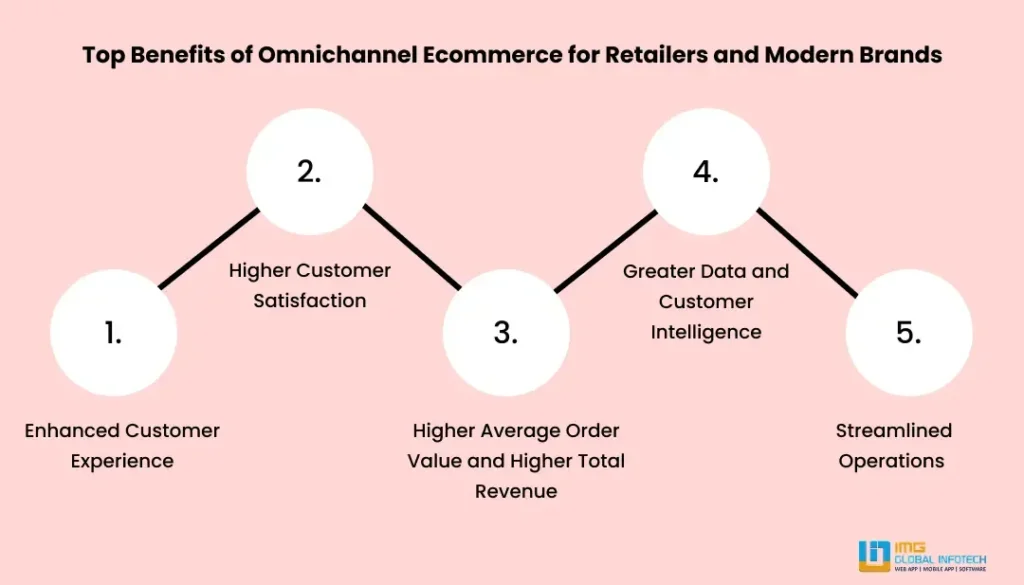
Omnichannel eCommerce provides retailers and brands with the ability to create seamless shopping experiences across many touch-points, which enables them to provide the highest level of customer satisfaction, increase their sales effectiveness, create a loyal customer base, and enhance their operational performance. In other words, omnichannel order management makes it easier for customers to shop with a retailer and/or brand.
1. Enhanced Customer Experience
Omnichannel eCommerce allows retailers/brands to provide customers with a consistent shopping experience across multiple omni-channeles (e.g., website and/or mobile apps; marketplace and/or social network; physical store). When customers interact with retailers/brands across multiple touch-points, they feel more connected to the retailer/brand.
2. Higher Customer Satisfaction
By providing customers with a customized shopping experience with a brand across multiple channels, retailers/brands strengthen the connection between customer and retailer/brand and improve the likelihood of repeat purchases in AI-powered omnichannel commerce experiences. The consistency of the customer experience across multiple channels helps create long-term relationships between customers and retailers/brands, which leads to increased customer loyalty and retention.
3. Higher Average Order Value and Higher Total Revenue
On average, customers who interact with a brand on more than one channel spend significantly more than customers who interact with the same brand only once (i.e., via a single channel). Therefore, by opening other avenues to engage customers with the additional reasons to purchase through those channels, brands create more purchasing opportunities generating a greater number of conversions per potential customer driving more revenue for each potential customer.
4. Greater Data and Customer Intelligence
When brands integrate their on-channel and off-channel sales channels, brands have a complete view of their customers based on behaviour, preferences and purchasing habits. This information and insight allow brands to make better decisions, refine their campaigns and as a result, improve their customers’ individual shopping experiences.
5. Streamlined Operations
By centralising inventory management, order processing and customer data, streamlining operations results in operational efficiency in omnichannel ecommerce strategy and tech stack. This will reduce errors linked to manual methods, enhance the accuracy of order fulfilment, maximise the efficiency of human resource allocations and enable businesses to expand at a rate exceeding what they would otherwise experience.
How to Build an Effective Omnichannel Ecommerce Strategy Step by Step
Building a great omnichannel ecommerce strategy is about much more than just having multiple selling channels. An effective omnichannel strategy takes planning, technology integration, and a customer-focused implementation. Hire ecommerce web developers that can build or create immersive shopping experiences that excite customers, ultimately resulting in increased profits for retailers.
1. Establish Goals and Map Customer Journeys
Establishing a clear understanding of business objectives, target audience(s), and points of contact before deploying an omnichannel approach is critical. Working with an omnichannel inventory management development agency, the examination of customer behavior and purchasing journeys aids the business in creating a cohesive strategy for its omnichannel initiatives, aligning with the consumer’s needs and the business’s long-range vision.
2. Use Appropriate Omnichannel Technology
Equally as important is ensuring that the proper systems are contemplated when creating fluid interaction between websites, mobile applications, marketplaces, social media environments, and brick-and-mortar environments. A properly trained ecommerce web development company in India can assist a business in selecting the appropriate scalable systems necessary for ensuring secure inter-system communication amongst those systems, as well as providing capabilities for future growth.
3. Centralize Customer and Inventory Data
The value of data being adequately used to create a seamless consumer experience across various touchpoints throughout an entire organization cannot be overstated; therefore, a business needs to create consolidated/centralized data storage solutions and cloud-based databases that enable the organization to reliably synchronize and share customer profiles, transaction histories, and inventory balances for all sales channels available to the organization.
4. Seamlessly Connect Customer Touchpoints
Companies can successfully develop fluid transitions for their customers across multiple sales channels such as mobile apps, websites, marketplaces, social media and stores when they utilize the ecommerce website development services in jaipur. With the help of a professional eCommerce app development firm, a business will be able to align all of its various touchpoints (mobile app, website, marketplace, etc.)
5. Use Personalization and Automate
The use of artificial intelligence-based recommendation engines, as well as the automation of various aspects of marketing, and chatbot-based, live customer service will provide customers with a better experience. The best ecommerce app development company in jaipur can create smart systems that employ intelligent automation to automate complex processes for customers.
6. Continued Performance Monitoring and Improvement
Instead of just implementing an omnichanism strategy, businesses should continually measure how their customers behave, review their sales performance, evaluate their customer service metrics and analyze their inventory with a goal of finding areas for improvement and fine-tuning overall sales strategy and performance. By working with a top ecommerce development company in India, businesses can access advanced analytics and ongoing support.
Essential Features Every Omnichannel Ecommerce Platform Should Include
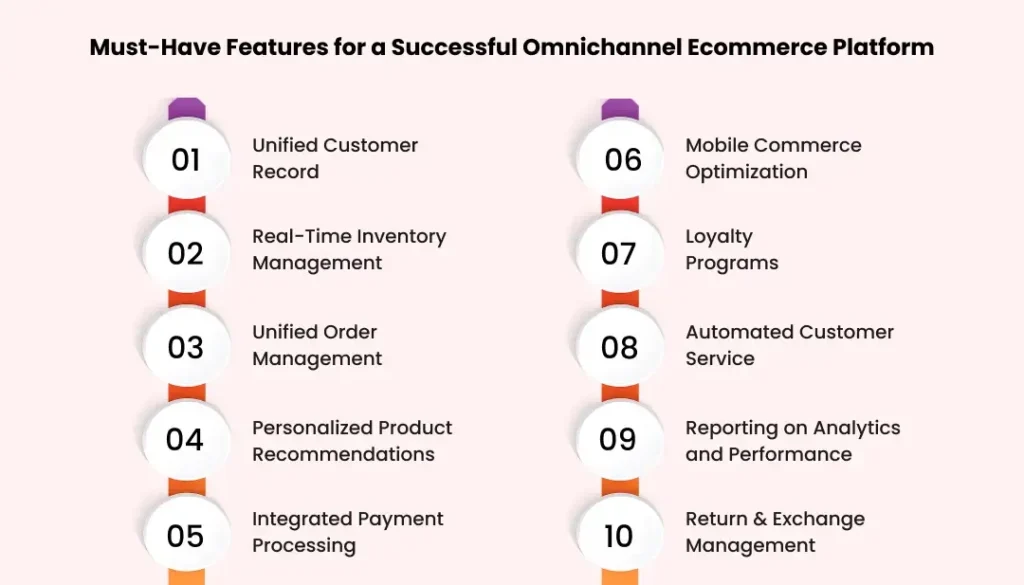
A successful omnichannel eCommerce solution must include features to connect all points of interaction with customers (all sales channels), provide a single inventory of products for sale across these various channels, and allow merchants to access a complete view of the customer’s order and related marketing efforts. Providing these shopping app development solutions features enables merchants to create a seamless, personalized, and superior shopping experience across multiple sales channels.
1. Unified Customer Record
When merchants combine data from customer records across web, online ecommerce app brick-and-mortar stores, and marketplaces, it results in a single unified and consistent profile for every customer.
2. Real-Time Inventory Management
Real-time inventory management allows retailers to monitor and control their entire inventory (on hand) at all sales channels at any point in time. Retailers can avoid stockouts or overselling products and can expedite order fulfillment.
3. Unified Order Management
Using a single order management tool to process orders from multiple sales channels simplifies how orders are fulfilled in omnichannel retail app development.
4. Personalized Product Recommendations
When merchants utilize customer purchase history and browsing behavior to provide product recommendations, they can increase their sales conversion rates.
5. Integrated Payment Processing
Integrating various forms of payment processing allows merchants to seamlessly process payments for online and offline sales, resulting in a more positive purchase experience for the customer.
6. Mobile Commerce Optimization
Improving Mobile Commerce Experience
Mobile commerce is growing quickly, so it’s important to ensure consumers can have the best possible experience when shopping from their phones or tablets.
7. Loyalty Programs
By providing an omnichannel loyalty or customer rewards program, you will be able to keep existing customers and extend the lifetime value of a customer to your business.
8. Automated Customer Service
Using chatbots and other automation tools can allow customers to have immediate and seamless access to customer service representatives and therefore improve their experience with your business.
9. Reporting on Analytics and Performance
Businesses should analyze and report on customer behavior, sales trends, campaign performance, and activity across all channels.
10. Return & Exchange Management
By allowing customers to return or exchange products via multiple channels, you can make it more convenient for them to return products.
Real-World Omnichannel Ecommerce Examples and Success Stories
Many international brands are now adopting an omnichannel e-commerce strategy to connect with customers in a more meaningful way. This creates more engagement and provides customers with added convenience, which can create opportunities for long-term customer loyalty as well as to continue to grow the business in a sustainable manner. Below are examples of companies that have successfully executed integrated channels to create an omnichannel retail solutions experience for their customers:
1. Zara
Zara provides a seamless shopping experience for customers by integrating their three shopping methods: the website, mobile App and physical stores. Customers who use the apps like zara can see what is available at their local stores for purchase. There are multiple purchasing methods available to customers, as well as an application to assist with click and collect orders. By providing an omnichannel shopping experience, Zara provides customers with more opportunities to purchase goods (thus creating satisfied customers), as well as providing solutions for increased sales with extended hours of operation.
2. Ikea
Ikea offers customers an experience through the ecommerce integration of traditional bricks-and-mortar stores, e-commerce and Augmented Reality ways of shopping. This apps like ikea will help customers better envision the items in their space, in addition to providing them the ability to purchase products online and either pick them up at the retail location or have them delivered to them. All of these ways to shop give customers an integrated or “omnichannel” shopping experience.
3. Nike
Nike uses “omnichannel” e-commerce solutions to provide customers with an omnichannel shopping experience linking their retail stores, online site, app and loyalty program of customers (e.g. special discounts based on customer purchasing behavior and loyalty).
Also Read – Build A D2C Ecommerce App Like Nike
4. Sephora
Sephora provides an omnichannel shopping experience for customers by utilizing omnichannel ecommerce solutions to facilitate in-person and online shopping. Apps like sephora allow customers to use their website to show how products will look on them using the “virtual” make-up application; and providing personalized beauty advice based on the customer’s profile.
5. Starbucks
Starbucks has achieved a connected customer experience through the integration of their mobile apps, reward programme, website and physical locations. Customers can order ahead, earn points towards rewards, pay via their app and redeem rewards creating an easy way for customers and helping them establish brand loyalty.
6. Walmart
Walmart excels at integrating the online and offline retail experiences through services such as curbside pickup, home delivery, and real-time inventory visibility. Customers may browse products online, purchase via different channels, and select different order fulfillment methods, improving shopping efficiency.
Common Challenges in Omnichannel Commerce and Strategies for Success
The omnichannel ecommerce platform has plenty of advantages but there are also challenges. Understanding the challenges you face and developing a solution or strategy will help you address your customers’ needs and provide consistent, efficient and customer-oriented shopping experiences.
1. Data silos between channels
Usually each channel e-commerce digital product) runs on a separate database with distinct and different information leading to problems such as missing inventory levels and misreporting fulfillment accuracy because the data returned back to you when a customer goes to your website to look for product details might be different than what they receive on the same product. In attempts at correcting this problem, multiple companies are implementing a consolidated data management platform that will compile the data from all of their sales, marketing, and customer service channels.
2. Issues in Inventory Management
Inventory Management by disparate channel specific systems could result in conflicting inventory data and/or inaccurate inventory data which negatively would affect the level of inventory on the shelf and an under/over-abundance of inventory would ultimately result in missed order fulfillment. The use of a real-time tracking system for inventory and a centralized order management system will allow you to have real-time visibility into your inventory and assist in increasing your overall data accuracy and increases in operational efficiency.
3. Same Customer Experience Across Channels
Your customers will feel more confident in your e-commerce business if you provide an equivalent experience (product, service, communication, support) across different touchpoints throughout their journey (social media, mobile devices and desktop computers). A consistent brand voice and persona helps create that confidence as well.
4. Ongoing Technical Integration Challenges
Technical integration challenges between your various e-commerce platforms, CRM software, payment gateways and analytic/BI tools will continue to be a challenge for the foreseeable future. Companies need to look for scalable omnichannel solutions and qualified technology partners who offer integration assistance to minimize complexity and mitigate operational disruptions.
5. Data Privacy & Security Threats
Customer data being used across multiple channels also exposes businesses to significant security risks and data breaches. Implementation of strong security measures and policies to comply with applicable data protection legislation can help ensure customer data privacy and promote confidence.
Emerging Trends: AI, Personalization, Voice Commerce, and Unified Shopping Experiences
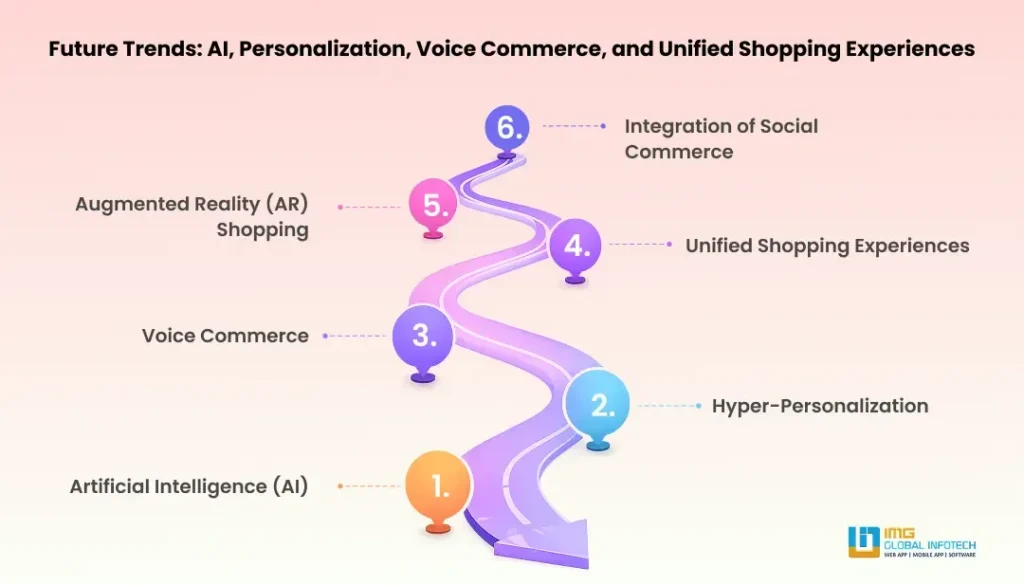
Digital technology growth has transformed what customers expect from eCommerce and how businesses operate in multiple channels. To meet this demand, companies are seeking to use AI, hyper-personalisation, Voice Commerce (e.g., Amazon Alexa) and a unified shopping experience to provide customers with a seamless and enjoyable experience when shopping online.
1. Artificial Intelligence (AI)
The automation of customer interactions with AI is fundamentally altering how businesses engage with customers every day through automation of processes supporting omnichannel eCommerce experiences, predicting how consumers will shop for products and optimizing operations of eCommerce businesses. Through the Use of ai in ecommerce such as chat bots, recommending products based on purchase history or predicting the quantity of Products available for sale helps create an excellent customer experience.
2. Hyper-Personalization
Using consumer data, brands can use it to generate personalized recommendations for what products a consumer may want to purchase, provide promotions targeted to individual consumers, and create customized content based upon a consumer’s purchase history, regardless of whether the purchase occurred through an online website, mobile application, social media platform, or brick-and-mortar store. This will ultimately lead to increased customer engagement and higher conversion rates.
3. Voice Commerce
Online shopping has become much more popular due to the growth of smart assistants and other voice-controlled appliances. Many of today’s consumers are now able to use voice commands to look up products, check pricing, buy products, receive shipping notifications and more, which enables digital shopping to be faster, easier and completely hands-free for the user.
4. Unified Shopping Experiences
For many retailers, starting an ecommerce business by creating an integrated experience between online and offline touch points has become an absolute priority. Unified omnichannel retail provides retailers the ability to synchronize the different aspects of their business (like customer data, inventory, payments, orders, etc.) to ensure that customers have the ability to switch from channel to channel and enjoy an integrated shopping experience.
5. Augmented Reality (AR) Shopping
With the ability to use AR, customers can try on or see a product before they actually buy it. AR can be used for anything from customers to virtually try on clothing pieces to “try out” different colours of makeup to placing furniture in a room to see how it will fit into their home, giving consumers confidence prior to purchasing and reducing the likelihood of a return with an overall better experience when shopping on e-commerce sites.
6. Integration of Social Commerce
Social media channels have become a significant sales channel for retailers and provide customers with the ability to discover, compare and purchase products without ever leaving a social media platform.By incorporating social commerce into the omnichannel strategy of a brand, they can effectively increase their reach and engagement while providing a hassle-free buying journey.
Conclusion
In 2026, the concept of omnichannel e-commerce will no longer be considered a competitive advantage, but an absolute business necessity. By unifying the physical and digital worlds of customers, retailers and brands will be able to deliver truly seamless experiences, increase engagement, drive sales, and ultimately, foster brand loyalty. From AI driven personalization to integrated commerce platforms, connected customer journey will remain the central theme for retailers in the years ahead. At IMG Global Infotech, we are dedicated to help businesses achieve their potential with custom-built, scalable omnichannel e-commerce solutions that are designed to meet and exceed modern customer expectations. With our leading e-commerce app development service, brands will be able to develop seamlessly integrated shopping experiences that not only boost operational efficiency but also pave the way for long-term success.