Real estate isn’t just about agents and open houses anymore. Now, it’s a fast-moving tech world, and mobile apps are right at the center of it all. Everything—from searching for homes and chatting with agents to analyzing market trends and closing deals—has moved online, which opens the door for all kinds of new ideas and game-changers.
As we head into 2026, real estate apps are evolving fast. Fresh technology is changing how people buy, sell, rent, and even handle property management.
But here’s the thing: simply listing homes isn’t enough. Today’s users want apps that actually understand what they need, offer virtual tours, automate paperwork, and break down complex data to make smart choices easier. If you’re running a real estate business or building these kinds of apps, keeping up with what’s next is crucial.
So, let’s take a look at the top real estate app development trends and see how they’re shaking up the property world.
Real Estate App Market Overview in 2026
As per the report of Mordor Intelligence, the IT market size in the real estate industry market is expected to grow from $11.63 billion in 2025 to $12.56 billion in 2026 and it is forecast to reach $18.45 billion by 2031 at a 7.99% CAGR over 2026 to 2031.
Key Report Takeaways:
- By deployment, cloud solutions captured 55.29% of the IT market in the real estate industry market size in 2025, and they are expanding at an 8.56% CAGR through 2031.
- By solution type, business intelligence and analytics are advancing at an 8.01% CAGR and are the fastest-growing segment to 2031.
- By end user, commercial real estate companies held a 45.10% revenue share in 2025, whereas real estate investors and REITs recorded the highest projected CAGR at 8.78% through 2031.
- By property lifecycle phase, operations and maintenance commanded 37.35% of the IT market in real estate industry market size in 2025; sales and marketing platforms are forecast to rise at a 9.02% CAGR between 2026-2031.
- By organization size, large enterprises led with 62.55% revenue share in 2025, while small and medium enterprises are projected to expand at an 8.66% CAGR through 2031.
Must-Know Real Estate Mobile App Trends for Businesses
From AI technologies to smart home integration, the real estate app development trends that are transforming to deliver value to businesses and customers in real estate app development. Here is a list to explore these trends and see how they can help businesses that enhance the customer experience.
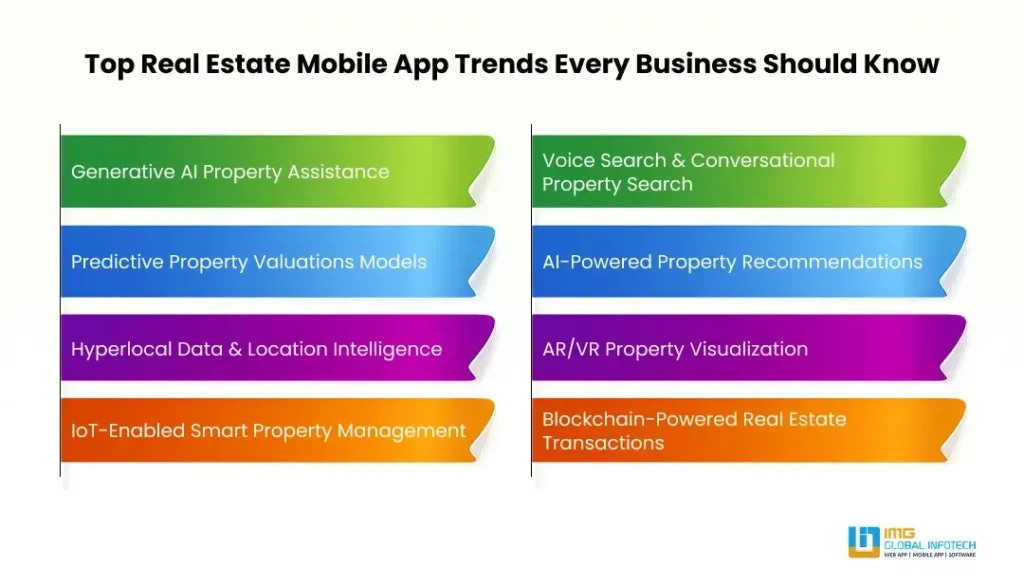
- Generative AI Property Assistance
Generative AI property assistants are emerging in the real estate app trends to enhance user experience. The users want instant support, and AI assistants can make it easier to offer quick answers through listings that can handle basic queries in the app.
- Predictive Property Valuations Models
It can understand the future property value, which is important for both users and investors. The predictive property valuation models integrate several elements like demand patterns, historical data, and location trends to estimate pricing. It can also help users to make more confident investment decisions that can eliminate risk. It also enhances trust in the platforms.
- Hyperlocal Data & Location Intelligence
The real estate apps now use hyperlocal data to show schools, transport, amenities, and safety details in different properties. This model can make listings, which is meaningful for decision-making. It can also improve how real estate apps can support smarter property for the buyers.
- IoT-Enabled Smart Property Management
Managing a bunch of properties by hand eats up time and drives up costs. With IoT, you can link smart devices like sensors, cameras, and locks—right to your real estate apps. That means less manual work and lower bills. Plus, these apps give you much better control over everything connected. In the end, property management gets simpler and easier to scale as your business grows.
- Voice Search & Conversational Property Search
Voice search is one of the best key real estate app market trends that are changing how users can seamlessly discover properties in 2026. Mostly users face problems while describing anything through typing so the voice search will help them to speak naturally to find properties quickly in the app.
- AI-Powered Property Recommendations
AI-driven property recommendations are among the top real estate app trends in 2026. AI technologies help in making the process seamless to analyze the user behavior according to their search history and budget to get better matches through the real estate apps.
- AR/VR Property Visualization
Some users prefer to explore properties visually before visiting them in the actual state. AR and VR-based property visualization make this possible through high-tech walkthroughs and 3D views in property app development trends. It can help users to understand the layout, space, and design in a real manner. This process can reduce unnecessary visits to enhance the decision-making process.
- Blockchain-Powered Real Estate Transactions
The blockchain-driven real estate transactions are one of the best trends in real estate apps in 2026 in real estate technology trends. It can prevent fake documents and property fraud by storing records in the app’s security system that is secured in a multi-layered safety system so nobody can change and manipulate the documents through the app.
Essential Features for Modern Real Estate Apps
Here is a list of top essential features for progressive real estate apps:
- Advanced Property Search Filters: Let users kind of filter properties by location, budget, the property category, amenities, size, and ownership preferences so the results stay more on point.
- Interactive Map Integration: Bring in a map-based browsing feel where people can check nearby landmarks, schools, hospitals, transport routes, and neighborhood details for that simple convenience.
- Virtual Property Tours: Show 360 degree virtual tours plus higher-quality property galleries so users can look around remotely before they even schedule a visit.
- Real-Time Property Listings Updates: Keep everyone updated with quick changes on new listings, price shifts, availability status, and even the recently sold ones.
- Secure In-App Communication: Add chat, voice, and video calling so buyers, sellers, and agents can communicate securely, without all the usual worry.
- Mortgage and EMI Calculator: Include built-in financial tools that estimate loan eligibility, mortgage payments, and monthly EMIs for clearer investment planning.
Benefits of Following Emerging Real Estate App Trends
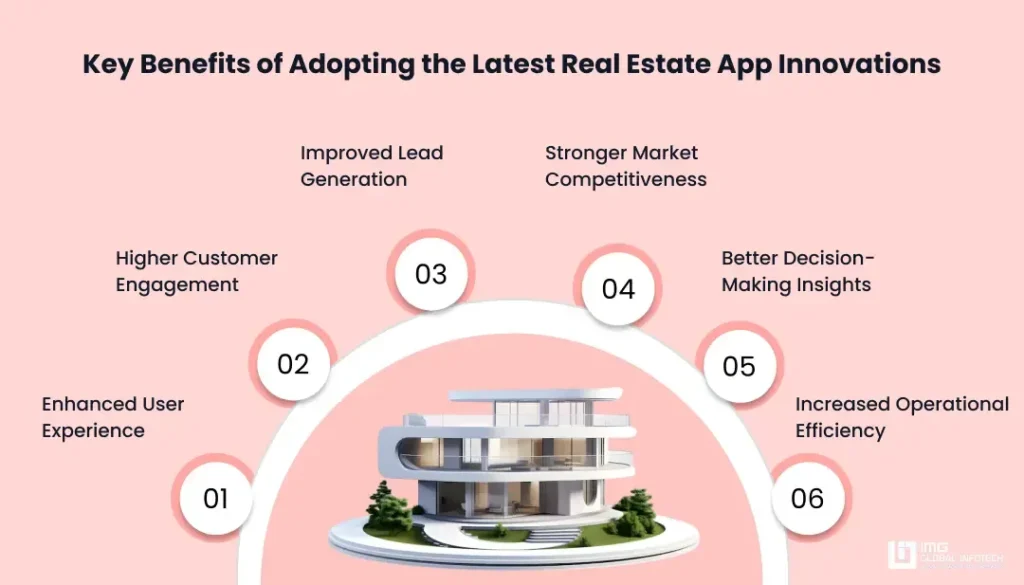
Following emerging real estate app trends sort of helps more than just the latest design and the same kind of polished functionality in real estate mobile app development. It tends to keep businesses competitive, boosts how much people interact with the app, and still delivers smooth property journeys across digital channels, even when the user switches devices.
Enhanced User Experience
A lot of modern trends lean into intuitive browsing, customized suggestions, and quicker responses, so the whole experience feels seamless, which then makes users more satisfied.
Higher Customer Engagement
There are interactive elements, guided virtual walkthroughs, smart alerts, and AI based recommendations that make people stay longer and keep looking around properties, rather than leaving after a few moments in real estate software development.
Improved Lead Generation
With advanced search options, predictive analytics, and more targeted marketing tools, companies can draw in the right prospects in property management app development. That way, lead quality improves, and it feels more consistent than before.
Stronger Market Competitiveness
By adopting emerging technologies, real estate businesses can stay ahead of competitors, satisfy the changing expectations, and strengthen their brand positioning a bit more than before.
Better Decision-Making Insights
With data analytics, user behavior tracking, and market intelligence tools, teams get more usable knowledge that supports smarter business strategies in practice.
Increased Operational Efficiency
Automation features streamline property management, deal with inquiries faster, and smooth communication processes too by AI in real estate app development, so there’s less manual effort and overall productivity actually goes up.
How Much Does It Cost to Develop a Real Estate App in 2026?
The average real estate app development cost in 2026 would be $5,000 to $15,000 or more. The exact cost is basically finalized on the basis of diverse factors and the level of the custom changes in the app development procedure.
Why Choose IMG Global Infotech for Real Estate App Development?
Choosing the right development partner can pretty much decide whether your real estate application really works out or not in property listing app development trends. With industry know-how, inventive technologies, and a user-first mindset, our team builds solutions that are scalable, packed with features, and tuned to your business objectives.
Industry-leaning Real Estate App Expertise
Our developers have a lot of experience crafting real estate applications that include property listings, virtual walk-throughs, agent administration, lead sourcing, and a smarter search engine, which helps keep users interested and pushes business growth along.
Bespoke Solutions Providers
We design custom real estate applications that fit your own way of doing business, so you get smooth workflows, more personal user experiences, adaptable integrations, and functionality that lasts—longer-term scale and operational clarity are included in real estate app development solutions.
Advanced Technology and Smart Integrations
We work with AI, cloud solutions, GPS tracking, virtual property tours, secure payment gateways, and CRM hookups to craft modern real estate platforms from smart real estate app solutions that boost overall performance and, honestly, keep customers more satisfied.
End-to-End Development & Ongoing Support
From early strategy work to UI/UX design, then engineering, QA testing, deployment, and long-term upkeep, our team sticks with you. So your real estate app stays safeguarded, refreshed, and still competitive in the market.
Final Thoughts
By 2026, real estate apps will go beyond simple property listings. They are now intelligent, immersive, and interconnected ecosystems that cater to buyers, sellers, agents, and investors. From blockchain-driven transactions and AI real estate data to comprehensive super apps and Smart Home connectivity – here are key trends in real estate app development in 2026: Real Estate Data powered by Artificial Intelligence Super App and Ecosystem Business Real Estate transactions powered by Blockchain.
These are not trends of the future; these are the now and the new by a leading real estate app development company. We continue to explore how businesses and property professionals can benefit by integrating and implementing new real estate app development technologies.
If you plan to build a new real estate app or want to scale up the current one, it would be beneficial for you to know new technologies to implement, which could improve its value and benefits.