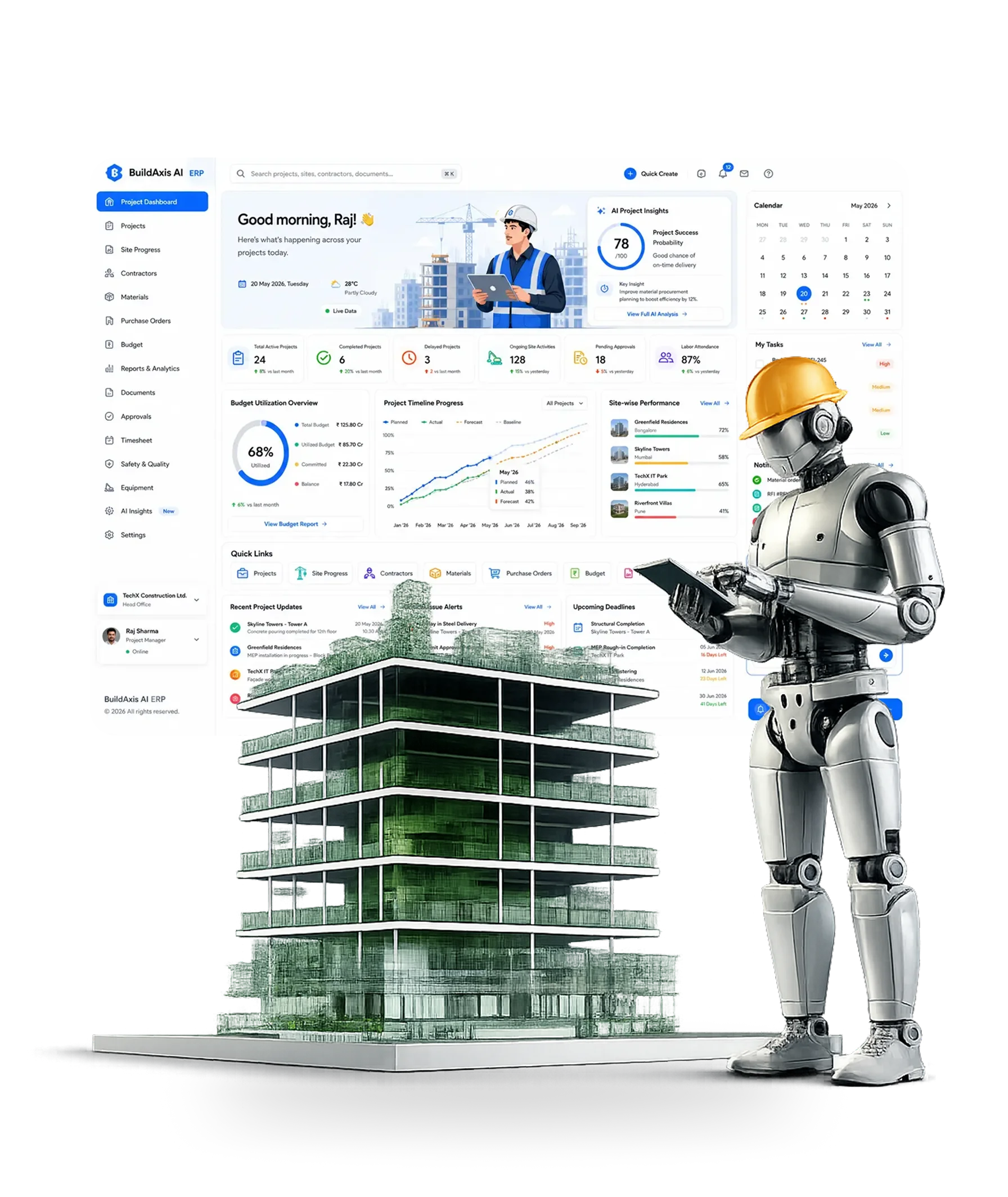
AI is transforming the pattern of workflow in several industries to deliver their best outputs. AI can also handle complex projects in industrial settings. For example: construction management, one typical job just because of sharp detail, multiple sites, and rising cost and labor demand in the business.
Integrating AI-powered software in construction management is a tricky but beneficial thought that can simplify the work process in construction management. Smarter AI tools can reduce the manual work and errors that can accelerate delivery optimization in construction management.
Through this blog, we will highlight how AI-driven construction management software can enhance project efficiency in construction businesses that can set the standards of efficiency and quality control.
What is AI-Powered Construction Management Software?
Broadly speaking, AI (artificial intelligence) is an area of computer science concerning the development of computer systems to do things that are usually done by humans.
A major sub-area of machine learning (ML), a process whereby algorithms learn patterns from huge amounts of data and can then make predictions without having been specifically instructed on how to do so in AI-powered construction management software.
But any AI tool’s capability is based solely on the accessibility and quality of the data feeding into it. Tangled paper workflows or fragmented spreadsheets results in data chaos and AI impotence.
Why Invest in AI-Powered Construction Management Software in 2026?
The construction industry is evolving technologically with AI-driven software taking over as the front-runner. Investing today not only positions you ahead of the competition but also saves you money and time.
Improved Project Planning
By learning from historical data and receiving real-time inputs, AI develops realistic project schedules to avoid delays and help project managers reach better decisions faster.
Prevents Cost Overruns
Through machine learning models, AI can foresee budget-related risks early on before costs soar out of control and ensure a project stays on track fiscally.
Boosted Site Safety
Smart sensors and cameras enabled by AI can observe job site conditions for dangers and immediately warn employees, ultimately decreasing injuries and potential liabilities.
Real-time Tracking of Construction
Automated reports and AI dashboards offer stakeholders live project progress at all stages, indicating milestones reached, resources consumed, and constraints.
Key Ways AI-Powered Construction Management Software Improves Project Efficiency
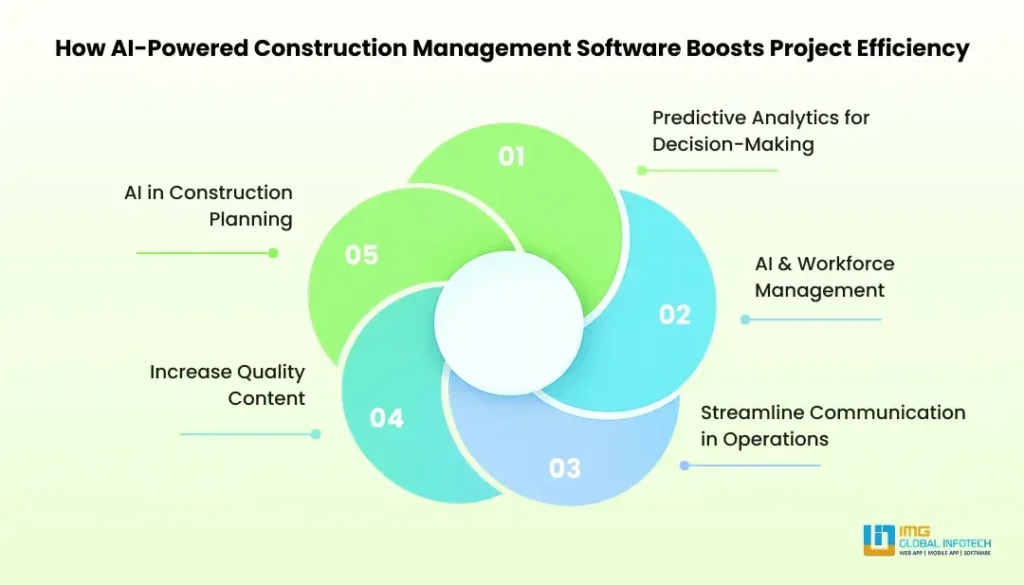
Here are some key ways that AI-powered construction management software can enhance project efficiency and streamline the smoother workflow process in construction operations.
Predictive Analytics for Decision-Making
AI technologies can enable predictive analytics to process historical data that can forecast the future trends in construction management software. This ability is very important for project managers and coordinators that can help to make informed decisions rapidly.
AI & Workforce Management
Worker management can be difficult. AI can help in scheduling, training, and tracking workers. Knowledge of a construction worker’s earnings would allow a reasonable structure to be formed. This complete practice can aid in construction management operations as well.
Streamline Communication in Operations
Effective communication is important for project success. AI tools can facilitate establishing better collaboration among the team that can provide real-time updates for seamless information gathering in construction operations.
Increase Quality Content
By early defect identification and compliance with standards, AI improves quality control in AI for the construction industry. The AI system is capable of analyzing images and data in order to spot defects that may go unnoticed by human observation.
AI in Construction Planning
For any operation, planning is a critical phase, and AI tools can assist in creating effective schedules for resource allocation plans in construction project management software. For example, if you want to know how to find subdivisions under any operation, the tools can help you in the research and analysis part.
Essential AI Features to Include in Construction Management Software
The construction industry is changing at lightning speed thanks to a variety of AI innovations. In addition to streamlining operations, AI is decreasing costly mistakes in construction management system. If it’s not already part of your management software, now is the time to start exploring AI features in construction.
AI-Driven Project Scheduling
AI analyzes the proposed schedule, resources, dependencies, and more to develop optimized construction schedules. When unforeseen delays occur, AI can adjust the schedule on the fly, ensuring projects remain on track without the need for manual intervention.
Predictive Risk Management
AI identifies possible risks through the use of historical project data and present site conditions, so managers are warned of potential issues like over-budget construction, safety hazards, and supply chain delays before they become critical to the project.
Automated Progress Tracking
AI uses both computer vision and aerial imaging taken by drone technology to track construction progress on the site from construction planning software. It is able to track work complete against the planned schedule and automatically generates instant and accurate progress reports.
Accurate Budget & Cost Estimation
AI can take into account historical project costs, material costs, and labor rates to provide a more precise forecast of the budget needed for a construction project from a reliable software development company. It also keeps track of spending and reports abnormalities in the expenses to avoid cost overruns.
Automated Document Management
AI can automatically manage, categorize, and locate construction documents such as plans, permits, contracts, etc. in construction management software development. It also automatically extracts essential information from the documents. This eliminates most manual labor and reduces the likelihood of human errors drastically.
Smart Safety Monitoring
Cameras and sensors with AI technology monitor the site in real time to detect safety breaches and dangerous worker behaviors in AI project management software. Supervisors will be notified instantly with alerts in order to prevent any incidents from happening and ensure full compliance.
Challenges of Implementing AI in Construction Management
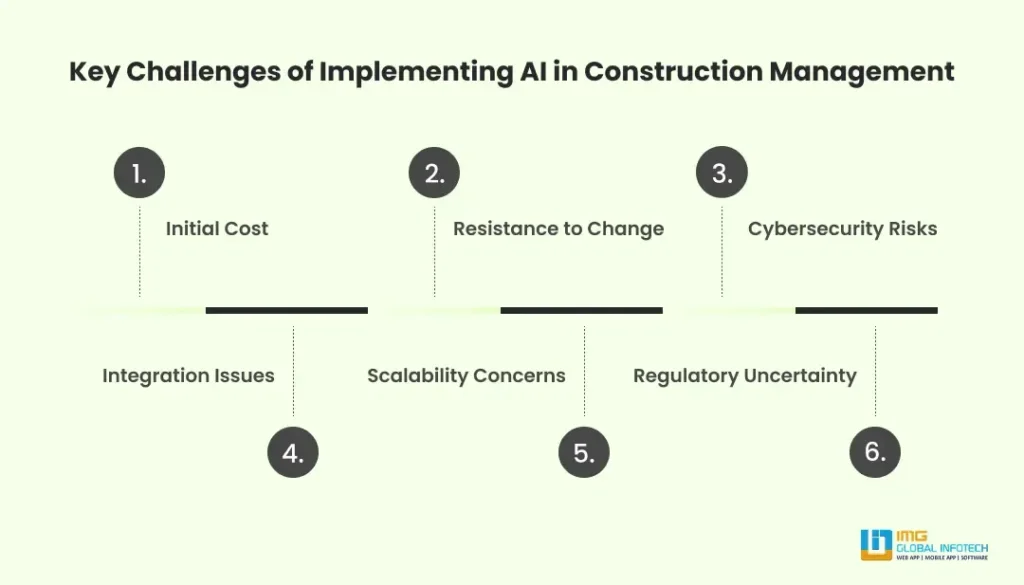
The integration of AI technology in the traditional construction workflow is itself a big obstacle. The midsize construction businesses that face particular hurdles due to resource constraints. Here are some key challenges that builders can face to integrate AI in traditional construction workflows.
Initial Cost
While AI adoption would be done in different phases of investment to integrate multiple capabilities in diverse business functions. From integrating AI capabilities to estimating software for activating functionality that can enhance project tools but also raise cost in operations.
Resistance to Change
Basically, this industry is well known for its slow adoption of new technologies. Indeed, the cultural resistance can check the AI adoption and adjust to new workflows. The successful AI development majorly requires comprehensive change management to master new tools as well.
Cybersecurity Risks
As construction companies move more and more of their business online, the risk of cyber threats is growing. Security is crucial to protect sensitive project and financial information between the parties in any construction management operations.
Integration Issues
The construction companies often use the multiple systems for diverse functions for project management in constructing accounting by AI in construction management. The integration of AI capabilities for these present systems. This also lacks the data structures that are needed for integration that can be complex and costly for significant technical work in construction operations.
Scalability Concerns
There is huge variation in project size, complexity, and requirements within the construction sector, and no “one size fits all” approach to AI systems will ever be feasible. There is a clear need for companies to consider how systems will evolve across multiple projects and scale at the business level.
Regulatory Uncertainty
The rapid AI advancements have outpaced regulatory frameworks. The construction businesses may face uncertainty for compliance requirements that maintain standards for AI usage. The regulatory uncertainty that upbringings hesitate to invest in AI technologies for future restrictions.
How Much Does AI-Powered Construction Management Software Development Cost?
The average construction management software cost would be $8,000 to $15,000 or more. The exact cost mainly depends on diverse factors and the level of the custom changes in the software development procedure.
Final Thoughts
Construction management software has changed how we plan, operate, and deliver a project. When the communications and data are updated and transmitted in real time, while managing and filing documentation and allocating the resources accordingly,
CMS has become effective on every aspect of the project cycle from planning to completion and ensures the project is delivered on time, under budget, and profitably by a leading construction management software development company. By effectively utilizing a CMS, your project can be completed seamlessly from start to end, enabling long-term business growth.