image
With such novel capabilities the insurance companies can create more accurate, faster, and consumer centric products. Automation of claims processing to detect risk and boosting customer care is all possible with AI agents, helping insurance firms improve their processes and lower prices. Such smart systems can analyze tons of information in real-time and insurance companies can use these to design better tailored products, accurate risk assessment, and more prompt decisions. With AI chatbots and virtual assistants transforming customer service into immediate response support around the clock, these innovative systems can also provide 24/7 assistance to customers without human intervention. The global market is going through an intense digital transformation and with every insurance company pushing for innovative processes to compete in the market and drive better productivity and meet customer demands, AI agents become an essential tool that is going to contribute and make 2026 a landmark for artificial intelligence in insurance where AI agents in insurance are no longer an imagination but a tangible and functional component of the entire global insurance ecosystem.
What Are AI Agents and How Do They Work?
An AI agent is a program that analyzes data, makes decisions, and performs certain tasks with no or little human assistance. These are a blend of various tools such as AI, Machine Learning, Automation, and Natural Language Processing (NLP) used for improving overall productivity and customer experience in different industries.
- It Collects customer information, claims, and policy details from different connected insurance systems.
- It analyzes the data using advanced AI predictive models and machine learning algorithms.
- It makes the appropriate decision based on preset guidelines, the organization’s policies, risks, and previous performances.
- It uses the above to automate tasks such as claiming and settlement, detection of fraud, and response to customer queries.
- It constantly improves its performance using feedback, user data, and updated datasets.
Role of AI in Modern Insurance Transformation
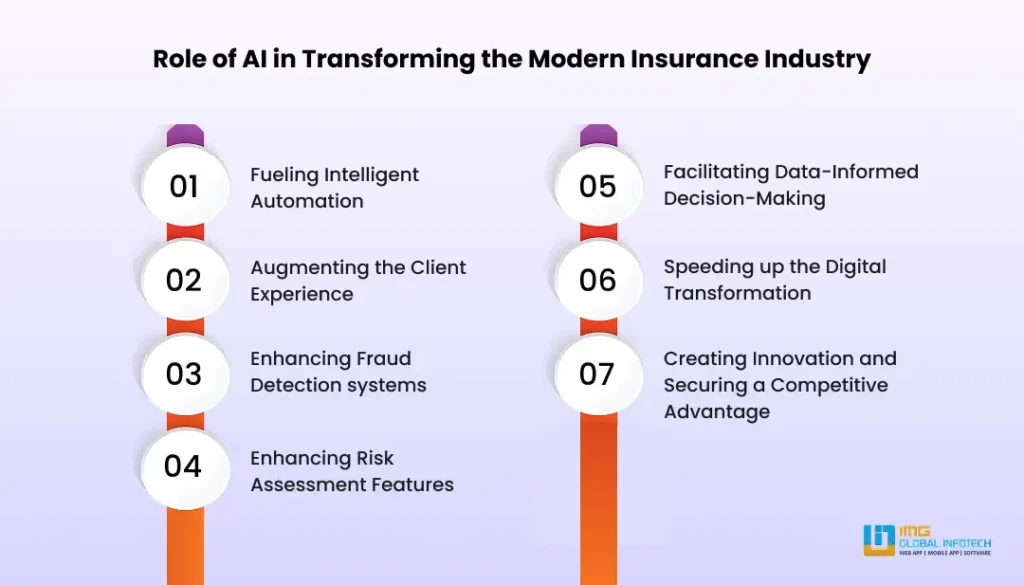
The introduction of artificial intelligence is dramatically altering the landscape of modern insurance by increasing operational efficiencies, optimizing the customer experience, automating complex processes, and facilitating data-driven decision making. Ai-powered insurance solutions allow insurers to drive innovation, minimize costs, enhance risk management, and maintain a competitive advantage in the highly fast-paced, increasingly digitized insurance environment.
1. Fueling Intelligent Automation
AI automates numerous repetitive tasks that exist within insurance operations; these tasks range from the administration of claims, renewal of policies, customer service functions and verification of documents. These insurance automation using AI efforts cut down the work force required for various functions, improve speed of operational execution, limit the scope for human error, and ultimately allow insurance companies to refine their existing processes, and enhance efficiency within every facet of the business.
2. Augmenting the Client Experience
Artificial intelligence driven by virtual assistants and chatbots is transforming the way policyholders and insurance companies communicate. People can get instant customer help, tailored insurance proposals, and quick responses to their questions, which leads to a higher-quality and enhanced total customer experience and stronger customer loyalty.
3. Enhancing Fraud Detection systems
AI in the insurance industry uses methods like deep learning to detect anomalies that might be indications of fraud. Insurance companies can get to know about the possibilities of a fraud even before it happens, thanks to machine learning, data mining, and various statistical methods.
4. Enhancing Risk Assessment Features
AI technologies support insurance companies in accurately evaluating the risks of prospective customers through the analysis of financial information, behavioral patterns, health conditions, driving records, and other types of personal data. The ai agents in insurance industry resulting from this data enable the insurer to offer better underwriting and fair, equitable policy pricing, reduce the overall level of the company’s risk and equip policyholders with customized coverage policies that adequately reflect the predicted needs and constraints of the client based on the freshest analytics.
5. Facilitating Data-Informed Decision-Making
Artificial intelligence processes extensive insurance datasets to uncover hidden insights about industry trends and to forecast potential changes. These agents in the insurance industry are useful for insurers in many ways, including helping them streamline their operations, get better at making strategies, reveal new consumer insights and attitudes, as well as make quick and smart decisions to achieve future growth and innovation in the company.
6. Speeding up the Digital Transformation
AI-based technologies assist insurers in doing away with their old infrastructures, automating their processes and shifting to the digital-first way of operation. This not only pulls the digital transformation efforts together but also increases the flexibility and scalability of the operations, and equips the insurers to respond promptly to the changes in consumer demands and ever-changing market trends.
7. Creating Innovation and Securing a Competitive Advantage
Automating procedures, developing insurance products tailored to the needs of customers, employing new customer engagement tools and optimizing operations, as well as lowering costs are some of the ways that companies leveraging AI are producing goods, customizing services, and client engagement strategies to distinguish themselves from other players in the highly competitive insurance industry.
Key Applications of AI Agents in Insurance
An increasing number of AI agents within the insurance sector are not only carrying out the complex processes of automation but also making the customers’ experience better, lowering the companies’ costs and improving the quality of decision-making via enhanced data analysis, prediction skills, and intelligent automated workflows.
1. Automated Claim Processing
Insurance companies automatically use AI agents to completely verify the documents, extract relevant information and analyze the contents of a claim. Digital transformation in the insurance sector helps to speed up the time frame in which settlement checks can be issued and reduce adverse processing errors, which is contributory to customer complaint reduction sufficient enough to allow faster claim approvals and even real-time claim status notifications.
2. Fraud detection and Prevention
AI agents identify and flag different irregular and out-of-the-ordinary transactions and activities that indicate a fraudulent intent by looking at a history of claims, customer behavioral patterns, and other anomalies. Besides using predictive analytics, continuous monitoring systems decrease the number of fraudulent claims and result in major financial gains.
3. Personalized Policy recommendations
AI agents can offer personalized insurance plan suggestions by analyzing customer profiles (e.g., demographic details, lifestyle, habits, or financial history). Personalization invariably leads to an increase in policy conversions and overall customer-company interaction.
4. AI- Powered Customer Service
While providing 24/7 support, AI agents can also lighten the load of human agents, dramatically improving the speed and quality of customer service overall, which is a factor in reducing operating costs. Besides handling inquiries about policies, making changes, calculating premiums, customer problem-solving, etc. insurance companies are also rolling out AI chatbots and virtual assistants.
5. Risk Scoring and Underwriting
By evaluating extensive data about a customer including their medical records, behavior (like driving habits), lifestyle, and financial history, AI underwriting and claims automation can gauge risk significantly faster. This enables them to offer more accurate insurance premiums, speed up the underwriting process, and improve the correctness of underwriting decisions by eliminating the human element of bias.
6. Policy Management Automation
Insurance companies are using AI agents to make their work processes more efficient by automating tasks like renewals, premiums, updating policies, and verifying documents. Reduction of administrative work and better communication between the insurer and the insured through using ai agents in enterprise applications can ultimately bring down both operational costs and the amount of paperwork.
7. Use Predictive Analytics for Business Expansion
AI agents utilize predictive analytics to analyze customer behavior, claim likelihood, market trends, and overall business growth in order to guide future business decisions. It assists in upgrading the product portfolio, increasing customer loyalty and attracting new clients.
8. Keeping Track of Regulation Compliance
To avoid the breach of laws, AI agents check all operations, transactions, policies, and other relevant activities for their alignment with current regulatory standards and requirements. AI-powered insurance solutions can lessen the risks of regulation violations and enhance the precision of audits and reports.
Benefits of AI Agents for Insurance Companies
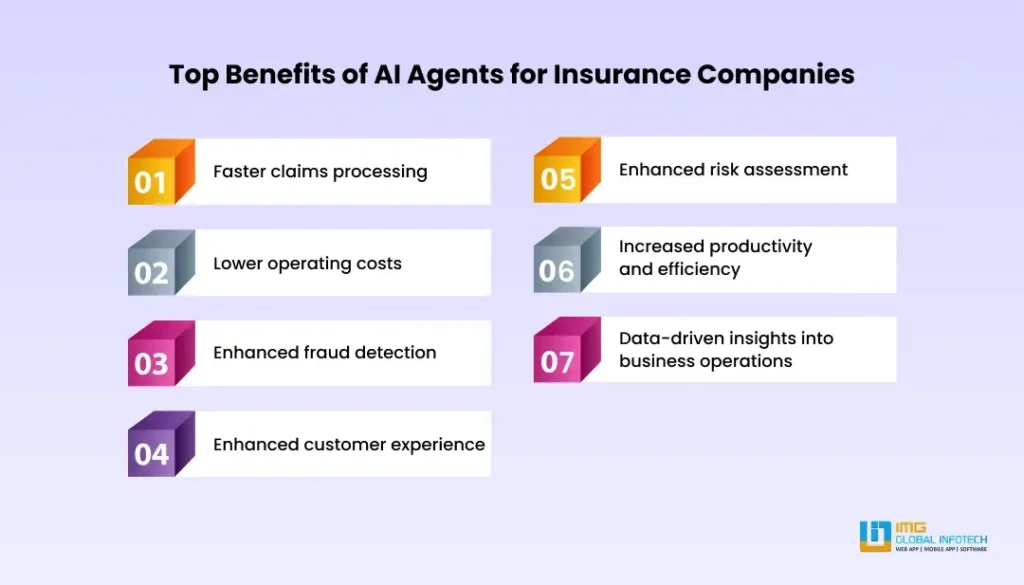
AI agents can provide significant benefits to insurance companies. Intelligent automation in insurance gives the companies the ability to accomplish more with less work, reduce the dependence on human efforts, increase customer satisfaction, and accelerate decision-making. With intelligent automation, AI agents help insurance companies reduce not only their operating costs but also their risks, while at the same time, delivering very personalized insurance that is a must-have in the very competitive digital insurance market.
1. Faster claims processing
Checking and evaluating documents and approving insurance claims are tasks that an AI agent makes automatic. Since these are the activities that lead to the completion of the insurance claim, ai claims processing in insurance is supporting the shortening of the claim settlement indirectly by accelerating the processes. Therefore, insurance companies will be able to improve their efficiency level not only in their internal operations but also in their capability of delivering the clients with quick claims payments, thus resulting in higher customer satisfaction.
2. Lower operating costs
Insurance companies have the potential to cut down their labor significantly by automating the tasks which are very monotonous and manual. This, in turn, will be leading to the companies’ cost-cutting.In the past, these resources would have been used primarily for claims processing, policy administration, and customer service functions. However, by reallocating the same resources to business development initiatives, the insurance company can make real progress towards achieving higher levels of operational efficiency.
3. Enhanced fraud detection
Employing an agentic ai insurance industry to monitor financial transactions, client behaviors, and examining historical claims for signs of fraudulent activity is an excellent method of recovering and preventing heavy financial losses that may occur after the fact while proactively working towards strengthening the functioning and stability of the whole insurance system and operations.
4. Enhanced customer experience
Providing immediate assistance to customers through chatbot development and virtual assistants significantly improves customer satisfaction and engagement leading to a speedy resolution of customer queries about claims processing and policy details. Besides, such interactions work towards building successful and long-lasting relationships.
5. Enhanced risk assessment
For an insurer, selecting the right risk level is paramount and to do this, they need to analyze the health and lifestyle aspects of their clients. AI underwriting in insurance assists them in this endeavor to a large extent by providing highly accurate risk assessments leading to the tailoring of insurance products for the clients and setting premium levels in accordance with individual needs. As a result, the risk for the insurer is reduced by as much as two-thirds.
6. Increased productivity and efficiency
AI agents simplify and automate repetitive time-consuming workflows, reducing processing errors and expediting decision-making for insurance professionals who can now dedicate more of their time and efforts towards crucial strategic initiatives and client relations management.
7. Data-driven insights into business operations
The ability of AI agents to derive and process data and generate relevant insights and analytics for insurance companies to analyze customer behavior, estimate market trends, predict future developments, and identify opportunities for strategic business development.
How Does Ai Boost Operational Efficiency For Insurance?
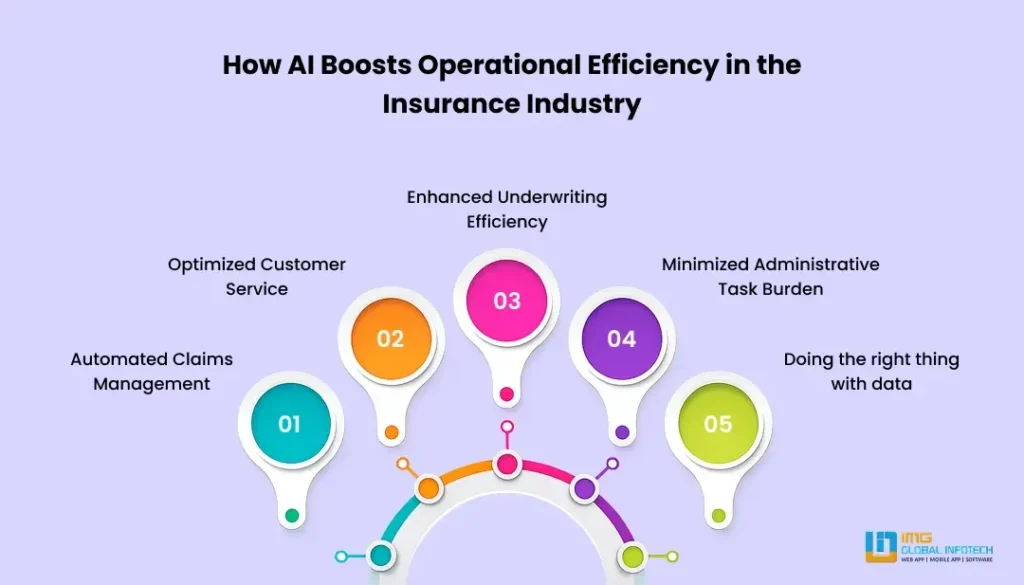
AI technologies are automating the routine, manual processes in insurance companies, improving workflow management, and enabling faster decision-making based on data. This changes the main operations of insurance companies. To gain efficiency, insurance companies are turning to AI solutions, a move that leads to enhanced productivity, fewer mistakes, and easier customer interactions.
1. Automated Claims Management
AI can speed up the entire claims handling process, including tasks like document verification and damage evaluation. AI-assisted claims approval limits errors, human dependence, operational backlog, and claim settlement time, thus boosting both the quality of customer service and efficiency.
2. Optimized Customer Service
With the help of AI, virtual assistants and chatbots can automatically take care of all customer questions about policy details and claim tracking. This, in return, does not only enhance the speed of reply but also the availability of round-the-clock service. Besides, a significant number of customers can be served effectively without any substantial delays.
3. Enhanced Underwriting Efficiency
The use of AI agents to comb through customer information such as medical records and behavioral trends enables insurance providers to arrange automated and faster underwriting decisions as well as improve the accuracy of risk evaluations. Underwriting that is based on data results in quick policy approvals, considerably cuts down on paperwork, maintains a uniform method for underwriting operations, and so on.
4. Minimized Administrative Task Burden
With AI’s ability to handle repetitive tasks that were previously done manually, the chances of human errors are minimized. As a result, the employees will have more time to focus on important things that lead to the welfare and satisfaction of the clients. Among these tasks are the document verification and processing of policy renewals.
5. Doing the right thing with data
AI agents can help the insurers by conducting large-scale and real-time analysis of the insurance data for uncovering the business trends and customer behaviors. Such valuable insights can be used as a basis for, amongst other things, smart and quick decision making in the areas of resource allocation and identification of inefficient processes. In a nutshell, this leads to a superior overall business strategy and more effective execution thereof.
How Insurance Companies Can Adopt AI Successfully?
If you are wondering how AI agents are transforming insurance companies you must know. An insurance business can adopt AI technologies effectively through an organized approach and sound data systems that allows for an early transition into the newer technology. Insurers must focus on employee up-skilling, scalable AI systems, customer focused innovations, and a compliance plan that would assure achievement of business objectives such as operational efficiency and business decision making.
1. Start with Clear Business Objectives.
Before any artificial intelligence in insurance is incorporated, specific areas or processes that are in need of simplification and the business objectives desired through the implementation of the AI system must be clearly defined. Clear objectives are instrumental in choosing the correct AI technology, defining priority use cases and targeting profitable ones, and keeping track of results effectively to achieve the desired business objectives from the AI deployment.
2. Implement Quality Data Management Systems.
The accuracy of a decision made by any AI system is a direct function of the data it uses. Insurers should therefore develop orderly and secure data systems to improve the performance of AI systems as well as enhance their predictive capabilities while minimizing the risk associated with operational tasks.
3. Cultivate Expertise in AI technology among employees.
A highly skilled and intelligent employee workforce is essential for any insurance business that aims at implementing AI. It is necessary to up-skill your workforce and manage their shift in roles for confident and productive utilization of AI tools.
4. Integrate AI systems with current systems.
AI agent development can be deployed in an insurance business in a highly productive manner if they integrate with the current systems (such as software systems, databases, and workflow management) within the organization. This can also facilitate real-time data flow, thus ensuring minimal impact on operational processes and customer satisfaction.
5. Prioritize Security and Regulatory Compliance:
Insurers must implement all safety protocols related to cybersecurity, data privacy and regulatory compliance when it comes to integrating AI technologies. Adhering to strict data protection laws and system security standards will build trust among clients and prevent any potential legal or operational issues.
Conclusion
The insurance industry is being transformed by the use of AI agents, which are helping in streamlining the processes, improving client service and fraud detection, while also enhancing rapid decision-making based on data. The utilization of AI from underwriting, to policy and claim management and the development of individualized insurance services will help insurance companies reduce costs, increase efficiency, and remain competitive in this ever-changing digital market. The role of AI based innovation will surely be paramount in the future of global insurance businesses as technology continues to progress.
IMG Global Infotech is a leading AI development company that works towards helping insurance companies build cutting edge AI driven systems suited for the contemporary business requirements. Our professional team assists insurance organizations build scalable, efficient, and secure intelligent insurance software solutions to ensure a successful digital transformation.